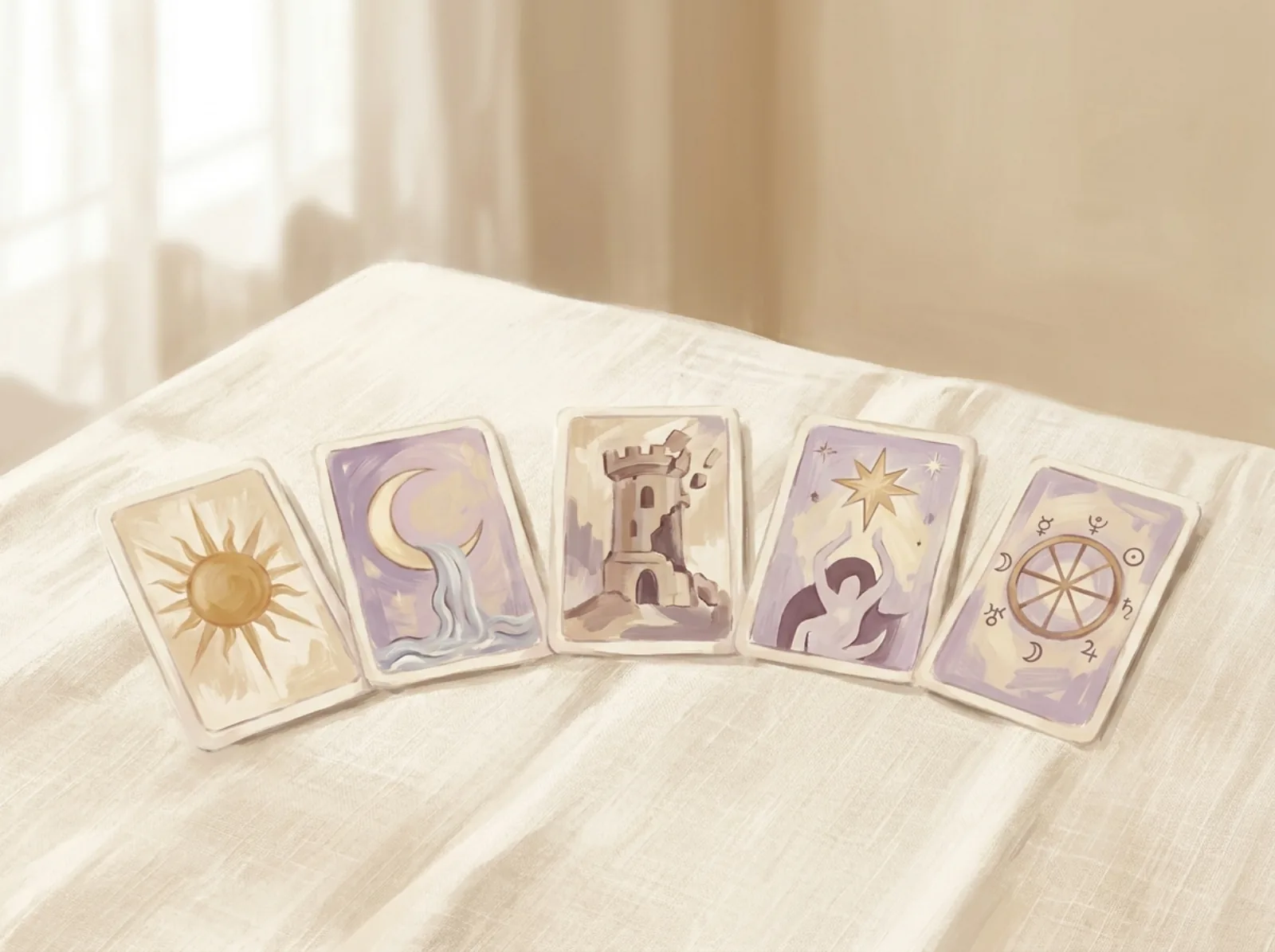
What The Tower Tarot Card Actually Means
The Tower is card XVI of the Major Arcana and, in most modern decks, the single image people flinch at when it lands face-up on the table. A stone tower is struck by lightning, its crown blown off, two figures falling headfirst against a black sky. It is dramatic on purpose. Nothing about this card is subtle, and that bluntness is a big part of its function in a reading. Part of our tarot library library.
At its core, the Tower represents a sudden, structural revelation — a moment when something you had built your life or self-image on turns out to be unsound and the whole thing comes apart faster than you can manage it. The keyword most tarot readers reach for is not disaster but awakening. The disaster is the surface event. The awakening is what the card is actually pointing at. Try our 3 Card Tarot Spread guide. Try our Career Tarot Spread guide. Try our Celtic Cross Tarot Spread guide. Try our Decision Tarot Spread guide. Try our Horseshoe Tarot Spread guide. Try our Love Tarot Spread guide. Try our One Card Tarot Pull guide. Try our Pentagram Tarot Spread guide.
In my experience with clients, the Tower rarely arrives out of nowhere. It usually shows up after weeks or months of quieter cards — the Devil's compromises, the Seven of Swords' small lies, the Four of Cups' emotional flatlining — that were trying to warn you. The lightning is not the beginning of the story. It is the last chapter. Try our Relationship Tarot Spread guide. Try our Shadow Work Tarot Spread guide. Try our Situation Action Outcome Spread guide. Try our Tarot Spread For Anxiety guide. Try our Tarot Spread For Beginners guide. Try our Tarot Spread For Clarity guide. Try our Tarot Spread For Grief guide.
For people using tarot as a self-reflection tool rather than a fortune-telling one, the Tower is genuinely useful precisely because it is uncomfortable. It gives you permission to name the thing you have been avoiding: the job that is quietly killing you, the relationship built on a version of yourself you no longer are, the belief you inherited but never chose. The card does not create the problem. It illuminates it. Try our Tarot Spread For Manifestation guide. Try our Tarot Spread For Self Love guide. Try our Yes No Tarot Spread guide.
The Rider-Waite Imagery, Symbol by Symbol
The Tower most people picture is the Rider-Waite-Smith version, painted in 1909 by artist Pamela Colman Smith under the direction of occultist Arthur Edward Waite. Waite wrote about the card in his 1911 book The Pictorial Key to the Tarot, and Smith translated his sparse notes into the visual language that has shaped almost every modern deck since. Their collaboration is why the card looks the way it does.
Look at the tower itself. It sits on a jagged mountain peak with no visible entrance, which is the first clue: it was built for isolation, not habitation. The gray stone is windowless below and only breaks open near the top, where three small openings emit flames. A crown, gold and heavy, is being blown off the summit by a bolt of lightning that strikes from a black sky.
Two figures fall from the tower, one dressed in red and blue robes suggesting royalty or authority, the other appearing more common. They fall in different postures — one head-down, one upright — which many readers interpret as the card leveling the difference between the powerful and the ordinary in a moment of shared collapse. Twenty-two flame-shaped yods (Hebrew letter shapes representing divine sparks) rain around them.
The lightning is the operative symbol. In esoteric tarot traditions Waite drew from, lightning represents sudden divine intervention or truth breaking through a constructed reality. It is not framed as punishment. It is framed as force that reveals. The tower collapses because it was never meant to withstand contact with what is actually real, and that is the card's whole thesis in a single image.
The Tower Upright: Meaning in Detail
Upright, the Tower reads as sudden change, revelation, upheaval, and the collapse of false structures. It can point to a job loss, a breakup, a health scare, a belief system cracking, a family secret surfacing, or a moment of clarity so sharp it reorganizes everything you thought you knew. What unites these events is that they cannot be undone once they happen, and they usually cannot be softened either.
Rachel Pollack, in her landmark 1980 book Seventy-Eight Degrees of Wisdom, describes the Tower as the moment ego structures give way to something more essential underneath. Pollack does not treat the card as bad news. She treats it as necessary demolition — the kind of thing that has to happen before the Star (the following card) can offer real, unforced hope. The order of the Major Arcana matters here.
Practically, when the Tower appears upright in a reading, ask yourself what has been unstable for a while. The card almost never introduces new problems. It reveals ones you were already managing, minimizing, or medicating around. This is why people often report a strange relief in the days after a Tower event: the exhausting work of pretending is finally over.
The upright Tower also tends to strip away external identifiers — titles, roles, other people's opinions of you — and leave you with a more accurate picture of what you actually want. That is why it so often precedes major life redirections. It is not that the Tower makes you change. It is that it removes the walls behind which change was impossible.
One more note. If you are reading for yourself and the upright Tower shows up during a period that genuinely feels calm and grounded, do not force a crisis narrative. Sometimes the card is naming a smaller structural shift — an old identity you have already outgrown, a friendship that is quietly closing — and its job is just to make the ending conscious rather than dramatic.
The Tower Reversed: Meaning in Detail
Reversed, the Tower's meaning does not flip. It softens, delays, or internalizes. The lightning is still there. It just has not fully struck yet, or it struck privately, or you are working very hard to keep it inside the tower where no one else can see. Most experienced readers treat the reversed Tower as the more painful position of the two, because avoidance costs more energy over time than collapse does in a single moment.
A reversed Tower can suggest that you sense a structure in your life is unsound but you are not ready to acknowledge it publicly. The relationship you know is over but have not named. The career you have quietly stopped believing in. The story about your family you can no longer defend but do not want to face. The card is not judging this. It is just noticing.
Mary K. Greer, in Tarot for Your Self, encourages readers to sit with reversed cards as invitations to look at what is being resisted. Applied to the reversed Tower, that means asking: what am I trying to hold up right now that clearly wants to fall? What would happen if I stopped bracing? Usually the answer is that you would grieve, and then you would be free.
The reversed Tower can also indicate a near-miss — a crisis that was building and got interrupted, deferred, or averted at the last moment. This is real, and it is worth honoring. But it is worth asking whether the underlying instability has actually been addressed, or whether the card will simply return, upright, in a later reading with more force.
The Tower in Love, Career, and Wellbeing Readings
In a love reading, the Tower is the card people least want to see and most often need to. Upright, it can indicate a sudden breakup, a revelation of dishonesty, or a moment when one partner finally says the thing that cannot be unsaid. It can also mark a mutual awakening — two people simultaneously realizing the relationship has been running on inertia rather than love. For singles, it often shows up when a dating pattern is about to break — the type you keep choosing, the situationship template, the belief that love has to be earned through overfunctioning.
The Tower in love is not always romantic loss, though. Sometimes it points to the collapse of a story you were telling yourself about a person — that they would change, that timing was the only problem, that love was enough to override incompatibility. When that story cracks, the relationship may actually survive it. What ends is the fantasy version, and what begins is a more honest one, if both people are willing to meet it.
In career readings, the Tower earns its reputation. Upright, it can indicate layoffs, restructures, a public conflict with a manager, a professional identity you built for a decade suddenly not fitting, or the moment you realize you need to leave the field entirely. The most useful reframe: the Tower rarely destroys work that is aligned with who you actually are. It destroys work that required you to be someone you are not. If the shoe fit, the shoe stays. If the shoe was pinching for years and you had convinced yourself that was normal, the Tower is the shoe finally coming off.
Reversed in career, the Tower can suggest a workplace situation degrading quietly — a boss becoming more erratic, a company running out of runway, a role being restructured without you being told. Trust that read. Update your resume, talk to former colleagues, and prepare rather than panic. The card is warning you early precisely so you have time to move.
In wellbeing readings, please read this section carefully: tarot is not a diagnostic tool, and this article is not medical advice. If you have symptoms that concern you, see a qualified clinician. That said, the Tower can show up around burnout, chronic stress, and the collapse of coping strategies that have quietly stopped working. It often points to the body finally refusing to carry something the mind has been overriding for years.
The American Psychological Association's Stress in America 2023 report found that a majority of adults said stress had impacted their mental health. Tarot cannot address that on its own, but a card like the Tower can function as a permission slip to take a crash seriously — to finally book the appointment, take the leave, or ask for the help you have been rationing yourself away from.
The Tower in Spiritual and Shadow Work
Spiritually, the Tower is often described as the card of initiation — the moment a false self dies so a truer one can live. In many esoteric readings of the Major Arcana as a journey (the Fool's Journey, popularized in modern form by writers including Rachel Pollack and Eden Gray), the Tower sits between the Devil (the trap of ego attachments) and the Star (renewed hope). You cannot skip this step. You can only delay it.
In shadow work specifically, the Tower represents the moment a defense mechanism you have relied on since childhood stops working. The people-pleasing that kept you safe. The perfectionism that got you approval. The avoidance that let you survive a chaotic home. Whatever the strategy was, it earned its place. But strategies have expiration dates, and the Tower is often what enforces them.
Benebell Wen, in her comprehensive 2015 book Holistic Tarot, treats cards like the Tower as opportunities for what she calls conscious, deliberate self-examination rather than passive fortune-consumption. Applied here, that means using the Tower as a mirror for the specific structure — belief, role, coping habit — that is currently costing you more than it is giving you.
If the Tower appears repeatedly across multiple readings for you, take that seriously as spiritual information rather than random chance. It does not mean disaster is stalking you. It usually means some part of you is already gathering the courage to let something end, and the card is essentially cheering that part on.
The Tower as a Yes/No Answer
Tarot readers disagree on yes/no methodology, and honestly, most experienced readers will tell you the Tower is a poor card to force into a binary. But if you are using a simple yes/no framework and the Tower appears, the cleanest reading is: no to preserving the situation as it currently stands, yes to the change that is trying to happen underneath it.
If you asked will this relationship survive as it is, the Tower reads as no. If you asked will I get clarity about this relationship, the Tower reads as yes — although the clarity may come faster and harder than you wanted. If you asked should I stay in this job, the Tower is generally interpreted as no, or at minimum a strong signal that the job will not stay in the shape you have known it.
For questions about whether something new will happen — a move, a proposal, a business launch — the Tower is not a clean yes or no. It usually suggests that whatever you are asking about will be preceded or accompanied by a significant disruption in the surrounding context. That does not mean do not do it. It means expect the terrain to shift while you are walking on it.
The most honest reframe for yes/no work: the Tower rarely answers the question you asked. It answers a bigger question you did not quite have the words for. If you are open to that, it is one of the most useful cards in the deck. If you need a clean yes or no for a small logistical question, pull a different card.
Timing With The Tower
Tarot timing is inherently imprecise, and any reader who tells you otherwise is overselling. That said, tarot tradition associates the Tower with the planet Mars, which in astrology governs sudden action, conflict, and breakthrough. Some readers use this to associate the Tower with Mars-ruled periods — historically Aries and Scorpio seasons in Western tropical astrology — for rough timing estimates.
Other readers timing-associate the Tower with hours or days rather than weeks, because the card's energy is fundamentally about speed. When the Tower comes up in a timing spread, most readers interpret it as sooner rather than later — a matter of days to a few weeks, not months. The core quality is suddenness, and that quality tends to hold across timing systems.
A more practical timing frame: the Tower often shows up in readings done within a two-to-six-week window before the event it is describing. This is not a rule, just a pattern I have noticed across years of doing readings. It seems to arrive when the underlying situation has become unsustainable enough that the mind can finally register what is coming.
If you draw the Tower and you want a timing read, look at the surrounding cards. A Page or an Ace nearby often speeds things up. Court cards involving specific people can indicate who will be present when the Tower event lands. Pentacles suggest a material or financial component; Cups an emotional one; Swords an intellectual or communicative one; Wands an energetic or professional one.
Common Tower Card Combinations
The Tower with the Devil is one of the most common and most useful combinations. Together, they usually indicate breaking free from an addiction, an unhealthy relationship, or a pattern of self-sabotage. The Devil names what has been binding you; the Tower names the moment the chain finally snaps. This pair often shows up around recovery, leaving toxic dynamics, or ending compulsive habits.
The Tower followed by the Star (its numerical successor in the Major Arcana) is the classic redemption sequence — collapse followed by genuine, unforced hope. If you draw these two together, particularly in past-present-future positions, take the sequence seriously as reassurance that the disruption is on the way to something better, not just more chaos.
The Tower with the Three of Swords doubles down on heartbreak, usually indicating a painful romantic or interpersonal ending that also fundamentally reorganizes your understanding of the situation. The Tower with the Ten of Swords suggests an ending you have been dreading for a long time finally arriving; often, oddly, with more relief than expected once it lands.
The Tower with Death is not a doomsday combination, despite how it looks. Death in tarot means transformation, and paired with the Tower it usually indicates a complete life-chapter closing so the next one can genuinely begin. This pairing often appears around major identity shifts — leaving a career, ending a marriage, moving countries, becoming a parent — where the old life and the old self both dissolve together.
Tarot Spreads That Highlight The Tower
Certain spreads make the Tower's meaning much clearer when it appears. The classic Celtic Cross positions the card most usefully in the crossing (position 2), near future (position 6), or outcome (position 10) slots, where its disruptive energy has room to be contextualized by surrounding cards rather than dominating the whole reading.
A three-card past-present-future spread is where the Tower often lands hardest, particularly in the future position, because there is nowhere for the meaning to hide. If this happens to you, resist the urge to redraw. Instead, do a follow-up spread specifically asking what the collapse is trying to make room for. This is where readings become genuinely useful rather than just alarming.
The Situation-Action-Outcome spread works beautifully with the Tower. Put the Tower wherever it lands, then read the other two cards as guidance on how to move through the disruption. The action card in particular tends to give practical, immediate direction that a single-card Tower reading cannot.
For deeper work, try a five-card spread I use often with clients: what is collapsing, what is being revealed, what needs to be grieved, what needs to be built, and what will support you. This structure gives the Tower somewhere to go. It transforms the card from a headline into a workable process, which is what the card actually wants to be used for.
What to Do RIGHT NOW If You Drew The Tower
If you just pulled the Tower and your stomach dropped, here is a practical sequence. Do this within the next hour if you can, before the anxiety sets in and starts writing stories.
1. Take three slow breaths and look at the card again. Notice which detail your eye actually lands on — the crown, the falling figures, the flames, the lightning. That detail is a starting point, not the whole message.
2. Write down, in one sentence, the current situation you were thinking about when you drew the card. Be specific. Not my life, but my relationship with X or my role at Y.
3. Ask yourself honestly: what have I already known about this situation for at least three months but not been willing to say out loud? Write that down too. This is usually what the Tower is pointing at.
4. Identify one small structural thing you can do in the next 48 hours to acknowledge what you just wrote. Not a dramatic decision. A calendar hold, a saved document, a scheduled conversation, a note to yourself.
5. Book a debrief with yourself in two weeks. Put it in your calendar now. Redraw a single card at that point and see what has shifted. Nine times out of ten, the second card is significantly gentler because you actually let yourself see the first one.
6. If the Tower touched on health, safety, or a genuine crisis, close the tarot app and contact a real professional. Cards are for reflection, not for replacing therapists, doctors, lawyers, or financial advisors. Please treat them accordingly.
The Tower Compared to Other Cards of Change
The Major Arcana contains several cards that involve change or ending, and the Tower is often confused with them. Understanding the distinctions makes readings much sharper. The clearest contrast is between the Tower and Death. Death is transformation as a natural process — the slow, inevitable turning of one chapter into the next. The Tower is transformation as sudden rupture — the wall coming down all at once. Death is autumn. The Tower is lightning.
The Wheel of Fortune involves change too, but the Wheel is cyclical and external — luck turning, circumstances shifting, forces outside your control moving into a new configuration. The Tower is not really about luck. It is about truth. The Wheel changes your situation. The Tower changes your understanding of it, and often forces the situation to change to match.
The Hanged Man is another card of shift, but the Hanged Man's shift is chosen — a voluntary suspension, a willing surrender, a decision to look at things from a new angle. The Tower is what happens when the Hanged Man's invitation has been ignored for too long. If you will not turn yourself upside down voluntarily, the card seems to say, the world will do it for you.
The Five of Pentacles, Three of Swords, and Ten of Swords all involve loss too, but at the Minor Arcana level — specific, contextual, day-to-day. The Tower is Major Arcana, which means it operates at the level of identity and life-structure rather than individual events. If those Minor Arcana losses are a fall down a flight of stairs, the Tower is the whole building coming down. The scale is different.
How to Journal With The Tower Card
Journaling with the Tower is where the card becomes genuinely transformative rather than just unsettling. The trick is to write not about what you are afraid the card is predicting, but about what it is actually asking. The predictive question keeps you passive. The reflective question puts you in the driver's seat of your own life, which is where you belong.
Try these prompts. Pick the two or three that make you flinch a little — that is usually where the useful writing lives. What am I currently protecting that I secretly know cannot be protected? What would I need to admit if I stopped defending it? What have I been calling stability that is actually stagnation? What in my life is asking to end, and what part of me is refusing to let it? Try Raka app to explore this in more depth.
A useful longer prompt for people who have been sitting with this card for a while: write a letter from your future self, five years out, describing what the current Tower event made possible. You do not need to know the answer intellectually to write the letter. Let your hand do the knowing. The exercise is remarkably clarifying, and it moves the card's energy from dread to direction.
Finally, if you are pulling a daily card and the Tower appears, try this one-line practice at the end of the day: what did I let myself see today that I could not see yesterday? Even a small answer counts. Small revelations, accumulated, are how the Tower actually does its work in most lives — not through single dramatic collapses, but through steady, honest looking.