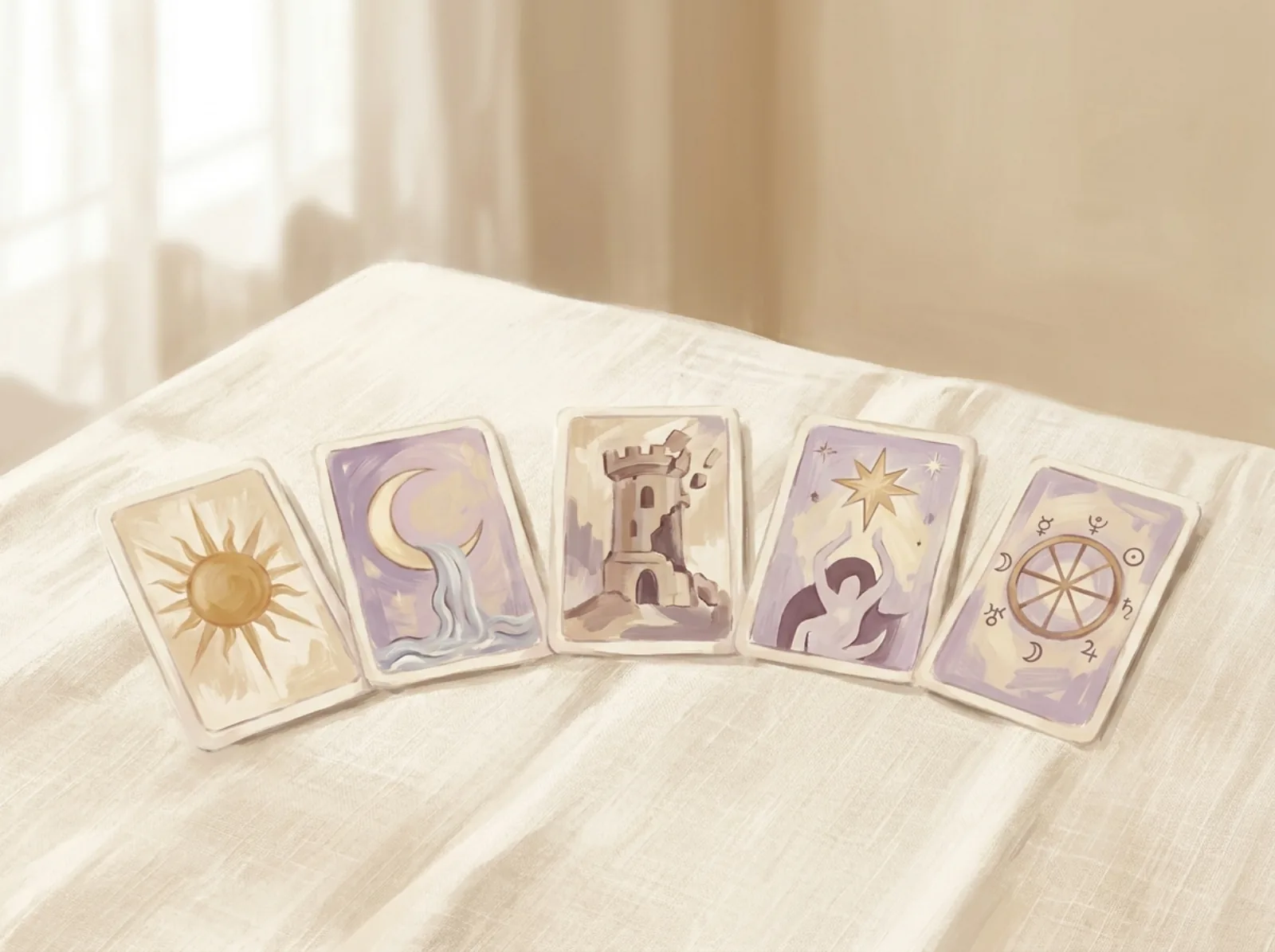
What is a yes/no tarot spread?
A yes/no tarot spread is a closed-question reading in which you draw a small number of cards, usually one, and interpret the result as leaning toward yes, toward no, or toward 'not yet' based on the card's suit, its position (upright or reversed), and its traditional Rider-Waite-Smith meaning. It is the shortest, most stripped-down spread in Western tarot, and it exists to answer questions phrased as a binary: should I, will I, is this, does she. Part of our tarot spread library. Part of our tarot spread guide. Explore the full library. Part of our astrology guide hub.
To do a yes/no tarot spread, you clarify a single closed question, shuffle the deck while holding that question in mind, cut once, draw the top card, and read its posture and imagery. In the most common scheme, upright cards from Wands, Cups, and the Major Arcana are read as yes; reversed cards and many upright Swords are read as no; and a handful of ambiguous cards (The Moon, the 2 of Swords, the 7 of Cups) are read as 'the question is not answerable in this form.' See our best tarot app 2026 guide for a full breakdown.
The spread has no single canonical inventor. It appears in twentieth-century occult manuals as a shorthand practice, not a formal ritual, and it is best understood as a reflection prompt rather than a prediction. In this guide I will walk through the single-card method I actually use, a three-card variation for anything you care about, a card-by-card yes/no reference for all 78 Rider-Waite-Smith cards, the pitfalls I have watched clients fall into for a decade, and the moments when a yes/no pull is genuinely the wrong tool. See our guide. See our best AI astrology app guide.
I am Maya Verghese, senior tarot editor at Raka, and I have read for around three thousand people in person and another few thousand through the app. This spread is the one I get asked about most, and it is also the one most often misused. My aim is to make it useful for you and to be honest about its limits.
The reading that taught me what this spread is for
A friend of mine, an emergency-room nurse in Manchester, sat down at my kitchen table one wet October afternoon and said, 'Do I take the night shift or not.' She had a job offer for a new hospital, better pay, worse hours, and the deadline to reply was the following morning. She had already made and unmade the decision four times that week. She did not want a life reading. She did not want the Celtic Cross. She wanted the smallest possible signal that would let her stop chewing her own thoughts.
That is exactly the terrain a yes/no spread is built for. She had done the homework, she had run the numbers, she had talked to her partner. She was stuck in the last inch of a decision, and she needed something to break the tie. I shuffled the deck, she cut it, and she drew the Eight of Cups reversed. The Eight of Cups upright shows a figure walking away from a stack of chalices toward a mountain in the moonlight; reversed, in most reading traditions, it signals a refusal to leave or a return to what you had before.
We sat with it for a minute. Reversed, in a yes/no frame, that card leans no. But the card's specific image also said something the binary could not: you do not actually want to walk away from your current hospital. She took the reading not as an oracle telling her what to do, but as a mirror telling her what she already knew. She stayed. Six months later she was made a charge nurse where she was.
I tell that story because it shows both what this spread can do and what it cannot. It cannot tell you whether the night shift was a better job. It can, when the question is small enough and honest enough, make you notice which answer you were already flinching toward. That is the only claim I will make for it in this guide, and it is the claim you should hold onto every time you use it.
How do you do a single-card yes/no tarot spread?
The single-card yes/no is the simplest layout in tarot. Here is the exact sequence I use, and the one I would teach a friend learning for the first time.
1. Phrase your question as a closed yes/no. Not 'What should I do about my job,' but 'Should I apply for this specific role by Friday.' The more specific and time-bound, the more usable the reading. Write the question down if you can; the act of writing forces the ambiguity out.
2. Shuffle the deck slowly while holding the question in your mind. There is no correct number of shuffles. I usually riffle three times and then overhand-shuffle until the deck feels settled. If a card jumps out during the shuffle, set it aside as your draw.
3. Cut the deck once with your non-dominant hand. Some readers cut into three piles and reassemble; some do not cut at all. The cut is a pause more than a technique.
4. Draw the top card and lay it face-up in front of you, preserving its orientation. Whether the card lands upright or reversed matters, so do not flip it toward yourself; turn it over left-to-right like a page.
5. Read the card in three passes. First, note its posture: upright or reversed. Second, note its suit and number, and check the reference table later in this article. Third, look at the actual image on the card and ask yourself which detail your eye went to first. That third pass is where the reading lives.
6. Speak or write your answer in one sentence. 'The card leans yes, but the image suggests I am rushing.' If you cannot articulate an answer in one sentence, the question was probably too big for a single card, and you should move to the three-card variation described later.
Do not redraw. If you do not like the answer and you shuffle again, you have not done a second reading; you have contaminated the first one. The discipline of accepting the first card is most of what makes the spread work as a reflection tool.
Position guide: what each card position actually means
In a one-card yes/no there is only one position, but that position carries three layers of information at once. Understanding what each layer contributes is what separates a useful reading from a coin flip.
Layer one is the binary. Suit and posture give you a directional lean: yes, no, or unclear. This is the layer most beginners stop at, and it is the least interesting layer.
Layer two is the traditional meaning. The Three of Cups is not just 'a yes card'; it is a card about small-group celebration, community, shared achievement. Its yes has a flavor. If you asked 'Should I go to my cousin's wedding,' the Three of Cups is a warmer yes than if you asked 'Should I take on a solo freelance project.'
Layer three is the image itself. Pamela Colman Smith's illustrations for the 1909 Rider-Waite-Smith deck are unusually detailed, and the detail your eye lands on first tells you something the standard interpretation does not. If you draw the Six of Swords and your eye goes to the still water rather than to the ferryman, that is data. Note it before you look up the meaning.
For the three-card variation covered later, the positions become: card one, the answer; card two, the reason; card three, the context you are missing. That structure prevents the reading from collapsing into a single-word verdict. The table below summarizes the position logic for both layouts.
| Layout | Position | What it holds | |---|---|---| | Single card | Card 1 | The lean (yes / no / unclear) and its flavor | | Three-card | Card 1 | The core answer | | Three-card | Card 2 | Why that answer (the underlying reason) | | Three-card | Card 3 | The context you have not seen yet | | Five-card variant | Cards 1-3 | Past, present, likely near-future direction | | Five-card variant | Card 4 | What to watch for | | Five-card variant | Card 5 | Final lean |
Card-by-card yes/no reference for the full 78-card deck
Every yes/no reader eventually needs a reference sheet. What follows is the one I use, built on the Rider-Waite-Smith tradition described in A.E. Waite's Pictorial Key to the Tarot (1910) and refined against Rachel Pollack's Seventy-Eight Degrees of Wisdom (1980) and Benebell Wen's Holistic Tarot (2015). Reversals mostly flip the lean, with a few exceptions noted.
Major Arcana. The Fool: yes, but naively. The Magician: yes. The High Priestess: unclear, wait. The Empress: yes. The Emperor: yes, with structure. The Hierophant: yes if conventional. The Lovers: yes. The Chariot: yes. Strength: yes. The Hermit: no, or 'not yet.' Wheel of Fortune: yes, timing not under your control. Justice: it depends on whether you deserve it. The Hanged Man: no, or delay. Death: no as it currently stands, yes to change. Temperance: yes, moderately. The Devil: no, or yes at a cost. The Tower: no, and something will break either way. The Star: yes. The Moon: unclear, do not decide now. The Sun: yes. Judgement: yes. The World: yes.
Wands (mostly yes). Ace: yes. 2: yes. 3: yes. 4: yes. 5: unclear, conflict. 6: yes. 7: yes, with effort. 8: yes, quickly. 9: yes but you are tired. 10: no, too much on you. Page: yes. Knight: yes, impulsively. Queen: yes. King: yes.
Cups (mostly yes, especially for relationships). Ace: yes. 2: yes. 3: yes. 4: no, apathy. 5: no. 6: yes, nostalgically. 7: unclear, illusion. 8: no, walking away. 9: yes. 10: yes. Page: yes. Knight: yes. Queen: yes. King: yes.
Swords (mostly no or difficult). Ace: yes, decisively. 2: unclear, stalemate. 3: no. 4: no, rest. 5: no. 6: yes, but painfully. 7: no. 8: no. 9: no. 10: no. Page: unclear. Knight: yes, aggressively. Queen: yes, coolly. King: yes, judgmentally.
Pentacles (mixed, lean yes for practical questions). Ace: yes. 2: unclear, juggling. 3: yes. 4: no, or hoard. 5: no. 6: yes. 7: no, or wait. 8: yes. 9: yes. 10: yes. Page: yes. Knight: yes, slowly. Queen: yes. King: yes.
Treat this table as a starting position, not a verdict. A reversed Three of Swords in a question about ending a stale friendship might not read as no; it might read as 'you are exaggerating the pain of this decision.' The reference gets you 80 percent of the way; the image and the context do the rest.
Upright versus reversed: the rules I actually use
How you handle reversals is the single largest source of variation in yes/no readings. There are three schools, and it is worth knowing which one you are practicing so you do it consistently.
The first school reads reversals as the opposite of the upright meaning. A reversed Star, ordinarily a yes, becomes a no. This is the simplest rule, and it is the one most beginner books teach. Its weakness is that it flattens cards that already carry contradiction, like the 5 of Swords, into a binary that erases their nuance.
The second school, argued for by Mary K. Greer in Tarot for Your Self (1984), reads reversals as the same meaning turned inward, delayed, blocked, or unconscious. A reversed Sun in this reading is not 'no'; it is 'yes, but the good news has not surfaced yet.' In a yes/no context this school tends to soften every answer into 'yes, eventually' or 'no, for now.'
The third school, which I mostly use, treats reversals as an intensity modifier rather than a strict flip. A reversed Wands card weakens the yes; a reversed Swords card intensifies the difficulty; a reversed Cups card usually flips to no because Cups are so relationally clear that inversion reads as blockage; a reversed Major Arcana card slows the answer down without cancelling it.
Whichever school you pick, pick one and stay with it for at least a month of readings before you evaluate. Switching midstream is how yes/no readings become self-serving. If you find yourself instinctively reinterpreting a card because you did not like the first answer, you have stopped reading and started negotiating.
A sample reading, walked through end to end
Here is a fully worked example. Names and identifying details are fictional; the pattern is drawn from a composite of readings I have done. Alex is a 34-year-old graphic designer in Toronto trying to decide whether to submit a short film to a specific festival with a Friday deadline. He has already made the film. The question is only whether to submit it to this festival.
Question, written down: 'Should I submit the short to the Aurora Festival by Friday?' Alex shuffled for about a minute, cut with his left hand, and drew the 8 of Pentacles upright. In the reference table, that reads as yes. In the image, a craftsman sits hammering coins at a bench, focused on the work itself rather than on the finished product.
The single-card reading here is a clear yes. But the flavor of the yes matters. The 8 of Pentacles is not about outcomes; it is about the discipline of continuing to do the work. Read in context, the card said less about whether the festival would accept the film and more about whether the submission itself was part of the practice Alex was trying to build. He submitted it.
We then did a three-card follow-up to check the reading. Card two, the reason, was the Page of Wands upright, a card of eagerness and first-attempt energy. Card three, the missing context, was the 4 of Cups upright, a card of dissatisfaction with what is already on offer. The three cards together said: submit, because you need the practice of putting work out; and be careful of assuming this festival is the one that matters, because you are also bored with your current situation and might overweight the outcome.
That is a full yes/no reading. Two minutes for the single card, five minutes for the three-card check, and a specific action to take by Friday. The reading did not tell Alex whether the film would be accepted. It told him what to notice about his own state while he waited. That is the honest boundary of what this spread does.
Common misreadings and how to catch yourself doing them
After a decade of reading and teaching, I can name the mistakes I make and watch other people make. If you learn to catch these, you will get more out of a one-card pull than most people get out of a ten-card spread.
Asking a question the spread cannot hold. 'Does he love me' cannot be answered by one card because you do not know what you mean by love, what timeframe you mean, or which version of him you are asking about. Reframe to 'Should I send him a message this week' before you draw. If you cannot reframe, do not do the spread.
Redrawing until you like the answer. Every reader has done this. If you draw again in the same sitting, you are not reading; you are lobbying. My rule: one draw per question per 24 hours, no exceptions.
Ignoring the image in favor of the reference table. The reference table is a starting position, not the reading. If your eye goes to the ferryman on the 6 of Swords and stays there, the reading is about departure, not about the water. Trust the first place your attention lands.
Reading a yes as an endorsement. A yes from a yes/no spread is a directional lean, not a guarantee that the outcome will be good. The 5 of Wands can read as yes to 'Should I take this contract,' and the contract can still be a mess. The card is telling you the direction of movement, not the quality of the result.
Using the spread on questions with legal, medical, financial, or safety consequences. This is the misreading I am strictest about. If you are asking whether to leave a partner who scares you, whether to start a medication, whether to take out a loan, whether to sue someone, the answer is not in the deck. It is in a professional whose job it is to help you decide. Tarot can accompany that decision; it cannot substitute for it.
Confusing the reader's mood with the reading. If you are reading for yourself on a bad night, the cards will look worse than they are. Note your state before you draw, and if you are exhausted or drunk or acutely anxious, put the deck away.
Variations of the yes/no spread worth knowing
The single card is the base case. Once you are comfortable with it, three variations are worth having in your repertoire.
The three-card yes/no. Draw three cards in a row, left to right. Card one is the core answer, card two is the reason, card three is what you are not seeing. Read the answer from card one, then use two and three to check whether it holds. If two of the three cards lean the same direction, that is your reading. If they split, the question is not ready to be answered.
The five-card timeline. Draw five cards: past, present, near future, what to watch for, final lean. This variation is useful when the yes/no question involves timing, for example 'Should I take this job in the next month.' The final card gives the lean; the middle three explain the arc; the fourth flags the risk.
The pendulum-check variation. Draw a single card, then draw a second card only if the first is one of the traditionally ambiguous cards (The Moon, the 2 of Swords, the 7 of Cups, the Hanged Man, the High Priestess). The second card is not a redraw; it is a clarifier that only exists to disambiguate the first. If the second card is also ambiguous, the reading is a 'not yet.'
The yes-with-conditions layout. Draw one card for the yes/no, then two additional cards labeled 'what makes this a yes' and 'what would turn it into a no.' This is my favorite variation for readings about creative or professional decisions because it converts a binary into a decision framework the querent can actually use during the week that follows.
When should you use a yes/no tarot spread (and when should you not)?
Yes/no spreads are best for a specific, narrow slice of questions. Knowing that slice is more important than knowing any technique in this article.
Use it for near-term, low-stakes, action-shaped questions. 'Should I send this email today.' 'Should I go to the party tonight.' 'Should I stop this project this week.' The horizon is short, the action is concrete, the consequence is reversible. Use it as a tiebreaker on decisions you have already thought through: if you have done the analysis and are still stuck between two defensible options, a one-card pull can surface the option you were already leaning toward.
Use it to notice your own reaction to the answer. This is the most underrated function of the spread. Draw a card, read it as yes or no, and notice how your body responds. Relief means one thing; a knot in your stomach means another. That reaction is the reading. The card is the excuse to have it.
Do not use it for medical decisions. If you are deciding whether to start or stop a medication, whether to seek a diagnosis, whether to have a procedure, the deck cannot help. Talk to a doctor. If you are struggling with your mental health, talk to a licensed therapist. Tarot at its best can be a reflection tool alongside therapy; it is not a substitute.
Do not use it for financial, legal, or safety decisions. Whether to take out a loan, sign an investment contract, sue someone, or leave a relationship you feel unsafe in are not questions for a card. Talk to a licensed financial adviser, a lawyer, or a domestic-violence helpline as appropriate. A yes from the deck has no bearing on the case, and treating it as if it does can cost you real money, real time, or real safety.
Do not use it for questions about another person's inner life. 'Does she like me,' 'is he cheating,' 'will they change,' cannot be answered by a card because the person's actual behavior is the only real evidence and the deck does not have access to it. Reframe every question about someone else into a question about your own next action. And do not use it for long-horizon life questions like 'Will I be happy in five years' — that scale belongs in a Celtic Cross, a birth-chart-informed reading, or an honest conversation with someone who knows you.
How to phrase a yes/no question so the spread works
Question phrasing is the single largest determinant of whether a yes/no reading is useful. Most bad readings are not bad card interpretations; they are good interpretations of badly phrased questions.
Make the question closed. 'Should I' or 'Will I' or 'Is this' constructions work. 'What should I do' does not. If the question has more than two possible answers, the spread cannot hold it.
Make the question about your own action, not someone else's. 'Should I message my brother this week' is a workable question. 'Will my brother reach out this week' is not, because you are asking the deck to predict another human being's behavior, which it cannot do.
Make the question time-bound. 'Should I apply to this program by the November deadline' works. 'Should I apply to this program someday' does not. A yes with no timeframe is a yes you can defer forever, and a defer-forever yes is the same as never having read the card.
Make the question specific. 'Should I take the job at Acme' is better than 'Should I change jobs.' Specificity does not narrow the reading; it gives the card something concrete to attach to.
Write the question down before you shuffle. This forces you to catch vagueness before it contaminates the reading. If, in the act of writing, you notice that your real question is different from what you thought, that noticing is already the beginning of your answer.
How is a yes/no spread different from a daily draw or a Celtic Cross?
Readers often conflate spreads that look similar. Here is how the yes/no fits alongside the two spreads it is most often confused with.
A daily draw is also a single card, but the question is different. In a daily draw, the question is open: 'What should I notice about today.' You are inviting the card to surface a theme, not to answer a binary. The reading of the card is exploratory; there is no lean to assign. A yes/no spread uses the same physical action but with a closed question and an assigned lean.
A Celtic Cross is a ten-card layout that maps a situation across positions like the heart of the matter, what crosses you, the recent past, the near future, and the final outcome. It is designed for complex, multi-factor questions where you want to understand a situation, not decide a binary. Using a Celtic Cross for 'Should I text him back' is overkill; using a yes/no for 'What is happening in my marriage' is under-kill.
A three-card past-present-future is closer to a Celtic Cross than to a yes/no. It is a situational reading, not a decision reading. Some readers do use it as a yes/no by counting how many cards lean yes, but I do not recommend that; the three positions are already doing a different job, and forcing a lean on them muddies both readings.
The rule I teach: match the spread to the question's shape. Binary decision, short horizon, one specific action: yes/no. Broad situational understanding, multiple factors: Celtic Cross. Daily reflection with no decision attached: daily draw. Emotional processing of a relationship: three-card past-present-future or a dedicated relationship spread.
Using Raka's AI companion for a yes/no reading
Raka is the app I edit tarot content for, and it includes an AI tarot companion that can walk you through a yes/no spread on your phone. I am biased about it, and I will be honest about what it does and does not do.
What it does well: it holds you to the discipline. When you type a question that is too open, it asks you to reframe. When you draw a card, it shows you the Rider-Waite-Smith image, gives you the traditional meaning, and offers a lean based on the school of reversal you have chosen in settings. When you try to redraw within the same day, it will let you, but it will note that you did.
What it does not do: it does not know your life. It does not know that the friend you are asking about is actually your sister-in-law, or that the job you are considering is your third career pivot in two years. The card and the reading logic are the same as if you drew at your kitchen table; the value the app adds is the structure and the reference material, not psychic access to your situation.
If you use Raka for yes/no readings, my recommendation is to type your question in full before you shuffle, take the app's reframe prompts seriously, and always read the image on the card yourself before you read the interpretation the app offers. The app is a scaffolding; you are the reader.
You can also use the app to keep a journal of your readings, which is the single most underrated habit in tarot practice. Over three months, a journal of yes/no readings against actual outcomes will teach you more about your own reading intuition than any book, including this article.
How this spread sits in the broader tarot tradition
Yes/no tarot is not a modern invention, but it is not an ancient one either. The tarot deck itself is documented from the mid-fifteenth century in northern Italy as a game deck (tarocchi), and its use for divination is well-documented only from the late eighteenth century onward, beginning with Jean-Baptiste Alliette (Etteilla) in France.
The Rider-Waite-Smith deck, which is the reference deck for almost every yes/no reference table you will find online, was published in 1909 by the Rider company in London. Its illustrations were drawn by Pamela Colman Smith to designs by A.E. Waite, and Waite's Pictorial Key to the Tarot (1910) is the source most yes/no assignments trace back to. Waite himself did not write about yes/no readings as a discrete method; the practice appears in twentieth-century occult manuals as a folk shorthand.
Rachel Pollack's Seventy-Eight Degrees of Wisdom, first published in 1980 and still in print, is the book I recommend to any serious reader who wants to understand what each card is doing beyond a reference table. Benebell Wen's Holistic Tarot (2015) is the best modern textbook and covers yes/no readings explicitly in its chapters on question framing.
IBISWorld's Psychic Services in the US industry report sizes the American psychic services market at around $2.3 billion, and Pew Research's 2018 findings note that roughly 29 percent of US adults believe in astrology, a related but distinct practice. These numbers are worth knowing because they tell you how many other people are also asking small questions of small spreads on any given evening. You are not the only person shuffling a deck tonight, and that shared practice is part of what makes tarot useful as a mirror even for people who do not believe in it as a predictor.
Frequently asked questions
What is the yes/no tarot spread?
A yes/no tarot spread is a closed-question tarot reading, most often a single card, in which upright cards from Wands, Cups, and the Major Arcana generally lean yes, reversed cards and most Swords lean no, and a handful of ambiguous cards signal 'not yet.' It exists to answer binary questions and works best as a reflection prompt on a decision you have already thought through, not as a fortune-telling verdict.
How do I do a yes/no tarot spread?
To do a yes/no tarot spread, write down a specific, closed, time-bound question, shuffle the deck while holding it in mind, cut once with your non-dominant hand, and draw the top card face up. Read its posture (upright or reversed), its suit and number, and the detail your eye lands on first. Speak your answer in one sentence and do not redraw. If the answer is ambiguous, move to a three-card variation rather than shuffling again.
When should I use a yes/no tarot spread?
Use a yes/no tarot spread for near-term, low-stakes, action-shaped questions like 'Should I send this email today' or 'Should I go to the event this weekend.' It works best as a tiebreaker on decisions you have already thought through and want to break a stalemate on. Do not use it for medical, financial, legal, or long-horizon life questions; those belong with a doctor, financial adviser, lawyer, or therapist respectively.
How is the yes/no tarot spread different from a Celtic Cross?
A yes/no tarot spread answers a binary question with one card, while a Celtic Cross is a ten-card layout that maps a whole situation across positions like the heart of the matter, what crosses you, and the final outcome. Use yes/no for a single small decision and a Celtic Cross for a complex situational reading. They are different tools for different question shapes; using a Celtic Cross for 'Should I text back' is overkill and using yes/no for 'What is happening in my marriage' is under-kill.
Can I do a yes/no tarot spread online or with an app?
Yes, you can do a yes/no tarot spread in any tarot app that shuffles a full 78-card Rider-Waite-Smith deck and preserves upright and reversed orientations. Raka, the app I edit tarot content for, walks you through the question framing, the draw, and the reading, and keeps a journal of readings against outcomes over time. The app cannot know your specific situation, so the value is the structure and reference material, not psychic access to your life.
What if I draw a card I do not understand?
If you draw a card you do not recognize, do not panic and do not redraw. Look at the image on the card and note the first detail your eye lands on. Then check the yes/no reference table for the card's default lean. If the card is one of the traditionally ambiguous cards, The Moon, the 2 of Swords, the 7 of Cups, or the High Priestess, the reading is a 'not yet' and you can draw a single clarifier card for context, but not a full redraw.
How often should I do a yes/no tarot spread?
Do a yes/no tarot spread no more than once per question per 24 hours, and no more than a few times per week across all questions. Drawing more often than that tends to become negotiation with the deck rather than reading, and it degrades your trust in the results. Many experienced readers use a single daily draw as a general reflection and reserve yes/no readings for specific decisions that arise, which is the pattern I recommend.
Do reversed cards always mean no in a yes/no tarot spread?
No, reversed cards do not always mean no in a yes/no tarot spread. Different reading schools handle reversals differently: some treat them as strict opposites, some as the same meaning delayed or blocked, and some as intensity modifiers that soften a yes or deepen a no. Pick one school and stay with it consistently for at least a month; the discipline of a single rule matters more than which rule you pick. Mid-reading reinterpretation is how yes/no readings become self-serving.