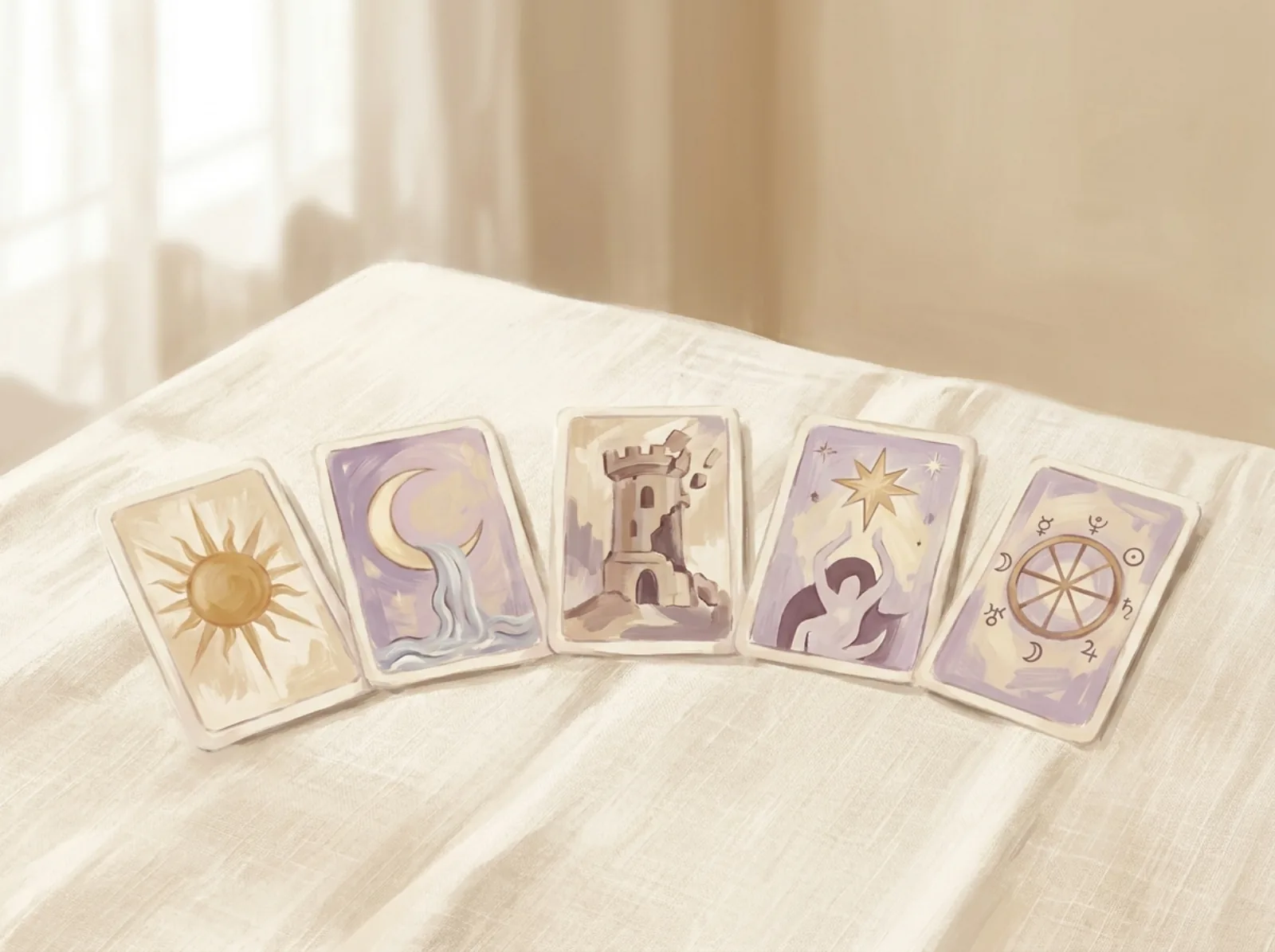
What The Devil Tarot Card Actually Means
The Devil is Key XV of the Major Arcana in the Rider-Waite-Smith tradition — the deck illustrated by Pamela Colman Smith in 1909 under the direction of A. E. Waite. Despite the horns and the theatrics, this card is not a report card on your soul. It is a mirror pointed at attachment, appetite, and the stories you tell yourself about why you cannot leave, quit, or change. Part of our tarot reference library.
In plain English, The Devil asks: where in your life are you convinced you have no choice? Where do you keep saying 'I have to,' when the honest verb is 'I keep choosing to'? Waite himself, in The Pictorial Key to the Tarot, tied the card to bondage of a very specific kind — the kind where the chains are only as tight as your grip on them. Try our 3 Card Tarot Spread guide. Try our Career Tarot Spread guide. Try our Celtic Cross Tarot Spread guide. Try our Decision Tarot Spread guide. Try our Horseshoe Tarot Spread guide. Try our Love Tarot Spread guide. Try our One Card Tarot Pull guide. Try our Pentagram Tarot Spread guide.
Modern readers like Rachel Pollack (Seventy-Eight Degrees of Wisdom) and Mary K. Greer (Tarot for Your Self) frame The Devil as shadow work in a single image. It is the card of the parts of you that you disowned, put in a costume, and then blamed for pulling the strings from the basement. Bringing them into conscious view is the point. Try our Relationship Tarot Spread guide. Try our Shadow Work Tarot Spread guide. Try our Situation Action Outcome Spread guide. Try our Tarot Spread For Anxiety guide. Try our Tarot Spread For Beginners guide. Try our Tarot Spread For Clarity guide. Try our Tarot Spread For Grief guide.
So when this card lands in a reading, the useful question is almost never 'am I cursed?' It is: what pattern am I ready to look at directly? What attachment — a substance, a person, a job, a self-image, a grudge — has quietly started running the show? Try our Tarot Spread For Manifestation guide. Try our Tarot Spread For Self Love guide. Try our Yes No Tarot Spread guide.
This guide will walk you through the imagery, upright and reversed meanings, love, career, health, spiritual and yes/no readings, timing, common combinations, spreads that highlight the card, and a journaling method you can actually use tonight.
Rider-Waite Imagery: What Pamela Colman Smith Actually Drew
Look at the card. The central figure is Baphomet-esque — a horned, winged, part-goat, part-human creature perched on a half-cube pedestal. This is not the Christian devil of medieval churches; it is the occult 'sabbatic goat' popularized by 19th-century writer Éliphas Lévi, who Waite and Smith drew from directly. The figure is a symbol, not a person.
The right hand is raised in a gesture that mirrors The Hierophant (Key V), but where The Hierophant blesses, this figure holds an inverted torch pointing at the ground with the left. Fire that should light the way is being aimed at the earth. That inversion is the whole thesis of the card in one gesture.
At the figure's feet stand a naked man and woman, chained by the neck to the pedestal. The chains are loose. Pollack points this out in almost every printing of Seventy-Eight Degrees of Wisdom — the figures could lift the chains over their heads and walk. They do not, because they have forgotten they can.
The man and woman have small horns and tails of their own — the man's tail ends in flame, the woman's in fruit. They have started to become what they are chained to. This is the psychological warning inside the card: what you refuse to face, you tend to grow to resemble.
The background is pure black. No stars, no landscape, no context. Where The Star (Key XVII) offers cosmos and hope, The Devil offers only the closed room of whatever you are currently obsessed with. That is not a moral judgment; it is a diagnostic.
The Devil Upright: Attachment, Obsession, and Honest Desire
Upright, The Devil is about bondage that feels good enough — or familiar enough — that you keep choosing it. That can be a substance, a person you know is wrong for you, a job that pays too well to leave, an identity you built at nineteen and never questioned, or the endless scroll on your phone at 1 a.m.
The card is not telling you desire is bad. Tarot is not puritanical. What it is naming is the difference between conscious desire ('I want this and I am choosing it with eyes open') and compulsive desire ('I do this and I do not know why and I feel worse afterward'). The Devil upright almost always points to the second.
In my experience editing readings for clients, The Devil upright most often lands when someone already knows what the pattern is. They do not need tarot to name it. What they need is permission to stop pretending they do not see it. The card gives that permission by making the thing visible on the table.
It can also land as raw, magnetic sexual chemistry — the kind that overrides your stated values. That is not automatically bad. But The Devil is asking you to be honest with yourself about what you are actually agreeing to, and whether the version of you that shows up in that dynamic is one you respect in the morning.
The upright card also flags materialism as a specific trap: the belief that if you just acquire one more thing — the house, the title, the follower count, the body — you will finally feel free. The Devil is the card of the second cube on the pedestal you keep climbing that never actually gets you off the chain.
The Devil Reversed: Release, Recovery, and Reclaiming Choice
Reversed, The Devil is one of the most hopeful cards in the deck. It is the moment the figures at the base of the card notice the chains are loose. It is the exhale after a long-held breath. It is the day you tell yourself the truth about the thing you have been in denial about.
This can look like ending an addiction, leaving a relationship or job that had you cornered, walking away from a contract you outgrew, or simply refusing to keep telling yourself a story that is no longer true. Reversed, this card marks the transition from 'I can't' to 'I could — and I might.' Try the Raka app to explore this in more depth.
Benebell Wen, in Holistic Tarot, notes that reversed Major Arcana cards often show the archetype being worked with consciously rather than acted out unconsciously. That is a good frame for The Devil reversed. You are still dealing with attachment or shadow material; you are just no longer pretending it is running you.
It can also, more soberly, indicate the early days of recovery — where the chain is off but the wrist still remembers the weight. Reversed does not mean instantly free. It means the direction has changed. That matters, and it deserves to be honored rather than rushed.
One caution: The Devil reversed can occasionally point to premature bypass — declaring yourself 'over it' before you have actually done the work. If the card feels too easy in the reversed position, ask whether you are truly free or just newly numb.
The Devil in Love and Relationships
In a love reading, The Devil upright most often describes a bond with high chemistry and low choice. The pull is real. The compatibility on paper may not be. This is the card of the ex you keep answering at midnight, the situationship you know is not going anywhere, or the marriage that runs on habit and shared logistics rather than mutual respect.
It is not automatically a breakup card. Long, healthy relationships can absolutely pull The Devil — sometimes as a flag that a specific dynamic inside the relationship (jealousy, control, codependency, a sexual pattern that no longer feels mutual) has quietly taken over. The relationship is not the problem; the dynamic is.
For single readers, The Devil upright can point to a type — the same wrong person in a different outfit. Consider what need that type keeps promising to meet, and whether it ever actually does. Tarot readers often call this 'karmic pattern,' but you can just call it a habit.
Reversed, The Devil in love is powerful. It can mean the end of an unhealthy dynamic, the moment one partner finally names a hard truth, or a couple's decision to go to counseling and unhook the pattern together. It can also mean you, personally, are done accepting less than you deserve. That reading rarely arrives before the person is ready to hear it.
If The Devil surfaces alongside repeated cards suggesting coercion, isolation, or fear — the Eight of Swords, the Ten of Swords, or the Five of Pentacles — treat the reading as a prompt to talk to a licensed therapist or a domestic-violence hotline in your country, not as tarot advice. Tarot is a mirror, not an intervention.
The Devil in Career and Money
In career readings, The Devil upright is the classic golden-handcuffs card. The salary is good. The title is impressive. The equity vests next year. And you cannot remember the last morning you woke up wanting to go in. The chain is loose; the paycheck is what keeps your hand off it.
It can also show workaholism as its own addiction — the identity built entirely from output, the phone that never gets put down, the vacation that becomes another slack window. The Devil is asking whether your relationship with work is one you chose or one you inherited from a scared, ambitious younger version of yourself.
In money readings, this card frequently points to debt — especially the shame spiral around debt, which is often heavier than the debt itself. It can also flag lifestyle inflation, gambling, crypto obsession, or the belief that the next raise will finally make you feel secure. Financial anxiety, per a 2023 American Psychological Association Stress in America report, is chronic for most US adults; the card is naming a pattern the culture reinforces.
Reversed in career, The Devil is the resignation email, the boundary that finally holds, the honest conversation with your manager about scope, or the moment you decide the industry itself is the wrong fit. It can also mark the end of impostor syndrome — the day you stop chaining yourself to a smaller version of your abilities.
None of this is personalized financial advice, and it should not be treated as such. If money or work stress is affecting your sleep, health, or safety, a licensed financial counselor or therapist is a better next step than another tarot reading.
The Devil in Health and Wellbeing
In health readings, The Devil upright most often flags compulsion loops — food, alcohol, cannabis, nicotine, prescription meds, doomscrolling, gambling, porn, shopping, work. Anything that offers short-term relief and long-term cost. Tarot cannot diagnose anything; it can only mirror what you already suspect.
It can also flag chronic patterns that stress the nervous system: poor sleep hygiene, over-caffeination, under-eating or over-eating, or the low-grade shame that keeps you avoiding the doctor. The Devil is often the card of the appointment you keep meaning to book.
Reversed, The Devil in a health reading can be genuinely encouraging — the first week of sobriety, the medication that finally works, the therapist you finally trust, the boundary with a family member that lets your body relax for the first time in years. It marks direction, not arrival.
This is the section where I want to be most direct with you. If The Devil card is showing up because you are struggling with addiction, self-harm, disordered eating, or suicidal thoughts, please treat the card as a sign to reach out to a licensed professional or a hotline in your country — SAMHSA's national helpline in the US (1-800-662-4357) is free, confidential, and 24/7. Tarot is a reflection tool. It is not a substitute for care.
None of the interpretations in this article constitute medical or psychological advice. Use them as journaling prompts, not diagnoses.
The Devil Spiritually: Shadow Work Without the Costume
Spiritually, The Devil is the card of the shadow — the Jungian idea that whatever you disown in yourself does not disappear; it just runs the show from the basement. Rachel Pollack described the card as the moment you meet the parts of yourself you have refused to look at, and discover they are neither as monstrous nor as powerful as you feared.
That is different from the pop-spiritual framing of 'high vibe only.' The Devil is the card that says you cannot bypass your way to wholeness. You have to walk into the dark room, turn on the light, and see what is actually there — which is usually a scared, hungry, younger version of you that needed something and never got it.
In a spiritual reading, this card can flag guru dependence, spiritual materialism (the collection of crystals, courses, and certifications used to avoid actually changing), or the seductive belief that one more retreat will finally fix you. The chain, in these cases, is made of good intentions and hashtags.
Reversed, spiritual Devil often marks the end of a phase — the guru whose contradictions you can finally see, the community you have outgrown, the practice you kept doing because you 'should.' It is the card of taking your authority back from anyone or anything you handed it to.
For non-religious readers: none of this requires belief in a devil, an entity, or the occult. The archetype works as psychology whether or not you treat the card literally.
The Devil as a Yes or No, and Its Timing
For yes/no readings, The Devil is a soft no — or, more precisely, a 'not like this.' The card rarely says the thing you are asking about is impossible. It says the version of you asking is chained to something that will make the answer costly. Ask again from a freer place and you may get a different reading.
Some readers treat The Devil as a yes for questions about chemistry, attraction, or 'will they contact me.' The pull is strong; contact often happens. Whether that contact is good for you is a separate question the card is quietly asking.
For timing, The Devil is traditionally associated with Capricorn in the astrological correspondences used by the Golden Dawn and popularized in decks like Rider-Waite-Smith and Thoth. That puts its calendar window roughly late December to mid-January in the Northern Hemisphere. Try top tarot app 2026 to explore this in more depth.
Practical readers also use The Devil to mean 'as long as the pattern holds.' The event you are asking about will not shift until the underlying attachment does. That is less romantic than a date on a calendar and usually more accurate.
None of these timing frames are predictions. They are frames for reflection. If you are making a real decision on a real deadline, use a calendar and a trusted human, not a card.
Common Combinations With Other Cards
The Devil + The Tower: a pattern about to break, often not gently. The lie you have been living inside is losing structural integrity. Painful in the moment, freeing in retrospect. If this pair lands, expect change and do not confuse discomfort with wrongness.
The Devil + The Lovers: the classic 'wrong person, right chemistry' pair. Also, in healthier readings, a conscious partnership choosing to look at its shadow together. Context is everything; look at surrounding cards to tell which reading is live.
The Devil + Three of Swords: heartbreak fused with attachment — the relationship that hurts and that you keep going back to. Often a prompt to talk to a therapist about the pattern, not just the person.
The Devil + Eight of Cups: you are finally walking away. The chain has come off; the road is dark but the direction is right. One of the more hopeful pairs the card makes.
The Devil + Ace of Pentacles: material temptation — the job offer, the loan, the deal — that has strings attached. Read the fine print. Not automatically bad; almost never simple.
The Devil + The Star: shadow followed by hope. The card of doing the hard work and being met on the other side by something gentler. When this pair lands reversed-and-upright respectively, many readers treat it as a strong sign of recovery in motion.
Spreads That Highlight The Devil
The Rider-Waite-Smith Celtic Cross is the traditional home for The Devil, and it is especially revealing when the card lands in the 'crossing' position (what is opposing you) or the 'hopes and fears' position (what you are afraid of, or secretly hoping for). Both readings are worth sitting with.
A three-card 'shadow spread' works beautifully when this card is the theme: (1) What am I chained to? (2) What is the chain actually made of? (3) What is one honest step toward freedom this week? Keep the third card actionable, not aspirational.
Mary K. Greer's 'breakthrough' spread from Tarot for Your Self is another strong container: past pattern / present grip / what wants to shift / first honest action / support available. The Devil almost always shows up in one of the first three positions and points to what the spread is really about.
For couples or friendships, a four-card 'dynamic spread' — my part, your part, the pattern between us, what the pattern is protecting us both from — often surfaces The Devil in the third position. That is not an accusation; it is a map.
For solo journaling, even a single-card pull with The Devil, held with the question 'where am I pretending I have no choice?', can move more than a full spread with a defensive question.
How to Journal With The Devil: Do This RIGHT NOW
If you drew The Devil today and want to actually use it, here is a numbered practice you can do in twenty minutes with a pen and a notebook. Do it before you look up any more meanings online.
1. Write the exact area of life the card is pointing at. One sentence. No hedging. 'My relationship with alcohol.' 'My job.' 'My relationship with X.' Naming it out loud on paper is half the work.
2. Finish this sentence five times, fast, without editing: 'I keep telling myself I have to ______.' Let the answers surprise you. Do not cross any out.
3. Now finish this sentence five times: 'The honest verb is: I keep choosing to ______.' Same rules. Same speed. Notice which sentences make your chest tighten. Those are the live ones.
4. Ask on paper: 'What need is this choice trying to meet?' Not what it costs — what it gives you. The Devil almost always names a real need being met in a costly way. Comfort. Numbing. Belonging. Certainty. Escape. Identity. Name it without judgment.
5. Finally: 'What is one two-percent step, this week, toward meeting that need in a less costly way?' Not a life overhaul. Two percent. Book one appointment. Send one text. Delete one app. Tell one honest person. Close the notebook. Go do the two-percent thing.
The Devil vs. The Tower, Death, and The Moon: A Quick Comparison
Readers new to tarot often lump the 'scary' Majors together. They are actually doing very different work, and knowing the difference sharpens every reading.
The Devil vs. The Tower (Key XVI): The Devil is the structure you built and are still living inside; The Tower is that structure collapsing. The Devil is chosen bondage; The Tower is forced revelation. They often arrive back-to-back — the pattern named, then broken.
The Devil vs. Death (Key XIII): Death is ending and transformation, usually welcome once you are through it. The Devil is what you refuse to let end. If Death is 'this chapter is over,' The Devil is 'and yet I keep rereading it.'
The Devil vs. The Moon (Key XVIII): The Moon is confusion, illusion, and the fog you have to walk through. The Devil is the specific attachment you are hiding inside that fog. The Moon asks 'what is real?'; The Devil asks 'what am I gripping?'
The Devil vs. the Five of Pentacles: The Five of Pentacles is scarcity — feeling locked out. The Devil is scarcity mindset — feeling locked in. Both feature exclusion, but from opposite sides of the door. Combined, they often point to poverty trauma running an adult decision.
When to Put the Cards Down and Call Someone
The Devil is a powerful reflection tool. It is also a card that can surface material — addiction, abuse, disordered eating, depression, coercion, financial ruin — that tarot is genuinely not equipped to handle. Knowing when to close the deck is part of reading responsibly.
If this card is landing repeatedly around a relationship in which you feel afraid, controlled, isolated from friends or family, or unsafe: please contact a domestic-violence hotline in your country (in the US, the National Domestic Violence Hotline is 1-800-799-7233). If it is landing around substance use, SAMHSA's US helpline is 1-800-662-4357. If it is landing around suicidal thoughts, please contact 988 in the US or your country's equivalent immediately.
None of the interpretations in this article are medical, psychological, financial, or legal advice, and they should not be used as such. If in doubt, please talk to a licensed professional. The card will still be here after that conversation, and the reading will be sharper for it.
In my own editorial practice, the readings I am proudest of have often ended with 'and this is the point where you should talk to someone qualified.' Good tarot points you toward better care, not away from it.
The Devil, at its best, is the card that stops you from lying to yourself about what you need. Let that be the whole gift.