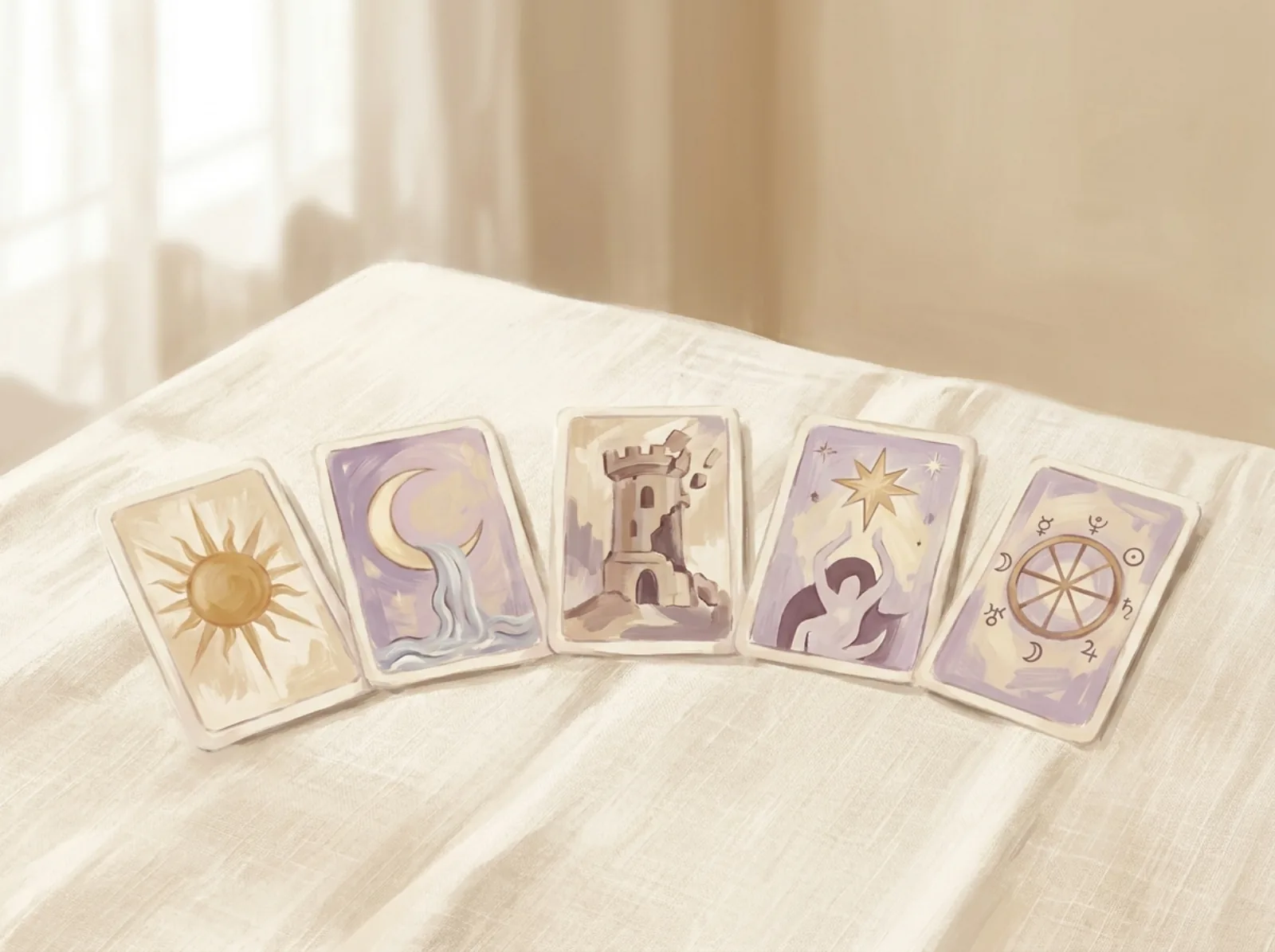
Why I still reach for this spread when a client says 'I want to manifest something'
The client I keep thinking about — I will call her Nadia, because that is not her name — booked a session last spring because she had been listening to a manifestation podcast for eight months and, in her own words, 'nothing was happening'. She wanted to leave a corporate marketing job and start a small ceramics studio. She had a Pinterest board, a saved list of kiln suppliers, a savings buffer, and absolutely no movement. Part of our card meanings library. Part of our all tarot spreads. Explore the full library. Part of our astrology library.
We had done a Celtic Cross the previous autumn and it had been illuminating but too wide. She left that session with a lot of insight and no next step. This time I pulled out a seven-card spread I have been refining for about four years, and by the end of the reading she had one physical action written in her calendar for the following Tuesday: email a specific studio in her city and ask about their open-studio hours. She emailed on the Tuesday. Six weeks later she had a shelf. See our best AI tarot app guide for a full breakdown.
That is the entire pitch for this spread. It is not more accurate than the Celtic Cross, or older, or more magical. It is narrower. It takes a vague longing and forces it through seven positions until what comes out the other end is a sentence you can put in your calendar. In a practice where most decks are used for reflection and mood, a spread that ends with a concrete verb is unusually useful. See our guide. See our best AI tarot app guide.
I have taught this layout to about two hundred readers now, in workshops and one-to-ones, and the feedback has been consistent enough that I feel comfortable writing it up. This guide covers the seven positions, how to shuffle and lay them, a sample reading, the mistakes I see most often, and where the spread fits alongside adjacent practices like the 369 method. It is written for people who already own a Rider-Waite-Smith deck or its close cousins, though almost any 78-card deck will work.
What a tarot spread for manifestation actually is (and what it is not)
A tarot spread for manifestation is a structured seven-card layout that helps you reflect on a single intention across seven angles: current reality, desired outcome, hidden block, aligned action, timing, energetic gift, and next physical step. It is a self-reflection tool grounded in the Rider-Waite-Smith tradition popularised by A.E. Waite and Pamela Colman Smith in 1910, and it is designed to convert an abstract wish into a concrete first move.
It is not fortune-telling. The cards will not tell you whether your business will succeed, whether your ex will call, or whether the flat you viewed on Saturday will be yours. Anyone who tells you tarot does that is either misusing the tool or selling something. What the cards do is give your subconscious a structured surface to project onto, in the same way that a good journaling prompt or a well-run coaching conversation does.
It is also not a substitute for professional advice. If your 'manifestation' involves a medical diagnosis, a legal dispute, a serious financial decision, or a mental-health crisis, the correct professional is a doctor, a lawyer, a licensed financial advisor, or a therapist. Tarot can sit alongside those conversations — many of my clients use it as a reflective supplement to therapy — but it does not replace them, and any reader who claims otherwise is out of their depth.
Rachel Pollack, in Seventy-Eight Degrees of Wisdom (1980), described tarot as a way of 'making the invisible visible'. That is the frame I would ask you to hold as you read on. The manifestation spread is a mirror with seven panels. What it shows you is already in you; the layout just makes it legible.
One last framing note before we go into the mechanics. The word 'manifestation' has been stretched thin over the last decade, especially in short-form video culture where it often gets confused with wishful thinking. In this guide I use it in a narrower sense: the process of clarifying a specific intention and taking aligned action toward it. The tarot spread supports the clarification and the action. It does not do the work for you.
The seven positions, and why they are in this order
The order of the seven positions is not arbitrary. It moves you from where you are, to where you want to be, through what is between them, and out into the physical world. Each position is a question the deck is helping you answer. Read them in sequence the first time; you can jump around later once the layout is familiar.
Position one is current reality. This card reflects your actual starting point, not the sanitised version you present at dinner parties. If the intention is 'I want to leave my job and start a studio', this card might reflect exhaustion, financial anxiety, or a quiet excitement you have been suppressing. Look at the figure's posture and gaze.
Position two is desired outcome. This card reflects the felt sense of the goal — not the outcome itself, but the emotional texture of what you are moving toward. A common surprise here is that the card does not match the story you have been telling. Someone chasing 'freedom' might draw the Four of Wands (celebration, home) rather than the Fool (leap into unknown). That mismatch is data.
Position three is the hidden block. This is the position readers tend to find hardest, because the block is by definition something you have not fully seen. Pay attention to any resistance you feel when the card is flipped; that resistance often is the block. In Nadia's reading this was the Seven of Pentacles reversed — impatience disguised as productivity.
Position four is aligned action. Note the word aligned. This card reflects the kind of action that fits your specific nature and situation, not a generic productivity prescription. If you draw the Hermit here, the aligned action is probably a period of solitude and study, not a networking sprint. Position five is timing — a rhythm or season rather than a date. Cups often suggest weeks; Wands, days; Pentacles, seasons; Swords, immediacy. This is the position most likely to be misread, so I have given it its own section further down.
Position six is the energetic gift. This card names a resource you already have and are underusing. It is my favourite position, because clients almost always relax when they see it. The manifestation you are chasing is closer than you thought; you have been carrying part of the answer.
Position seven is the next physical step. This is the whole point of the spread. Whatever this card reflects, you translate it into one specific, small, calendar-able action within the next seven days. If you cannot name the action, you have not finished the reading.
Step-by-step method: how to do the spread in about twenty minutes
You need a 78-card deck (Rider-Waite-Smith or a close successor), a notebook, a pen, and roughly twenty quiet minutes. A candle is optional and mostly aesthetic; the reading works fine at a kitchen table with the kettle on.
1. Write your intention as one present-tense sentence at the top of a fresh page. 'I am running a small ceramics studio in my city' is better than 'I want to maybe eventually start a pottery thing.' Specificity is the whole game.
2. Shuffle the deck for at least sixty seconds while holding the sentence in mind. Do not think about the cards; think about the sentence. Overhand shuffle, riffle, or the pile method — the mechanics do not matter, the duration and focus do. Then cut the deck once with your non-dominant hand and reassemble it in any order that feels right. This small ritual marks the transition from shuffling to reading; do not skip it, the pause matters.
3. Deal seven cards face-down in the layout described in the position guide below. I like a horseshoe shape with position seven at the top, but a straight line works equally well. Whatever layout you choose, use the same one every time so the positions become spatially familiar.
4. Flip the cards left to right, one at a time, in position order. Do not flip them all at once and scan the reading; the sequence is part of the meaning. Pause after each flip long enough to notice your first reaction before naming it.
5. Read each card in the context of its position, not in isolation. The Tower in position one (current reality) is a very different message from the Tower in position seven (next physical step). Position always modifies meaning.
6. Write the reading in your notebook in three passes: first a one-sentence summary of each card, then a paragraph on how positions three (block) and four (aligned action) speak to each other, and finally the single physical step from position seven, written into your calendar with a date.
7. Close the deck. Some readers like to pull a single 'clarifier' card at this point if a position feels murky; my advice for the first year of practice is to resist that urge. The murk is often the point.
Position guide: a table of what each card reflects
The table below is the reference I hand to workshop attendees. Screenshot it, print it, tape it inside the lid of your deck box. It condenses the seven positions into a form you can consult mid-reading without breaking your focus.
Position 1 — Current reality. Question: Where am I actually starting from? Look at posture, environment, and any figures in the card. Reflects the emotional and material ground under the intention.
Position 2 — Desired outcome. Question: What does the goal feel like, not just look like? Reflects the emotional texture of arrival, which often surprises the querent by differing from the stated goal.
Position 3 — Hidden block. Question: What have I not been letting myself see? Reflects the pattern, belief, or avoidance holding the intention static. Frequently a court card or a reversed minor arcana.
Position 4 — Aligned action. Question: What kind of action fits me, not a generic self-help prescription? Reflects mode of movement — solitary study, community, bold pitch, quiet craft — rather than a specific task.
Position 5 — Timing. Question: What rhythm or season is this unfolding on? Reflects a tempo rather than a date. Suits and numbers matter more here than usual; see the timing section below.
Position 6 — Energetic gift. Question: What resource do I already have that I am underusing? Reflects an existing strength — often a card that feels almost too flattering, which is a sign to take it seriously rather than dismiss it.
Position 7 — Next physical step. Question: What is one calendar-able action within the next seven days? Reflects the bridge from reflection to reality. The whole spread collapses without this position; do not skip it.
When you should use this spread — and when you really should not
Use this spread when an intention has been sitting in your head for weeks or months without moving. That is the classic signature: you can describe the goal, you have thought about it, you may even have made a Pinterest board or a spreadsheet, and yet no concrete step has been taken. The spread's structural bias toward a next physical action is exactly what unstuck-but-idea-rich situations need.
Use it at the start of a new cycle — a new moon, a birthday, a quarter, a fresh 369-method round. The 369 method (writing an intention three times in the morning, six times at midday, nine times in the evening) benefits from a clarifying reading at the start; the tarot spread names what you are actually writing about. The two practices braid together well.
Use it when you have finished a project and feel a familiar restlessness about the next one. The energetic gift position (six) is particularly useful in transitions, because it reminds you of strengths from the previous chapter that you can port into the new one.
Do not use this spread for questions with a right or wrong answer that a professional can give you. 'Should I take this medication?' is a doctor question. 'Should I sign this contract?' is a lawyer question. 'Is my portfolio allocation sensible?' is a financial-advisor question. Tarot can help you notice how you feel about those questions, but the substantive answer belongs elsewhere.
Do not use this spread when you are in acute emotional distress. If a reading is going to be a coping mechanism to avoid a difficult conversation or a needed appointment, close the deck and make the appointment. Benebell Wen, in Holistic Tarot (2015), is unusually clear on this point: the deck is a supplement to a healthy life, not a substitute for one.
Do not use this spread daily for the same intention. Once per lunar cycle is the outer bound of usefulness. Repeated readings tend to produce contradictory noise, which is your subconscious asking you to actually take the last step it suggested rather than pull a new one.
A sample reading, walked through card by card
Let me walk you through the reading I did with Nadia, with details changed to protect her privacy. Her intention, written at the top of her page, was: 'I am running a small ceramics studio in my city within twelve months.' Seven cards, dealt in a horseshoe with position seven at the top.
Position one (current reality): Eight of Pentacles. A figure hammering out coins at a workbench, absorbed but repetitive. Nadia laughed when I described it, because she said it looked exactly like her marketing job — competent, productive, and airless. The card reflected her actual starting point rather than the version she gave friends. That is what position one is for.
Position two (desired outcome): Four of Wands. A garlanded arch, two figures celebrating, a homelike feeling. This surprised her; she had expected the Fool or the Sun, some card of exhilarating leap. What she actually wanted, the deck suggested, was a settled, communal, homey creative life — closer to a village pottery than a solo art career. That reframing shifted the whole reading.
Position three (hidden block): Seven of Pentacles, reversed. The reversal here often reads as impatience masquerading as productivity — endless research, endless planning, no actual planting. She had been reading about kiln suppliers for six months without visiting a single studio. The block was not fear of failure; it was addiction to preparation.
Position four (aligned action): The Hierophant. A traditional card of learning within an established structure. Not a solo leap, not a bootcamp, but apprenticeship — finding an existing potter and learning from them. This aligned with her Four of Wands outcome; the community was the point.
Position five (timing): Page of Cups. A young figure, water suit, gentle tempo. I read this as weeks-to-months rather than days or years — a slow unfolding, appropriate to her twelve-month intention. The Page's playfulness suggested the timing would feel exploratory rather than urgent.
Position six (energetic gift): The Empress. Creative fertility, generosity, the ability to hold a garden. Nadia hosts a monthly dinner for eight friends and always has. The Empress reminded her that she was already running a small creative community; she did not need to learn how, only to redirect it.
Position seven (next physical step): Three of Pentacles. Three figures collaborating on a cathedral. The next physical step was collaborative and specific: contact a working studio and arrange to see it. Not read about it, not follow it on Instagram — visit. She emailed a studio the following Tuesday. That email is the whole reason this reading mattered.
How to read the timing card without falling into the prediction trap
Position five is the position that most tempts readers back into fortune-telling. Clients often want a date — 'when will it happen?' — and it is easy to oblige with an authoritative-sounding answer. Resist this. Timing in tarot is genuinely a rhythm, not a schedule, and treating it otherwise is where practices lose their integrity.
A useful heuristic, drawn loosely from Mary K. Greer's Tarot for Your Self (1984), is to read suits as tempos. Swords tend to move fast — thought, decision, air. Wands move quickly too but with more heat — days to a couple of weeks. Cups flow more slowly, in the tempo of relationships and emotions — weeks to months. Pentacles are the slowest, moving in the rhythm of seasons and material accumulation — months to a year.
Numbers add texture. Aces and low pips suggest beginnings; middle numbers (five, six, seven) suggest process; high numbers (nine, ten) suggest culmination. Court cards suggest the timing depends on a person — either the querent or someone in their orbit — rather than on the calendar.
When Nadia drew the Page of Cups in position five, I did not tell her 'expect it in April'. I said 'this looks like a slow, exploratory unfolding across weeks and months, with an emotional quality — you will feel it moving before you see it moving'. That framing is honest and useful. A date would have been dishonest and, if wrong, corrosive to her trust in the practice.
If a client insists on a date, I return them to their intention. 'You wrote twelve months at the top of your page. The timing card is telling you the tempo will feel appropriate to that window. Now let us look at position seven, which tells us where you start.' Redirecting to position seven almost always resolves the timing anxiety, because action metabolises waiting.
Common mistakes I see readers make with this spread
The most common mistake is skipping position seven. Readers get absorbed in the emotional richness of positions one through six, close their notebooks, and forget that the whole point of the spread is a physical action. Two weeks later the intention is still in exactly the same place, and the reading gets blamed for not 'working'. The reading worked; the reader did not finish it.
The second most common mistake is pulling clarifier cards for every position. If a card is unclear, the correct move is usually to sit with it, look at the imagery, and journal — not to pull another card. Clarifiers are legitimate occasionally, but they compound quickly; four clarifiers into a seven-card spread and you have a nineteen-card mess with no through-line.
The third mistake is treating position three (hidden block) as a diagnosis of someone else. 'The block is my partner, my boss, my mother.' Rarely. The block is almost always internal — a belief, a fear, an avoidance pattern — and other people are usually the surface on which it plays out. If your block card keeps pointing outward, that is itself a diagnosis worth noticing.
The fourth mistake is reshuffling and redoing the spread when the first reading feels uncomfortable. This is the tarot equivalent of asking the same question in five different tones until you get the answer you want. Uncomfortable readings are usually the useful ones. Sit with the discomfort for at least twenty-four hours before considering a re-shuffle.
The fifth mistake is reading the cards without their positions. A student of mine once described the Tower in position one as 'catastrophe incoming'. But in position one (current reality) the Tower reflects a collapse that has already happened or is happening now — a job loss, a breakup, a health event. That is a completely different message from the Tower in position five, which might reflect sudden timing. Position modifies meaning. Always.
The sixth mistake is doing this spread for someone else's intention. Manifestation is first-person by nature. If a friend asks you to 'manifest her ex coming back' via this spread, decline gently. You can teach her the spread. You cannot do it for her, because the whole point is her clarification, not yours.
How this spread relates to the 369 method and other manifestation practices
The 369 method — writing an intention three times in the morning, six times at midday, and nine times in the evening for a set number of days — is a repetition practice popularised by short-form video creators, loosely drawing on numerology attributed to Nikola Tesla. Its usefulness, in my view, has nothing to do with mystical vibrations; it works because repeated writing forces clarification and daily attention.
The tarot spread for manifestation pairs with 369 in a specific way. Run the spread once at the start of a 369 cycle. Use the intention sentence you wrote at the top of your reading page as the exact sentence you write out three, six, and nine times each day. This locks the practice to a single, refined intention rather than the drifting version most 369 practitioners end up with by day nine.
It also pairs well with vision-boarding, though I would suggest an unpopular sequence: do the reading first, board second. Most people board first, which locks them into an image-based version of the goal before they have interrogated it. The reading — especially position two (desired outcome) and position six (energetic gift) — often reveals that the boarded version was slightly off.
It fits alongside journaling in the tradition of Julia Cameron's morning pages, though the spread is more architectural and the pages are more expressive. Use pages for daily process and the spread for periodic direction-setting. They are not competing.
It does not pair well with practices that promise outcomes without action — some of the 'high-vibe' scripts circulating online position manifestation as a passive receiving stance. The seven-card spread's structural insistence on a next physical step makes it incompatible with pure-passivity framings. That incompatibility is a feature.
If you are moving from a Law of Attraction background into tarot, expect this spread to feel more grounded and less magical than what you may be used to. That grounding is what makes it repeatable across years without burning out.
Variations: shortening, expanding, and adapting the spread
A three-card version works when you have twenty minutes and a strong intuition about your intention. Use positions one (current reality), three (hidden block), and seven (next physical step). This 'skeleton' variation is my go-to for weekday check-ins between full monthly readings.
A five-card version drops positions five (timing) and six (energetic gift), keeping current reality, desired outcome, hidden block, aligned action, and next physical step. This is useful when timing is not the question — for instance, when the intention has an externally-imposed deadline.
A nine-card version adds two positions: 'what to release' (before position one) and 'who supports this' (before position seven). I use this variation for larger intentions like career changes or relocations, where releasing an old identity and identifying allies are meaningful parts of the process.
A partnered variation, for couples or business partners with a shared intention, has each person do the full seven-card spread separately, then compare positions three (block) and seven (next step). Divergent blocks and convergent next steps are common and productive; convergent blocks and divergent next steps are worth a long conversation.
An oracle-deck substitution works if you do not own a Rider-Waite-Smith. Any 78-card tarot deck in the RWS lineage — the Wild Unknown, the Modern Witch, the Rider-Waite-Smith itself — reads cleanly through this spread. Non-tarot oracle decks work less well because they lack the suits and numbered progression that structure positions five and six.
A digital variation, using an app such as Raka on Google Play, keeps the same seven positions but replaces the physical shuffle with an algorithmic one. The reflective mechanism is the same. Raka's AI companion walks through each position in the Rider-Waite-Smith tradition and prompts the journaling questions I use in workshops, which some readers find useful when working alone late at night without a notebook to hand.
Where tarot fits in the broader landscape of reflective practice
The US mystical services market — psychic, astrology, tarot, and adjacent practices — was valued at approximately $2.3 billion in IBISWorld's 2023 industry report on Psychic Services. That is a large enough market to sustain thousands of professional readers, hundreds of published deck creators, and a healthy secondary economy of workshops, apps, and books. It is also small enough, culturally, that most practitioners know each other's work.
Belief in astrology and tarot has been reasonably stable in the US over the last decade. Pew Research's 2018 survey on New Age beliefs found that about 29% of US adults believed in astrology, and adjacent Pew work has tracked similar figures for other reflective and divinatory practices. Younger adults — Millennials and Gen Z — hold these beliefs at higher rates than the general population, which has driven both the app boom and the resurgence of physical decks.
Within that landscape, tarot occupies a distinct niche. Unlike astrology, which is chart-based and can feel deterministic, tarot is prompt-based and reflective — every reading is co-created between the cards and the reader. Unlike affirmations, which are output-focused, tarot is input-focused; it asks you to look before you speak. Unlike coaching, it is not conversational; the deck cannot ask you a follow-up question, so the discipline of self-questioning has to be yours.
The manifestation spread specifically sits between the reflective and the action-oriented traditions. It borrows from coaching frameworks in its insistence on a next step, from journaling in its use of a written intention, and from classic tarot in its seven-position architecture. That hybrid nature is why it travels well across the different audiences who arrive at it — the 369 crowd, the Julia Cameron crowd, the therapy-adjacent crowd, the pure-tarot crowd all find a version of themselves in it.
It is important to be clear-eyed about limits. Tarot is not evidence-based in the sense that cognitive behavioural therapy is. It has not been through randomised controlled trials, and the mechanism by which it 'works' is best understood as structured projection — you are the intelligence in the room, and the cards are giving that intelligence a surface to work on. Held that way, the practice is honest and durable. Held any other way, it drifts into territory best avoided.
Closing thoughts and how to keep the practice honest
If you take one thing from this guide, take the seventh position seriously. Every other position can be discussed, journaled, sat with, and left unresolved. Position seven must produce a calendar entry. That single discipline is the difference between a reflective hobby and a practice that changes your life over years.
A useful ritual for keeping the practice honest: at the end of each month, review the last month's manifestation readings and note which position-seven actions you actually took. Not to judge yourself, but to notice. Over a year you will see patterns — which kinds of next steps you follow through on, which you avoid, which types of intentions produce action and which produce reading-loops. That meta-pattern is often more useful than any individual reading.
Keep a small library of reference books rather than relying only on card-meaning apps. Waite's Pictorial Key to the Tarot (1910) is the source text and worth reading in the original despite the archaic prose. Pollack's Seventy-Eight Degrees of Wisdom (1980) is the modern standard. Wen's Holistic Tarot (2015) is the most useful single volume for a working practitioner. Greer's Tarot for Your Self (1984) is the classic for personal practice. Between them, you have a couple of thousand pages of considered thought that no app can fully replicate.
Use apps for what they do well — availability, portability, the discipline of a daily draw, the convenience of a guided walkthrough when you are travelling without a deck. The Raka app on Google Play, which our team makes, is built with the seven-position architecture of this spread in mind and can walk a new reader through it end to end. But do not let any app, ours included, become the whole practice. The physical deck matters. The pause of shuffling matters. The pen in your hand matters.
Finally: be kind to yourself when a reading is uncomfortable. The hardest cards — Tower, Ten of Swords, Three of Swords, Devil — usually show up in the positions where you most needed to see them. That is not the deck being cruel; that is the mirror being accurate. Sit with the discomfort, write the position-seven action, and take the next small step. The rest, as they say, is practice.
Frequently asked questions
What is the tarot spread for manifestation?
A tarot spread for manifestation is a structured 7-card layout that helps you reflect on an intention rather than predict its arrival. The seven positions cover current reality, desired outcome, hidden block, aligned action, timing window, energetic gift, and the next physical step. It is a self-reflection framework built on the Rider-Waite-Smith tradition, not fortune-telling, and it pairs naturally with journaling methods like the 369 practice used to clarify goals.
How do I do a tarot spread for manifestation?
Write your intention in one present-tense sentence, shuffle a standard 78-card Rider-Waite-Smith deck while holding the sentence in mind, and cut the deck once with your non-dominant hand. Deal seven cards face-down in the shape described in the position guide, then flip them left to right. Read each card in the context of its position, not in isolation, and finish by writing the single physical step suggested by position seven into your calendar.
When should I use a tarot spread for manifestation?
Use it when an intention feels stuck between wanting and doing — you have named a goal but keep circling it without action, or you can feel resistance you cannot articulate. It is also useful at the start of a new moon cycle, a birthday, a quarter, or a 369-method reset. Avoid it for urgent medical, legal, or financial decisions; those belong with a licensed professional, not a deck of cards.
How is the manifestation spread different from a Celtic Cross?
The Celtic Cross is a ten-card diagnostic spread that surveys a whole situation — past, present, near future, self-image, environment, hopes and fears. The manifestation spread is narrower and more active: seven cards, one intention, one physical step at the end. Where the Celtic Cross asks 'what is happening here?', the manifestation spread asks 'what am I choosing, and what is the next move?' Use the Cross for depth, this spread for direction.
Can I do this spread online or with an app?
Yes. A digital shuffle uses the same reflective mechanism as a physical one — the meaning lives in your interpretation, not the paper. The Raka app on Google Play walks you through the seven positions with an AI companion that explains each card in the Rider-Waite-Smith tradition and prompts journaling questions. Physical decks still have advantages — the pause of shuffling, the texture of the cards — so many readers alternate between the two depending on setting.
What if I get a card I don't understand?
Sit with the image before reaching for a book. Notice one detail — a colour, a posture, an object — and ask what it might reflect about your intention. Then consult a trusted source such as A.E. Waite's Pictorial Key to the Tarot (1910) or Rachel Pollack's Seventy-Eight Degrees of Wisdom (1980). If the card still resists you, write the question down and return to it in a week. Confusion is data; it usually points at the exact place your intention is unclear.
How often should I do this spread?
Once per intention, not once per day. Repeating the spread for the same goal within a week tends to produce noise rather than insight — you are effectively asking the deck to change its mind. A useful cadence is one manifestation spread per lunar cycle, or one at the start of each 369-method round. If circumstances shift meaningfully — new information, new obstacle, new opportunity — a fresh spread is appropriate.
Do reversed cards change the meaning in this spread?
They can, if you already read reversals in your practice. In the manifestation layout, a reversal in position three (hidden block) often intensifies the block, while a reversal in position six (energetic gift) can suggest a strength you are underusing. If you are new to tarot, keep all cards upright for your first year — Mary K. Greer's Tarot for Your Self (1984) recommends this to avoid overwhelming beginners with too many variables at once.