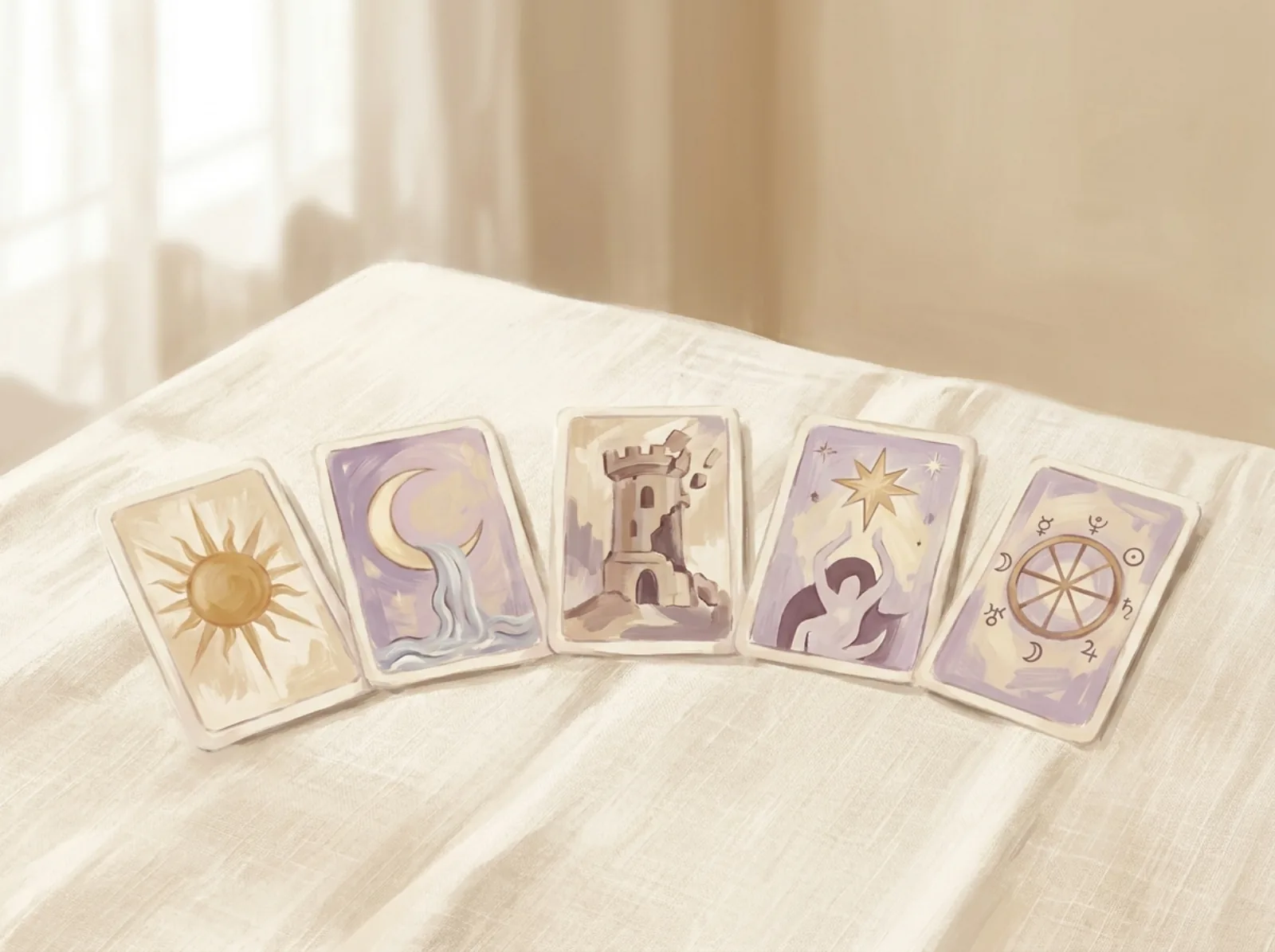
The reading that convinced me three cards is usually enough
The first time I trusted a 3 card tarot spread over a bigger one, I was sitting on the floor of a friend's apartment in Manchester. She was three weeks from signing a lease on a flat with a partner she was not sure she wanted to live with, and she asked me to do the full Celtic Cross. I set up all ten positions, flipped card after card, and by the time I got to the outcome we had both mentally rewritten her relationship four times. She left more confused than she arrived. Part of our tarot reference library. Part of our all tarot spreads. Explore the full library. Part of our tarot reference.
A week later she texted me again. Same question. I told her to sit down, shuffle her own deck, and pull three cards: situation, what is blocking me, what would help. She drew the Four of Cups, the Devil, and the Star. She looked at me and started laughing. Then she started crying. She had her answer in under ninety seconds — a bored discontent she had been ignoring, a self-imposed cage of obligation and sunk cost, and permission to hope for something cleaner. She did not sign the lease. See our best AI tarot app 2026 guide for a full breakdown.
That reading is why I write about the 3 card spread the way I do. Ten cards let you build a story that flatters your denial. Three cards leave you nowhere to hide. In eleven years of reading — first with a battered Universal Waite my aunt in Toronto sent me for my seventeenth birthday, then professionally through Raka — I have come back to the three-card pull more than any other single technique. It is not a starter spread you graduate from. It is the tool most working readers quietly rely on for the majority of real questions. See our guide. See our best natal chart app guide.
So what actually is a 3 card tarot spread?
A 3 card tarot spread is a reading in which you shuffle a tarot deck, deal three cards face down in a row, and interpret each card according to a position you assigned before you flipped. The three positions form a small narrative structure: past-present-future is the most famous, but situation-obstacle-advice, mind-body-spirit, and you-them-relationship are equally traditional and often more useful. The deck is almost always a 78-card Rider-Waite-Smith deck or one of its many stylistic descendants, published originally in 1909 by William Rider & Son with Pamela Colman Smith's illustrations under A.E. Waite's direction.
The spread is deceptively small. Three cards create three explicit meanings and one implicit fourth meaning — the arc between them — which is where most of the real insight lives. Rachel Pollack, whose 1980 book Seventy-Eight Degrees of Wisdom remains one of the best English-language guides to Rider-Waite-Smith tarot, calls this movement between cards the 'story quality' of a spread. Three cards is the minimum count that produces a story. Two cards give you a comparison. One card gives you a mood. Three cards give you cause, condition, and direction.
That is also why the spread has survived every fashion in tarot for a century. Waite included a version of it in The Pictorial Key to the Tarot (1910). Every reputable modern text — Benebell Wen's Holistic Tarot (2015), Mary K. Greer's Tarot for Your Self (1984, still in print) — teaches a variant of it in the first fifty pages. It is the spread most likely to be your first, the spread most likely to be your daily practice ten years in, and the spread most professional readers reach for when a client is overwhelmed and needs a clean answer to a specific question.
None of that means the cards predict the future. In the tradition Raka and most contemporary Western readers work in, tarot is a tool for structured self-reflection. The 3 card spread is a device for holding a single question steady long enough that you can see it from three angles you would not have chosen on your own.
How to do a 3 card tarot spread, step by step
Here is the procedure I teach every beginner who signs up for a Raka onboarding session, and it is the same procedure I use myself when I have a question that actually matters. Skipping steps rarely ruins the reading but it usually flattens it. Do it slowly the first ten times. After that you can compress the ritual to about three minutes without losing anything.
1. Write your question down in one sentence. Not a paragraph, not three questions stapled together. If you cannot fit it in a sentence you are asking two questions and you need to pick one. 'Should I take the job in Denver?' is a spread. 'What is going on with my career and also my mother?' is two spreads on two different days.
2. Choose your positional framework before you shuffle. Past-present-future for questions about arc. Situation-obstacle-advice for decisions and stuck patterns. Mind-body-spirit for wellbeing check-ins. You-them-relationship for interpersonal dynamics. The choice matters — the same three cards mean different things in different frames.
3. Shuffle the deck for as long as feels right, at minimum thirty seconds, holding the question in mind. Some readers cut the deck into three piles with the non-dominant hand and restack; some do not. Either is fine as long as you do the same thing every time.
4. Deal three cards face down from the top of the deck, left to right, in a straight row. Do not deal from the middle. Do not deal five and pick three. The randomness is the point.
5. Flip the first card, then the second, then the third, always left to right. Read each card on its own before you read the row. Note the image first — what the figure is doing, what surrounds them, which direction they face — before you consult any book meaning.
6. Now read the arc. What is the story from card one to card three? Does the middle card obstruct the movement or enable it? Do the outer cards face each other or face away? Rider-Waite-Smith is a visual language and the eyeline of the figures is doing real work.
7. Write everything down in a tarot journal before you look up any meaning you are not sure of. Your first-instinct read is the reading that belongs to you. The book meanings are for calibration afterwards.
Past-present-future: the most-taught version and what it actually does
Past-present-future is the version most beginners meet first, and it is also the version most beginners misuse. The 'past' position does not mean your childhood or last year; it means the recent condition that produced the current situation. The 'present' position is not you today in general; it is the specific dynamic at play in the situation you asked about. The 'future' position is not a prediction; it is the trajectory the current dynamic is on if nothing changes.
That last point is the one that matters most and the one every serious tarot writer keeps hammering. Benebell Wen in Holistic Tarot is emphatic: the future card describes a probable direction, contingent on the current pattern continuing, and the entire point of drawing it is so you can decide whether to intervene. If the future card is grim, the spread is not doom, it is a warning that lets you act. If the future card is bright, the spread is not a guarantee, it is a nudge to keep doing what you are doing.
Past-present-future works best for questions with a visible arc — a project you have been building, a relationship you have been in for a while, a habit you have been trying to change. It works badly for pure decision-making, because 'past' rarely gives you decision-relevant information for a choice you have not made yet. For decisions, use situation-obstacle-advice instead.
A sample arc: Ten of Wands (past), Four of Swords (present), The Star (future). Reading: you burned yourself out carrying too much (past), you are now in a period of enforced rest whether you chose it or not (present), and if you honor the rest a genuine renewal of hope and clarity is available (future). If you skip the rest, the Star does not arrive on schedule.
Situation-obstacle-advice: the version working readers use most
If you asked me which of the classic 3 card frameworks I actually use most often for paying clients, the honest answer is situation-obstacle-advice. It is the workhorse. Past-present-future gets the marketing; situation-obstacle-advice gets the work done. The reason is that most people bring readers questions that are functionally decisions — should I stay, should I go, should I speak up, should I quit — and this frame is built for decisions.
The first card names the current situation as the deck sees it, which is often subtly different from how the querent sees it. That gap is where insight lives. The second card names the obstacle: not a person, not fate, but the pattern or fear or unmet need that is blocking movement. The third card names advice: not what will happen, but the disposition or action most likely to unlock the situation.
The trick with the second card is to read the obstacle as internal by default. If the Devil comes up as the obstacle, the reading is almost never 'someone is oppressing you.' It is almost always 'you are staying in a cage whose door is open.' Waite in The Pictorial Key describes the chains on the Devil card as loose enough to lift off — the figures are prisoners of their own consent. That reading is a century old and it still lands harder than any modern interpretation I have seen.
A sample arc for a client debating whether to quit a stable job to freelance: The Emperor (situation), Eight of Cups (obstacle), Page of Pentacles (advice). Reading: you are inside a structure that is stable and safe (situation), what is blocking you is your reluctance to walk away from something that is no longer feeding you (obstacle), and the advice is to begin as a beginner — a small pilot project, a modest first client, not a dramatic full exit (advice).
Mind-body-spirit: the check-in spread
Mind-body-spirit is the spread for when you do not have a specific question but you know something is off. It is the tarot equivalent of a body scan. The first card describes what is going on in your thinking — the loops, the preoccupations, the mental weather. The second card describes what is going on in your body — energy, tension, physical health signals. The third card describes what is going on at the level of meaning — values, sense of purpose, connection to whatever you consider larger than yourself.
I use this spread with clients who show up saying 'I just feel weird lately.' It is a diagnostic, not a prescription. It surfaces the imbalance so the person can decide what to do about it, which almost always involves something outside tarot — sleep, therapy, a conversation with a doctor, a phone call to a friend. The spread's job is to name the imbalance, not to fix it.
A common pattern I see in this spread: an active, busy card in the mind position (Knight of Swords, Seven of Pentacles), a depleted card in the body position (Four of Swords, Ten of Wands, sometimes the Tower), and a numb or waiting card in the spirit position (Four of Cups, Hanged Man). That combination almost always means the person is overworking, ignoring their body's protest signals, and has lost touch with what they actually care about. The intervention is not more tarot. It is rest, and often a licensed therapist.
To be explicit: if any 3 card spread you do surfaces sustained physical symptoms, persistent low mood, or thoughts of self-harm, close the deck and call a doctor or a mental health professional. Tarot is a reflection tool, not a substitute for clinical care. Raka's onboarding says this and I will say it here.
You-them-relationship: reading a dynamic without reading the other person
You-them-relationship is the spread beginners most want to do and the spread beginners most often get wrong. The mistake is treating the 'them' card as a psychic surveillance camera pointed at another human being. It is not. Ethical tarot in the modern Western tradition — and Mary K. Greer's Tarot for Your Self is very clear on this — does not read third parties who have not consented to being read. What the second card actually shows you is your perception of the other person, filtered through your current state.
With that reframe the spread becomes enormously useful. First card: how you are showing up in this relationship. Second card: how you are currently perceiving the other person, which tells you as much about your projections as about them. Third card: the dynamic between you — the thing you two make together that is bigger than either of you alone.
The third card is the one to sit with longest. Relationships are systems, and the third card names the system. If it is the Two of Cups the system is mutual regard, whatever the individual cards say. If it is the Five of Swords the system is competition and score-keeping, even if you both consider yourselves generous people. If it is the Ten of Pentacles the system is legacy and stability, which can be beautiful or suffocating depending on the other cards.
A sample arc between an adult child and an aging parent: The High Priestess (you), The Emperor (them), Four of Pentacles (relationship). Reading: you approach this relationship with a lot of held-back intuition and things you are not saying (you), you perceive them as rigid and controlling of the frame (them), and the system you have built together is one of mutual gripping onto position and resource (relationship). The advice is not in the cards; the advice is that you now know what the pattern is.
A specialty variation: the decision-crossroads spread
The four spreads above are the classical set. There is a fifth 3 card variation I use often enough to teach, borrowed from a handful of modern readers and standardized in my own practice: the decision-crossroads spread. It is designed for the specific moment where you are choosing between two roughly equal options and you cannot see either clearly.
The three positions are: what is at the heart of Option A, what is at the heart of Option B, and what is the underlying question you are actually trying to answer. The third position is the one that does the heavy lifting. Most binary decisions are surface-level dramatizations of a deeper question the person has not named. The third card names it.
A sample arc for a client choosing between two graduate programs: Nine of Pentacles (Option A — a program in her home city, described by the card as independent, comfortable, financially secure), Eight of Wands (Option B — a program abroad, described by the card as fast movement, momentum, communication), Six of Cups (underlying question — do I stay close to home and family, or step out into something new). She realized she had not been choosing between two schools. She had been choosing whether to become more separate from her mother. The programs were incidental.
This spread works because it refuses to answer the binary question. It reframes it. That is often what a good tarot reading actually does — it makes you realize you have been asking the wrong question for weeks.
When you should absolutely NOT use a 3 card spread
For all its versatility, the 3 card spread is wrong for some questions and it is worth being honest about which ones. First, do not use it for questions involving many stakeholders. A workplace conflict with five people and an HR process needs more than three cards can hold. Second, do not use it for long timelines. A three-year plan cannot be responsibly summarized in three cards. Use a larger spread or a series of monthly one-card pulls.
Third, do not use it for questions that belong to a licensed professional. If the honest question is 'what is wrong with the lump I found,' the answer is a doctor, not a spread. If the honest question is 'should I sign this contract,' the answer is a lawyer. If the honest question is 'should I put my savings in this stock,' the answer is a fiduciary financial advisor. Tarot can help you notice how you feel about these decisions. It cannot make them for you and should never be presented as if it can.
Fourth, do not use it repeatedly on the same question. If you draw a 3 card spread on Monday and do not like the answer, and you redraw on Tuesday, you are not doing tarot, you are gambling. Benebell Wen calls this 'shuffling until you win.' The correct interval before re-asking the same question is at least a month, and often longer, and only if the underlying situation has actually changed.
Fifth, do not use it on other people without their permission. Reading a friend's love life because you are curious is a boundary violation dressed up as a hobby. If they want a reading they will ask.
A full sample reading, walked through slowly
To make the method concrete, here is an anonymized example from my Raka reading logs, walked through in the way I would talk a client through it in real time. Details are changed enough to preserve privacy. The querent — I will call her Rachel — asked whether she should tell a close friend that she had been hurt by something the friend said six weeks earlier. She chose situation-obstacle-advice.
She shuffled for about forty seconds, cut the deck, dealt three. Card one, situation: Three of Swords. The Rider-Waite-Smith image is a heart pierced by three swords under a stormy grey sky. First read: the situation is a real, unresolved wound. Not imagined, not petty. The card validates that the hurt happened and that it has not healed on its own.
Card two, obstacle: The Moon. Pamela Colman Smith's illustration shows a path winding between two towers with a dog and a wolf howling at a moon that has a human face. First read: what is blocking Rachel from acting is not the friend, it is her own uncertainty about what actually happened — is she overreacting, did the friend mean it, is her memory reliable, is her fear of the conversation bigger than the actual conflict. The obstacle is the fog, not the terrain.
Card three, advice: The Star. A figure kneels by water pouring from two jugs beneath a large central star. First read: the advice is to speak from the vulnerable, hopeful place rather than from the wounded one. Not to accuse, not to score-point, but to name what happened and stay open to what the friendship could still be.
Reading the arc: a real wound (Three of Swords), obscured by uncertainty about whether she is entitled to name it (The Moon), best addressed by naming it honestly and without armor (The Star). Rachel had the conversation two days later. It went well. That is not because the tarot predicted it would. It is because the spread gave her a structure for a decision she had already been circling for six weeks.
Common misreadings that flatten the spread
After a decade of teaching this spread, the same handful of mistakes come up over and over. Naming them is worth more than any additional card meanings I could offer. First mistake: reading each card in isolation and never reading the arc. The row is the reading. If you interpret three cards as three separate mini-readings, you have done three one-card pulls, not a spread.
Second mistake: assigning positions after you flip the cards. This is cheating and you will do it once and never do it again because the reading feels hollow. The whole discipline of the spread is committing to a frame before you see the answer.
Third mistake: over-weighting the Major Arcana. Beginners often see a Major Arcana card — The Tower, The Devil, Death — and let it swallow the whole reading. Rachel Pollack's advice is worth repeating: Majors describe forces or archetypes, Minors describe how those forces show up in daily life. A Ten of Pentacles in the future position is often more actionable than a Wheel of Fortune. Do not underread the Minors.
Fourth mistake: reading reversals inconsistently. If you use reversals, use them every time. If you do not, do not. Flipping between the two based on what you 'feel' from card to card produces readings that are really just projection with extra steps. Pick a rule.
Fifth mistake: consulting the guidebook before you consult the image. Rider-Waite-Smith is a visual system. The cards are illustrated for a reason. If you look up the meaning before you look at the picture, you are working with someone else's read of the card, not your own. The book is for after.
Where the 3 card spread came from — a short honest history
Tarot cards are older than the 3 card spread. Playing-card tarocchi decks were used for games in fifteenth-century Italy long before anyone used them for divination. The occult use of tarot really begins in the late eighteenth century with Antoine Court de Gebelin and Etteilla in France, but the version most modern readers know — the Rider-Waite-Smith deck — was published in London in 1909, illustrated by Pamela Colman Smith under the direction of A.E. Waite, both members of the Hermetic Order of the Golden Dawn.
Three-card layouts are not a Waite invention. Simple linear spreads of three or five cards appear in earlier French cartomantic practice, and Waite's own Pictorial Key to the Tarot (1910) includes a version. What did change in the twentieth century is the frame. Nineteenth-century tarot was largely presented as fortune-telling. Twentieth-century tarot, especially after Eden Gray's popularizing books in the 1960s and Rachel Pollack's Seventy-Eight Degrees of Wisdom in 1980, reframed the practice as a psychological and reflective tool. That is the frame Raka works in and the frame this article uses.
The 3 card spread survived every trend of the last hundred years — the Aleister Crowley Thoth deck of 1944, the New Age boom of the 1970s, the psychological turn of the 1980s, the Instagram tarot explosion of the 2010s, the AI tarot moment of the 2020s — because it does one thing well and does not pretend to do more. It is small enough to be a daily practice and structured enough to produce real insight.
According to IBISWorld's 2024 report, psychic services in the United States alone were a $2.3 billion industry, and tarot apps consistently rank in the top mind-body-and-spirit categories on both the App Store and Google Play. That is a lot of people pulling three cards every morning. Most of them, if they are doing it well, are using it as a reflection prompt and closing the deck within ten minutes.
How Raka handles the 3 card spread and why we designed it that way
Raka is our AI tarot, astrology, and numerology app, published by Vyve Health Tech and available on Google Play. When we designed the 3 card spread flow, we made three deliberate choices that reflect the philosophy I have been describing throughout this article.
First, we ask you to write your question before you draw. The app will not let you shuffle until you have named the question in a text field. This sounds small and it changes everything. Most bad readings are questions that were never properly formulated.
Second, we present the three positions before you shuffle and we ask you to pick one — past-present-future, situation-obstacle-advice, mind-body-spirit, you-them-relationship, or the crossroads variation. You cannot draw first and label later. The discipline is enforced by the interface.
Third, our AI interpretation always names both a Rider-Waite-Smith textbook meaning and a personal-reflection question tailored to your stated query, and it always closes with a reminder that tarot is a reflection tool, not a prediction. If your question suggests medical, legal, financial, or mental health stakes, the app surfaces a note about consulting a licensed professional. This is not a legal disclaimer glued on at the bottom. It is baked into the flow because we believe it is what ethical modern tarot practice actually looks like.
You do not need Raka to do a 3 card spread. A cheap Rider-Waite-Smith deck and a notebook will do the same job. But if you are starting out and the intimidation is keeping you from actually practicing, a well-designed app can lower the friction enough that you build the daily habit. That habit is what makes you a reader.
How to build a 3 card practice that actually lasts
Most people who buy a tarot deck use it three times and put it in a drawer. Almost every long-term reader I know built the habit the same way: one 3 card pull a day, at the same time of day, journaled in the same notebook, for thirty consecutive days. That is the whole practice. Nothing exotic.
Pick a slot in your morning routine. After coffee, before email, is the classic. Use the same positional frame for the whole thirty days — mind-body-spirit is my recommendation for a first month because it does not require a specific question. Shuffle for thirty seconds, deal, flip, and write three sentences: what each card shows, what the arc across them says, and one sentence of intention for the day.
Do not look up meanings you already sort of know. If you have no idea, look it up, and note the reference. Over thirty days you will notice the same cards recurring around the same themes in your life, which is the actual mechanism by which tarot 'works' — not because the cards know your future, but because the repeated act of pattern-noticing sharpens your attention to what was always there.
At the end of thirty days re-read your journal from the start. You will see the arc of your own attention across a month. That arc is the reading. Then start a new month with a different positional frame. Within a year you will be a competent tarot reader whether you ever pay for a course or not. The 3 card spread is not a stepping stone to something bigger. For most working readers, most of the time, it is the practice.
Frequently asked questions
What is the 3 card tarot spread?
A 3 card tarot spread is a reading in which you draw exactly three cards from a shuffled tarot deck and interpret each one according to a predefined position, such as past, present, and future. It is the most-taught beginner spread in the Rider-Waite-Smith tradition because it forces you to hold a single question in mind and read the cards as a narrative arc rather than as isolated omens. Any three positions you can name — situation, obstacle, advice; mind, body, spirit — turn it into a different tool.
How do I do a 3 card tarot spread?
Shuffle your deck while holding a clear, single-sentence question in mind. Cut the deck into three piles with your non-dominant hand and restack in any order. Deal three cards face down from the top, left to right. Choose your positional framework before you flip — past-present-future, situation-obstacle-advice, or mind-body-spirit are the classic three. Flip the cards left to right, read each in isolation, then read the arc across all three. Write down what you saw before you Google meanings.
When should I use a 3 card tarot spread?
Use a 3 card tarot spread when your question is specific enough to answer in one sentence and general enough that you do not already know the answer. It fits daily check-ins, a single decision with two roughly equal options, a stuck feeling you want to name, or a relationship dynamic you want to see from a new angle. Skip it when the situation involves many moving people, a long timeline, or a legal, medical, or financial choice that needs an actual professional.
How is the 3 card tarot spread different from the Celtic Cross?
The 3 card spread gives you a headline; the Celtic Cross gives you an X-ray. Three cards produce a single clean arc — cause, condition, direction — usually in under ten minutes and readable by a total beginner. The 10-card Celtic Cross adds hopes and fears, external influence, near future, final outcome, and the querent's self-image, which is powerful but easy to over-interpret. Most professional readers use a 3 card spread first and only escalate to the Celtic Cross when the initial pull raises more questions than it answers.
Can I do the 3 card tarot spread online or with an app?
Yes, and a well-designed app is often better for beginners than a physical deck because it standardizes the shuffle, tracks your history, and explains each card in context. Raka, our AI tarot companion, walks you through a 3 card spread step by step, remembers what you drew last week, and offers Rider-Waite-Smith interpretations without the fortune-telling framing. A physical deck still wins for tactile ritual, but digital pulls remove the intimidation that stops most beginners from actually practicing.
What if I get a card I don't understand?
Sit with the image before you read the meaning. Look at the figure's posture, where their eyes are pointed, what is behind them, what colors dominate. Then read A.E. Waite's original description in The Pictorial Key to the Tarot (1910) or Rachel Pollack's chapter in Seventy-Eight Degrees of Wisdom. Note your first gut reaction in a journal even if it contradicts the textbook meaning — over months you will see that your intuitive reads often carried the real message the book only sketched.
How often should I do this spread?
Once a day is a reasonable ceiling for personal practice; more than that and the readings start blurring into each other. Many working readers do a single 3 card pull each morning as a reflection prompt and reserve deeper multi-card spreads for weekly or monthly reviews. If you find yourself pulling repeatedly on the same question hoping for a different answer, stop — you already have your answer and you are negotiating with the deck. Come back in a week with a different question.
Do reversed cards matter in a 3 card spread?
Only if you decide before you shuffle that they do. Reversals — cards that land upside down — traditionally soften, block, or invert the upright meaning, and Mary K. Greer's Tarot for Your Self covers the interpretive schools in depth. Many experienced readers ignore reversals in 3 card spreads because the small card count already gives each position enough weight. Beginners should pick one rule and stick with it for at least thirty readings before switching, otherwise you will not know what your instinct is telling you.
Is the 3 card tarot spread a form of fortune-telling?
No. In modern practice — the tradition Raka and most Western readers work in — a tarot spread is a structured reflection prompt, not a prediction. The three cards do not tell you what will happen; they give you three images to think against, which is why the same spread read a month apart can produce completely different insights on the same question. Treat the results as a mirror for what you already half-know, not as a forecast, and never as a substitute for medical, legal, financial, or mental-health advice from a licensed professional.