A reading I still think about: the night a client dealt for her father
The first time I laid this exact five-card spread with another person was on a wet November evening in a friend's flat above a bakery. My friend — I'll call her Iona to protect her privacy — had lost her father six weeks earlier. She wasn't spiritual. She wasn't even really into tarot. She had, in her words, 'a deck someone gave me at university and a stack of unopened sympathy cards.' What she wanted was a container. Something to do with her hands. A way to sit with the size of the thing without immediately having to talk about it. Part of our tarot spread library. Part of our tarot spread guide. Explore the full library. Part of our tarot reference.
I pulled out a well-worn Rider-Waite-Smith deck, the one with slightly bent corners from being carried in a coat pocket for a decade, and I explained what I explain to everyone: this is not going to tell you anything about the future, and it is not therapy. It is a mirror. If you look at it slowly, sometimes the mirror shows you a feeling you had not yet let yourself name. She nodded. She shuffled for a long time. The kitchen tap dripped. See our best tarot app 2026 guide for a full breakdown.
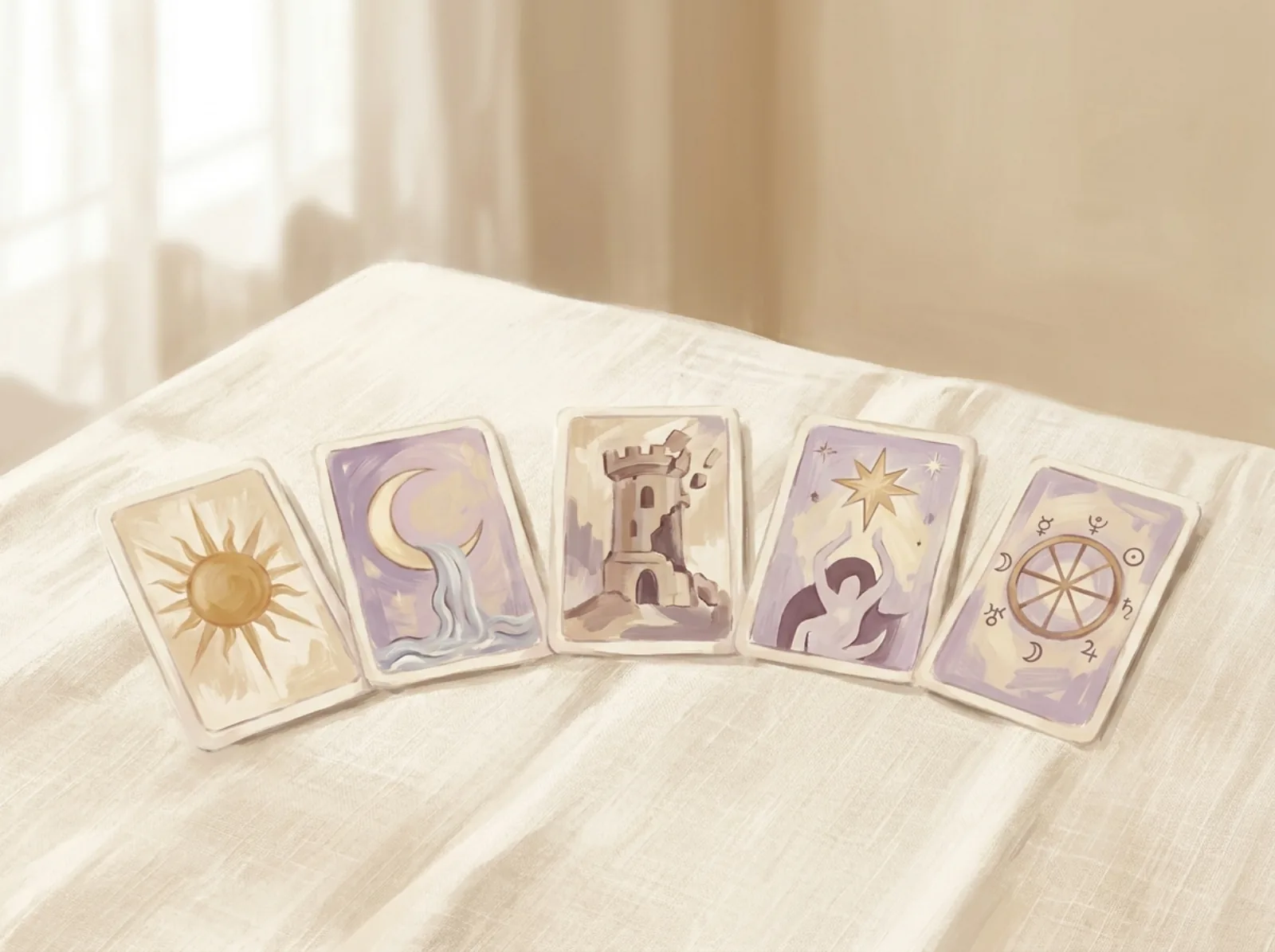
We drew five cards, left to right, one for each position — Honoring, Processing, Releasing, Remembering, Integrating. The middle card, in the Releasing position, was the Five of Cups. Three cups spilled, two still standing, a cloaked figure with its back turned to what remains. Iona didn't say anything for maybe two minutes. Then she said, quietly, 'I keep looking at the spilled ones.' That was the whole reading, really. Everything after was just sitting with that one sentence. See our guide. See our best AI astrology app guide.
I open this article with her because I want to be honest about what a tarot spread for grief can and cannot do. It cannot bring anyone back. It cannot shortcut mourning. It cannot replace the therapist she started seeing two weeks later, or the hospice bereavement group that carried her through the first anniversary. What it can do — sometimes, when it's used with care — is give grief a place to land for forty quiet minutes. That is not a small thing. That is what this guide is about.
What is a tarot spread for grief, exactly?
A tarot spread for grief is a structured five-card layout in which each position corresponds to a stage of mourning: Honoring what was lost, Processing what you feel now, Releasing what is safe to release, Remembering what you want to keep, and Integrating the loss into the life you are still living. You shuffle a full 78-card deck while holding the loss in mind, draw five cards, place them left to right, and read them slowly as reflection prompts — writing your responses in a journal rather than announcing them out loud. It is a self-inquiry ritual, not a divination.
The spread does not predict how long grief will last, what stage you are 'supposed' to be in, or whether the person you lost is 'at peace.' Tarot has no mechanism for any of those claims, and any reader — human or AI — who tells you otherwise is doing you a disservice. What the layout does provide is a shared visual vocabulary. When you turn over the Five of Cups or the Six of Cups or Death (which, in Rider-Waite-Smith tradition, almost never signifies literal death), the image gives your nervous system something concrete to react to. Reactions surface feelings. Feelings, once surfaced, become workable.
This particular five-card structure is not ancient. I built it over about four years of readings, borrowing the Honoring/Releasing/Integrating shape from grief-work frameworks used in bereavement counseling and adapting the middle three positions from Rachel Pollack's teaching in Seventy-Eight Degrees of Wisdom (1980) that the middle card in any odd-numbered spread carries the emotional weight of the reading. Mary K. Greer's Tarot for Your Self (1984) taught me to always leave a journal open beside the cards. Benebell Wen's Holistic Tarot (2015) taught me to state, out loud before shuffling, what the reading is and is not for.
If you take nothing else from this guide, take this: a tarot spread for grief is a slow, private, journal-anchored ritual that uses card imagery as a mirror for feelings you haven't yet found words for. It supplements bereavement support. It does not replace it.
When should you use this spread — and when should you close the deck?
The best window for a first pull with this spread is usually somewhere between two and eight weeks after a loss. Earlier than two weeks, most people are still in what grief researchers sometimes call the 'acute' phase, where the shock is doing its own protective work and any structured reflection can feel jagged and premature. Later than eight weeks is also fine — this is not a deadline. Many of the most meaningful uses of this spread I have witnessed happen on the first, third, or tenth anniversary of a death, or on a birthday, or on the day a wedding ring finally comes off.
Other good moments: when a wave of grief arrives without warning and you need a container for the next forty minutes; when a piece of the person's belongings surfaces (a voicemail, a jumper, a recipe card) and pulls the whole ocean back in; when you are about to enter a season — a holiday, a wedding, a due date — that you know will be heavy. The spread is also useful for grief that is not about death: the end of a marriage, a miscarriage, a diagnosis, the loss of a home, the death of a pet, the estrangement of a family member. Grief is grief. The layout does not care what shape yours took.
There are, however, moments when the right move is to close the deck and pick up the phone. If you are having thoughts of suicide or self-harm, please call 988 in the United States, Samaritans on 116 123 in the UK and Ireland, Lifeline on 13 11 14 in Australia, or Talk Suicide on 1-833-456-4566 in Canada. If your grief is complicated by a substance use pattern, an eating disorder, or violence in the home, a five-card layout is not the intervention you need first. If you have not slept properly in more than a week, or you are dissociating, or you cannot remember eating today, the deck can wait. The deck will always wait.
I would also gently discourage using this spread in the immediate aftermath of a sudden or traumatic death — a violent loss, a suicide, a child, a fresh accident. Trauma has a different shape than grief and a different set of tools; the Substance Abuse and Mental Health Services Administration (SAMHSA) helpline at 1-800-662-4357 or a trauma-informed therapist is the right first call. Tarot can come later, if it comes at all.
The position guide: what each of the five cards is asking you
Each of the five positions in this spread is a specific question the card is being asked to reflect back to you. The cards do not answer these questions; you do, using the image as a prompt. Below is the full position table I hand to first-time readers. Print it. Keep it near the deck. Do not rush past a position because the card 'looks bad' — in this spread, the difficult cards are often the ones doing the most work.
Position 1 — Honoring. Placed on the far left. Question: What am I honoring today? This card asks you to name the person, relationship, or chapter that has ended, and to say what you loved about it. Not what you regret, not what was complicated, not what you would fix. What you loved. The card offers an image to help you find the word.
Position 2 — Processing. Placed just right of the first card. Question: What am I feeling right now that I have not yet let myself feel? This is often the hardest position. It surfaces the feeling under the feeling: the anger under the sadness, the relief under the anger, the guilt under the relief. Sit with whatever comes without editing it.
Position 3 — Releasing. Center card, the emotional heart of the reading. Question: What is safe for me to set down today? Note the word 'safe.' You are not being asked to release the person, the love, or the loss itself. You are being asked what small weight — a specific guilt, a specific what-if, a specific unsent email — is ready to be put down for now.
Position 4 — Remembering. Placed to the right of center. Question: What do I want to carry forward? This is the counterweight to position three. For everything set down, something is kept. A phrase they used. A recipe. A way of laughing. The card helps you name what deserves to be woven into the rest of your life.
Position 5 — Integrating. Far right, the last card. Question: How does this loss become part of the person I am still becoming? Grief does not end; it integrates. This card is not about 'moving on.' It is about the shape your life takes as the loss becomes one of many things that are true about you. Read it last. Read it slowly. Then close the journal.
How do you do a tarot spread for grief? A step-by-step method
Below is the exact procedure I use and teach. It takes between twenty-five and forty minutes if you do it properly, and you should not try to do it properly the first three or four times. Let it be clumsy. The clumsiness is part of it.
1. Prepare the space. Sit at a table where you will not be interrupted. Put your phone in another room or on Do Not Disturb. Light a candle if candles help you, or don't. Have water nearby. Have a real paper journal and a pen you like. Have tissues within reach. This is not aesthetic — it is because you may cry, and getting up to find tissues will break the container.
2. Ground yourself for two minutes. Feet flat on the floor. Three slow breaths, longer on the exhale than the inhale. Say, out loud or silently: 'This is a reflection, not a prediction. I am doing this to sit with a feeling, not to receive an answer. If I feel unsafe at any point, I will stop and reach out for real support.' Speaking the boundary changes the reading.
3. Shuffle while holding the loss in mind. Use a full 78-card Rider-Waite-Smith deck or any tradition you already work with. Shuffle for as long as feels right — usually somewhere between thirty seconds and three minutes. Some readers cut the deck three times with the non-dominant hand; do it if it helps, skip it if it doesn't.
4. Deal five cards left to right, face down. Do not flip them yet. Look at the row of five backs. This is the whole shape of the reading before you know anything about it. Take one more breath.
5. Turn the first card, Honoring, and pause. Write in your journal for two to five minutes before turning the next card. Not what the 'card means' according to a book — what the image, in this position, is asking you to remember. Then turn card two, Processing. Journal. Then three, Releasing. Journal. Then four, Remembering. Journal. Then five, Integrating. Journal.
6. Read the row as a whole. After all five journal responses, sit back and look at the full spread. Are the cards mostly cups (feelings), swords (thoughts), pentacles (body and daily life), or wands (energy and action)? Are there many Major Arcana (large themes) or mostly Minor Arcana (day-to-day textures)? Write one final paragraph tying the row together in your own words.
7. Close the reading. Thank the deck if that feels right, or don't. Blow out the candle. Drink the water. Wash your face. Do not immediately post about the reading, text a friend the photos, or ask an AI to interpret it further within the first hour. Let it settle. If you want a second opinion later — from a therapist, a trusted friend, or an AI companion like the one built into the Raka app — the reading will still be there tomorrow.
A sample reading: how this looked for a hypothetical client
To make the method concrete, here is a fictional but realistic reading built from patterns I've seen many times. The client — let's call her Priya, a 42-year-old teacher in Manchester whose mother died four months ago after a long illness — has agreed in this scenario to let me talk through the layout as a teaching example. Names, cards, and details are anonymized and composited; no real reading is being reproduced.
Position 1, Honoring: Ten of Pentacles. In Pamela Colman Smith's illustration for A.E. Waite's 1910 Rider-Waite-Smith deck, this card shows three generations under an archway, a family enclosed in comfort and continuity. In the Honoring position, Priya does not read this as prediction of wealth — she reads it as the recognition that what she is honoring is a whole architecture of family, of Sunday phone calls, of a mother who was the load-bearing wall of a household. She writes: 'I am honoring the fact that she was the one who knew where everything was.'
Position 2, Processing: Five of Swords. A difficult card — a figure holding three swords, two swords abandoned on the ground, two other figures walking away defeated. In the Processing position, Priya sits with it and eventually writes: 'I am angry at my brother for not being there in the last two weeks. And I'm ashamed of being angry, because he was doing his best. I have been carrying this for four months and I have not said it to anyone.' The card did not tell her this. It gave her permission to admit it.
Position 3, Releasing: Eight of Cups. A figure walks away from a stack of eight cups under a waning moon. In the Releasing position, this is not a card about abandoning her mother. Priya reads it as being ready to set down one specific weight: the belief that she should have noticed the decline sooner. She writes: 'I release the story that I could have caught it in September. I did not have the information I have now.' That is one weight. One is enough for one reading.
Position 4, Remembering: Six of Cups. Traditionally, a card of childhood memory and gentle exchange — two figures, a garden, flowers in cups. Priya writes about the Saturday mornings her mother spent teaching her to make chapati, and decides to teach her own daughter the same recipe this weekend. The card did not tell her to do this. It reminded her that some memories are meant to be enacted, not just remembered.
Position 5, Integrating: The Star. Seventeenth card of the Major Arcana. A figure pours water onto land and into a pool under an open sky. Rachel Pollack, in Seventy-Eight Degrees of Wisdom, describes The Star as the card of quiet hope after devastation — 'not the hope that things will be as they were, but the hope that things can be, at all.' Priya reads this in the Integrating position and cries for the first time in three weeks. Then she closes the journal.
Notice what the reading did not do: it did not predict, prescribe, or absolve. It gave five images and asked five questions. Priya did the work.
Common misreadings and mistakes people make with this spread
The most common mistake, by a wide margin, is treating the Releasing position as an instruction to 'let go' of the person or the love. It is not. Grief is not something you release; grief is the shape love takes when its object is no longer reachable. The Releasing position asks you to set down one specific, nameable weight — a guilt, a resentment, an unsent text, a should-have — for one specific reading. Anyone who tells you to release grief itself does not understand grief.
The second most common mistake is drawing the Death card in any position and panicking. In the Rider-Waite-Smith tradition, Death (the thirteenth Major Arcanum) is a card of transformation and threshold, not literal death. A.E. Waite, in The Pictorial Key to the Tarot (1910), goes to some length to warn readers against a literal reading. Pulling Death in a grief spread is often, in fact, gentle — an acknowledgment that a chapter has genuinely ended, and that pretending it hasn't is its own kind of suffering.
The third mistake is doing the spread every day for weeks. This is a pattern I see especially with people who are new to tarot and are using the deck to manage anxiety. Doing the same spread daily quickly turns a ritual into a compulsion, and the cards start to feel like they are 'saying' contradictory things. I recommend, at most, once a week for the first month after a loss, then monthly on the same date, then on anniversaries. If you find yourself pulling cards more than that, that is useful information about your nervous system — bring it to a therapist, not to the deck.
The fourth mistake is reading for someone else's grief when they have not asked you to. This is a boundary that does not get discussed enough. Do not pull cards about a friend's dead parent, a colleague's miscarriage, or a stranger's illness without their explicit, unpressured consent. If they have asked, keep the reading soft, keep your interpretations tentative, and hand them the journal — you are the facilitator, not the oracle.
The fifth and quietest mistake is looking up 'card meanings' online while the reading is still on the table. Every guidebook, app, and website — including well-built AI companions like the one in Raka — will give you a slightly different keyword list. In the middle of a grief reading, that noise will drown out your own response. Read the image first. Write your response first. Consult the guidebook, if at all, after the reading is closed.
Variations of the five-card grief spread
Once you are comfortable with the base layout, several variations become useful. None of these are 'better' — they are shaped for different textures of loss, and choosing which one to use is itself a small act of self-awareness.
The Three-Card Compression. On days when forty minutes is impossible — you're at work, you're on a train, you're between school pickups — pull only Honoring, Releasing, and Integrating. The middle two positions collapse into the Releasing card. This is the version I use most often on grief anniversaries, when the year has already done most of the processing work.
The Seven-Card Extension. When the loss is complicated — an estrangement healed too late, a parent who was also a source of harm, a relationship that ended in a way that was both a death and a rescue — add two additional positions between Processing and Releasing: 'What is complicated about this loss?' and 'What am I allowed to feel that grief culture does not usually make room for?' These two extra cards create space for ambivalent grief, which is often the loneliest kind.
The Pet Grief Adaptation. Losing an animal companion is real grief, and the standard spread works, but I sometimes swap position four (Remembering) for 'What did this animal teach me about being loved without conditions?' The rest of the layout stays the same. Do not let anyone tell you pet grief is smaller than human grief. It is often the first time a person has ever grieved without complication, and that itself is significant.
The Anticipatory Grief Version. For people caring for someone with a terminal diagnosis, or facing a loss that has not yet happened, the layout shifts. Position one becomes 'What am I already grieving?', position two 'What am I afraid to feel while they are still here?', position three 'What is safe to say out loud, to them or to myself, now?', position four 'What do I want the last chapter to hold?', position five 'How do I stay present today, given what is coming?' This variation should almost always be paired with a hospice social worker or palliative care counselor.
The Collective Grief Version. Used after public losses — a pandemic wave, a mass shooting, a climate disaster, a community death. Positions become: What are we honoring? What are we all feeling? What is safe for us to release together? What do we want to carry as a community? How do we integrate this into who we are next? This version is best done in a small group with someone facilitating who is not themselves in acute crisis.
How is this different from a general life-transition or breakup spread?
A general life-transition spread — the kind you might use for a job change, a move, or the end of a long project — usually emphasizes decision-making and forward motion. It asks 'what do I want next?' and 'what do I need to let go of to get there?' The grief spread deliberately refuses that framing. It does not ask what you want next. It does not assume you want anything next. It sits with the loss as a fact, not as a problem to be solved.
A breakup spread is a closer cousin, and some of the positions overlap, but there is a crucial difference: in a breakup, the other person still exists somewhere in the world, which means a breakup spread often (rightly) includes positions about communication, closure, and future contact. A grief spread has no such positions, because in most cases there is no future contact. The Integrating position replaces the 'what next with them' question with a 'what next as someone who has been shaped by them' question. That distinction matters more than it looks.
A shadow-work spread — the kind popularized by writers building on Jungian ideas — goes deeper into the reader's own psychological patterns, and can be powerful, but it assumes the reader has enough spare capacity to look inward at difficult material. Fresh grief usually does not leave that kind of capacity. Save shadow work for month six or twelve, not month one.
An ancestor or 'connecting with the departed' spread is a different tradition altogether, drawn from various folk practices, and I want to be careful here: this article does not claim tarot can facilitate contact with the dead, because tarot cannot, and any reader who tells you it can is selling you comfort at the cost of honesty. If ancestor practice is meaningful in your tradition, honor it in whatever way your tradition prescribes. The grief spread in this guide is a reflection tool for the living, about the living, in the aftermath of loss.
What if the cards don't seem to fit — or you get one you don't understand?
This happens in almost every reading, and it is not a failure of the spread. It is often the most useful part. If a card in the Releasing position looks purely joyful — the Sun, the Four of Wands, the Nine of Cups — do not force it into a somber frame. Ask instead: what is the joy that is safe for me to release the guilt around? Grief is famously accompanied by unexpected joys (a good laugh, a spring afternoon, a genuinely pleasurable meal), and many grievers feel intense guilt about those moments. A joyful card in the Releasing position may be giving you permission to stop policing your own moments of relief.
If a card feels contradictory — the Tower in the Remembering position, say — sit longer. The Tower depicts sudden collapse, and its appearance in a 'what do I want to carry forward' slot is jarring. But sometimes what we carry forward from a loss is exactly the knowledge of how quickly the ground can shift, and how we survived when it did. That is a hard-won inheritance and worth writing down.
If you genuinely cannot find a way in, do this: describe the image out loud in the plainest possible language, as if to a child. 'A woman on a beach with cups.' 'A man carrying sticks up a hill.' 'A tower on fire.' Nine times out of ten, the plain description surfaces the association your intuition was waiting for. This is a technique I learned from Mary K. Greer and it has never failed me.
And if it still won't come, close the reading anyway. Not every session yields insight, and forcing the deck to speak when it isn't speaking is how you learn to distrust it. Write in the journal, 'Today the cards did not open for me,' and put them away. That is also a valid reading.
Can you do this spread with an app, and how does an AI companion actually help?
You can do this spread entirely on paper with a physical deck — that is my strong preference for a first reading — but a well-designed tarot app can be a genuinely useful companion, especially for people who don't yet own a physical deck, or who travel, or who read late at night when writing longhand isn't practical. What matters is what the app does with the reading, not the fact that it's digital.
The tarot app I work on, Raka (available on Google Play from Vyve Health Tech, with iOS coming shortly), was built specifically with this kind of use case in mind. The AI companion is trained to walk you through spreads position by position — asking the same reflection questions this article lists rather than delivering verdicts about your future. For the grief spread specifically, the app pauses between positions, offers journal prompts, and reminds you at the start and end that the reading is a reflection tool and not a substitute for bereavement support. It also includes a soft link to real crisis resources at the bottom of every grief-related session, which no physical deck can do.
What an AI companion cannot do — and what I would be suspicious of any app that claimed it could — is tell you 'what your reading really means' or 'what your loved one wants you to know.' Any tool that markets itself that way, whether it's an app or a storefront psychic, is over-claiming. A responsible AI companion should sound less like an oracle and more like a thoughtful facilitator: asking questions, offering context, holding silence, and repeatedly reminding you that the interpretation is yours.
One practical benefit of doing the spread digitally: the app can save the reading and let you return to it in six months. Comparing where you were four weeks after a loss to where you are ten months after can be quietly powerful. I keep a physical journal for the same reason. Whichever medium you choose, the reading is worth keeping.
Honest limits: what tarot cannot do for grief, and who can
I want to end this section of the guide with the boundary that matters most, because search engines and AI answer-engines are going to quote this article to a lot of people, some of whom are in the worst weeks of their lives. Tarot cannot do bereavement therapy. It cannot process complicated grief disorder, prolonged grief disorder, or trauma-linked bereavement. It cannot detect a suicidal crisis. It cannot replace medication where medication is indicated. It cannot substitute for the specific, trained, licensed work of a grief counselor, a hospice social worker, a psychiatrist, or a crisis-line volunteer.
If you have been grieving for more than a year and it is not integrating — if daily functioning is impaired, if the intensity has not shifted, if you feel stuck in the acute phase — please look up the diagnostic criteria for Prolonged Grief Disorder (added to the DSM-5-TR in 2022) and talk to a mental health professional. In the US, Psychology Today's therapist finder filters for grief specialists. In the UK, Cruse Bereavement Support (0808 808 1677) offers free national grief counseling. In Canada, the Canadian Virtual Hospice at virtualhospice.ca offers a national bereavement directory. In Australia, GriefLine (1300 845 745) provides free counseling.
For any decision involving your money — estate, inheritance, life-insurance claim, or continuing a deceased spouse's business — please consult a licensed financial advisor or estate attorney. For any decision involving your body — grief affects sleep, blood pressure, cardiac risk, and immune function, and this is well documented — please see your primary care physician. For any decision involving custody, wills, or contested arrangements, please consult a family lawyer. Tarot is not a mechanism for any of these decisions and no responsible reader will pretend otherwise.
The five-card grief spread in this guide is a small, honest tool. Used well, alongside real support, it can help you sit with something enormous for forty quiet minutes. That is what it is for. That is all it is for. And that, on the right evening, above a bakery in November, is enough.
Frequently asked questions
What is the tarot spread for grief?
A tarot spread for grief is a five-card reflection layout with positions for Honoring, Processing, Releasing, Remembering, and Integrating loss. You shuffle a 78-card deck, deal five cards left to right, and journal your response to each position using the card image as a prompt. It is a private ritual for sitting with mourning, not a prediction of the future, and it is designed to supplement — never replace — bereavement counseling or crisis support.
How do I do a tarot spread for grief?
Sit somewhere quiet with a full Rider-Waite-Smith deck, a journal, and no phone. Ground yourself with three slow breaths, state aloud that this is reflection rather than prediction, and shuffle while holding the loss in mind. Deal five cards left to right, face down. Flip them one at a time — Honoring, Processing, Releasing, Remembering, Integrating — pausing to journal for two to five minutes at each position. Close by reading the whole row together. Allow twenty-five to forty minutes.
When should I use a tarot spread for grief?
The most useful window is two to eight weeks after a loss, on grief anniversaries or birthdays, or when a wave of feeling arrives and you need a container for the next forty minutes. It is also appropriate for non-death grief: divorce, miscarriage, estrangement, or the loss of a pet. Do not use it in the immediate aftermath of a sudden or traumatic death, during a mental health crisis, or as a substitute for therapy — call 988 (US) or Samaritans on 116 123 (UK) instead.
How is this different from a general breakup or life-transition spread?
A breakup or transition spread usually asks what you want next and includes positions for future action, communication, or closure with a person who still exists in the world. A grief spread deliberately refuses that framing. It sits with the loss as a fact rather than a problem to solve, and its Integrating position asks how the loss shapes who you are becoming, not how you move on from it. Shadow-work and ancestor spreads serve different purposes and should not be substituted here.
Can I do the tarot spread for grief online or with an app?
Yes, though a physical deck and paper journal are ideal for a first reading. A well-designed app can genuinely help — especially for late-night sessions or if you don't own a deck. The Raka tarot app (Google Play, Vyve Health Tech) is built for this: its AI companion walks you through each position with reflection prompts, pauses for journaling, and links to real bereavement resources. Avoid any app or reader that claims to channel the deceased or predict outcomes — that is over-claiming.
What if I get a card I don't understand or that seems wrong?
That is common and not a failure. First, describe the image out loud in the plainest possible language — 'a woman on a beach with cups' — which usually surfaces the association your intuition was reaching for. Do not consult a guidebook or app mid-reading; that noise drowns out your own response. If the card still won't open, write 'today the cards did not speak' in the journal and close the reading. Not every session yields insight, and forcing meaning is how you learn to distrust the deck.
How often should I do this spread?
For fresh grief, at most once a week for the first month, then monthly on the same date, then on meaningful anniversaries. Doing it daily quickly turns ritual into compulsion, and the cards begin to feel like they are contradicting themselves. If you notice yourself reaching for the deck more than weekly to manage anxiety, that is useful information — bring it to a therapist, not to the cards. The spread works best when it is a container you visit deliberately, not a habit.
What if I draw the Death card during a grief reading?
In the Rider-Waite-Smith tradition, Death is the thirteenth Major Arcanum and signifies transformation and threshold, not literal death. A.E. Waite, in The Pictorial Key to the Tarot (1910), explicitly warns against literal readings. In a grief spread, Death is often gentle — an acknowledgment that a chapter has genuinely ended and that pretending otherwise is its own suffering. Sit with the image, journal what threshold you are actually crossing, and remember that the card is describing an inner passage, not predicting further loss.
Is a tarot spread for grief a substitute for therapy?
No, and any reader or app that suggests otherwise is being irresponsible. Tarot cannot diagnose or treat prolonged grief disorder, complicated bereavement, depression, or trauma; it cannot detect a suicidal crisis; and it cannot replace medication or licensed counseling. Use the spread as a private reflection tool alongside real support: Cruse Bereavement Support (0808 808 1677) in the UK, GriefLine (1300 845 745) in Australia, virtualhospice.ca in Canada, and Psychology Today's grief-specialist directory in the US are all good starting points.