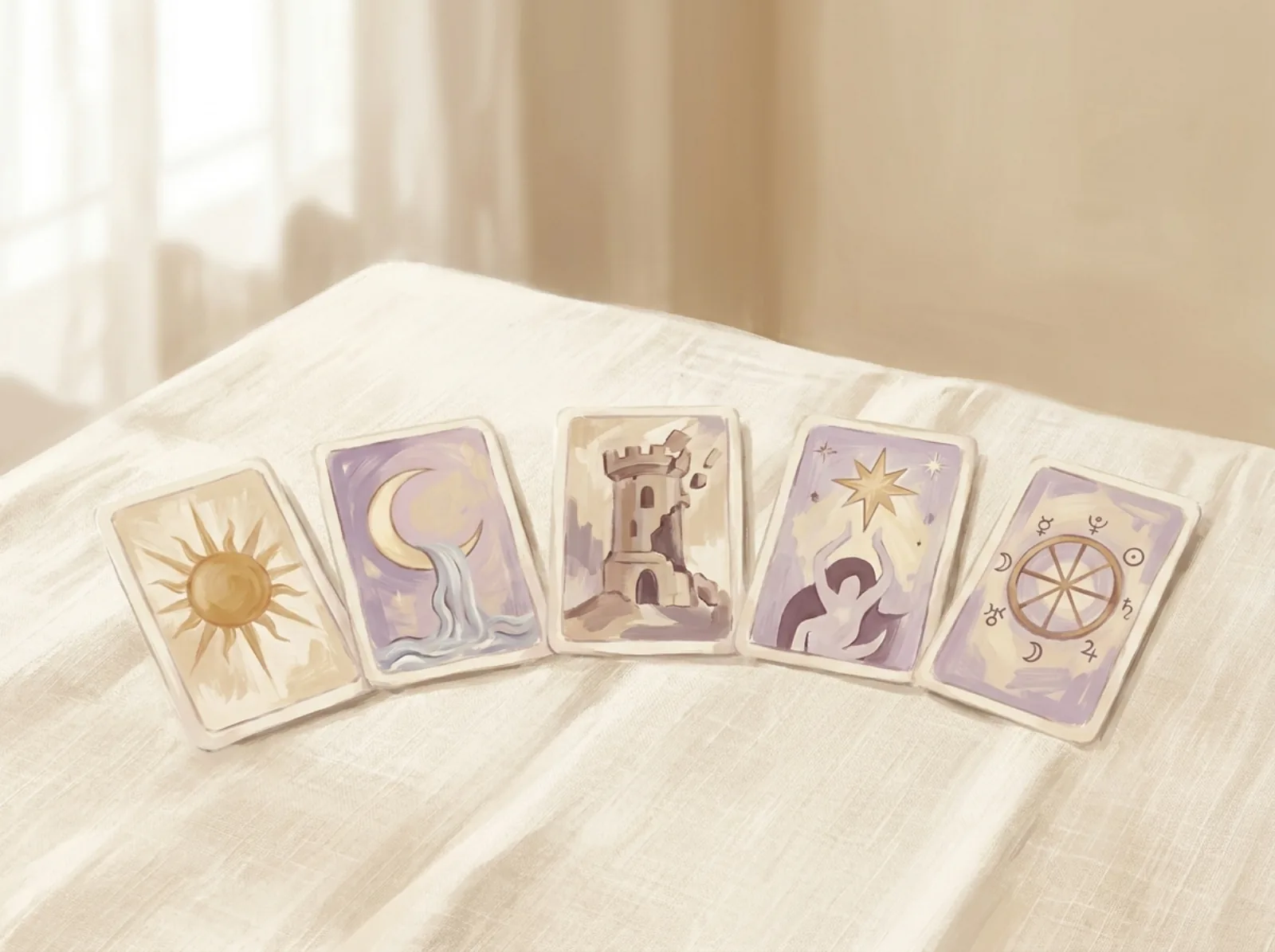
The reading that convinced me one card was enough
The first time I trusted a single card, I was sitting on the floor of a walk-in wardrobe with a client I will call Nora, who had booked a full Celtic Cross to decide whether to leave her marriage. We were forty minutes in, ten cards on the carpet, and she was crying because the reading had given her too much to hold. She kept asking me which card was the answer. There was no answer. There were ten cards, and ten cards was a mistake for that day. Part of our tarot reference library. Part of our complete tarot spread library. Explore the full library. Part of our astrology library.
I asked her to shuffle again. I asked her to draw one card. She drew the Two of Swords — a blindfolded woman holding two crossed blades under a crescent moon, refusing to look. She started laughing and crying at the same time and said, that's it, I already know, I just don't want to look at it yet. She didn't need ten cards. She needed one honest mirror and permission to sit with it. See our best AI tarot app 2026 guide for a full breakdown.
That is the case for the one card tarot pull, and it is why I have used it as my own daily practice for nine years. A single card is not a lesser reading. It is a different tool — smaller, sturdier, more repeatable, more honest. It cannot construct a story you want to hear across ten positions. It just shows you a picture and asks what you see. See our guide. See our best natal chart app guide.
This guide is about that practice. How to do it, when to use it, when not to, what the classic Rider-Waite-Smith imagery is actually pointing at, and how to build a daily draw into a ritual you keep past the third week of January. I will use the tradition Arthur Edward Waite and Pamela Colman Smith set down in 1909, because that is the deck most modern readers learn on, and because its imagery was designed to work exactly this way — one image, read like a small painting.
What is a one card tarot pull, in plain language
A one card tarot pull is a tarot practice in which you shuffle a deck, hold a question or theme in mind, and draw a single card as a reflection prompt. That is the whole spread. There are no positions, no cross, no timeline. The card is not a prediction. It is a mirror the size of a playing card, and its job is to give you something specific to think about for the next few minutes, hours, or day.
In the Rider-Waite-Smith tradition — the illustrated deck first published in 1909 by A.E. Waite and Pamela Colman Smith, and reissued by U.S. Games Systems since 1971 — every card is a small scene. The Three of Cups shows three women raising goblets at a harvest. The Eight of Pentacles shows an artisan bent over his workbench. The Tower shows lightning striking a fortified building and two figures falling. These are not abstract symbols; they are pictures a beginner can read.
That readability is why the one card pull works. You do not need to memorise seventy-eight card meanings before you can sit with a single image and ask yourself what it is showing you. You can start today, with the deck you got as a birthday present that is still in the box, and you can be doing meaningful daily practice within a week.
The practice has other names. Some readers call it a daily draw, a card of the day, a morning card, a check-in card, or a pip. In app form — Raka, for example, offers a daily card view with an AI companion that walks you through the traditional imagery — it is usually called a daily card or daily pull. All of these describe the same underlying spread: one card, one intention, one honest look.
When is the best time of day for a daily draw
The best time of day for a daily draw is whichever slot you will actually keep. That sounds like a dodge and it is not — most abandoned tarot practices fail because they were scheduled at aspirational times rather than realistic ones. The person who plans a 6 a.m. shuffle at their meditation altar usually pulls three cards on a Sunday and none by February. The person who pulls one card at the kitchen table while the coffee brews is still doing it in April.
That said, morning and evening each have distinct character. A morning pull sets an intention: it asks what do I need to notice today, what energy am I carrying in, what would I be wise to watch for. The card becomes a lens you carry through the day, and you often find its imagery echoing back at you in the afternoon — a Ten of Wands morning becomes obvious when you are carrying a laptop, a tote bag, and two mugs at 4 p.m.
An evening pull, by contrast, is a review. You are asking what was actually true today, what did I miss, what showed up that I should have seen. Evening pulls are more honest than morning pulls, because you have data. They are also better for beginners, because the card has something concrete to attach to — you can point at a Five of Cups and say, yes, I was sulking about the meeting instead of noticing the two cups still standing.
Some readers do both. A morning card sets the intention; an evening card reviews the day. Two draws, thirty seconds each. If you journal, the pair becomes a very small daily practice with real structure: intended lens, actual lens, what I learned. It is more powerful than a weekly ten-card reading, and it takes less time than doom-scrolling a news app before bed.
How to do a one card tarot pull, step by step
Here is the method I teach. It takes under five minutes once you have done it a few times, and the whole thing fits on a Post-it. Do not add ceremony you will not sustain; the ritual is the daily repetition, not the props.
1. Choose a question or a theme. It can be as specific as how should I approach the 2 p.m. meeting, or as open as what do I need to notice today. Vague questions produce vague readings; specific questions produce specific ones. If you cannot think of anything, use what am I not seeing right now — it is my most reliable prompt.
2. Shuffle the deck while holding the question in mind. There is no wrong way to shuffle. Overhand, riffle, or a slow ground-and-mix on the table all work. Shuffle for as long as feels right — most readers stop when the deck feels settled, which is usually thirty to sixty seconds. 3. Cut the deck, if you like. Some readers cut with the left hand into three piles and reassemble; some do not cut at all. Both are traditional.
4. Draw the top card and place it face up in front of you. If it comes out reversed (upside down), leave it reversed only if you already read reversals; otherwise, turn it upright. Reversals are a technique to add later, not a requirement.
5. Look at the card for at least twenty seconds before reading any meaning. Note the first three things you see: a figure, a gesture, a colour, a weather condition, the direction someone is facing. Say them out loud if you can. This step is the whole point; skipping it turns tarot into a lookup table.
6. Now read the traditional meaning — from A.E. Waite's Pictorial Key to the Tarot, Rachel Pollack's Seventy-Eight Degrees of Wisdom, Benebell Wen's Holistic Tarot, or a trusted app companion such as the one built into Raka. Notice which parts of the traditional meaning land for your question and which do not.
7. Write one sentence. Not a paragraph — one sentence, in a small notebook or a notes app, dated. The sentence combines the card, your question, and your immediate response. Example: Nine of Pentacles for how am I doing today — reminded me that I have quietly built something good and I keep refusing to enjoy it. That is the whole practice.
How to interpret a single card versus a spread of many
Reading one card is not a smaller version of reading many cards. It is a different discipline. In a Celtic Cross, each position tells the reader what the card means — this one is the situation, this one is the obstacle, this one is the outcome. The positions do the interpretive heavy lifting, and the reader combines them into a story. In a one card pull, there are no positions to lean on. The card must be read on its own image and on its relationship to the question.
That means image-first reading matters more in a single-card practice. You cannot outsource meaning to the position label. You have to look at the card. Waite and Smith deliberately built the minor arcana as scenes rather than pips for exactly this reason — Smith's illustrations were meant to give a reader something to describe. The Five of Pentacles shows two figures walking past a stained-glass window in the snow. The card is telling you a story before any book gets involved.
A useful trick: describe the card as if you were describing a painting to someone who cannot see it. Who is in it, what are they doing, what is the weather, what is the mood, where is the light. Then apply your description to the question. If you asked what am I avoiding and drew the Two of Swords — blindfolded, arms crossed, back to the water — your description already contains the answer. That is the answer. The book meaning will confirm it.
The one card also disciplines you to accept a partial view. A spread of many cards flatters the reader with the sense that they are getting the whole picture. A single card admits, honestly, that you are getting one angle. That honesty is a feature, not a bug. Most of the time in life you are also getting one angle. The card teaches you to work with what you have.
When a single card feels too thin, that is real data, not a failure of the spread. It usually means the question is too big for one card, and you should either narrow the question — from what should I do about my career to what should I notice about today's meeting — or use a three-card spread instead. Choosing the right spread size for the question is part of the craft.
A position guide for the single card
A one card pull has, technically, no positions. But in practice, the framing you bring to the shuffle acts as a position, and choosing that framing well is what makes daily draws feel useful instead of vague. Below is a reference table of the most common single-card framings I use with clients, and what each one is best for.
| Framing | Question you hold | Best used for | |---|---|---| | Card of the day | What do I need to notice today? | Morning practice, general check-in | | Evening review | What was true today that I missed? | Journaling before bed, week reviews | | Energy check | What is the mood I am carrying right now? | Mid-day reset, before a meeting | | Blind spot | What am I avoiding looking at? | When you feel stuck or defensive | | Approach | How should I approach this specific situation? | Before a hard conversation or decision | | Message from the situation | What is this situation trying to teach me? | For recurring problems that will not resolve | | Permission slip | What am I allowed to let go of today? | Perfectionism, over-scheduling, guilt | | Weekly theme | What is the through-line of this week? | Sunday evening, monthly on the new moon |
Notice that none of these are prediction framings. There is no what will happen tomorrow, no will he call me, no will I get the job. Those questions are not wrong to ask, but they are not what a single card is best at. A single card is best at surfacing your own current relationship to something — your assumptions, your avoidance, your hopes, the story you are already telling yourself. It is a mirror for internal weather, not a satellite for external forecasts.
In practice, most daily-draw readers rotate through two or three of these framings. Mine are card of the day for weekday mornings, blind spot for Wednesdays when the week is halfway done and I have usually stopped paying attention, and weekly theme for Sunday evenings. Pick two you will use, and drop the rest. A short list you keep is worth more than a long list you forget.
A sample reading: how I would walk a client through this
Let me walk you through a fictional but grounded example so the method is concrete. The client — I will call her Rowan — is a 34-year-old graphic designer in Toronto who has been offered a promotion to art director. She has one week to decide. She books a fifteen-minute session because she does not want a full reading; she wants a check-in.
I ask her what she wants the card to answer. She says something like, should I take the job. I gently redirect. Tarot is not for making the decision — it is for surfacing what you are actually thinking about the decision. We rephrase together: what am I avoiding looking at as I decide about this promotion. She likes that better. She shuffles for about forty seconds, cuts the deck into three piles with her left hand, reassembles, and draws the top card.
It is the Four of Cups. A young man sits under a tree, arms and legs crossed, looking sullenly at three cups on the ground in front of him while a fourth cup is offered to him by a hand from a cloud. He is not looking at the fourth cup. He may not even have noticed it. In Waite's Pictorial Key, the keyword is discontent — a moment of dissatisfaction with what one has, a refusal of what is being offered.
I ask Rowan to describe the card before I tell her the book meaning. She says, he looks like he already thinks he's above this. He's sulking. She laughs, then goes quiet. She says, oh — I have been walking around for two weeks acting like this promotion is beneath me, and I think that is because I am scared I will fail at it, not because it is actually beneath me.
That is the reading. The card did not tell her to take the job. It surfaced the story she was already telling herself about the job and asked her whether that story was honest. She left the session still undecided, but decided about a different thing — she was going to stop pretending disinterest and admit fear. That is what a single card is for.
For the record: she took the job. That is not the point. She could have turned it down for good reasons and the reading would have been just as useful. The card was a mirror, not a compass.
Common mistakes and misreadings
The most common mistake in a one card pull is treating the card as a verdict. The Tower does not mean disaster is coming. The Death card does not mean anyone is dying. The Ten of Swords does not mean betrayal is imminent. These cards mean something is ending, something is changing, something is being over-dramatised in your own head. Read the picture, read the mood, read the direction the figure is facing. Do not read the card as a headline.
The second most common mistake is redrawing. You pull a card, you do not like it, you shuffle again and pull another. This is called question-shopping, and it dissolves the entire practice. The card was honest the first time. The second card is not more accurate; it is more comfortable, which is not the same thing. If you routinely dislike the first card, that is data about you, not about the deck.
The third mistake is over-elaborating on a small card. Not every card is a life-changing message. The Six of Wands might just mean you should enjoy the small win at work today. The Page of Cups might just mean pay attention to a text you have been ignoring. Small cards are allowed to mean small things. Assigning cosmic weight to every draw is exhausting and quickly makes the practice feel like homework.
A fourth mistake — subtler — is looking up the meaning before looking at the card. Apps and books are a wonderful backstop, but if you go to the meaning first, you skip the reflective step that makes the practice worthwhile. Look at the picture first. Say what you see. Then check the meaning. The gap between what you saw and what the book says is where the learning happens.
Finally: do not use a daily draw to diagnose or treat mental health, medical conditions, legal problems, or financial decisions. Tarot is a tool for self-reflection and creative introspection. It is not a substitute for a licensed therapist, doctor, lawyer, or financial advisor. If a draw keeps surfacing serious distress — hopelessness, panic, obsessive thoughts — that is a signal to talk to a professional, not to keep pulling cards until you feel better.
When you should not use a one card tarot pull
A one card pull is my most-used spread, but there are questions it is genuinely bad at. Knowing when not to use it is as important as knowing how to use it — otherwise you end up trying to read a single card as if it were ten, and the reading collapses under weight it was not built to carry.
Do not use one card for questions that require contrast. Should I stay or should I go, is he honest or is he lying, is this the right industry or the wrong industry — these are questions with two sides, and a single card cannot easily represent both. Use a two-card or three-card spread and let each position hold one side of the tension. The card will feel much clearer when it has a partner to be compared with.
Do not use one card for questions that require timeline. When will this happen, what happens next, how will this unfold over the next six months — these want a past-present-future or a monthly spread. A single card cannot represent progression; it is a photograph, not a film. Asking a photograph to show you motion is the wrong request.
Do not use one card for compound questions. What is happening with my relationship, my job, and my family right now is three questions in a trench coat, and a single card will collapse them into an unhelpful blur. Break the question into its parts and pull one card for each, or use a three-card spread with each position assigned to one domain.
And do not use one card as a substitute for talking to someone who can actually help. If you find yourself pulling cards about a persistent panic response, a suicidal thought, a legal notice, or a medical symptom, put the deck away and call a professional. In the US and Canada, 988 reaches suicide and crisis lifelines. In the UK, Samaritans is 116 123. In Australia, Lifeline is 13 11 14. A card is a mirror; it is not a hand to hold.
Variations of the one card pull
Once the basic daily draw is stable, most readers naturally branch into small variations. Here are the ones I find most useful, all still built on a single card.
The two-question single card. You pull one card and ask it two questions in sequence — first, what am I bringing to this situation, then, what does the situation want from me. Same card, two lenses. The card often shifts meaning between the two readings, which is instructive. This is Mary K. Greer's territory; her 1984 book Tarot for Your Self treats the deck as a dialogue partner rather than an oracle, and this variation flows directly from that framing.
The clarifier. You pull one card, sit with it for a full minute, and only if it is genuinely opaque do you pull a second card as a clarifier — never a third. The clarifier is not a redraw and not a vote; it is a second angle on the same question. Some traditional readers frown on clarifiers because they can slide into question-shopping. Used sparingly, they are fine.
The seven-day card. You draw one card on Sunday for the whole week ahead. You keep it on your desk or your phone lock screen. Each evening, you note one thing that echoed the card that day. On the following Sunday, you review the seven notes together. This is a beautiful way to slow tarot down and to notice how a single image can play out across a week of real life.
The moon-cycle card. You draw one card at the new moon and one at the full moon — two draws a month. This suits people who like the natural rhythm of lunar cycles but find daily practice too dense. It also pairs well with journalling that you already do around the new and full moon, if that is a rhythm you keep.
The question-first pull. Instead of choosing a framing before you shuffle, you shuffle first and let a question surface as you shuffle. When a question has taken clear shape in your mind, you stop shuffling and draw. This is Benebell Wen's suggestion in Holistic Tarot (2015) — she treats the shuffle itself as part of the divinatory act, and the emergent question as more honest than one you arrived with.
Journaling with a single card
The single sentence I mentioned earlier is the minimum. If you want more, the following journaling template takes about five minutes and turns a daily draw into a genuinely reflective practice. Do it in whatever medium you already use — a leather notebook, a Notes app, an Obsidian file, or an app like Raka that keeps daily draws searchable.
Line one: date, card name, question. Example — 8 August, Nine of Pentacles, what am I not letting myself enjoy.
Line two: describe the picture in one sentence, as if to someone who has never seen the card. Example — a woman in a garden of ripe grapevines, one gloved hand out for a small falcon, alone and clearly at ease.
Line three: what part of that description hooks you today. Example — alone and at ease. I keep making my own solitude sound like a problem when it is actually the whole point. Line four: one action for the day. Example — take the walk without a podcast.
Once a week — Sunday evening works well — read the seven entries in a row. Patterns emerge that no single day would show you. You notice that the same card returned three times, or that four of the seven cards were cups, or that every morning card was about pausing and every evening card was about doing more. That weekly pattern is the real reading. The daily pulls were the raw data.
This is where an app helps. A physical journal makes the daily practice tactile and lovely; a digital journal makes patterns searchable. Both are fine. Raka's daily-card view keeps a running log with the card image, your notes, and the traditional meaning side by side, and its AI companion can walk you through the imagery of a card you drew six months ago that suddenly seems relevant again. I use paper on the good weeks and my phone on the busy ones. The point is that you keep the record at all.
How the one card sits inside the wider tarot tradition
The daily draw is not new. Readers have used single cards as brief consultations for as long as there have been playing-card decks in Europe, and the practice predates tarot itself — cartomancy with ordinary playing cards was widespread in eighteenth-century France well before Etteilla published his tarot manuals. The modern one card pull, though, is a specifically twentieth-century practice, and it is inseparable from the illustrated Rider-Waite-Smith deck.
A.E. Waite's 1910 Pictorial Key to the Tarot describes the cards as pictures a reader is meant to look at, not codes a reader is meant to decrypt. Pamela Colman Smith illustrated all seventy-eight cards with scenes rather than pips, and that decision — arguably the single most consequential design choice in modern tarot — is what makes single-card reading possible for beginners. You can pull one Smith card and read it without having memorised a book. That is not true for older Marseille-style decks with abstract minor arcana.
Rachel Pollack's Seventy-Eight Degrees of Wisdom, first published in 1980 and still the standard modern text, treats each card as a small essay. Her writing gives you permission to read a single card slowly, on its own, without a spread. Mary K. Greer's Tarot for Your Self (1984) explicitly encourages daily one-card practice as a way to build fluency with the deck. Benebell Wen's Holistic Tarot (2015) is more encyclopedic but returns repeatedly to the daily draw as the foundation practice.
Reading these authors in sequence — Waite for the pictures, Pollack for the meaning, Greer for the practice, Wen for the reference — is the most reliable curriculum I can recommend for a serious daily reader. All four are in print, all four are cited by professional tarotists working today, and all four treat the one card pull as a foundational practice rather than a training-wheels version of a bigger spread.
The market has grown up around that practice. IBISWorld's 2023 industry report put US psychic services — a category that includes tarot, astrology, and related mystical services — at roughly $2.3 billion in annual revenue. Statista tracks steady growth in spiritual and astrology apps globally. Pew Research has repeatedly found that around 30 percent of US adults believe in astrology, with belief higher among women and adults under 50. Tarot is a smaller slice of that market than astrology, but the shape is the same: interest is rising, apps are the primary discovery surface, and the one card daily draw is by a wide margin the most-performed spread across those apps.
Using an app for your daily draw
Physical decks are wonderful. If you have one, use it. But if you do not, or you travel, or you are learning and want a companion to walk you through the imagery, an app is a legitimate way to do this practice. There is nothing about the shuffle that requires paper cards; the reflection is what matters.
A good tarot app should do a few specific things. It should show the traditional Rider-Waite-Smith imagery in a size you can actually look at — not a thumbnail. It should give you the traditional meaning, ideally with attribution to a real source. It should let you write notes and save them to a searchable journal. And it should stay out of your way — no push notifications begging you to buy premium meanings, no anxiety-inducing predictions dressed up as guidance.
Raka, the app I edit for, was built around exactly the daily-draw pattern this guide describes. You pull one card a day. The card view shows the classic Smith illustration, the Waite-based keywords, and an AI companion you can ask questions to — including questions about the imagery, about how a card relates to a specific situation, or about how today's card connects to one you drew last week. Notes are saved and searchable. The practice stays yours; the app is a workbench.
That said, an app cannot fix a lazy practice. If you tap the button and read the auto-generated meaning without ever looking at the picture or asking yourself a question, the app is doing the wrong work. Use whatever tool you use — paper or pixel — to slow down for two minutes and be honest. That is the whole spread. The tool is not the point; the daily two minutes are.
A four-week plan to build the habit
If you want to actually build a daily draw practice rather than read about one, here is the exact protocol I give clients. It is small on purpose. Ambitious plans fail.
Week one: one card a day, morning only, no journal. Look at the card for twenty seconds. Say one sentence out loud about what you see. That is the whole task. Do not read a book meaning yet. The point of week one is to learn to look.
Week two: same, but add the book meaning after your twenty-second look. Use one source — pick either Waite, Pollack, or a trusted app companion — and stick to it for the whole week. Notice the gap between what you saw and what the book says. Do not resolve the gap; just notice it.
Week three: add a one-sentence written note per day. Date, card, one sentence. Nothing more. On Sunday, read the seven sentences in one sitting. Notice any pattern. Do not force a pattern; just look.
Week four: add an evening card — one card, one sentence, dated. You are now pulling two cards a day, journaling two sentences a day. That is roughly four minutes of practice, and it is the ceiling I recommend for a sustainable long-term daily draw. Do this for the rest of week four, then decide what shape you want your practice to have from here.
By the end of the four weeks, you will know whether daily tarot is your practice or not. It is fine if it is not. Some people are calmer with a weekly draw or a moon-cycle draw. Some people find that the practice slides into the background of their morning routine and quietly stays there for years. Both outcomes are valid. What is not valid is buying six decks in the first month and then never pulling a card. Start with the one card. Start today. That is the whole tradition.
Frequently asked questions
What is the one card tarot pull?
A one card tarot pull is a tarot practice where you draw a single card from a shuffled deck to serve as a focused reflection prompt for a day, a decision, or a specific question. It is the simplest and most repeatable spread in tarot, prized because a single image is easier to sit with than a sprawling layout. In the Rider-Waite-Smith tradition it is often used as a daily card, a morning check-in, or an evening review, and it is treated as a mirror for self-reflection rather than a prediction of the future.
How do I do a one card tarot pull?
To do a one card tarot pull, pick a clear question or theme (for example, what do I need to notice today), shuffle your deck while holding that intention, cut it if you like, and draw the top card. Turn it face up, look at the image before reading any book meaning, and note the first three things you see — a figure, a gesture, a colour. Read the traditional keywords, then journal one sentence about how the card lands for the question you asked.
When should I use a one card tarot pull?
Use a one card tarot pull when you want a small, honest prompt rather than a full narrative — a morning intention, an evening review, a quick check on your mood, or a nudge before a meeting or difficult conversation. It is ideal for daily practice, for beginners learning the deck, and for readers who feel overwhelmed by larger spreads. Skip it when a question truly needs contrast, timeline, or several viewpoints; those questions belong in a three-card or Celtic Cross spread.
How is the one card tarot pull different from a three-card spread?
A one card tarot pull gives you a single image to sit with, while a three-card spread gives you a small story — usually past/present/future, situation/action/outcome, or mind/body/spirit. The one card is a mirror; the three card is a sentence. Use one card for daily practice, mood checks, and beginner learning. Use three cards when you need context, contrast, or a sense of movement over time. Both are valid; the one card is simply the more sustainable daily habit.
Can I do the one card tarot pull online or with an app?
Yes, a one card tarot pull works well online or in an app because the practice is about the reflection, not the physical cards. Apps like Raka let you draw a daily card, save it to a journal, and ask an AI companion to walk you through the imagery and traditional meaning of the Rider-Waite-Smith deck. That is genuinely useful for beginners and for anyone who wants their daily draws searchable later. A physical deck is lovely, but not required — the honesty of your reflection is what carries the practice.
What if I get a card I don't understand?
If you draw a card you don't understand, stop reading meanings for a moment and describe the picture out loud — who is in it, what they are doing, what the weather looks like, what mood you read from their posture. Then check one trusted source such as A.E. Waite's Pictorial Key or Rachel Pollack's Seventy-Eight Degrees of Wisdom. Write down both the traditional meaning and your gut response. Confusion often clears within a week as the same card returns in different contexts.
How often should I do this spread?
Most daily-draw practitioners pull one card each morning or each evening, five to seven days a week, and review the week on a Sunday. Once a day is plenty; more than that tends to dilute the practice and encourage question-shopping until you get the answer you want. If you miss a day, skip it rather than pulling two. The point of a one card tarot pull is repetition — a small ritual you actually keep beats an ambitious one you abandon by February.
Is a one card tarot pull suitable for serious decisions?
A one card tarot pull is suitable for reflecting on a serious decision, but not for making one. Use the card to surface your assumptions, fears, and hopes about the choice — what am I avoiding, what am I hoping for, what would I do if I trusted myself. For decisions with medical, legal, financial, or mental-health stakes, consult a licensed professional. Tarot is a tool for self-reflection and creative introspection; it is not a substitute for therapy, legal counsel, or a doctor.