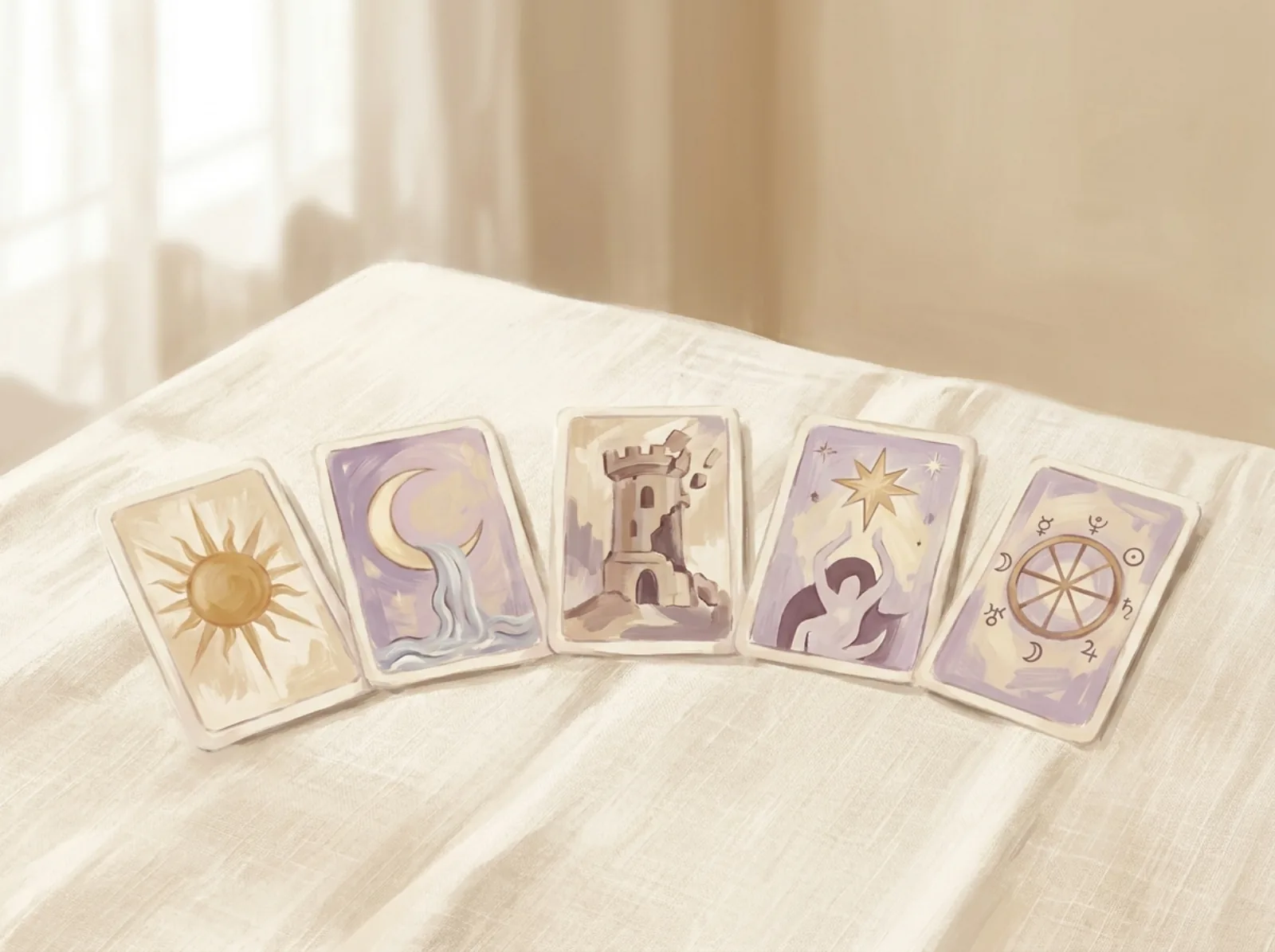
What The Moon tarot card actually means
The Moon is the eighteenth card of the Major Arcana, numbered XVIII, and it sits deep in what most tarot writers call the Fool's night journey. By the time you reach The Moon in the traditional sequence, you have already passed through the fire of The Tower and the hope of The Star. The Moon is where hope meets the unconscious. It is the card of things half-seen. Part of our tarot library library.
At its core, The Moon is about the gap between what is actually happening and what your mind is telling you is happening. That gap can be filled with intuition, and it can just as easily be filled with fear. Part of the work of this card is learning which of those two is speaking to you at any given moment. Most beginners assume one; experienced readers know it is almost always both. Try our 3 Card Tarot Spread guide. Try our Career Tarot Spread guide. Try our Celtic Cross Tarot Spread guide. Try our Decision Tarot Spread guide. Try our Horseshoe Tarot Spread guide. Try our Love Tarot Spread guide. Try our One Card Tarot Pull guide.
In my experience with clients, The Moon rarely shows up to warn about external betrayal. It shows up when someone is refusing to name something they already sense. A relationship that feels off. A job offer that looks perfect on paper. A friendship that has quietly become one-directional. The Moon is the pause before you finally say it out loud. Try our Pentagram Tarot Spread guide. Try our Relationship Tarot Spread guide. Try our Shadow Work Tarot Spread guide. Try our Situation Action Outcome Spread guide. Try our Tarot Spread For Anxiety guide. Try our Tarot Spread For Beginners guide. Try our Tarot Spread For Clarity guide.
So when this card lands in your spread, resist the urge to demand a clean prediction. The Moon is not a card of clarity. It is a card that asks you to sit with uncertainty long enough for the real question to surface. That reframe alone changes how usefully you can work with it. Try our Tarot Spread For Grief guide. Try our Tarot Spread For Manifestation guide. Try our Tarot Spread For Self Love guide. Try our Yes No Tarot Spread guide.
Rider-Waite-Smith imagery: what you are actually looking at
The version of The Moon most readers know was illustrated by Pamela Colman Smith in 1909, commissioned by Arthur Edward Waite for what is now called the Rider-Waite-Smith deck. Smith was a working artist and theater designer, and her card is composed like a stage set. Foreground, middle ground, background, symbolic sky. Every element earns its place.
In the foreground, a small crayfish or lobster crawls out of a pool of water. This is the oldest part of the psyche, what modern therapists might loosely call the limbic brain, emerging from the unconscious. Behind it, a dog and a wolf howl at the moon, representing the domesticated and wild aspects of the same instinct. They are not fighting. They are singing at the same thing.
A path runs between them, past two towers, and disappears over the horizon. The towers echo those in the Death card and the Star, marking a threshold. The moon above has a full face and a crescent, and fifteen yod-shaped drops fall from it, which Waite described as dew of thought. The whole image is bathed in a strange, cool light. Nothing here is happening in daylight.
Rachel Pollack, in her classic Seventy-Eight Degrees of Wisdom, points out that the path is the crucial detail. The Moon is not a card about staying by the pool. It is a card about walking the road anyway, in the dark, past your own howling instincts. The picture is telling you that clarity is not a prerequisite for movement. It is often the reward for it.
The Moon upright: meaning in a reading
Upright, The Moon signals that something in the situation is being distorted. That distortion can come from your fear, your desire, your projections, or plain missing information. The card is not saying you are wrong. It is saying you cannot yet trust your read. When The Moon shows up, treat your first interpretation as a draft, not a verdict.
This card also honors genuine intuition. If you have had a nagging feeling for weeks that you cannot logically justify, The Moon says give that feeling a hearing. Something in you is picking up a pattern your conscious mind has not organized yet. Journal it. Speak it out loud. See if it holds up in daylight.
Upright Moon often coincides with vivid dreams, disrupted sleep, or a period where your emotional weather feels heavier than the facts of your life warrant. That is not a warning. That is the card doing its job. The unconscious material you have been outrunning is asking for a few minutes of your attention. Give it those minutes and it usually gets quieter.
Practically, upright Moon in a reading is a signal to delay large, hard-to-reverse decisions if you possibly can. Not forever. Just past the current fog. Two weeks of not signing, not sending, not confessing is almost never the wrong call when this card is on the table.
The Moon reversed: what changes
Reversed, The Moon most often means the fog is lifting. Something you have been unable to see clearly is coming into focus, either through your own reflection, an honest conversation, or the situation simply revealing itself. Where upright Moon says wait, reversed Moon frequently says look now.
The other common reversed meaning is the opposite, and context tells you which. Sometimes reversed Moon points to willful self-deception, a place where you already know the truth but are choosing not to act on it. If the surrounding cards feel stuck or defensive, like the Four of Cups or the Seven of Swords, this is usually the reading.
Mary K. Greer, one of the most respected modern tarot educators and the author of Tarot for Your Self, teaches that reversals often show energy that is internal, delayed, or released. All three fit The Moon. Internal: you are working the confusion out privately. Delayed: the clarity is coming, but on its own schedule. Released: the fear is loosening its grip.
When you get reversed Moon in a personal reading, ask one question. What have I recently stopped pretending? The answer, however small, is usually where the card is pointing. That single admission is the whole message.
The Moon in love and relationships
In love readings, The Moon is one of the most commonly misread cards. People see it and immediately jump to lying, cheating, or a secret partner. Sometimes, rarely, that is what is happening. Far more often, The Moon in love points to unspoken feelings, mixed signals, or one or both people acting from an old wound rather than the present relationship.
If you are single and The Moon appears, the card is asking you to look at your pattern. Not your partner, your pattern. Are you drawn to the same emotionally unavailable type each time? Are you mistaking intensity for intimacy? The Moon in a single-person love reading is the card of dating the ghost of your last relationship, or the ghost of a parent. Naming that ghost is the work.
If you are partnered, The Moon usually flags a conversation that has been circling the drain without landing. You know the one. You start it, one of you deflects, and it ends up nowhere. The card is not telling you the relationship is doomed. It is telling you that the current level of honesty in it is not sustainable. Something needs to be said clearly, and soon.
Reversed in love, The Moon can be genuinely hopeful. A misunderstanding clears. A partner opens up about something they have been holding back. You realize a fear you had about them was your own history, not their behavior. Give the reveal room to breathe before you react to it.
The Moon in career and money readings
Career-wise, The Moon usually shows up around jobs, offers, or workplaces where you do not yet have the full picture. A role that sounds perfect in the interview but has odd energy in the office. A promotion that comes with unspecified expectations. A client whose brief keeps quietly changing. The Moon says ask the second and third question before you commit.
This is also the card of creative work that is still gestating. If you are a writer, designer, founder, or artist and The Moon lands on your project, the honest read is that the work is not ready to be shown yet. That is not failure. That is a normal stage. Forcing it into daylight prematurely usually kills the thing you are trying to make.
For money specifically, The Moon warns against decisions made from anxiety or on incomplete information. That includes both fear-based selling and hope-based buying. If your gut says the numbers do not add up, the card is backing your gut. If your gut says this is definitely going to work but you cannot explain why, the card is asking you to explain why anyway. Out loud, to another person.
Reversed in a work reading, The Moon can mean a hidden dynamic at your job is finally becoming visible. A quiet office politics situation, a manager's actual priorities, a partner's real position. You may not love what you see, but you can finally work with it.
The Moon in health and spiritual readings
The Moon frequently correlates with sleep, dreams, hormonal cycles, mental health, and anything that lives in the nervous system rather than in bloodwork. If it comes up in a health-focused reading, treat it as a nudge to pay attention to rest, stress, and the parts of your body that respond to being unheard for too long. Tarot is a reflection tool, not a diagnostic one. If a physical or mental health symptom is genuinely worrying you, book a real appointment with a clinician, not a spread.
Spiritually, The Moon is the card of the dark night phase. Not depression as a clinical condition, but the honest, ordinary experience of a season where nothing feels lit up. Prayer feels flat. Your regular practices feel performative. You are not doing anything wrong. You are in the part of the cycle the card is named for.
Benebell Wen, in Holistic Tarot, describes The Moon as a card of the shadow self, meaning the parts of you that do not fit your preferred self-image. The invitation is not to fix those parts. It is to acknowledge that they exist, that they have information, and that ignoring them tends to make them louder, not quieter.
Practically, when The Moon shows up in a spiritual reading, one small change usually helps. Keep a paper journal by your bed for two weeks and write down whatever is in your head when you wake up. No editing. That single habit does more with this card's energy than almost anything else I have seen.
The Moon as a yes or no card
For strict yes or no questions, The Moon is one of the least yes-or-no cards in the deck. Most working readers treat it as a soft not yet, or as a signal that the question itself needs to be rephrased. If you are asking yes or no and pulling The Moon, the card is essentially saying you do not have the information you would need to act on either answer.
When it does lean, upright Moon leans toward no, or toward wait. Reversed Moon leans slightly toward yes, particularly if the question is about whether a truth will come out or a situation will become clearer. But these are tendencies, not rules. Anyone who tells you a Major Arcana card gives a clean binary answer is oversimplifying.
A more useful move is to pull one clarifier and read the pair. If The Moon plus the Ace of Swords lands, the answer is essentially you will know soon, and the truth will be sharp. The Moon plus the Two of Swords is a hard stalemate. The Moon plus the Sun is often a genuine yes with a delay.
In my practice I have stopped doing pure yes or no questions on emotional topics entirely. The Moon is one of the cards that taught me why. The question underneath the yes or no is almost always the real reading.
Timing with The Moon: when does it happen
Traditional timing associations tie each Major Arcana card to an astrological correspondence, and The Moon is linked to the sign of Pisces. That gives it a rough seasonal window of mid-February to mid-March in the northern hemisphere, though this is a symbolic association rather than a hard forecast. Susan Miller and other astrology writers describe Pisces season as a time of dissolving edges, which fits the card perfectly.
On a shorter cycle, many readers associate The Moon with the full moon or the days just before it, when emotional material tends to surface. If a client asks me when something will resolve and The Moon shows, I usually suggest we look again after the next full lunation, roughly a 28-day arc. That is not a prediction. That is a practical review window.
For hour-scale or day-scale timing, The Moon typically resists precision. The card is essentially telling you that timing is not the useful question right now. Clarity is. Anyone who gives you an exact date from this card is guessing and dressing it up.
If timing is genuinely urgent, pull a second card specifically for timing and read the two together. Numbered pip cards give more workable answers here than a Major Arcana card ever will. The Moon's contribution to a timing reading is almost always the same word: later.
Common Moon card combinations
The Moon plus the High Priestess is the deepest intuition combination in the deck. Together they say your inner knowing is correct and you should trust it, even without external evidence yet. This pairing frequently shows up around decisions that others cannot understand but that feel absolutely right to you.
The Moon plus the Devil is a hard combination and worth naming carefully. It often points to an attachment or pattern that is being fueled by fear, shame, or a story about yourself that is not accurate. This is a therapy-and-honest-friends combination, not a manifestation combination. In real health-adjacent versions of this pair, please talk to a licensed professional.
The Moon plus the Sun in the same spread is one of the most hopeful pairings the card has. It reads as fog followed by clarity, or a difficult period ending in genuine daylight. If they land in past-present-future positions with the Sun in the future, treat it as the reassurance it is.
The Moon plus any Cups court card, particularly the Knight or Page of Cups, often shows up around romantic messages, invitations, or approaches where the sender's intentions are unclear. Read the person's actions over months, not their words this week. The Moon plus the Three of Swords is heartbreak with a hidden cause that will eventually become visible.
Spreads that highlight The Moon
Some spreads are built for exactly the kind of ambiguity The Moon carries. My favorite for this card is a simple four-card layout: What am I seeing clearly. What am I not seeing. What is the fear underneath. What is the truth. Use it any time The Moon shows up in a one-card daily pull and refuses to explain itself.
The classic Celtic Cross is also strong for Moon-heavy readings because it separates hopes and fears from the actual outcome position. If The Moon lands in your hopes and fears slot, the reading becomes about untangling your projection from the situation itself. That is often the entire lesson.
For dream work, try a three-card spread the morning after a vivid dream: What did the dream show. What does it want me to notice in waking life. What is the small action. The Moon shows up in this spread more than any other card, and it responds to it well.
If you are working on a creative project and want to hear from the unconscious layer of it, pull three cards asking: What is the project asking of me. What am I resisting about it. What would happen if I stopped rushing it. Nine times out of ten, at least one Moon-family card shows up in the resistance position.
How to journal with The Moon (RIGHT NOW steps)
If The Moon just landed in a reading and you want to work with it in the next hour, here is a sequence I give clients. It takes roughly twenty minutes and it is more useful than any predictive interpretation you could stack on top of the card.
Step one: write down the question or situation you pulled the card about, in one sentence. Step two: write down your first, gut-level interpretation of what The Moon is saying, no editing. Step three: list three things about the situation you actually know for certain, from evidence. Step four: list three things you are assuming, guessing, or hoping about the situation but cannot prove.
Step five: read the two lists back to back and notice how much of your current emotional weather is coming from column four rather than column three. That awareness alone often shifts the intensity by half. Step six: write one sentence starting with the phrase, What I am not letting myself see is. Do not edit that sentence. Whatever comes out is the reading.
Step seven, optional but powerful: put the card face up on your nightstand and revisit the journal entry in seven days. The delta between what you wrote today and what you know a week from now is where The Moon actually does its work. This step is the single reason I keep a physical tarot journal instead of a digital one.
The Moon versus adjacent cards
The Moon is often confused with the High Priestess because both cards deal with the unconscious and both feature the moon symbolically. The distinction that helps me most: the High Priestess is knowing without needing proof, calmly. The Moon is not-knowing, and being uncomfortable about it. Priestess trusts the veil. Moon is walking through the veil in a fog.
The Moon versus the Seven of Cups is another common mix-up. Seven of Cups is too many options, most of them fantasy. The Moon is one situation, distorted. If you are choosing between five imagined futures, that is Seven of Cups energy. If you are stuck inside one real situation you cannot see clearly, that is The Moon.
The Moon versus the Eight of Cups is more subtle. Eight of Cups is walking away from something you have outgrown, often at night, often with sadness. The Moon is the phase just before that walking, when you know something is off but have not yet named what. Eight of Cups is the decision. Moon is the fog that surrounds the decision.
Finally, The Moon versus The Star. These two are neighbors in the Major Arcana and they belong together. The Star is quiet hope after crisis. The Moon is the strange, dreamlike testing period that follows that hope. If Star is the first breath of morning, Moon is the last watch of the night. Neither is better. Both are necessary.
When to close the deck and call someone real
Tarot is a reflection tool. That is its actual job and its actual value. There are things it is genuinely useful for, like slowing down, hearing yourself, noticing a pattern, or opening a conversation with a partner. There are things it is not built for, and pretending otherwise is where readers, including me at times, get themselves into trouble.
If The Moon is showing up around a mental health concern, particularly persistent low mood, anxiety that is interfering with your sleep or work, or intrusive thoughts, please talk to a licensed therapist or your GP. If it is showing up around a physical symptom, book the appointment. Tarot has never diagnosed anything and never will. According to Pew Research Center's 2018 survey on new age beliefs, roughly 30 percent of US adults consult tools like tarot, but professional care is a different category of help entirely.
If The Moon is showing up around a financial decision that could meaningfully change your life, talk to a fee-only financial planner before you sign. If it is showing up around a legal matter, talk to a lawyer. The card can absolutely help you notice how you feel about the decision. It cannot help you read the contract. Try Raka app to explore this in more depth.
And if The Moon is showing up in a relationship where you feel unsafe, please close the deck, and reach out to a qualified support line in your country. In the US that is 988 for crisis, and 1-800-799-7233 for domestic violence. In the UK, 116 123 for Samaritans. Tarot can hold your hand through a hard season. It should never be the only thing holding it.