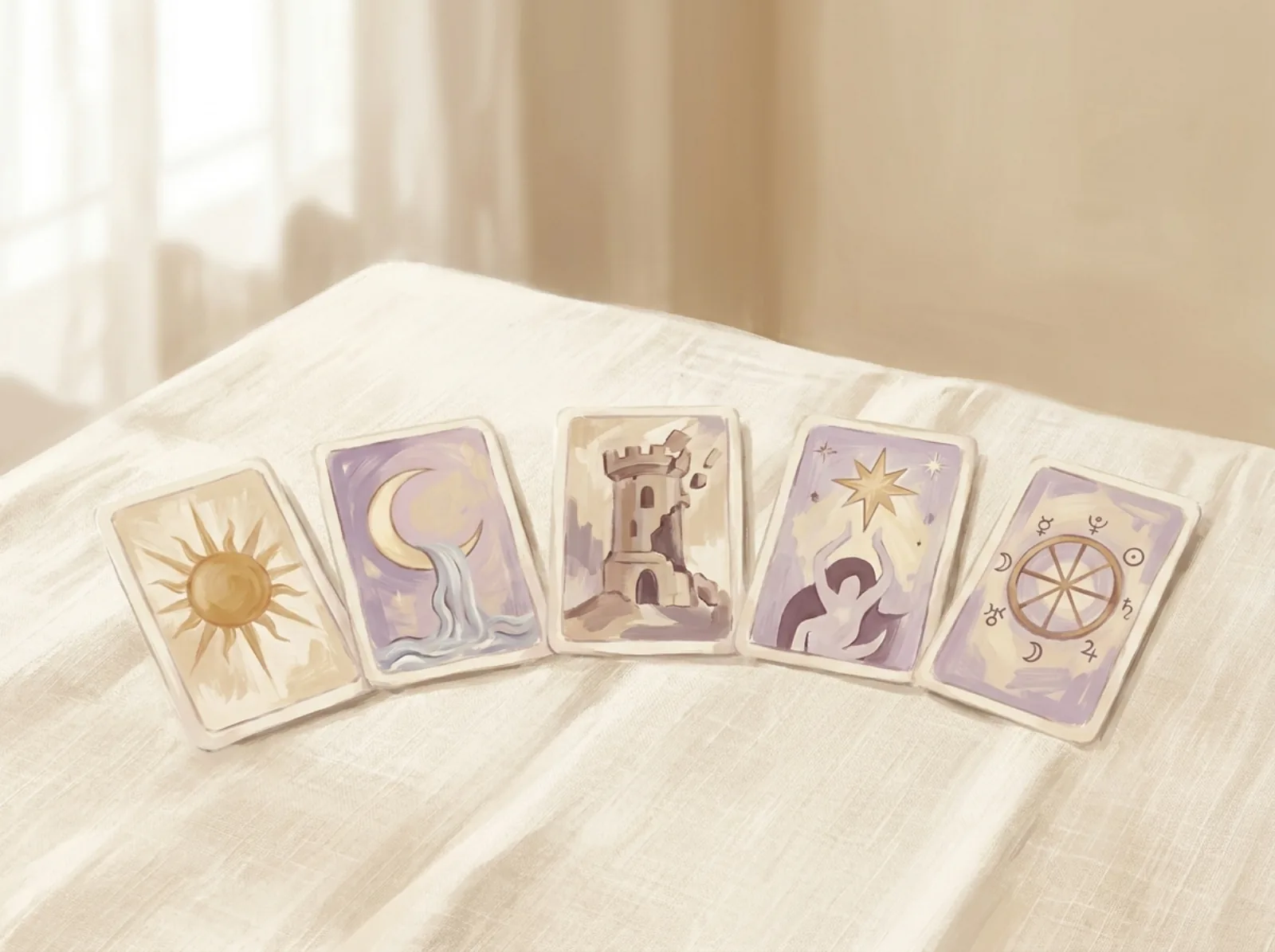
The reading that made me trust this spread
A woman I will call Nadia sat across from me at a small table in a Brooklyn cafe last November, two job offers open on her phone. One was a promotion inside her current company, safe and boring and well paid. The other was a smaller role at an early-stage startup that made her stomach flutter every time she opened the email. She had made three spreadsheets. She had asked six friends. She was, by her own admission, more confused than when she started. Part of our card meanings library. Part of our complete tarot spread library. Explore the full library. Part of our tarot library.
I pulled a decision spread. Not a Celtic Cross, not a three-card past-present-future, not any of the sprawling diagnostic layouts that make sense when a client wants to understand a whole situation. Nadia did not need to understand her situation. She understood it perfectly. She needed to see two options placed next to each other on a table so her body could tell her which column made her lean in and which one made her shoulders drop. See our best AI tarot app guide for a full breakdown.
The current-energy card for the safe job was the Four of Pentacles: a figure clutching coins, guarded, contracted. The current-energy card for the startup was the Eight of Wands: eight staves in flight, motion, momentum, a slight blur at the edges. Nadia laughed before I said a word. She had already decided. The cards had not told her anything she did not know. They had simply arranged what she already knew in a shape she could finally see. See our guide. See our best AI tarot app guide.
That is what the decision tarot spread does. It is the spread I reach for when a client is not confused about the facts, only about the feelings underneath the facts. It is small, elegant, and refuses to pretend it is anything other than a mirror. And it is the spread I want to walk you through in this guide.
What is a decision tarot spread, exactly?
A decision tarot spread is a comparative tarot layout that places two options side-by-side, usually in parallel columns, so a querent can weigh the emotional, energetic, and psychological texture of each path before making a real-world choice. Most versions use between five and nine cards. The core structure is one significator card at the top that clarifies the question, followed by two columns of matched positions — current state, hidden factor, likely trajectory — one column per option.
It belongs to a family of tarot spreads sometimes called comparative or dilemma spreads. Rachel Pollack, whose 1980 book Seventy-Eight Degrees of Wisdom remains one of the most cited texts in modern Western tarot, describes comparative layouts as tools for making the invisible visible. Benebell Wen, in Holistic Tarot (2015), frames them as structured reflection exercises rather than predictive readings. Both authors are clear that the cards do not choose. They surface material for the reader to work with.
The decision spread differs from a general reading in one important way. It has a job. Every card is oriented toward a specific comparison, which means it resists the sprawl that can happen when a reader lays down ten cards and tries to make a story from all of them. Focused questions get focused readings. That constraint is a feature.
It is important to say clearly, and to keep saying, what this spread is not. It is not a fortune-telling device. It is not a therapist. It is not a financial advisor, a doctor, a lawyer, or a career coach. If your decision involves medical treatment, legal exposure, or a financial commitment that could hurt you or your family, please consult a licensed professional. Tarot is a reflection prompt. Use it as one.
When should you actually reach for this spread?
The decision tarot spread earns its keep in a narrow band of situations, and it is worth being honest about the edges. Use it when you have two clearly defined options and both are viable. Both have to be things you could actually do. Comparing 'take this job' to 'become a professional astronaut in six months' is not a decision spread, it is a daydream. Both paths need to be real doors you could walk through.
Use it when the friction is emotional or values-based rather than factual. If you are stuck because you do not have information — you do not know the salary, you do not know the lease terms, you do not know whether the surgery is covered — no spread will help you. Go get the information. Come back to the cards when the facts are on the table and you are still unsure because two futures both feel plausible.
Use it when you have already tried the obvious tools and they have not moved you. Pros-and-cons lists. Talking to friends. Sleeping on it. The decision spread is often the tool people reach for after the other tools have run out. That is fine. It exists precisely for the moment when analysis has stalled and something less linear needs to enter the room.
Use it when you can honor the reflection with a small ritual: ten minutes uninterrupted, a journal, a cup of something warm. If you cannot slow down enough to actually sit with the cards, the spread will not help. It is not a fast tool. It is a slowing-down tool.
When should you not use this spread?
Do not use the decision spread when you already know the answer and you are hoping the cards will contradict you. This is the single most common misuse in my experience. A person shows up wanting permission to do the thing they have already decided against, or permission not to do the thing they have already decided for. If you can feel yourself steering the interpretation, put the deck down. The reading will only make you feel worse.
Do not use it for urgent decisions with hard deadlines and high stakes, especially medical or legal ones. If your doctor has recommended a procedure, sit with your doctor. If a lawyer has advised a course of action, sit with your lawyer. Tarot can be part of your emotional processing around those decisions, but it should never be the deciding voice. That is not what it is for and any honest reader will tell you so.
Do not use it more than once on the same question in a short window. Redrawing when you dislike the first reading collapses the practice into a slot machine and destroys whatever reflective value it might have had. Wait at least a full lunar cycle before re-reading the same question. Mary K. Greer, in Tarot for Your Self (1984), is emphatic on this point: repetition erodes trust in the process.
Do not use it on behalf of someone else without their consent. Reading for a partner, sibling, or friend without their knowledge — 'should they leave their job?' — is both an ethical breach and, in my experience, a spread that comes out murky every time. The cards seem to know when the question is not yours to ask.
The seven-card decision spread: position guide
There are dozens of variations of the decision spread and I will cover several later, but the seven-card version is my default. It is small enough to read carefully, large enough to give texture, and its symmetry makes the comparison legible at a glance. Below is the layout and a table of what each position means.
Card 1 sits at the top of the layout, centered above both columns. Beneath it, three cards run down the left (Choice A: positions 2, 3, 4) and three cards run down the right (Choice B: positions 5, 6, 7). Read Card 1 first. Then read Column A top to bottom. Then Column B top to bottom. Then compare the two columns, position by position.
| Position | Name | Meaning | |---|---|---| | 1 | The Real Question | What the choice is actually about beneath the surface framing | | 2 | Path A: Present Energy | The current emotional and practical texture of choosing A | | 3 | Path A: Hidden Factor | What you are not yet seeing about A; unconscious pull or blind spot | | 4 | Path A: Likely Trajectory | Where A is pointing you if you continue in that direction | | 5 | Path B: Present Energy | The current emotional and practical texture of choosing B | | 6 | Path B: Hidden Factor | What you are not yet seeing about B; unconscious pull or blind spot | | 7 | Path B: Likely Trajectory | Where B is pointing you if you continue in that direction |
A note on position 1: this is the card most people rush past, and it is the most important card in the spread. The Real Question card often reframes what you thought you were asking. A person shows up asking 'should I take the job or stay?' and pulls The Hermit for position 1. The real question is not about the job. It is about their need for solitude and clarity, which no external move will resolve. Sit with position 1 for at least two full minutes before you look at anything else.
How do you do a decision tarot spread, step by step?
Here is the full procedural walkthrough. This is the version I teach beginners and the version I still use myself when I am reading for a client. Take your time with each step; the sequencing matters.
1. Define both options in one sentence each. Write them down on paper, not in your head. 'Take the promotion at Company X' and 'Accept the offer at Startup Y.' Vague framings produce vague readings. If you cannot articulate both options in a single sentence each, you are not ready for the spread yet — clarify first.
2. Shuffle the deck slowly while holding a single question in mind: 'What do I need to see about Choice A versus Choice B?' Not 'which one should I pick?' The former invites reflection. The latter invites projection. Shuffle until the deck feels ready. Some readers shuffle a set number of times; I shuffle until I stop noticing the shuffling. Whichever you prefer, be consistent.
3. Cut the deck into three piles with your non-dominant hand, then restack in any order that feels right. This is optional but many readers, including Benebell Wen, recommend it as a way to physically slow the process down. Deal the significator card face-up at the top position. Pause. Look at it. Do not name it yet. Just look at the image.
4. Deal Column A: three cards down the left, face-up, in order — present energy, hidden factor, trajectory. Then deal Column B: three cards down the right, same order. Do not read anything yet. Just lay them all down first.
5. Read the significator first. What is the real question? Speak it out loud if you are alone or write it down. Then read Column A top to bottom, without looking at Column B. Notice the emotional arc of the three cards together. Journal for two or three sentences.
6. Read Column B the same way. Then compare the columns position by position: A2 versus B2, A3 versus B3, A4 versus B4. This is where the spread earns its keep. Notice which comparisons feel loudest to you emotionally — those are the ones your body is already voting on.
7. Close the reading by writing one sentence: 'What I noticed today.' Do not decide yet. Sleep on the reading for at least one night before you act on anything. If the deadline is longer than a week, revisit the notes twice before you commit.
A sample reading: two apartments, one impossible choice
Let me walk through a fictional but grounded example. The client, whom I will call Priya, was choosing between two apartments in Manchester. Option A was a small, cheaper flat in a quiet neighborhood twenty-five minutes from her office. Option B was a larger, more expensive flat right in the city center, ten minutes from work but noisy. She had visited both twice. She still could not decide.
Position 1, The Real Question: The Two of Swords. A blindfolded figure holding two crossed swords, seated with her back to water. Priya was avoiding a deeper question about whether she wanted to build a quiet life or a stimulating one. The apartment choice was a proxy for a larger identity question. We paused here for five minutes before continuing.
Column A, the quiet flat. Present energy: Four of Cups — a figure sitting under a tree, three cups in front of him, a fourth cup being offered by a cloud that he is not looking at. Priya was drawn to A partly out of exhaustion, not desire. Hidden factor: The Hermit — solitude, restoration, inner work. There was a real gift here for her, but only if she treated the move as intentional retreat rather than passive withdrawal. Trajectory: Six of Pentacles — balance, generosity, sustainable resources. A stable life, financially comfortable, with room to give.
Column B, the city flat. Present energy: Eight of Wands — motion, momentum, excitement, things happening quickly. Hidden factor: Five of Pentacles — financial strain, feeling on the outside looking in. The rent would stretch her. Trajectory: The Tower — sudden change, disruption, upheaval. Not necessarily bad, but volatile.
Comparison: A offered rest and financial stability but risked stagnation. B offered stimulation and career acceleration but risked burnout and financial strain. The Real Question card — the Two of Swords — reminded Priya she was choosing an identity, not just a floor plan. She took A, with a clear commitment to treat it as retreat rather than resignation. Six months later she started a side project she had been avoiding for years.
What are the most common misreadings of this spread?
The first common misreading is treating one column as 'good' and the other as 'bad' based on the general vibe of the cards. This is almost always wrong. A column of traditionally pleasant cards can point to complacency; a column of traditionally difficult cards can point to necessary growth. The Tower is not a veto and the Ten of Cups is not a green light. Read each card in the position it landed in, not as a mood score for the option.
The second common misreading is skipping the significator. People are eager to get to the meat of the comparison and glance at position 1 for two seconds before diving into the columns. Position 1 is the frame. Without it, the columns float. Read the significator first, sit with it, name the real question out loud, and only then move to the columns.
The third is confusing 'trajectory' with 'prediction.' The trajectory position shows you where the current momentum of that choice is pointing given everything you know right now. It is not fixed. It is not a prophecy. If you take Path A and behave differently than your current pattern suggests, the trajectory changes. The card is diagnostic of the momentum you would be walking into, not a future engraved in stone.
The fourth is reading the two columns in isolation and forgetting to compare position by position. The whole point of the spread is the comparison. A2 versus B2. A3 versus B3. A4 versus B4. If you skip the comparison step, you have done two three-card readings, not one decision spread.
The fifth is redrawing when you dislike the result. Do not do this. Note the discomfort, journal about it, and wait at least a lunar cycle before returning to the question. Discomfort is data.
How do you interpret conflicting or ambiguous cards?
Sometimes a column tells a clear story. Sometimes it tells three unrelated stories that seem to contradict each other. This is not a failure of the spread. It is often the most honest reading you will get, because it reflects the actual complexity of the choice.
When the three cards in one column feel contradictory, treat the contradiction as the message. A column that shows Ten of Cups (present), Five of Swords (hidden), and Nine of Pentacles (trajectory) is telling you that this path looks happy on the surface, has a conflict or ego dynamic underneath, and lands somewhere stable and comfortable. The contradiction is the story. That is a path where you would need to navigate a real tension in order to arrive at the good outcome.
When a card confuses you, sit with the image before reaching for a book. Notice colors, figures, direction of gaze, weather, objects on the table, expressions on faces. Ask what the picture would mean if a friend had drawn it for you this morning. Then, and only then, check A.E. Waite's Pictorial Key to the Tarot (1910) or Rachel Pollack's Seventy-Eight Degrees of Wisdom for traditional meaning. Your first read matters. Do not skip it.
When two adjacent positions seem to say opposite things, notice the direction. The Chariot in present energy pointing to the Four of Pentacles in trajectory suggests momentum congealing into contraction. Read the direction of the arc as much as the individual cards.
When you truly cannot make sense of a card, note the confusion in your journal and move on. Confusion is often a marker of a place your conscious mind is not yet ready to look. Come back to that card in a week. It usually clarifies once life provides more context.
Variations of the decision spread worth learning
The seven-card version is my default, but there are several variations worth having in your toolkit. Each shifts the emphasis in a useful way.
The Three-Card Fork. Simplest possible version: one card for Path A, one card for Path B, one card for the underlying question. Good for quick daily readings or when you are still learning. Weakness: not enough texture for major life decisions.
The Five-Card Y-Spread. One significator, two current-state cards (one per path), two outcome cards. Mary K. Greer describes a variation of this in Tarot for Your Self. Useful when you want a quick read but with more depth than three cards.
The Nine-Card Extended Decision Spread. Add a fourth card to each column representing 'what this path asks of you' — the growth edge, the sacrifice, the challenge you would be signing up for. This is the version I use when a client is choosing between two paths that both look genuinely appealing and I want to understand what each will cost them.
The Pros and Cons Spread. Two columns of four cards each, no significator. Left column: pros of Choice A, cons of Choice A, pros of Choice B, cons of Choice B. Less elegant than the standard decision spread but useful when you want to force yourself to see the shadows of each path. Best done alongside a written pros-and-cons list, not as a replacement for one.
The Third Path Spread. One card for Path A, one for Path B, one for a third path you have not yet considered. Powerful when you suspect you are trapped in a false binary. Sometimes the third card is nonsense. Sometimes it names an option you had dismissed and unlocks the whole reading.
Can you do a decision tarot spread with an app?
Yes, and this is worth talking about honestly rather than defensively. I am the senior tarot editor at Raka, an AI tarot app on Google Play, so I have obvious bias. I also read with physical decks daily. Both are real. Here is what I actually think.
A physical deck offers something an app cannot: the tactile ritual of shuffling, the weight of the cards, the physical arrangement on a table you can walk away from and return to. If you are reading for yourself in a quiet room with time to spare, use a physical deck. It slows you down in ways that matter for a spread designed to slow you down.
An app is genuinely useful in three scenarios. First, when you travel and cannot bring a deck. Second, when you want a private reading late at night or in a public place. Third, when you want to keep a searchable, longitudinal journal of your readings so patterns become visible over months and years. That last use case is where I think apps genuinely outperform physical decks — human memory is unreliable and searchable notes are gold.
Raka walks you through the decision spread position by position, remembers your past readings, and lets you journal inside the app so your reflections stay attached to the specific reading that prompted them. Our AI companion is trained on classical sources including A.E. Waite and Rachel Pollack and is designed to prompt reflection rather than issue verdicts. It will not tell you which path to take. Nothing should.
The honest test for any tool, digital or physical, is whether it makes you actually reflect. If your app is prompting you to sit longer with the cards, you are using it well. If it is encouraging quick swipes and next-question compulsion, it is a slot machine dressed as a spiritual practice. Choose accordingly.
The one caveat you should hear twice
Tarot is a reflection practice, not a decision-making authority. This bears repeating because the language around tarot — 'the cards say,' 'the deck told me' — can slowly slide from metaphor into belief if you are not careful. The cards do not say anything. You are the one reading. The spread is a structured prompt for you to hear yourself think.
The US mystical services industry, according to IBISWorld's 2024 report on Psychic Services, is a $2.3 billion market. Pew Research reports that roughly 30% of American adults consult horoscopes, tarot, or fortune tellers at least occasionally. This is not a fringe practice. Precisely because it is mainstream, it is worth being clear about the boundaries. Tarot is not a substitute for therapy, medical advice, financial planning, or legal counsel. It is a companion tool for the reflective work you are already doing.
If your decision involves a mental health crisis, please contact a licensed therapist or, in the US, call or text 988 for the Suicide and Crisis Lifeline. If it involves a medical procedure, sit with your doctor. If it involves a legal exposure, sit with a lawyer. If it involves a financial commitment that could destabilize your household, sit with a fee-only fiduciary financial advisor. The cards can be part of your emotional processing around those decisions. They should never be the deciding voice.
Read this paragraph twice if you need to. I would rather you close this article slightly annoyed at the repetition than take a card as a verdict on something that deserves professional care.
How to close a reading and actually decide
The reading is not the decision. This is the transition point many people miss. You have laid down seven cards, you have noticed patterns, you have journaled a few sentences. Now what?
Wait. Not forever, but at least one night. Sleep on the reading. The mind consolidates during sleep in ways that make morning-after clarity noticeably different from evening-of insight. If the decision has a longer deadline, wait a week. If it has a shorter one, wait until morning. The wait is part of the practice.
Return to the practical. Look at your spreadsheet, your calendar, your budget. The decision spread is meant to complement analytical tools, not replace them. A choice that felt clear during the reading but falls apart the moment you open your budget was not actually clear. That is fine. Return to the cards, or return to the spreadsheet, or return to a friend. Reflection is iterative.
Notice what your body is doing. This is not mystical, it is just paying attention. When you imagine taking Choice A tomorrow morning, does your chest tighten or loosen? When you imagine Choice B, same question. Somatic signals are real data. The decision spread often makes these signals more available because it has forced you to sit still for twenty minutes.
Make the decision, and then let the cards go. Do not keep the spread photographed on your phone as a talisman. Do not check back six months later to see if the trajectory 'came true.' The reading served its purpose in the room. Once you have decided, the cards are done. Life takes over.
A final word from the reading table
I have been reading tarot professionally for over a decade and I still reach for the decision spread more often than any other layout when a friend or client is stuck between two paths. It is small, it is honest, and it refuses to pretend it is anything other than a mirror.
If you are new to tarot, the decision spread is one of the best places to start. It is short enough to read without exhausting yourself, structured enough to give you a scaffold, and immediately applicable to real questions in your real life. Start with the three-card fork if the seven feels intimidating. Work up.
If you have been reading for a while and you have gotten fancy with ten-card diagnostic spreads, come back to the decision spread when a client shows up in analysis paralysis. You will be surprised how often the smallest layout does the biggest work.
And when you use it, please use it in the spirit in which it is intended. Not as a fortune-telling device. Not as a substitute for professional advice. Not as permission to avoid the harder work of talking to the people your decision affects. Use it as a mirror. That is all it is. That is all it needs to be. The rest is you.
Frequently asked questions
What is the decision tarot spread?
The decision tarot spread is a comparative layout that maps two options side-by-side, typically using five to nine cards. One column represents Path A, the other Path B, with a shared card at the top clarifying what you actually need to weigh. It is a reflection tool designed to surface unspoken assumptions, emotional pulls, and blind spots. It does not predict outcomes or make the choice for you. You still choose.
How do I do a decision tarot spread?
Write down both options in one sentence each. Shuffle while holding the question 'What do I need to see about Choice A versus Choice B?' Deal one significator card at the top, then two parallel columns of three cards each: current energy, hidden factor, and likely trajectory for each path. Read column A completely, then column B, then compare. Journal for ten minutes before deciding anything. Sleep on it if the decision is major.
When should I use a decision tarot spread?
Use it when you have two clearly defined options and you are stuck in analysis paralysis. It works best for choices where both paths are viable and the friction is emotional or values-based rather than factual. Examples: two job offers, staying versus leaving a relationship, moving cities, quitting a program. Avoid using it when you already know the answer and want the cards to justify it, or when the decision involves urgent medical, legal, or financial stakes better handled by a licensed professional.
How is the decision tarot spread different from the Celtic Cross?
The Celtic Cross is a ten-card diagnostic spread covering one situation in depth: past, present, hopes, fears, external influences, and probable outcome. The decision spread is comparative, not diagnostic. It puts two options in parallel so you can see them next to each other. Use the Celtic Cross when you want to understand a single situation fully. Use the decision spread when you already understand the situation and need to weigh two forward paths.
Can I do the decision tarot spread online or with an app?
Yes. A physical deck offers tactile ritual and slower pacing, but a well-designed app works when you travel or want a private reading late at night. Raka, our AI tarot companion, walks you through the decision spread position by position, remembers your past readings, and lets you journal in-app so patterns become visible over months. Apps are convenient. They are not a substitute for sitting with the cards. Use whichever encourages you to actually reflect.
What if I get a card I don't understand?
Sit with the image before you reach for a book. Notice colors, figures, direction of gaze, weather, objects. Ask yourself what the picture would mean if a friend had drawn it for you today. Then check A.E. Waite's Pictorial Key or Rachel Pollack's Seventy-Eight Degrees of Wisdom for traditional meaning. If it still feels opaque, that opacity is data. Note it in your journal and revisit next week. Confusion often marks the exact spot where your thinking is unresolved.
How often should I do a decision tarot spread on the same question?
Once per genuine question. Redrawing because you disliked the first reading turns the practice into a slot machine and dilutes any reflective value. Wait at least a lunar cycle, roughly four weeks, before re-reading the same question. If circumstances materially change — new information, new offer, new deadline — that is a new question and a new spread is fine. Journal between readings so you can tell the difference between fresh insight and repetition.