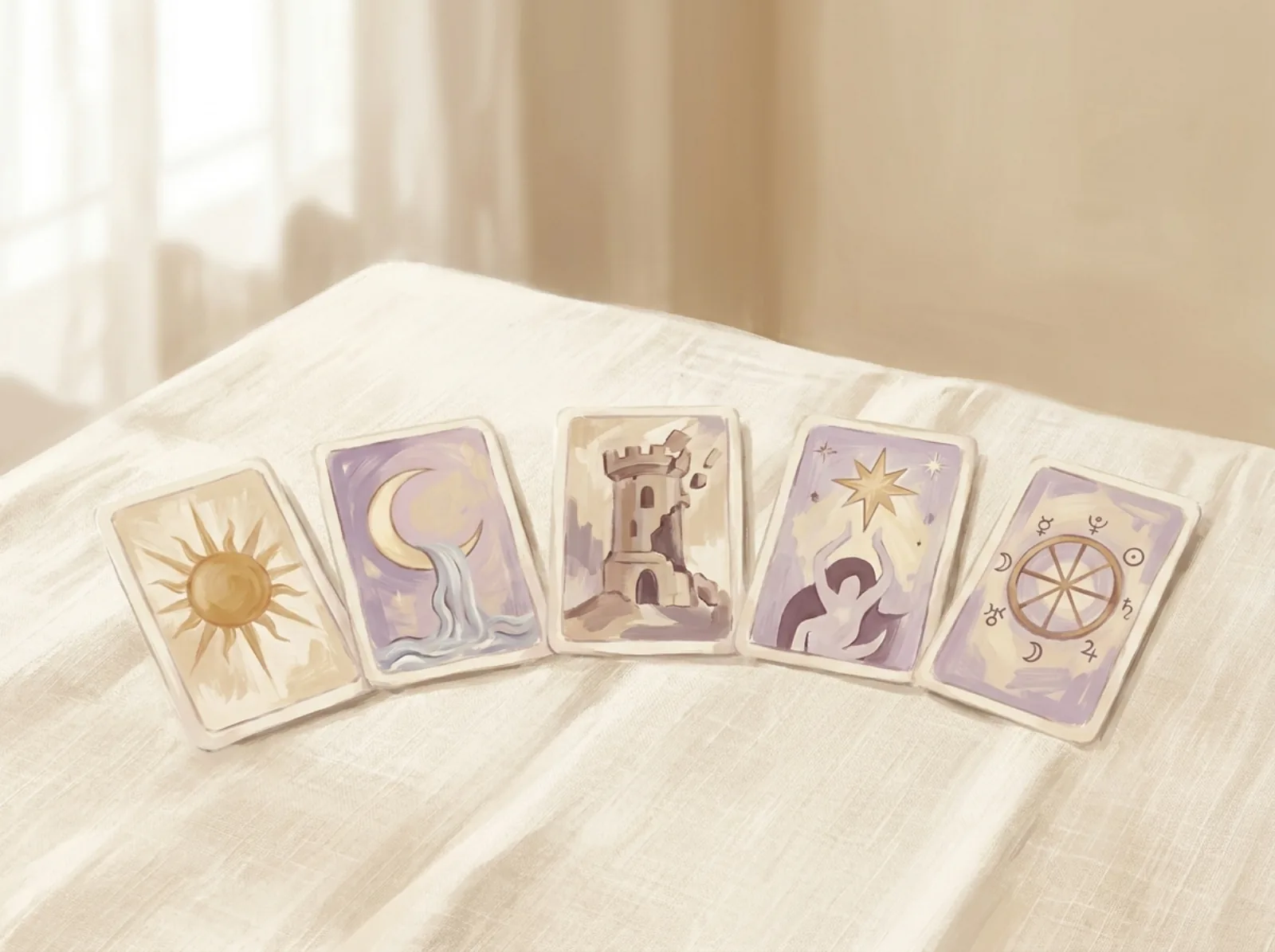
The 3 a.m. reading that made me build this spread
The first time I used this layout on myself, I was sitting on a rented kitchen floor in Manchester at three in the morning with a very cold cup of tea and a Rider-Waite-Smith deck I had owned for eleven years. I was not in danger. I was not in crisis. I was in that specific, humming, low-grade anxiety that has no obvious edges — the kind where you cannot point to the thing that is wrong, only to the fact that your shoulders have been up near your ears since Tuesday. Part of our tarot spread library. Part of our complete tarot spread library. Explore the full library. Part of our complete astrology reference.
I had already tried the tools I usually trust. I had walked. I had journaled the way my old therapist taught me. I had done the boring, unglamorous four-seven-eight breathing. Nothing was landing, because I could not name what I was anxious about. My brain kept offering candidates — the tax return, an unanswered email, a friend who had gone quiet, the vague sense that I had aged out of some invisible timeline — and every candidate felt half-true, which is the worst kind of true. See our best tarot app 2026 guide for a full breakdown.
So I did what I do when language fails: I reached for the deck. But the spreads I knew were wrong for the moment. The Celtic Cross was too big. A one-card pull was too small. A yes-or-no draw would have insulted the actual question, which was not a question yet. I wanted something that would help me separate the trigger from the sensation from the story I was telling about the sensation, because I could feel those three things were tangled and I could not untangle them alone. See our guide. See our best AI astrology app guide.
I laid down five cards. Trigger. Body. Story. Resource. Next step. The Nine of Swords fell in the story position, which is almost a cliché, and I laughed out loud in the kitchen. The card is a woman sitting up in bed with her head in her hands, nine swords hanging on the wall above her — a picture Pamela Colman Smith drew in 1909 that has been quietly describing three-in-the-morning ever since. I wrote for twenty minutes. I slept by four.
This article is that spread, refined over hundreds of readings for myself, friends, and clients, and pressure-tested against the way anxiety actually behaves. It is not a cure. It is a scaffold — the kind of scaffold that gives an overactive mind somewhere structured to put itself for fifteen minutes. If you are in acute crisis, please close this tab and call a licensed clinician; the numbers are further down the page. If you are in the humming, unnamed, Tuesday-shoulders kind of anxiety, keep reading.
What is a tarot spread for anxiety, in one paragraph?
A tarot spread for anxiety is a five-card reflective layout that helps you separate an anxious moment into its component parts — the external trigger, the physical sensation in your body, the mental story you are telling about the sensation, the internal or external resource you already have access to, and one small, grounded next action. It is a journaling tool, not a prediction tool. The cards are prompts. You supply the meaning.
The positions are deliberately borrowed from the language of cognitive-behavioural and somatic self-help — trigger, sensation, cognition, resource, behaviour — because those categories map cleanly onto the imagery of a 78-card Rider-Waite-Smith deck and because they give the anxious mind something concrete to sort through. When the mind is spiralling, structure is a kindness. Five slots is enough to make distinctions. Five slots is not so many that the spread becomes another thing to be anxious about.
This spread is not a substitute for therapy, medication, or a call to a crisis line. It will not diagnose an anxiety disorder. It will not tell you whether to take the job, leave the relationship, or move cities. What it will do, on a good night, is help you notice that the thing you thought you were anxious about is not quite the thing you are actually anxious about — and that noticing, on its own, is often enough to loosen the grip by a single, useful degree.
When should you use this spread — and when should you absolutely not?
Use this spread when your anxiety is chronic, low-grade, and unnamed. The Sunday-evening dread that arrives before you have consciously remembered what Monday contains. The 3 a.m. wake-up where your brain immediately produces a slideshow of every awkward thing you have said since 2011. The mid-afternoon dip where you cannot tell whether you are hungry, lonely, or genuinely worried. The decision-paralysis loop where you have been staring at the same email for forty minutes. These are the spread's native habitat.
Use it also when you have been anxious for long enough that you have lost track of the original trigger. Anxiety compounds. A worry about money becomes a worry about worrying about money becomes a global sense that you are not coping. The spread's first position exists precisely to interrupt that compounding — to make you write down, in ink, what actually happened in the last twenty-four hours that your nervous system is still metabolising.
Do not use it during an active panic attack. If your heart is racing, your hands are tingling, and you feel like you cannot breathe, you do not need a five-card layout — you need to slow your exhale, put your feet on the floor, and, if the episode is severe or unfamiliar, contact a medical professional. Tarot is a slow, symbolic practice; panic is a fast, physiological event. The tool is wrong for the moment.
Do not use it as a substitute for a therapist if you have been anxious most days for more than a few weeks, if the anxiety is interfering with sleep, work, or relationships, or if it is accompanied by any thoughts of harming yourself. In the United States, call or text 988. In the United Kingdom and Ireland, call the Samaritans on 116 123. In Canada, call or text 988. In Australia, call Lifeline on 13 11 14. Please. The cards will still be there when you are safer.
Do not use it to seek reassurance about a specific outcome — will he text back, will I get the job, will the biopsy be clear. That is the domain of prediction, and prediction is exactly what a reflective-tarot practice is not for. Benebell Wen, in Holistic Tarot (2015), is unusually clear on this point: the deck is a mirror for your own cognition, not an oracle for external events. Ask it to reflect. Do not ask it to promise.
The five positions, one by one
Position one is the trigger. This card represents what actually happened, in the outside world, that your nervous system is responding to. It is deliberately placed first because anxious minds tend to skip the trigger and go straight to the story. Whatever falls here, read it literally before you read it symbolically. A Pentacles card often points to money, work, or the body. A Cups card often points to a relationship or an emotional exchange. A Swords card often points to a conversation, an email, or something you read. Wands often point to a project or a decision.
Position two is the body. This card represents the felt sensation — where the anxiety is living in your torso, your jaw, your gut, your hands. Somatic therapists have been arguing for decades that anxiety is a physiological event with a cognitive echo, not the other way around, and this position honours that. Look at the posture of the figure in the card. Are they curled, braced, reaching, frozen, running, sleeping? Ask your own body whether it recognises the shape.
Position three is the story. This is the sentence your mind is repeating on a loop underneath the day. Something is going to go wrong. I am behind. I am a fraud. They are angry with me and have not told me yet. The card here is often the one that produces the loudest inner reaction — the flinch, the eye-roll, the sudden urge to reshuffle. Do not reshuffle. Write down the sentence the card seems to be pointing at, even if the sentence is embarrassing.
Position four is the resource. This is the thing you already have — a person, a practice, a memory, a skill, a boundary — that is available to you right now, without you having to acquire anything new. Anxious minds are excellent at inventorying what is missing and terrible at inventorying what is present. This position exists to correct the ledger. If a Court card falls here, ask which person in your life has that card's energy. If a Major Arcana card falls here, ask which of your own capacities it is naming.
Position five is the next step. Not the plan. Not the five-year strategy. The single, specific, physically achievable thing you could do in the next hour that would move you one degree toward the ground. Drink a glass of water. Send the two-sentence email. Text the friend. Go outside for eleven minutes. The card here should be read for its most modest possible instruction. If it seems to be telling you to burn your life down, you are over-reading it.
Position guide at a glance
The table below is deliberately compact. When you are anxious, you do not want to read a wall of text — you want a scaffold you can lay out on the table next to your cards. Screenshot it, print it, copy it into the front of your journal.
Position 1 — Trigger. Question: What actually happened in the last 24 hours? Read literally first, symbolically second. Suit hint: Pentacles = material, Cups = relational, Swords = communicative, Wands = creative or directional.
Position 2 — Body. Question: Where is this living in me physically? Read the posture, tension, and orientation of the figure on the card. Notice whether your own body relaxes or tightens when you look at the image.
Position 3 — Story. Question: What sentence is my mind repeating? Read the card as a mirror for the loop, not a prescription. Nine of Swords, Five of Pentacles, Eight of Swords, and the Devil often surface here — none of them are verdicts.
Position 4 — Resource. Question: What do I already have? Court cards point to people. Aces point to raw capacities. Majors point to archetypal strengths inside you. Never read this position as absent — the resource is always something.
Position 5 — Next step. Question: What is the smallest grounded action available in the next hour? Read for the modest, physical, do-able instruction. If the card seems dramatic, downgrade the instruction until it fits inside sixty minutes.
How do you do this spread, step by step?
Step one. Choose a quiet-enough room. This does not have to be a candlelit ritual space — a kitchen table at 3 a.m. with a half-charged phone is fine. What matters is that you can put down five cards without something knocking them over and that no one is going to ask you a question in the next fifteen minutes.
Step two. Open your journal to a fresh page and write the date, the time, and one sentence about what you noticed in your body that made you reach for the deck. Not a diagnosis. Not a story yet. Just a physical fact: tight jaw, shallow breath, restless legs, a knot under the ribs.
Step three. Shuffle. There is no correct shuffling technique. Riffle, overhand, wash the cards face down on the table — whichever feels natural. Shuffle until you feel a small internal click that says stop, or, if you do not trust that feeling yet, count out sixty seconds. Mary K. Greer, in Tarot for Your Self (1984), suggests shuffling while silently naming the question, which is a reliable way to keep the mind on task.
Step four. Deal five cards from the top of the deck, left to right, face down. Then turn them over one at a time, in order, pausing after each. Do not fan them all up at once — the whole point of the spread is sequential attention, and anxious minds will otherwise stampede to whichever card looks most alarming.
Step five. For each card, in order, write three things in your journal: what you see in the image (literal description), what the position is asking (from the guide above), and what sentence surfaces when you hold those two things together. Do not censor the sentence. If it is petty, write it. If it is embarrassing, write it. The spread only works if the writing is honest.
Step six. When you reach position five — the next step — put the pen down and do the thing the card seems to be suggesting, within the next hour, at the most modest possible scale. Then close the deck. Do not re-draw. Do not do a clarifier. Do not do the spread again tomorrow to see if the cards have changed their minds. Let the reading settle.
A sample reading — a fictional client called J.
J. is a composite — a fictional stand-in for the kind of reading I have done many times, with details changed so that no real client is identifiable. She is thirty-four, works in a creative agency in Toronto, and has been waking up at 4 a.m. every night for a week with what she describes as a general sense of dread and no specific thing to blame it on. She has a therapist she sees fortnightly and has already told her therapist about the waking. She wanted to do a spread in the meantime.
Trigger — Three of Pentacles reversed. On its feet, this is the collaborative-work card: three figures conferring over a cathedral wall, agreeing on the plan. Reversed and in the trigger position, J. reads it as the meeting last Tuesday where a project she has been leading for four months was quietly reassigned in her absence. She had not, until this moment, connected the meeting to the waking. She writes: it started on Wednesday morning.
Body — Four of Swords. A knight lies on a stone tomb, hands folded, three swords on the wall, one beneath him. J. reads the frozen, effigy-like posture and immediately notices her jaw is clenched and her shoulders are up. She writes: I am holding still like something is going to hit me. The card is not saying rest; it is showing her the bracing.
Story — Nine of Swords. The three-in-the-morning card, as predicted. J. writes the sentence her mind has been running underneath the week: they have decided I am not the person for this and no one is going to tell me. She underlines it. She notes, in the margin, that this sentence is not the same as the trigger — the trigger was a reassignment; the story is a global verdict about her worth. Separating those two things is already useful.
Resource — Queen of Pentacles. A grounded, embodied, resource-rich figure. J. reads this as her own capacity — she has three years of savings, a solid CV, a stable apartment, and a body she has been training to run half-marathons. She writes: I am not actually precarious. She also reads the card as pointing to her older sister, who has navigated a similar reassignment and would take the call.
Next step — Six of Cups. Children in a garden, one handing the other a cup of flowers. J. reads this, at its most modest scale, as: call your sister. Not tomorrow. Tonight. She does. The 4 a.m. waking does not vanish — this is not a spread that vanishes things — but the sentence underneath it changes from a global verdict into a specific, workable question, which is what her therapist helps her open up the following week.
Common misreadings, and how to catch yourself doing them
The first common misreading is treating the trigger card as a prediction. If the Tower falls in position one, the spread is not telling you that your life is about to collapse; it is telling you that something in the last twenty-four hours felt like a structural shake — a difficult email, an unexpected bill, a conversation that upended an assumption. Read it as description, not forecast. Rachel Pollack, in Seventy-Eight Degrees of Wisdom (1980), spent an entire chapter on the Tower reminding readers that the card describes an experience of revelation, not a cosmic verdict.
The second common misreading is trying to soften the story card. The Nine of Swords is uncomfortable. The Devil is uncomfortable. The Five of Pentacles is uncomfortable. Anxious readers will often reshuffle, add a clarifier, or reinterpret the card into something gentler. Do not. The story position is the one place in this spread where the card is supposed to sting — it is naming the loop your mind is already running, and softening the card just puts you back inside the loop with less information.
The third common misreading is skipping the body card because you do not know how to read somatically. You do. Look at the figure on the card. Are they upright, curled, reaching, running, sleeping, kneeling, blindfolded? Then check your own posture. Somatic reading is not mystical; it is just paying attention to which way the body in the picture is oriented and asking whether your body is oriented the same way. If you cannot tell, put your hand on your sternum and breathe once. That is often enough to bring the sensation into focus.
The fourth common misreading is refusing the resource. Anxious minds love to look at the Queen of Pentacles and say, yes, but I do not really have savings, and the friend I would call is busy, and my body is not actually that reliable. Notice the reflex. The resource position is designed to interrupt exactly that reflex. Whatever the card is pointing at, name one specific instance of it in your actual life, even a small one. Small resources count.
The fifth common misreading is over-scaling the next step. The Ace of Wands falls in position five and suddenly you are planning to quit your job and move to Lisbon. Downscale the instruction until it fits inside the next hour. The Ace of Wands, at the scale of the next hour, is more like: send the first sentence of the email. Open the document you have been avoiding. Text the person. The spread rewards modesty.
The sixth common misreading is running the spread again if you do not like the result. This is the single most reliable way to unlearn everything the deck has just told you. Close it. Sleep on it. If, in three days, the situation has genuinely changed, you may pull again — but the second reading should be about the new situation, not a re-argument with the first.
Variations on the spread, once you know the base
The base spread is five cards, left to right. Once you have run it a handful of times, some variations are worth knowing. None of them are strictly necessary — the original layout does the work — but they let you tune the spread to particular flavours of anxiety.
The Sunday-night variant. Add a sixth card above position one, called the week ahead. This card is not a prediction; it is a question, phrased as: what is the one situation in the next seven days that my nervous system is bracing for? Read literally. This variant is useful for the specific, low-grade dread that arrives on Sunday evenings around six p.m. and disperses by Wednesday.
The decision-paralysis variant. Replace position five, next step, with two cards side by side, called Option A and Option B. This is not the spread telling you which option to choose — it is the spread showing you what each option looks like when held up against the trigger, body, story, and resource you have already laid down. You still have to choose. But you get to choose with more of the picture visible.
The relational variant. Add a card below position three, called their story. This card represents your best guess at what the other person in the situation is actually experiencing — not what your anxious mind assumes they are experiencing. This variant is useful when the anxiety is about a specific person and you have been imagining their internal state on your behalf for days. Read the card with unusual generosity toward them.
The bedtime variant. Do not lay position five at all. Draw only four cards — trigger, body, story, resource — and then, instead of an action card, write one sentence in your journal in the form: tonight, I am setting this down. This is the version I use most often at 3 a.m., because at 3 a.m. the next step is almost always sleep, and pretending otherwise is a form of self-harm.
The morning-after variant. Run the full five-card spread first thing in the morning, before checking your phone, about a situation that kept you awake. This is a different reading from the same spread run at midnight — the morning nervous system is a different nervous system — and the two readings, held next to each other in a journal, often reveal which part of the anxiety was situational and which part was time-of-day.
How this spread differs from the spreads it looks like
This is not a Celtic Cross. The Celtic Cross, in its Waite-descended form, is a ten-card layout designed to map a whole situation from multiple angles — past, present, hopes, fears, environment, outcome. It is a magnificent tool and the wrong tool for an anxious 3 a.m. Ten cards is too many cards when the nervous system is already overloaded, and the outcome position specifically invites the kind of predictive reading that this spread is trying to avoid.
This is not a three-card past-present-future draw. Past-present-future is a lovely general-purpose layout, but it treats anxiety as a temporal problem, when anxiety is much more often a categorical problem — you cannot tell the trigger from the sensation from the story. The five-card version separates the categories that past-present-future collapses.
This is not a shadow-work spread. Shadow-work spreads, in the Jungian lineage popularised in tarot by writers like Mary K. Greer, are designed for excavation — for bringing repressed or disowned material into consciousness over weeks or months of steady work. This spread is designed for the opposite: for immediate, in-the-moment triage. If the reading surfaces something that needs excavation, take it to your therapist, not back to the deck.
This is not a decision spread. Decision spreads compare paths. This spread assumes there is not necessarily a decision to be made — that the anxiety may be about a situation you are simply inside of, with no fork in the road, and that the appropriate response is grounding rather than choosing. The decision-paralysis variant above exists for the times when a fork is genuinely present.
This is not a self-diagnosis tool. Nothing in this layout will tell you whether you have generalised anxiety disorder, social anxiety, panic disorder, PTSD, or any other clinical condition. Only a licensed clinician can do that. The spread is a fifteen-minute journaling practice for people who are already, separately, taking care of the clinical dimension of their mental health — or who are using it as a bridge until they can.
Which cards tend to show up here — and what to do when they do
The Nine of Swords shows up in the story position more than any other card, in my experience. It is Pamela Colman Smith's most literal drawing — a person sitting up in bed with their head in their hands — and it names the 3 a.m. loop with unusual precision. When it appears, do not try to soften it. Write the loop down verbatim. The card is doing its job.
The Eight of Swords also frequents the story position. A blindfolded, loosely bound figure surrounded by swords, standing on ground that is not, in fact, blocking her exit. When it appears, the sentence to write is usually some version of I am trapped, followed by the honest question: am I? The card is often pointing at a bind that is more perceptual than actual.
The Four of Swords shows up in the body position more than any other card. It shows a knight lying still on a tomb — braced, held, effigy-like. When it appears, notice where in your body you are holding still. It is often the jaw, the shoulders, the pelvic floor, or the diaphragm. The card is not telling you to rest; it is showing you the bracing so you can, if you want to, put it down.
The Devil sometimes appears in the story position, and it almost always startles the reader. In A.E. Waite's Pictorial Key to the Tarot (1910), the Devil is a card of self-imposed bondage — the chains around the figures' necks are visibly loose. When it appears here, the sentence to write is usually about a loop of catastrophic thinking that has, on closer inspection, a slack chain. Notice the slack.
The Star often appears in the resource position, and it is one of the more consoling cards to see in an anxious reading. A figure kneels by water, pouring from two vessels, under an eight-pointed star. It names hope as a resource, but a specific kind of hope — not optimism, but the quiet, embodied sense that replenishment is possible. When it appears, name one small ongoing source of replenishment in your actual life.
The Six of Cups and the Ten of Pentacles both appear frequently in the next-step position when the reading is about isolation. Both cards are relational. Both point, in different registers, at asking someone for a moment of ordinary company. The Six suggests a friend; the Ten suggests family or chosen family. The instruction, at its most modest scale, is almost always: call them.
Why reflective tarot is not therapy — and why that matters
Reflective tarot, as taught by Rachel Pollack, Benebell Wen, Mary K. Greer, and the wider post-1980 lineage, treats the deck as a projective tool. The cards do not know anything. They are structured images that give the mind somewhere to project material that is otherwise hard to access. This is a legitimate and useful practice, and it is not therapy, because therapy involves a licensed clinician, a therapeutic relationship, a diagnostic framework, and an evidence base for specific interventions.
That distinction matters for a spread aimed at anxiety, because anxiety is a clinical category with clinical treatments — cognitive behavioural therapy, acceptance and commitment therapy, exposure and response prevention, and, for many people, medication — that have decades of trial evidence behind them. Nothing in this article replaces any of that. If your anxiety is persistent, escalating, or interfering with daily life, the most useful thing this spread can do is help you notice that fact clearly enough to book the appointment.
Reflective tarot can, however, sit alongside therapy in ways that many therapists (including several I have worked with as an editor at Raka) are perfectly comfortable with. It can be a between-sessions journaling scaffold. It can be a way to surface material to bring into the room. It can be a self-soothing ritual that gives structure to an unstructured evening. It cannot, and should not, replace the room itself.
The mystical services industry in the United States is estimated by IBISWorld at roughly $2.3 billion in annual revenue as of the mid-2020s, and a 2018 Pew Research Center survey found that about 29% of American adults said they believed in astrology. Those numbers describe a large, growing, and mostly self-directed spiritual marketplace. They also describe a marketplace that is under-regulated and easy to misuse for mental-health purposes it is not equipped to serve. Please use it accordingly.
If you are in the United States and in crisis, call or text 988. In the United Kingdom and Ireland, call the Samaritans on 116 123. In Canada, call or text 988. In Australia, call Lifeline on 13 11 14. If you are unsure whether what you are experiencing counts as a crisis, that uncertainty is itself a reason to call. The people on the other end of those lines are trained precisely for the calls that begin, I do not know if this counts.
Doing this spread with an app — including Raka
You do not need an app to do this spread. A physical deck, a notebook, and a quiet fifteen minutes are the whole toolkit, and there is something specific and useful about the tactile ritual of shuffling that a screen cannot fully replicate. If you have a deck, use the deck.
That said, there are moments when an app is the honest tool. Three in the morning in a hotel room where your deck is at home. A lunch break at a desk where you do not want colleagues asking about the cards. A period of travel. A first-time reader who does not yet own a deck and wants to try the practice before committing to one. In those moments, a well-designed tarot app can hold the scaffold and the journaling prompts and the position guide in one place.
Raka, which I edit for and which is available on Google Play under Vyve Health Tech, is one such app. It includes this five-card spread as a preset, with an AI companion that walks through the positions in order and prompts the same reflective questions the article above walks through — trigger, body, story, resource, next step. The companion is explicitly not framed as an oracle. It is framed as a journaling partner. It will, more than once, tell you that a particular reading is a moment for a therapist and not a moment for another spread.
There are other reputable tarot apps in the market — Labyrinthos, Golden Thread, and Tarot in the Land of Mystics all have loyal users, and Statista's app-market tracking shows steady growth in the mindfulness-and-spirituality app category through the mid-2020s. Try a few. The right app is the one you will actually open at 3 a.m., which is a personal question that no review can answer for you.
Whichever tool you choose — physical deck, Raka, another app, a printout of the position guide taped inside a notebook — the practice is the same. Five slots. Fifteen minutes. One honest sentence per card. One modest next step. Then close the deck and go do the thing.
Frequently asked questions
What is the tarot spread for anxiety?
The tarot spread for anxiety is a five-card reflective layout that separates an anxious moment into its trigger, body sensation, mental story, available resource, and one grounded next step. It is designed as a journaling scaffold, not a prediction tool, and it draws on Rider-Waite-Smith imagery and reflective-tarot pedagogy from writers like Rachel Pollack and Benebell Wen. It is not therapy, does not diagnose anything, and should sit alongside — never replace — care from a licensed clinician when anxiety is persistent or severe.
How do I do a tarot spread for anxiety, step by step?
Sit somewhere quiet, open a journal, and note one physical sensation you notice. Shuffle a 78-card deck while silently naming the situation. Deal five cards left to right, face down, then turn them over one at a time. For each card, write what you see, what the position asks (trigger, body, story, resource, next step), and one honest sentence. Then do the modest next-hour action the fifth card suggests, close the deck, and let the reading settle.
When should I use a tarot spread for anxiety?
Use it for chronic, low-grade, unnamed anxiety — Sunday-night dread, 3 a.m. loops, decision paralysis, mid-afternoon dips where the trigger has gone fuzzy. Do not use it during an active panic attack, as a substitute for a therapist if anxiety is persistent, or in any moment involving thoughts of self-harm. In those moments, contact a licensed clinician or a crisis line: 988 in the US and Canada, 116 123 for Samaritans in the UK, 13 11 14 for Lifeline in Australia.
How is this different from the Celtic Cross or a three-card past-present-future spread?
The Celtic Cross is a ten-card, full-situation map — too large and too outcome-oriented for an anxious moment. Past-present-future is a temporal layout, but anxiety is usually a categorical tangle rather than a timeline. This spread separates trigger, body, story, resource, and next step, which are exactly the categories anxious minds collapse together. It is smaller than the Celtic Cross, more specific than a three-card draw, and deliberately non-predictive throughout its five positions.
Can I do this tarot spread online or with an app like Raka?
Yes. A physical deck and a notebook are the traditional tools, and the tactile shuffling is genuinely useful, but a well-designed app is a reasonable substitute when you are travelling, in a shared space, or new to tarot. Raka, on Google Play under Vyve Health Tech, includes this exact five-card spread with an AI companion that walks through the positions and prompts the same reflective questions. Labyrinthos and Golden Thread are other reputable options. Use whichever tool you will actually open at 3 a.m.
What if I get a card I do not understand?
Describe the image out loud before you consult any book. What is the figure doing, where are they looking, what is above them, what is below them, what colours are dominant? That literal description is usually eighty percent of the reading. Then check the position — trigger, body, story, resource, next step — and ask which of the things you just described most matches the question. If you still want a reference, Rachel Pollack's Seventy-Eight Degrees of Wisdom is a good one to grow with.
How often should I do the tarot spread for anxiety?
As often as the situation genuinely changes, and no more. Once or twice a week during a difficult period is reasonable. Nightly readings about the same worry tend to become a compulsion in the shape of a ritual, which is the opposite of what a reflective practice is for. If you find yourself reshuffling to get a different answer, or drawing daily to check whether the cards have changed their minds, close the deck for a week. If the underlying anxiety persists, that is information for a therapist.
Is a tarot spread for anxiety safe if I am already in therapy or on medication?
For most people, yes — reflective tarot sits comfortably alongside talk therapy and prescribed medication, and can be a useful between-sessions journaling scaffold. It is not a treatment, it will not interact with your medication, and it does not replace anything your clinician is doing. If you are unsure, mention the practice to your therapist; most are neutral or supportive about journaling tools of any flavour. Never stop or adjust medication based on a tarot reading. That is not what the deck is for.