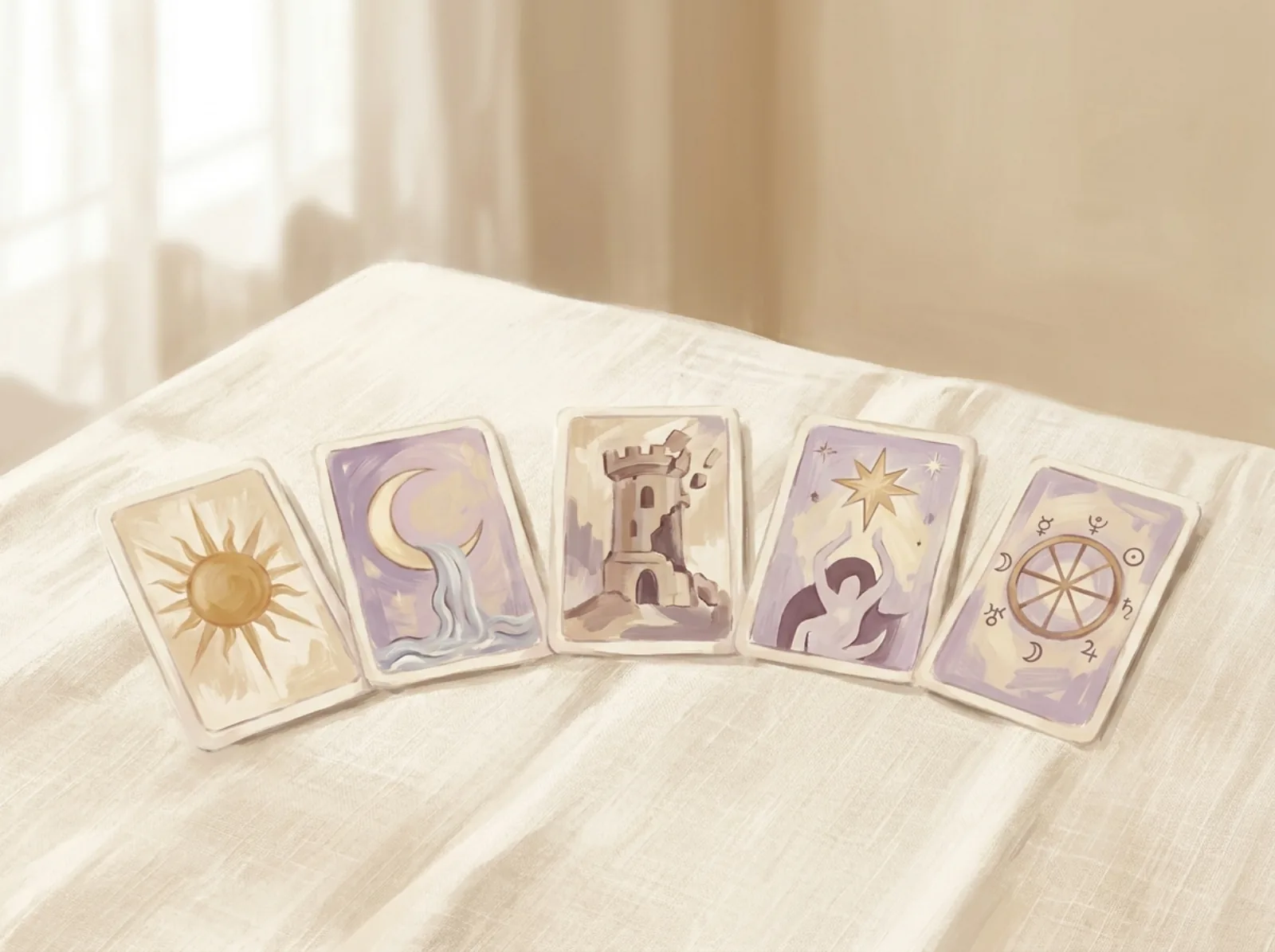
The reading that made me stop offering love spreads
A client I'll call J. came to my table at a small London tea shop about four years ago and asked for a love reading. She had been dating someone for eleven months and wanted to know, in her words, whether he was the one. I almost laid out the three-card past-present-future love spread I used for walk-ins. Something stopped me. Part of our tarot guide library. Part of our complete tarot spread library. Explore the full library. Part of our complete astrology reference.
J. was not asking about a stranger. She was asking about a specific human being who had opinions, moods, a mother she disliked, and a job that took him to Edinburgh three days a week. A three-card fortune-telling layout was going to flatten all of that into a yes or no. So I put the cards down and asked her to describe the last argument they'd had. She talked for twenty minutes. See our top AI tarot app guide for a full breakdown.
Then I dealt a five-card relationship spread: one card for her, one for him, one for the shared dynamic, one for the current obstacle, one for the emerging potential. What came up was not romantic at all. Her card was the Queen of Swords — clear-eyed, boundaried, a little lonely. His was the Page of Cups — sincere, immature, still figuring out how to name a feeling. The centre card was the Two of Cups, but reversed. The obstacle was the Five of Pentacles. See our guide. See our top astrology app guide.
J. looked at the layout for a long time. Then she said, quietly, that they were both waiting for the other person to grow up first, and neither of them was going to. She thanked me, tipped generously, and left. Six months later she emailed to say they had broken up amicably and were still friends. The spread hadn't predicted that. It had just given her permission to say out loud what she already knew.
That is what a relationship tarot spread is for. Not to tell you what will happen. To hand you a structured mirror so the thing you already sense can finally get spoken. This guide walks through three of the layouts I use most — the classic five-card You-Them-Us, the seven-card feelings-thoughts-actions extension, and a long-term compatibility variant — with position guides, sample readings, and the mistakes I see people make most often. It covers when to use each spread, when to skip tarot entirely, and how to work with an AI companion if you don't have a reader handy.
What is a relationship tarot spread, exactly?
A relationship tarot spread is a specific layout of five to seven tarot cards designed to surface reflection about a two-person partnership. It is broader than a love spread and structurally different from a general reading. Where a love spread typically answers a binary question (Do they love me? Will we reconcile?), a relationship spread maps a dynamic — what each person brings, where they meet, and what the partnership itself looks like as a third entity.
The standard modern relationship spread uses three columns. The left column represents you. The right represents them. The middle represents the space between you: chemistry, communication, obstacles, potential. Some layouts extend to seven cards by adding feelings-thoughts-actions rows, and long-term compatibility variants stretch to ten or more. The five-card version is the workhorse and the one this guide starts with.
The spread works with any standard tarot deck. The Rider-Waite-Smith deck, illustrated by Pamela Colman Smith and published by A.E. Waite in 1909, is the reference deck most tarot writing points to because its imagery on all 78 cards has been the shared visual vocabulary of Western tarot for over a century. Any deck that follows the Rider-Waite-Smith structure — the same 22 Major Arcana, four suits of Minor Arcana, and four court cards per suit — will work identically.
It is important to be clear about what the spread is not. It is not a predictive instrument. It cannot tell you whether a person loves you, whether they will propose, or whether the relationship will last. It is a projective tool: ambiguous images given a defined position, which your intuition then organizes into meaning. As Rachel Pollack put it in Seventy-Eight Degrees of Wisdom (1980), the cards give shape to what the reader already senses but has not yet articulated. That is the mechanism. That is the whole mechanism.
When should you use a relationship spread — and when should you skip it?
Use a relationship tarot spread when you are stuck describing a partnership in words. If you find yourself circling the same three sentences every time a friend asks how things are going with your partner, a spread can break the loop. The card positions force you to say something specific about a piece of the dynamic you might otherwise keep vague.
Use it after a specific incident that will not stop replaying — an argument, a text you can't decode, a decision one of you made that unsettled you. The spread gives the incident a container. You lay out the cards, you journal for twenty minutes, and the incident becomes a thing you have processed rather than a thing that is still processing you.
Use it at inflection points. Moving in together. Defining the label. Introducing family. Considering breaking up. In all of these moments what you actually want is not a prediction — you want your own gut on paper, in a form you can look at later without the pressure of the moment. A five-card spread and half an hour of journalling does that reliably.
Skip it during acute emotional crisis. If you are dysregulated, drunk, mid-fight, or in a genuine mental-health episode, tarot will not help. The cards will mirror your dysregulation back and you will read every reversal as catastrophic. Wait 24 hours. If the dysregulation lasts longer than that, a licensed therapist will serve you better than a deck of cards — and the two are not competing services.
Skip it when the question is really a safety question. If you are wondering whether to stay with someone who has hurt you physically, is coercively controlling you, or is threatening you, the answer is not in the cards. In the US, the National Domestic Violence Hotline is 1-800-799-7233. In the UK, the National Domestic Abuse Helpline is 0808 2000 247. Use those. Skip it when you're asking about someone else's inner life without their consent — a spread about whether your ex is thinking about you is a spread about your own preoccupation, not about them.
How do you do a five-card You-Them-Us spread? A step-by-step method
Here is the complete procedure for the classic five-card relationship spread. It should take you about 45 minutes end to end — 5 minutes to prepare, 5 minutes to shuffle and deal, 20 minutes to read, and 15 minutes to journal. Do all of it in one sitting.
1. Pick your question. Frame it as an open question, not a yes/no. What is the current dynamic between me and X? works. Does X love me? does not. Write the question at the top of a fresh journal page. Naming the question in writing anchors the reading.
2. Prepare the space and shuffle. Clear a flat surface. Silence your phone. Sit down. If a small ritual helps you focus — a candle, a specific playlist, three slow breaths — do it. If ritual feels performative to you, skip it. The point is attention, not choreography. Then shuffle the full 78-card deck while holding the question in mind. Shuffle for as long as feels right; most readers stop when their hands do.
3. Deal five cards face down in a cross or plus pattern: card 1 lower-left (You), card 2 lower-right (Them), card 3 centre (The dynamic between you), card 4 top (The current obstacle or challenge), card 5 bottom (The emerging potential or advice). Some readers deal all cards face up; either works.
4. Turn card 1 first. Read it in isolation. What is your immediate reaction? What is the figure doing, what are they holding, what colours dominate? Only then consult a book meaning if you want to. Write two or three sentences in your journal about what this card seems to say about you in this partnership. Repeat this move for cards 2, 3, 4, and 5 in order. Do not skip ahead. Reading each card fully before moving on prevents the temptation to bend earlier cards to fit later ones.
5. Once all five are read, look at the whole spread. Which suits dominate? (Cups suggest emotion, Swords thought, Wands action, Pentacles material reality.) How many Major Arcana appeared? (Many suggest big themes; few suggest everyday dynamics.) What is the story if you read the cards left to right, then top to bottom?
6. Journal for a final ten minutes. Write down the one sentence you would say to a friend who asked what the reading said. That sentence is usually the reading. Close the deck. Do not re-draw. Do not re-read for the same question this week. Come back to the journal entry in a month and see whether the reading still fits.
Position guide: what each card position means
Each position in the spread has a specific job. Reading a card in position 1 (You) is not the same as reading the same card in position 3 (The dynamic). The position frames the interpretation.
Position 1 — You. This is you as you show up in this specific partnership, not you in general. A Queen of Swords here does not mean you are always sharp-tongued; it means you bring sharp-tongued energy to this relationship. Ask: how am I showing up here, and does that match how I want to show up?
Position 2 — Them. This is your perception of the other person in this partnership. It is important to name that as perception. The card is not a diagnostic of them; it is a picture of the version of them you are in relationship with. If a King of Pentacles comes up, ask: what parts of them am I seeing as stable, providing, grounded — and what parts might I be projecting?
Position 3 — The dynamic between you. This is the partnership as a third entity. Not you, not them, but the thing you create together. The Two of Cups here is the classic mutual-recognition card. The Five of Wands is petty conflict. The Tower is upheaval that neither of you is fully causing. Ask: what is the shape of what we make together?
Position 4 — The current obstacle. This is what is currently in the way. It might be internal to you, internal to them, external circumstance, or something structural in the dynamic. The card names the obstacle; your reflection identifies which category it falls into. The Five of Pentacles often points to something one or both of you feels excluded from.
Position 5 — Emerging potential or advice. This is what wants to happen next if the obstacle is met, or the counsel the spread is offering. Read it as a suggestion, not a prophecy. The Ace of Cups here says an emotional opening is available. Whether you and your partner actually walk through it is not decided by the card.
Position table: the five-card You-Them-Us layout at a glance
For quick reference, here is the five-card spread as a table. This is the layout to memorize; every variation in this guide builds on it.
Position 1 — You: How you are showing up in this partnership right now.
Position 2 — Them: Your perception of the other person in this partnership.
Position 3 — The dynamic: The partnership as a third entity — what you two create together.
Position 4 — The obstacle: What is currently in the way — internal, external, or structural.
Position 5 — Emerging potential: What wants to happen next, or the advice the spread offers.
A useful practice is to draw this layout in your journal before you shuffle, with the position names labelled. That way you cannot forget which card sits where and you have a visual record of the reading afterwards. If you use the Raka app, the app draws the layout for you and labels each card as you turn it over.
How do you do the seven-card feelings-thoughts-actions spread?
The seven-card variant is the spread I reach for when the five-card layout is too coarse — when I already know the general shape of the dynamic and want to see the internal weather of each person more clearly. It splits both the You and Them columns into three rows: feelings, thoughts, and actions.
The layout is two columns of three cards, with a seventh card centred beneath as the shared dynamic or bridge card. Column 1 (You): card 1 top (your feelings), card 2 middle (your thoughts), card 3 bottom (your actions or what you are actually doing). Column 2 (Them): card 4 top (their feelings), card 5 middle (their thoughts), card 6 bottom (their actions). Card 7 sits centred below both columns as the meeting point.
The interpretive move this spread makes possible is comparing the rows. If your feelings card and your actions card are radically different — the Nine of Cups (contentment) at the top and the Eight of Cups (walking away) at the bottom — that mismatch is itself the reading. You feel one thing and are doing another. Same for their column.
You can also read across. Compare your feelings card to their feelings card. Compare thoughts to thoughts, actions to actions. Are you both feeling similar things while thinking about the situation completely differently? Are your actions aligned even when your internal states aren't? These cross-column comparisons are where the spread earns its extra two cards.
When to use this variant: use it when you already know how the partnership feels overall but want to understand where the mismatch is. It is especially useful for long-term relationships where you can articulate roughly what is wrong but not why. It is less useful for a brand-new dating situation, where five cards are usually enough and seven produce noise.
How do you do a long-term compatibility spread?
The long-term compatibility spread is a ten-card layout for a very specific question: what does this partnership look like over time, and what would make it sustainable? Use it at meaningful decision points — moving in, getting engaged, considering having children together — not as a routine reading.
The layout: three cards for the foundation (how you began, what drew you together, the unspoken agreement you made early), three cards for the current state (your daily reality now, your friction now, your ease now), three cards for the trajectory (the direction of drift, the shared work available, the shape of the partnership if you both keep growing), and a tenth card centred as counsel — what the spread is asking you to consider.
This is not a prediction of the future. The trajectory cards describe the direction the partnership is drifting given the pattern established by the foundation and current state. Direction is not destiny. The counsel card is not a mandate. Both are prompts for a longer conversation — usually with your partner, sometimes with a therapist.
A note about doing this spread with your partner present: it can be powerful, and it can also be destabilizing. Only try it if you have both agreed, in advance, that the cards are a reflection prompt and not a verdict. If either of you is going to treat a Tower card as evidence for a case you were already building, do the spread alone first and share what you learned in your own words.
Benebell Wen's Holistic Tarot (2015) has an extended discussion of long-form partnership spreads and the ethics of reading for two people at once. It is the reference I recommend most often to readers who want to work seriously with compatibility layouts. Rachel Pollack and Mary K. Greer both address the same territory from different angles; between the three books you have most of the modern Western tarot conversation about relationships covered.
Sample reading: a walkthrough with the five-card spread
To make this concrete, here is a fictional but grounded sample reading. The client is a composite — call her R. — and the cards drawn are cards I have actually seen come up in this configuration more than once.
R.'s question: What is the current dynamic between me and my partner of three years? She writes it at the top of her journal, shuffles the Rider-Waite-Smith deck for about ninety seconds, and deals five cards face down in the plus pattern.
Card 1, You: The Hermit. R. is turned inward right now. The Hermit is a solo figure with a lantern, walking his own path. In the You position, this suggests R. has been prioritizing her own reflection over the partnership — not in a bad way, but noticeably. She journals: I've been in my own head for months.
Card 2, Them: The King of Wands. In her perception, her partner is charismatic, driving forward with projects, confident. She notes it and also notes the projection risk — is this how he actually is, or how she needs him to be while she is being The Hermit? Both, probably.
Card 3, The dynamic: The Four of Cups. A figure sits under a tree, three cups in front of him ignored, a fourth being offered from a cloud. The partnership itself is in a period of emotional dissatisfaction where something is on offer but not being received. Neither of them is enjoying what they already have.
Card 4, The obstacle: The Seven of Swords. Something is being held back. Not necessarily a betrayal — more often, in this position, an unspoken thought, a plan being kept private, a truth someone is not yet willing to say. R. immediately knows what it is on her side. She writes it down.
Card 5, Emerging potential: The Star. Quiet renewal. A slow return to hope. Not a fireworks card — a candle card. The spread is suggesting that if the withheld thing is spoken, something gentle becomes possible.
The whole spread: three Major Arcana (Hermit, Star) and two Minor. Cups and Swords dominate — emotion and thought, no fire, no earth. R.'s one-sentence summary: I've been so deep in my own head that I've stopped receiving what he's offering, and there's something I need to tell him. That sentence is the reading. The cards did not produce it. They gave her the structure to say it.
Common mistakes readers make with relationship spreads
Reading the same spread three times in a week hoping for a different answer. If you drew the Tower on Monday and don't like it, drawing again on Wednesday is not going to un-Tower your situation. The cards did not change. You are looking for permission to ignore what you already read. Wait a month.
Treating card 2 as a diagnosis of the other person. It is not. It is a picture of your current perception of them, filtered through your own state, mood, and unresolved history. A relationship spread cannot tell you what someone else is thinking. It can only tell you what your intuition is currently doing with the information you have about them.
Ignoring the position and just reading the card meaning. The Two of Cups in position 3 (dynamic) is a very different reading from the Two of Cups in position 4 (obstacle) — in the second case it might be suggesting that mutual romantic idealization is itself the obstacle. Position frames meaning. Always read them together.
Reading for someone who has not consented. Doing a full relationship spread about your ex, your crush, or your friend's marriage without their knowledge is common and it is also a small ethical problem. It is your projection with a deck of cards attached. If you must do it, name it as a reading about your own preoccupation, not about them.
Taking a reversed card as automatically bad. Reversals modulate a card; they don't invert its moral valence. A reversed Ten of Swords can be relief from a long ordeal. A reversed Three of Cups can be a friendship that needs recalibration, not the end of one. Read what you actually see.
Turning a reflection into a verdict. The most common mistake is finishing a spread and treating what came up as final. Nothing in a tarot spread is final. It is a snapshot of your intuition on a given afternoon. Six months of therapy, one honest conversation with your partner, or a single new piece of information can change everything the spread said.
Variations of the relationship spread
The chemistry-communication-future variant. Three cards only, one for each named quality. Fast, useful for a first reading with a new partner, and light enough that it does not carry the weight of a full You-Them-Us. Read chemistry as embodied resonance, communication as verbal fit, future as trajectory available if both are honoured.
The heart-mind-body triad. Three cards for each of you, mapping to emotional connection, intellectual connection, and physical connection. Six cards total plus an optional seventh for what the connection is asking you to grow into. Useful for partnerships where one dimension is clearly strong and another clearly isn't.
The friendship spread. The same five-card You-Them-Us layout works for platonic friendships and family relationships. Card 5 tends to be less about romantic potential and more about the shape the friendship wants to grow into next. Under-used and often more illuminating than romantic readings.
The reconciliation spread. For when a partnership has ended or paused and one of you is considering re-opening it. Card 1: what actually happened. Card 2: what you have learned since. Card 3: what they may have learned. Card 4: what is different now. Card 5: what would need to be true for it to work. This is a scenario spread, not a will-we spread.
The check-in spread. Two cards only. Card 1: how the partnership is. Card 2: what it needs from us this month. Do it once a quarter. It is boring and clarifying, which is the right combination for long-term partnerships.
Building your own variant. Mary K. Greer's Tarot for Your Self (1984) is the classic instructional text on designing personal spreads. The principle: name the positions before you shuffle, keep the number of cards to what you can hold in your head at once (usually five to seven), and give every position a job that is different from every other position's job. If two positions overlap, delete one.
How to work with an AI companion on a relationship spread
Digital tarot has become significantly more sophisticated in the last five years. A well-designed tarot app does three things a physical deck alone cannot: it shuffles a genuinely random 78-card deck without your hands biasing which cards surface, it stores every reading you have ever done so you can look back at patterns, and — if it has an AI companion — it can offer reflection prompts tuned to the specific cards you drew.
Raka, our tarot app on Google Play (publisher Vyve Health Tech), includes a dedicated Relationship spread with a companion walkthrough. You choose the layout (five-card, seven-card, or the ten-card compatibility variant), the app deals the cards, and the companion prompts you position by position with questions rather than answers. It never tells you what a card means about your partnership. It asks you what the card is bringing up for you.
The general principle when using any AI companion for tarot: use it for prompts, not verdicts. The value of the companion is that it slows you down and asks better questions than you would ask yourself alone at 11pm. The moment it starts declaring what the reading means, it has stopped being useful. If a tool tells you your partner is cheating on you based on a Seven of Swords, close the tool.
You can also use general-purpose LLMs like ChatGPT or Claude to walk through a spread. Paste the layout, the position names, and the cards drawn, and ask the model to help you brainstorm what each position might be pointing at. The model doesn't know anything mystical about your relationship. It knows the traditional card meanings and can hold structure while you think. That's a real use.
What no digital tool can do is replace a licensed therapist, a doctor, or a financial advisor. If the reading surfaces content that belongs in one of those rooms — real depression, real physical symptoms, real money trouble in the partnership — take it there. Tarot is a reflection tool. It is not a substitute for professional help and no serious tarot writer, from A.E. Waite to Benebell Wen, has ever claimed otherwise.
The cultural and market context for relationship tarot in 2025
Tarot for relationships is not niche. According to IBISWorld's 2024 report on the US psychic services industry, the market is worth roughly $2.3 billion annually and grew steadily through the 2020s. Pew Research's most recent surveys on American religious and spiritual belief found that about 30% of US adults consult tarot cards, astrology, or fortune-tellers at least sometimes, with women and adults under 50 over-represented.
The digital layer is smaller but growing fast. Statista and app analytics providers put the global spiritual and mystical app category at hundreds of millions of downloads across the major platforms, with tarot apps making up a meaningful subset. Google Play alone hosts dozens of tarot apps ranging from single-deck reference tools to AI-guided reading environments.
The reason relationship spreads specifically are so common in this market is that partnerships produce reliable, recurring reflection needs. People rarely wonder what their career is thinking about them. They very often wonder what their partner is thinking about them. Tarot offers structured self-reflection, and self-reflection about partnerships is one of the largest applied uses of the tool.
None of this makes tarot a science. The market size tells you people find the practice valuable, not that the cards predict the future. Every serious writer in the modern Western tarot tradition — Waite, Pollack, Greer, Wen — has explicitly framed tarot as a reflective and psychological tool rather than a divinatory one. The market growth reflects growing acceptance of that framing, not a growing belief in prophecy.
If you are new to tarot and want the best starting library: A.E. Waite's Pictorial Key to the Tarot (1910) for the traditional card meanings, Rachel Pollack's Seventy-Eight Degrees of Wisdom (1980) for depth of interpretation, Mary K. Greer's Tarot for Your Self (1984) for practice and journalling exercises, and Benebell Wen's Holistic Tarot (2015) for the most comprehensive modern reference. That is roughly two thousand pages of tarot writing and it is enough to last most readers a decade.
When to close the deck and pick up the phone
A relationship tarot spread is a reflection tool. It has real uses and clear limits. The most important thing this guide can tell you is when to stop shuffling.
Stop if the spread keeps pointing at the same thing and you keep re-drawing hoping for different cards. The cards have told you what you needed to hear. The next step is a conversation with your partner or a session with a therapist, not another spread.
Stop if the reading surfaces something that belongs to a professional. Signs of clinical depression or anxiety in you or your partner belong with a licensed therapist or psychiatrist — in the US the SAMHSA helpline is 1-800-662-4357. Signs of coercive control, financial abuse, or physical harm belong with a domestic abuse specialist. Financial entanglement belongs with a licensed financial advisor. Legal separation belongs with a family lawyer. Tarot is complementary to those services. It does not replace them.
Stop, too, if the tarot practice is becoming a way to avoid the conversation you know you need to have. A ten-card spread about whether your partner has changed since the argument is often a substitute for asking your partner whether they have changed since the argument. The cards are easier. They are also less accurate about your partner than your partner is.
Use the spread. Take it seriously. Then close the deck, put the cards away, and go do the thing the reading was actually asking you to do. That is where the practice becomes useful and stops being a hobby. That is why Maya Verghese, at least, still keeps a well-worn Rider-Waite deck in her kitchen drawer twenty years in — not because it tells her what is going to happen, but because every so often it hands her a sentence she needed and could not otherwise say.
Frequently asked questions
What is the relationship tarot spread?
A relationship tarot spread is a specific layout of tarot cards designed to surface reflection about a two-person partnership rather than a single individual. Most commonly it uses five to seven positions: one column for you, one for the other person, and a middle column for the shared dynamic (chemistry, communication, obstacles, potential). It is a self-reflection tool that clarifies what you already sense, not a fortune-telling device. Rider-Waite-Smith is the most cited deck for these readings.
How do I do a relationship tarot spread?
Shuffle a full 78-card tarot deck while holding a specific question about the partnership in mind — something open like What is the current dynamic between us? Deal five to seven cards in the layout you have chosen (You-Them-Us is the most common). Read each position individually first, then look at pairs, then at the whole spread as one narrative. Journal what you notice. Do not read for someone who has not consented.
When should I use a relationship tarot spread?
Use a relationship tarot spread when you feel stuck describing a partnership in words, when a recurring friction keeps returning without resolution, when you are about to make a decision (move in, define the label, end things) and want your own gut on paper, or when you need a structured way to reflect after a specific incident. Skip it during acute emotional crisis, active conflict, or when a licensed therapist would serve you better.
How is the relationship tarot spread different from a love spread?
A love tarot spread typically focuses on a single question — Do they love me? Will we get back together? Is this person right for me? A relationship spread is broader and less binary. It maps the dynamic itself: what each person brings, where you meet, where you clash, what the partnership as a third entity looks like. Relationship spreads suit long-term partners, friendships, family, and co-parenting, not only romantic prospects.
Can I do the relationship tarot spread online or with an app?
Yes. Digital tarot apps shuffle the full 78-card deck algorithmically and lay out spreads the same way a physical deck does. Raka, our AI-guided tarot app on Google Play, includes a dedicated Relationship spread with a companion that walks you through each position and suggests reflection prompts. Digital readings are equivalent in intent — the reflection you bring to the cards matters more than whether they are pixels or paper.
What if I get a card I don't understand?
Sit with it before looking anything up. Note the image, the colors, the figure's posture, and what you feel. Only then consult a source — A.E. Waite's Pictorial Key to the Tarot (1910) for the traditional meaning, Rachel Pollack's Seventy-Eight Degrees of Wisdom for depth, or the guidebook that came with your deck. Your first-glance reaction is data. The book meaning is context. Both belong in the reading.
How often should I do this spread?
Not often. Most experienced readers, including Mary K. Greer in Tarot for Your Self, caution against repeatedly asking the same question — the cards did not change, you did. A useful cadence for a relationship spread is once per meaningful shift: a new stage of the partnership, a specific incident worth processing, or a quarterly check-in. Weekly readings on the same partnership tend to produce anxiety, not insight.
Is a relationship tarot spread accurate?
Tarot is not a predictive instrument that can be tested for accuracy. It is a projective tool — the cards are ambiguous images that give your intuition a structured surface to work on. What people call an accurate reading is usually a reading that named something they already half-knew. Use the spread to clarify your own perception of the relationship. For decisions about safety, health, or finances, consult qualified professionals.