The reading that made me stop giving career advice
The first time I understood what a career tarot spread was actually for, I was sitting across from a woman named — I'll call her Priya, because I still use that pseudonym in my notes — in a coffee shop in Toronto in the autumn of 2019. She had a signed offer letter in her bag from a fintech firm in London. Base salary was nearly double what she was making. Visa sponsored. Start date six weeks out. She had already told her mother she was going. She had not told her husband. Part of our tarot reference library. Part of our all tarot spreads. Explore the full library. Part of our astrology library.
She asked me to do a reading. I almost refused. I do not do drop-in readings for friends of friends about six-figure decisions, because the stakes make the deck feel radioactive. But she was crying quietly into her flat white, and she said, and I remember this exactly, 'I just need to see it from outside my head for one minute.' That is the sentence that is the actual use case for a career tarot spread. Not prediction. Externalization. See our best AI tarot app 2026 guide for a full breakdown.
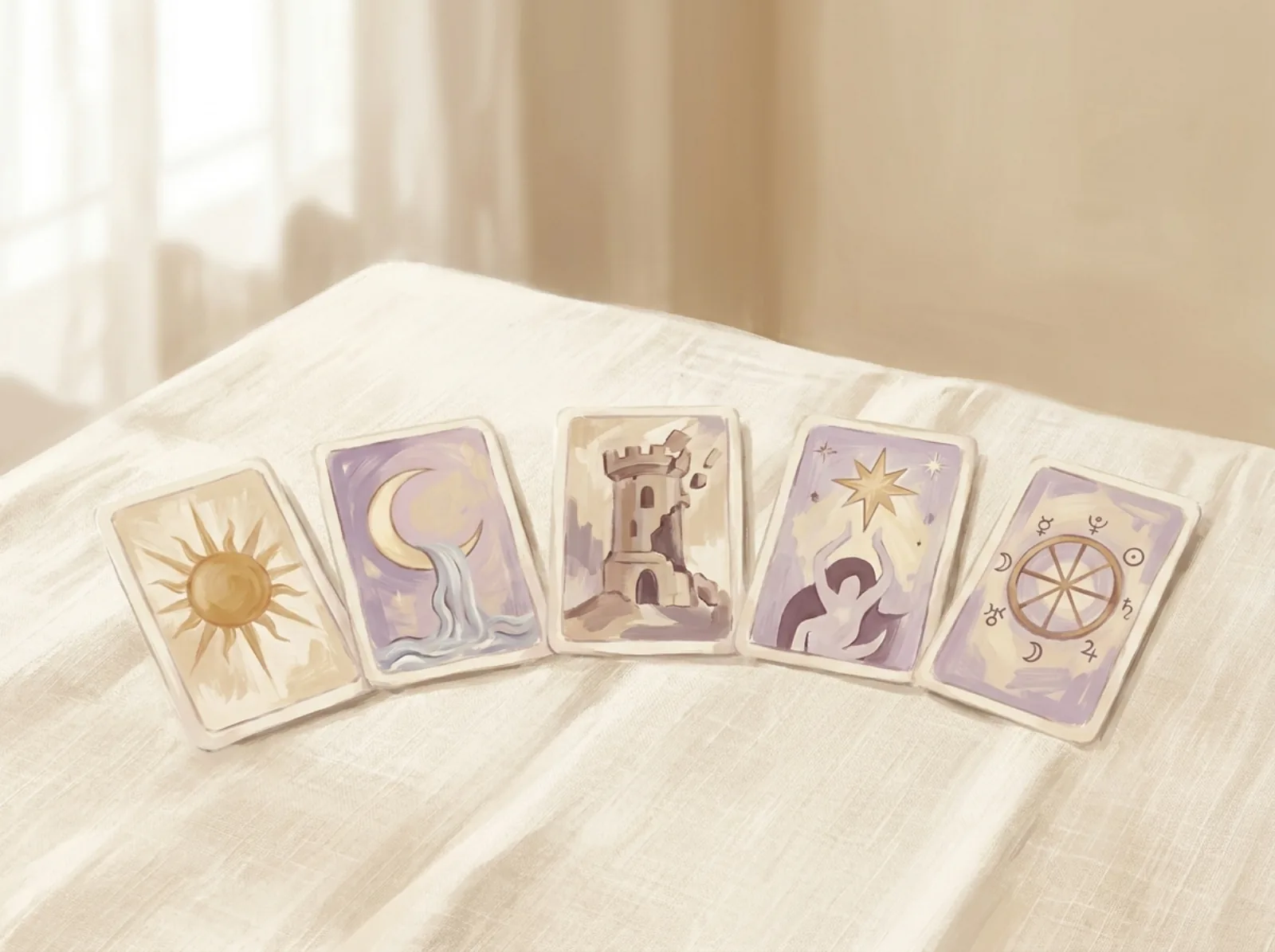
I laid out five cards. What I stand in now. What is hidden. What is blocking me. What the best next step looks like. Where that step leads if I take it. She drew the Four of Pentacles in the first position — a figure clutching coins so tightly he cannot move. She looked at the picture for maybe forty seconds and said, out loud, 'I already left. I've been gone for a year. I'm just scared of losing what I have.' She did not need me. She needed the card to hold the mirror steady while she looked. See our guide. See our best natal chart app guide.
She took the London job. Whether that was the right call I genuinely do not know — I have not spoken to her in three years. But the reading was correct in the only way a career spread can be correct: it named the thing she was refusing to name, and it did so in under ten minutes. This guide is about how to do that same job for yourself, honestly, without turning the deck into a fortune-teller or a therapist. Both would be a category error.
What is a career tarot spread, precisely
A career tarot spread is a defined layout of tarot cards — most often five, sometimes three, occasionally seven — where each position holds a fixed meaning tied to a work question, and the card that lands in that position becomes a prompt for reflection. That is the entire definition. Everything else is technique. It is a journaling exercise with images instead of blank pages, and images are useful because the human brain finds patterns in pictures faster than it finds them in prose.
The tradition this guide draws from is Western tropical tarot using the Rider-Waite-Smith deck, first published in 1909 with illustrations by the artist Pamela Colman Smith and structured under the direction of the occultist A.E. Waite. Waite's 1910 companion volume, The Pictorial Key to the Tarot, is still the reference document. The reason this specific deck dominates career and decision spreads is that Smith painted narrative scenes on the minor arcana — earlier decks had shown only pip patterns, like playing cards — which means every card gives you a story to walk into.
It is not a fortune-telling tool. It is not a therapist. It is not a financial planner. It cannot tell you whether the market will recover, whether the startup will get its Series B, whether your boss will retire, or whether the job offer is a trap. It is a mirror with borders and prompts. Rachel Pollack, in Seventy-Eight Degrees of Wisdom, first published in 1980 and still the most cited modern text, calls the deck a 'moving mandala' — a set of images arranged and re-arranged to help the reader see her own situation from a slight remove.
The specific question the career spread answers, then, is not 'What will happen?' It is 'What am I not letting myself see about what is already happening?' That reframe is not decoration. It determines whether the reading is useful or wasted. When people write to Raka's editorial inbox saying tarot 'didn't work,' nine times out of ten they asked a prediction question. The tenth time, they were fine, they just did not like what they saw.
When to use this spread — and when to close the deck instead
The career tarot spread earns its keep in a narrow band of situations. Use it when you have a specific work decision in front of you, when you have already gathered the material information about that decision, and when you feel stuck in a loop where you keep re-reading the same offer email or drafting the same resignation letter and then closing the tab. That loop is what the spread breaks. It gives your looping brain something concrete to look at.
Use it before an interview, especially one you have already prepared for tactically, to clarify what you actually want from the role rather than what you think you should want. Use it when you are two weeks into a new job and something feels off and you cannot name it. Use it when you have been offered a promotion that would move you further from the work you love. Use it when you keep saying 'I should start my own thing' and doing nothing about it. Use it, in short, when the problem is legibility, not information.
Do not use it when you have not done the research. If you are considering leaving a stable job to freelance and you have not calculated your runway, opened a spreadsheet, or spoken to two people who do the work you want to do, the deck cannot help you and will likely give you false permission. Do not use it as a substitute for a licensed therapist if your work distress is bleeding into your sleep, your eating, your relationships, or your body. Those are signals for a professional, not for a card.
Do not use it to make legal or financial decisions. If your question is 'should I sign this non-compete' or 'should I take the equity instead of the salary,' the answer requires an employment lawyer or a fee-only financial advisor. The deck can tell you how you feel about signing. It cannot tell you what the clause actually enforces. Confusing those two produces expensive mistakes. I have watched it happen. Twice.
The five positions, and what each one is actually asking
The spread I teach at Raka, and that I use myself, has five positions, laid left to right in a straight line. Simplicity is the point. Ten-card spreads like the Celtic Cross are wonderful for broad life reflection but tend to overwhelm a specific work question — you end up interpreting fourteen relationships between cards when the decision was 'should I take the offer.' Five cards give you enough angles to triangulate without so many that you start hallucinating patterns.
Position one is Where I Stand Now. This is not a diagnosis of your career, it is a diagnosis of your current relationship to the specific question. If you are considering an offer, this card describes your posture toward that offer today. Position two is What is Hidden. This is the factor you are underweighting — often something you already know but have chosen not to look at directly. Position three is What is Blocking Me. This is the actual obstacle, which is almost never what you say it is when someone asks you casually over coffee.
Position four is The Best Next Step. Note the phrasing carefully. It is not 'the right answer' and it is not 'what will happen.' It is the next honest action available to you given the first three cards. It might be 'ask for more information,' 'have the hard conversation,' 'wait two weeks,' or 'send the email.' Position five is The Likely Outcome If I Follow That Step. This is not fate. It is a projected trajectory assuming you act on card four, which you may or may not choose to do.
The reason this structure works is that it forces sequence. You cannot skip to the outcome without doing the honest work of the first three cards. Beginners tend to lay all five and stare at the fifth first, which is exactly like flipping to the last page of a mystery novel. Read them in order. Do not look at card five until you have written one sentence about each of cards one through four. This is the single discipline that separates a useful spread from an entertaining one.
How to do this spread, step by step
Step one: write your question down in one sentence on paper or in a notes app. Not in your head. On paper. The question must be specific and it must not be answerable with yes or no. 'Should I take the offer' is a bad question. 'What am I not seeing about this offer from Company X' is a good question. Bad questions produce muddy readings, and then the reader blames the deck.
Step two: shuffle a Rider-Waite-Smith deck, or a deck that follows the same structure, while holding the written question in mind. Shuffle for as long as it takes to stop thinking about lunch. There is no magic number of shuffles. When your hands feel like they want to stop, stop. Step three: cut the deck once with your non-dominant hand, into two roughly equal piles, then reassemble in the reverse order. This is a focus ritual, not a supernatural procedure.
Step four: lay five cards face-up, left to right, in a single row. Do not lay all five and then look. Lay them face-down first, then flip them one at a time as you read. Step five: for each card, write one sentence in your notebook. First describe the picture in plain language — 'a woman blindfolded holding two swords sitting on a bench by the sea.' Then write what that image, in this position, has to do with your question. Do not skip the description step, ever. It is the whole method.
Step six: once you have written a sentence for each of the five positions, read the whole spread as a single story, left to right. What is the arc? What changes between position one and position five? Step seven: close the deck. Do not draw clarifier cards on the first pass. Step eight: wait forty-eight hours before you take any action based on the reading. If the reading still feels true two days later, it probably is. If it does not, that is data too.
A sample reading — anonymized but real in shape
Let me walk through a reading I did for a Raka user — with her written permission, details changed enough that no one could identify her, but the card sequence is what actually came up. Call her M. She was a mid-career marketing director at a healthcare startup in Austin, four years in, offered a VP role at a competitor for a 22 percent raise. Her question, which we workshopped for ten minutes before shuffling, was: 'What am I not letting myself see about accepting the VP role at Company B?'
Position one, Where I Stand: Four of Cups. A figure sitting under a tree, arms crossed, three cups in front of him, ignoring a fourth being offered from a cloud. M laughed when she flipped it. 'I'm bored,' she said. 'I'm just bored at my current job and I've been pretending it's something more meaningful.' The card did not tell her that. She told her, using the card as permission. Position two, What is Hidden: Eight of Pentacles. A craftsman patiently making coins. Hidden factor: she still had craft to learn in her current role that she had been dismissing.
Position three, What is Blocking Me: The Tower. A struck tower, figures falling. She went quiet for a while. Then she said the block was that she had been through one bad startup collapse already and could not tell whether her hesitation about Company B was informed pattern-matching or just trauma. That is exactly the kind of surfaced ambiguity a good spread produces. Position four, The Best Next Step: Two of Swords. The blindfolded woman by the sea. The step was not to decide, but to sit with the choice for another week without collapsing it prematurely.
Position five, The Likely Outcome: Six of Swords. A figure being ferried across still water. The projected trajectory if she took the wait step: a considered transition, not a dramatic one. She did not accept the VP role. She also did not stay. Four months later she took a different role at a third company that neither of us had been thinking about. The spread did not predict that. But it gave her permission to stop deciding on the false binary in front of her, which was the actual gift.
The common misreadings that turn a good spread into a bad decision
Misreading one: treating position five as prophecy. The Likely Outcome position is a projection contingent on you taking the step in position four. If you do not take that step, or you take a different one, the outcome shifts. Readers who read card five as 'what will happen' end up either fatalistic or disappointed. Mary K. Greer, in Tarot for Your Self, published in 1984 and still the standard workbook for personal tarot practice, is emphatic on this: the outcome position describes tendency, not destiny.
Misreading two: cherry-picking. A card comes up that you do not like, so you draw a clarifier, then another clarifier, then another, until you get a card that says what you already wanted to hear. This is called deck-shopping, and it is the tarot equivalent of asking your parents, then your friends, then a stranger on the internet, until someone tells you to buy the house. Do not draw clarifiers on the first pass. If you must, allow yourself exactly one, and treat it as commentary, not correction.
Misreading three: literalism. The Death card does not mean anyone is dying. The Tower does not mean the building is on fire. The Devil does not mean your boss is possessed. These are archetypal images inherited from a medieval European visual tradition, and Waite chose them for symbolic force. Benebell Wen, in Holistic Tarot, published in 2015 and now the most comprehensive contemporary reference in English, spends nearly a hundred pages disentangling literal from symbolic readings. Read her before you panic about a card.
Misreading four: doing the spread for someone else's decision. If your question is 'should my partner take this job,' close the deck. You can do a spread about how you feel about your partner taking the job, which is legitimate self-reflection. You cannot do a spread that decides for another adult. That is not tarot, that is projection with props. Misreading five: doing the spread when you are drunk, exhausted, or acutely emotional. Same rules as sending an important email. Wait until morning.
Variations of the career spread for different questions
The five-card spread I have described is the default. For different flavors of career question, the position labels shift. For a job-offer spread specifically, I use: What this role would give me / What this role would cost me / What I am projecting onto it / What the honest tradeoff is / How I would feel six months in. The costs position is the crucial one, because most people running a job-offer spread have already decided in favor and are looking for confirmation.
For a resignation spread — the 'should I quit' question — I use a seven-card variant: What is actually wrong here / What I have tried already / What I have not tried / What staying looks like in six months / What leaving looks like in six months / What I owe the people around me / What I owe myself. This one takes longer, needs a full hour, and often produces a decision that is not 'quit' or 'stay' but 'have this specific conversation first.' That third option is usually invisible before the spread and obvious after.
For a business pivot or founder question — 'should I shut this down, keep going, or change direction' — I use a three-card triangle: The current thing / The next thing / The thing I am afraid to admit. Founders often ignore the third position and it is always the most important. For an interview prep spread, three cards is enough: What they need to hear from me / What I need to hear from them / What I most want to remember about who I am walking in. This one, done the night before, has settled more of my own nerves than any breathing exercise.
For a longer-arc career direction question — 'what should the next three years look like' — the five-card spread does not work, because the timeline is too vague. Use a monthly ritual instead: one card at the start of each month with the question 'what does this month want me to focus on,' and keep a log. At the end of twelve months you have a year of self-observed patterns, which is more valuable than any single reading. Raka's saved-readings feature makes this specifically easy, which is one of the reasons the app exists.
How this spread differs from the Celtic Cross, the daily draw, and other adjacent layouts
The Celtic Cross is a ten-card general-purpose spread covering the situation, the crossing influence, the foundation, the past, the crown, the near future, the querent's self-image, external environment, hopes and fears, and final outcome. It is exhaustive, and for a big fuzzy life question — 'what is going on with me right now' — it is unmatched. For a specific work decision it is overkill. You end up interpreting eight positions that are not relevant to whether you take the offer.
The daily draw, one card in the morning as a focus prompt for the day, is the opposite end of the spectrum. It is a meditation tool. Use it to build a relationship with the deck and to learn card meanings by repeated exposure. It cannot answer a career question because it has no positions and no structure. It is fine to do a daily draw during a period when you are also running a career spread once a week — they serve different purposes.
The three-card spread — past, present, future — is the most commonly taught first spread, and I actively discourage it for career questions. The past position is rarely useful when the decision is forward-looking, and the future position tends to be read as prediction rather than projection. If you want a three-card layout for career, use the founder triangle I described above: current thing, next thing, the thing you are afraid to admit. Those are three positions that do work you cannot do without the deck.
There is also a set of relationship-style spreads sometimes applied to career — the 'you and your boss' spread, the 'you and this company' spread — that treat your relationship to work as a partnership. These can be useful once you have already answered the primary decision. They are not a replacement for the five-card career spread; they are a follow-up. Sequence matters. Big question first, texture questions after, always in that order.
The reversal question, and why I use them sparingly for career readings
Reversed cards — cards that come out of the shuffle upside-down and are read with modified meaning — are a longstanding tradition in Western tarot. Waite included reversed meanings in Pictorial Key. Pollack discusses them at length. Whether to use them is a live debate among modern readers, and it is a debate I have opinions about in the specific context of career spreads.
For career readings, I do not shuffle in a way that produces reversed cards, and I recommend beginners do the same. The reason is that career decisions produce enough ambiguity on their own — 'is this a good move or a bad move' is already the question — and adding a second layer of upright-versus-reversed interpretation tends to muddy rather than clarify. You end up second-guessing whether the Ten of Pentacles reversed means 'not quite yet' or 'the opposite of stability' or 'stability that comes at a cost,' and you have lost the thread of the actual question.
Once you have been reading for two or three years and you have built a personal library of what specific cards mean to you in specific positions, adding reversals is a legitimate way to deepen the practice. Wen's Holistic Tarot has a strong chapter on this. Until then, keep the deck upright. The image on the card is layered enough. The Two of Swords upright already contains the meaning 'held decision.' You do not need reversed to unlock it.
If you inherit a deck that has been used with reversals and you keep pulling reversed cards even after re-ordering, that is not a message from the deck. That is friction in the cards. Straighten them once, shuffle thoroughly, and move on. Attributing narrative significance to a physical artifact of the shuffle is exactly the kind of category error that turns tarot from a reflection tool into a superstition, and superstition is the enemy of the practice.
The evidence base — what we actually know about tarot use in decisions
Tarot is not evidence-based medicine. It has not been studied in randomized controlled trials for career decision-making, and any article that tells you otherwise is fabricating. What we do have is market data on how many people are using it. IBISWorld's 2023 report on the US Psychic Services industry — which includes tarot, astrology, and other mystical services — sized the market at approximately $2.3 billion, with steady growth over the past decade driven partly by app-based delivery. That is a real number from a real source.
Pew Research Center's 2018 survey on Americans and the paranormal found that roughly 29 percent of US adults believe in astrology, and separate consumer research from Statista over 2021–2023 shows tarot and astrology app downloads growing significantly year over year, particularly among adults aged 25 to 44. What this tells us is descriptive, not prescriptive: a lot of people are using these tools. It does not tell us whether the tools are working, because 'working' has not been defined in a way that could be tested.
There is one adjacent body of research worth naming: the psychology literature on structured reflection and journaling as decision aids. James Pennebaker's expressive writing studies, running since the mid-1980s, consistently find that structured written reflection on a difficult question improves clarity and reduces rumination. A tarot spread with a written journaling protocol is, functionally, a structured reflection exercise dressed in symbolic imagery. That is a reasonable inference to draw. It is not proof that the deck 'works.'
If you are the kind of person who needs the practice to have some empirical scaffolding to feel legitimate, I would offer this: the spread does not need to be true in a metaphysical sense to be useful in a practical one. The five positions are a template for slower thinking. The images are prompts that bypass verbal loops. The written record is a decision journal. If those three things help you make a better career choice than you would have made in your head, the practice is doing its job. That is the honest claim.
The therapy caveat, the financial caveat, and the legal caveat
If your career distress is disturbing your sleep, your appetite, or your relationships, or if you are having thoughts of harming yourself, close this article and contact a licensed mental health professional. In the US, you can reach the 988 Suicide and Crisis Lifeline by call or text. In the UK, the Samaritans are at 116 123. In Canada, the Talk Suicide Canada line is 1-833-456-4566. In Australia, Lifeline is 13 11 14. Tarot cannot do this work. It is not equipped to and it should not be asked to.
If your career question involves money — whether that is a large severance decision, a stock-versus-salary offer negotiation, a business loan, or a startup runway calculation — pair the tarot reflection with a conversation with a fee-only fiduciary financial advisor. Fee-only advisors are paid by you and only you, which removes the commission conflict. The National Association of Personal Financial Advisors maintains a searchable directory. Tarot can tell you how you feel about the money question. It cannot do arithmetic.
If your career question involves a contract — a non-compete, an equity vesting schedule, a severance agreement, a partnership agreement, an intellectual property assignment — pair the tarot reflection with a consultation from an employment lawyer in your jurisdiction. Contract language is enforced by courts, not by symbolism, and the difference between what a clause says and what a clause does can only be assessed by someone who reads those clauses for a living. Do not sign contracts based on card readings. I should not have to write that sentence, but I do.
Finally, if your career question involves your physical health — whether the job is making you sick, whether you can sustain a role given a chronic condition, whether a schedule is compatible with medical treatment — talk to your doctor. This is the caveat I want most to be clear about, because career decisions and health decisions are almost always entangled and almost never discussed together. The deck cannot see your labs. The deck is not a substitute for the appointment you have been putting off.
How to build a personal practice around this spread over time
A single career spread is useful. A sustained career reflection practice, running months and years, is transformative in a way a single spread is not. The reason is the review loop. When you do a reading, write it down, take some action, and then months later go back and see what actually happened versus what you saw in the cards, you learn something about how you read — where your blind spots are, which cards you consistently misinterpret, which questions the deck is good for and which it is not.
The way I run my own practice: I keep a tarot journal, a physical notebook, one line per day. When I do a spread, I write it up in full — question, position, card, first interpretation, action taken. Once a quarter I read the last three months' entries. Once a year, on the last day of the year, I read the whole year. This has been the single most useful career development exercise I have done, and I mean that against a background of coaching, executive education, and about eighty books on career strategy.
The reason it works is that career decisions get evaluated wrong. We remember the outcome — I took the job, it went badly — and we forget the process — I was doubtful going in and ignored the doubt. The written spread record preserves the process, which is the thing you can actually learn from. Outcomes are contaminated by luck. Process is the signal. This is a distinction Annie Duke makes in Thinking in Bets that applies precisely to tarot journaling, though she was writing about poker.
If you are using an app, use one that lets you save readings with the date and your notes attached and lets you search them later. That is one of the design principles behind Raka's spread feature — I helped write the spec — and it is the specific feature I use most. If you are using physical cards, keep the notebook next to the deck and do not separate them. The deck without the journal is entertainment. The deck with the journal is a practice.
Where to go from here
If this is your first time doing a career tarot spread, start with the five-card layout I described in the step-by-step section. Do it once about a decision you are actually facing right now. Write it down. Wait forty-eight hours. Notice what surfaces. Do not do it again for at least two weeks. Do not, under any circumstances, do multiple spreads back to back on the same question hoping for a better answer. That is the fastest way to lose respect for the practice.
If you want to go deeper on the tradition, read Rachel Pollack's Seventy-Eight Degrees of Wisdom first, because it will change how you see every card. Then Benebell Wen's Holistic Tarot, which is closer to a textbook and will teach you method. Then A.E. Waite's Pictorial Key to the Tarot, which is short, sometimes archaic, and worth reading for the source-text perspective on Smith's images. Mary K. Greer's Tarot for Your Self is a workbook and is best read with a notebook open.
If you want a companion that walks you through spreads without requiring you to memorize seventy-eight card meanings from scratch, Raka has an AI reader built for exactly this pattern — you ask a question, it walks you through the spread, and it saves the reading so you can look at it again in three months. It is a tool I edit for and it is the tool I use myself. It is not a replacement for building the practice by hand, but it lowers the friction of getting started, which for most people is the actual barrier.
Whatever tool you use, the one thing I would ask you to take from this guide is that tarot is not for outsourcing decisions. It is for slowing them down long enough that you can hear yourself think. In a professional culture that rewards speed of judgment and punishes uncertainty, a practice that gives you permission to sit with a question for two days before deciding is not a superstition. It is a discipline. That is the argument for keeping a deck on your desk. The rest is illustration.
Frequently asked questions
What is the career tarot spread?
A career tarot spread is a structured layout of tarot cards, most commonly three to seven positions, used as a reflective exercise for a specific work question — a job offer, a resignation, a pivot, a promotion push, or an interview. Each position holds a defined meaning (present situation, hidden factor, likely outcome), and the card drawn there becomes a prompt for self-examination. It is a journaling tool with pictures, not a forecast, and it works best when your question is concrete.
How do I do a career tarot spread?
Write your question down in one sentence, no yes-or-no phrasing. Shuffle a Rider-Waite-Smith deck while holding the question in mind. Cut once with your non-dominant hand. Lay five cards left to right: Where I Stand, What is Hidden, What is Blocking Me, The Best Next Step, and The Likely Outcome If I Follow It. Read each card in position, then read the whole spread as a story. Write down what surfaced. Wait forty-eight hours before acting.
When should I use a career tarot spread?
Use it when you already have a specific decision on the table and you feel stuck — a written offer with a deadline, a resignation you keep drafting and deleting, a pivot you have been researching for months, an interview next week. The spread works when you have gathered information but cannot metabolize it. It is not useful when you have done zero research, when you want the deck to give you permission for something reckless, or when the real problem is untreated anxiety.
How is the career tarot spread different from a Celtic Cross?
The Celtic Cross is a ten-card general-purpose layout covering past, present, future, hopes, fears, environment, and outcome. It is thorough but sprawling for a specific work decision. A career spread is tighter, usually five to seven positions, all aimed at one question. The Celtic Cross is a wide-angle life photograph. A career spread is a portrait. If you want situational overview, use Celtic Cross. If you want to decide something specific by Friday, use a career spread.
Can I do a career tarot spread online or with an app?
Yes, and for many readers it works better than physical cards because the interpretations, position meanings, and journaling prompts are built in. Raka, the app I edit for, walks you through card meanings in each position and lets you save readings so you can compare what you drew in March against what actually happened in June. That review loop is the difference between tarot as entertainment and tarot as a sharpening tool. Physical decks are lovely; digital decks are studyable.
What if I draw a card I don't understand?
Do not look up a keyword and stop. Look at the picture first. In a Rider-Waite-Smith deck, Pamela Colman Smith drew narrative scenes on every card — a figure walking away, a cup being offered, a tower struck by lightning. Describe what you see in one sentence, then ask what that image has to do with your question. If you are still lost, check Rachel Pollack's Seventy-Eight Degrees of Wisdom or Benebell Wen's Holistic Tarot, both of which give layered readings rather than one-line definitions.
How often should I do a career tarot spread?
For any single decision, once is usually enough, and re-drawing within seventy-two hours to get a different answer is the most common mistake beginners make. For career life more broadly, a monthly reflection spread on the first of the month is a reasonable rhythm — it gives you a track record to review at year's end. If you find yourself pulling cards daily about the same job question, that is a signal to talk to a career coach or therapist, not the deck.
Should I use tarot to make a final decision about quitting my job?
No. Use tarot to surface what you already know and are avoiding — the resentment, the relief, the fear, the specific grievance you have not named out loud. Then take that clarified feeling into a conversation with a partner, a mentor, a career coach, or a licensed therapist, and pair it with a written financial runway calculation. Tarot is the first step of a decision, not the last. Anyone, myself included, who tells you the deck decided for them is skipping the accountability that makes a decision yours.