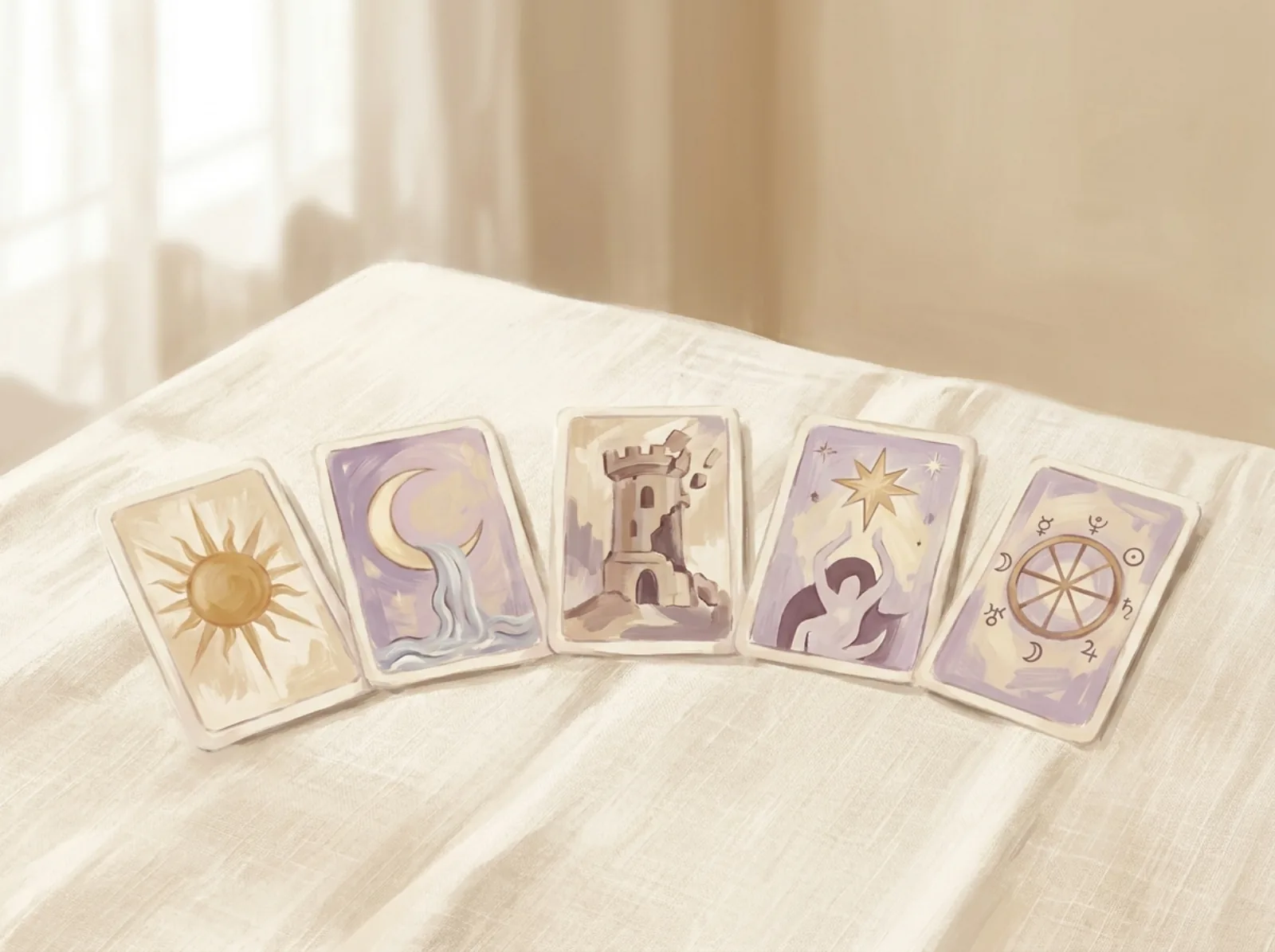
What is a love tarot spread, and when is it actually the right tool?
A love tarot spread is a fixed arrangement of tarot cards in which each position represents a specific facet of a romantic question — usually including the querent's feelings, the other person's feelings, the shared dynamic between them, hidden influences, and a possible next step. The layout gives structure to what would otherwise be a vague pull, letting a reader trace how the cards speak to one another rather than in isolation. In the Western tarot tradition rooted in the Rider-Waite-Smith deck (A.E. Waite, Pictorial Key to the Tarot, 1910, illustrated by Pamela Colman Smith), a love spread is not a prediction of what will happen. It is a mirror for what you already feel but have not yet let yourself name. Part of our card meanings library. Part of our complete tarot spread library. Explore the full library. Part of our complete astrology reference.
I want to say that clearly at the top because the way this tool gets marketed online — with countdowns and 'will he text me back' clickbait — actively harms people. In fifteen years of reading, first at a metaphysical shop off Camden High Street, then online for Raka, I have watched more clients get hurt by a bad prediction-frame than by any card in the deck. The frame decides everything. See our best AI tarot app guide for a full breakdown.
So here is how I use the phrase in this guide, and how the Raka editorial team uses it in the app: a love tarot spread is a deliberate reflection exercise, using an image-based system with roughly six hundred years of Western symbolic tradition behind it, to help you sit with a romantic question long enough to hear your own answer. It is closer to journaling with pictures than to fortune-telling. It is closer to a therapist's Socratic question than to a horoscope column. See our guide.
The last time I picked up a deck for myself was for something small and specific. A friend — I will call her R. — had asked me at brunch whether she should reply to a two-line message from an ex who had left her nine months earlier. She had not touched the message in four days. She was not asking me to predict what he would do. She was asking me to help her figure out what she wanted to do. That is the question a love spread is built for. See our best AI tarot app guide.
We used the Reconciliation Clarity Spread I describe further down this guide. The reading did not tell her to reply or to block him. It surfaced the fact that she had already made the decision two days earlier and was looking for permission to sit with it. She left brunch, deleted the thread, and paid the bill. That is what a good love spread does.
If you came to this article hoping I would tell you which cards mean he is coming back, I am going to disappoint you on purpose. What I will give you instead is seven spread designs, a step-by-step method for each, a sample reading, the most common ways people misread these layouts, and a very clear line about when to close the deck and call a licensed therapist. Deal?
Why do love spreads work as reflection tools when we know they are not predictive?
The honest answer is projection, in the technical psychological sense rather than the pejorative one. When you look at an image that is ambiguous enough to hold multiple readings — the Two of Cups, the Lovers, the Three of Swords — you fill in the ambiguity with material from your own inner life. Rachel Pollack, whose Seventy-Eight Degrees of Wisdom (1980) remains the deepest single English-language commentary on the Rider-Waite-Smith imagery, called this the deck's 'wisdom function': the cards give the unconscious a vocabulary it did not previously have.
That vocabulary matters in romantic questions specifically, because love is the domain where we most reliably lie to ourselves. We rationalise. We minimise red flags. We construct narratives in which we are entirely the wronged party or entirely the villain, because the middle is unbearable. A tarot image is stubborn. The Five of Cups shows a figure staring at three spilled cups while two full ones sit behind them, ignored. You can argue with a friend. It is much harder to argue with that picture when you have just asked what you keep missing in this relationship.
Benebell Wen makes this case rigorously in Holistic Tarot (2015), which I recommend to every intermediate reader who wants to move past app-generated meanings. She frames tarot as an analytic tool comparable in function — though not in evidence base — to structured journaling, Jungian active imagination, or the reflective questioning used in coaching. The cards do not know anything. You know things. The spread gives you a scaffold on which to notice what you know.
This is also why the physical or on-screen structure of a spread matters. A random three-card pull with no position labels is a vibe check. A three-card spread with defined positions — you as you show up in this connection, them as they show up, the space between you — turns the same three cards into three specific reflection prompts. Structure is the whole game.
None of this requires belief in a supernatural mechanism. I have read for atheist software engineers, agnostic ER nurses, and one Jesuit priest, and the spreads worked in each case for the same reason: they slowed the person down and forced a specific, named question.
What do you need before you sit down to a love reading?
Practically, you need four things, and none of them are candles or incense unless those genuinely help you focus. First, a full 78-card tarot deck. I recommend the standard Rider-Waite-Smith or a close derivative (the Universal Waite, the Radiant Rider-Waite, or the Smith-Waite Centennial) for anyone in their first two years of reading, because the entire English-language literature is keyed to that imagery. Deviant Moon and Wild Unknown are gorgeous but they will slow you down while you are still learning.
Second, a surface. A cleared table, a bed with a folded scarf laid across it, or the Raka app's spread canvas if you are reading digitally. Physical readers should have enough room to lay out ten cards without cards touching the edge — a Celtic Cross variant needs roughly the space of a large placemat.
Third, a specific question. This is where most love readings fail before a single card is turned. 'Will we get back together?' is not a question a spread can meaningfully hold, because it demands a prediction the deck cannot provide. 'What am I actually feeling about the possibility of reaching out to my ex?' is a question a spread can hold beautifully. The rewrite is not a semantic trick. It shifts the reading from a fortune-telling frame to a reflection frame, which is the only frame where tarot has any integrity.
Fourth, a container for the emotions the reading might raise. That can be a journal open next to you, a voice note app, a scheduled call with a friend afterwards, or, if the question sits near real distress, a therapist's number in your phone. This last piece is not optional. Love spreads pull grief, longing, shame, and old attachment wounds to the surface. If you do not have somewhere to put what surfaces, do not do the reading yet.
One thing you do not need: to have memorised all 78 card meanings. Mary K. Greer's Tarot for Your Self (1984) makes this point forcefully — the meanings live in the imagery and in the position, and a beginner reading intuitively from the picture is often more accurate than an intermediate reader reciting a dictionary definition. Trust the picture first, the book second.
How do you shuffle, cut, and set intention for a love reading?
Shuffling is a physical practice that does two things at once: it randomises the card order, and it gives your nervous system time to settle into the question. Both matter. I shuffle for roughly the length of one slow inhale-exhale cycle repeated seven times — about ninety seconds — while silently holding the specific question I have written down. If the question drifts during the shuffle, I stop, re-read the written question, and start again.
There is no correct shuffle technique. Overhand, riffle, smoosh (spreading the cards face down on the table and mixing them in circles with both hands) — all work. What matters is that you can feel when the shuffle is done. Most readers describe this as a subtle sense of the deck 'settling.' If that language feels too woo, treat it as the moment when your intrusive thoughts about grocery lists stop and the question fills the front of your mind.
Cutting the deck is optional and traditional rather than mechanically necessary. If you cut, use your non-dominant hand, cut into three piles moving left, and restack right-to-left. I do this because the small ritual creates a clear transition between 'thinking about the question' and 'reading the answer.' If it does not add anything for you, skip it.
Setting intention out loud helps more than people expect. Even a single sentence — 'I am asking this spread to help me understand what I am feeling about M., not to predict what M. will do' — anchors the reading in reflection rather than prediction. The Raka app prompts you to type this sentence before it deals a spread for exactly this reason. Written intentions are harder to drift from than mental ones.
Finally, do not repeat a reading the same day because you did not like what came up. This is the single most common integrity failure I see. If a reading lands hard, close the deck, journal, sleep, and come back in a week if you still need to. Re-shuffling for a better answer teaches you nothing except how to lie to yourself with props.
Spread one: the three-card new connection layout
This is the spread I hand every beginner who wants to read about a new person they are seeing — someone they have been on three or four dates with, or a longer situationship that has not yet defined itself. It is minimal on purpose. Early connections do not have enough shared history to support a ten-card Celtic Cross, and trying to force one produces meaningless noise.
The layout is three cards in a horizontal row, dealt left to right. Position one, on the left, is 'what I am bringing into this connection' — your current pattern, hunger, wound, or gift as you show up. Position two, in the centre, is 'what they appear to be bringing' — with the enormous caveat that you can only read your perception of them, not them directly. Position three, on the right, is 'what the shared space is asking of both of you right now.'
How to do it, step by step. One: write your question. A good one is 'What is actually happening in the connection between me and [name] right now?' Two: shuffle for ninety seconds holding that question. Three: deal three cards face down, left to right. Four: turn the leftmost card and sit with it for one full minute before speaking or writing. What does the figure in the image seem to be doing? Where are they looking? Five: turn the middle card and repeat. Six: turn the right card and read all three as a sentence — left, middle, right — as if the images were a three-panel comic.
When to use it. Early dating, four to twelve weeks in, when you cannot tell whether what you are feeling is real interest or novelty. Also useful after a first significant conflict in a new connection, when you want to check whether you are catastrophising.
When not to use it. Do not use this spread for questions about ex-partners, marriages, or any relationship with more than a year of shared history. Three cards cannot hold that much material, and you will end up projecting your entire relationship onto three images.
Spread two: the seven-card partnership check-in
This is the workhorse of my practice for established couples — people who have been together at least a year and have real shared infrastructure: a lease, a joint calendar, a language of inside jokes. It is designed for the moment when nothing is obviously wrong but something feels quietly off, or for scheduled relationship check-ins (I recommend one every quarter, tarot or no tarot).
The layout is a horseshoe. Cards one, two, and three sit in an ascending diagonal from the lower left. Card four sits at the top centre. Cards five, six, and seven descend in a mirroring diagonal to the lower right. Card one is 'where we were'. Card two is 'where I currently stand'. Card three is 'where you currently stand — as I perceive it'. Card four, the top of the arch, is 'the shared field between us right now'. Card five is 'the invitation of the moment'. Card six is 'what I need to bring more of'. Card seven is 'what I need to release'.
Notice that positions six and seven are entirely about the querent, not the partner. This is deliberate and non-negotiable in my practice. A love spread that gives you seven cards' worth of instructions about what your partner should change is not a reading, it is a grievance list with tarot as decoration. The check-in spread ends on the querent's own agency because that is the only variable you actually control.
The seven-card check-in pairs well with an actual conversation afterwards. I ask clients to write one sentence per position, then share only positions one, two, four, six, and seven with their partner — positions three and five stay in the reader's private journal, because they are perceptions and possibilities rather than statements of shared fact.
When not to use it. Do not use this spread in the acute aftermath of an affair, a serious breach of trust, or during a mental health crisis for either partner. Those situations need a couples therapist, not a card layout. The check-in is for the ordinary weather of a functioning relationship, not for storms.
Spread three: the reconciliation clarity spread for ex-partners
This is the spread I designed after watching too many people use general love spreads to torture themselves about exes. The problem with a generic layout in the ex-partner context is that it invites the querent to read every ambiguous card as evidence that reconciliation is imminent. The Reconciliation Clarity Spread is built to refuse that invitation.
Five cards, laid in a cross. Card one, centre: 'What actually ended it, as I can see it now with distance.' Card two, top: 'What I have been telling myself the story is.' Card three, bottom: 'What I am still carrying that has nothing to do with them.' Card four, left: 'What reconciliation would actually require from me, not just from them.' Card five, right: 'What my life is asking me to build if this door stays closed.'
Notice that no position asks 'will they come back' or 'do they still love me'. Those questions are unanswerable by a deck of cards, and asking them keeps you stuck in a fantasy relationship with the version of your ex who lives in your head. The five positions here are all about the querent's clarity, because clarity is the only thing that makes a good decision possible — whether the decision is to reach out, to stay no-contact, or to leave the possibility genuinely open without organising your life around it.
I gave R., the friend I mentioned at the start, exactly this spread over eggs benedict and lukewarm coffee. Her card four, the reconciliation-would-require position, was the Ten of Wands — the figure bent under a bundle of staves, staggering towards a distant town. She looked at it, laughed once without much humour, and said 'yeah, I do not have that in me right now.' That was the reading. The image did the work I could not have done by asking her the question directly.
This spread should not be used within the first thirty days of a breakup. Grief in the acute phase is not ready for clarity, and forcing it produces false clarity that later collapses. Wait. Sit with the mess. Come back to the deck when you can hold the cards without your hands shaking.
Spread four: the unrequited feelings spread
Unrequited love has its own shape, and it deserves a spread that respects that shape rather than pretending it is the same as any other romantic question. What makes it distinct is the asymmetry: one person is experiencing an intense inner reality that the other person may not know about, may know about and not reciprocate, or may reciprocate partially but not act on. A spread for this situation has to hold all three possibilities without collapsing into the most flattering one.
Four cards, laid in a diamond. Top: 'The feeling itself — what is it actually made of?' Right: 'What in me this person is answering — the hunger, the wound, the projection.' Bottom: 'What is objectively knowable about the other person's position, based on their actual behaviour.' Left: 'What I am being asked to learn from this that has nothing to do with whether they ever return the feeling.'
The right-hand position — what in you this person is answering — is the position that does the actual healing work. Most sustained unrequited feeling is not really about the specific person. It is about a template. The unavailable parent, the earlier partner who left, the version of yourself you cannot access without someone else's gaze. The card in that position will often name the template with uncomfortable precision. Sit with it.
The bottom position deserves its own note. 'Objectively knowable' means their actions, not their words, and certainly not your interpretation of their words. If a person has told you they are not available, replied to your messages once a fortnight for six months, or is in another committed relationship, that is the objective data. A card in this position does not override that data. It contextualises it.
This spread is not appropriate for questions about a person you have never spoken to, a public figure, or someone you know only through social media. If you find yourself wanting to do a tarot spread about someone in that category, the reading you actually need is a conversation with a therapist about limerence. That is not a judgement. Limerence is a well-documented pattern and there is real help for it, and none of that help lives inside a tarot deck.
Spread five: the breakup clarity spread
This is the spread for the twenty-four to seventy-two hours after a breakup, when everything feels like a mistake and you cannot tell which decisions to trust. It is deliberately short — four cards — because a devastated nervous system cannot integrate a ten-card reading, and trying to do one will just retraumatise you.
Four cards in a square. Top left: 'What was true about the relationship that I stopped being able to see clearly.' Top right: 'What was true about the relationship that I am tempted to now erase.' Bottom left: 'What this ending is protecting in me.' Bottom right: 'The very next small right thing.'
The two top cards work as a pair. Grief distorts memory in two directions at once. In the first week, we tend to remember the relationship as either uniformly wonderful — how could I have thrown this away — or uniformly terrible — good riddance, I am fine. Both distortions are defences against sitting with the full picture, which is that most relationships that end contained real love and real incompatibility, and both were true the whole time. The top two positions insist on holding both.
The bottom-right position is the position I care about most in this spread. Grief cannot be solved in four cards. But grief can survive the next hour, the next meal, the next work meeting, if you can identify one small right action. The card in this position is not a life plan. It is permission to do one specific concrete thing: text your sister, take the shower, cancel the party, eat the toast. Small right things are how you get through the first week.
Do not do this spread while intoxicated, in the middle of the night after less than three hours of sleep, or in the physical presence of the person you have just broken up with. If you cannot wait until morning, cannot wait until sober, or cannot wait until you are alone, you are not in a state where any reading will help you. Put the deck down and text a friend.
Spread six: the twin flame mirror spread
I need to preface this one with a caveat, because the twin flame concept has been badly abused by parts of the online spiritual community, and I have watched people stay in genuinely harmful situations because they had been convinced the harm was proof of a cosmic bond. The framing I use is deliberately narrow. In this guide, 'twin flame connection' means a relationship in which the intensity of mutual mirroring — the way each person surfaces the other's unresolved material — is unusually high. It does not mean a person is destined to be with you regardless of how they treat you. Nothing means that.
With that said, mirroring-heavy connections are real and they do deserve a spread that reflects their structure. Six cards, laid in two vertical columns of three, left column for you and right column for them. Row one: 'the wound each of us walked in with'. Row two: 'the pattern each of us is currently running'. Row three: 'the invitation each of us has been offered by this connection'.
Read the rows across, not the columns down. The point of this layout is to see the mirroring — how your wound and their wound rhyme, how your pattern and theirs interlock, how the invitation to each of you is the same lesson from opposite sides. This is what a twin flame spread should surface, not fated-mate certainty.
The spread will sometimes reveal that the mirroring is real but that the relationship is not currently a container in which either person can do the work. That is a valid outcome. Intensity of connection is not the same thing as suitability for a shared life. The Rider-Waite-Smith Tower is the card I most often see in this reading, and it is almost never bad news in the long run — it is the collapse of a structure that could not hold what the connection was surfacing.
If you are asking this spread about a relationship that involves any form of abuse — physical, sexual, financial, or a pattern of coercive control — please close the deck now and contact a domestic violence support service in your country. In the US, the National Domestic Violence Hotline is 1-800-799-7233. In the UK, Refuge is 0808 2000 247. No spread justifies staying. No cosmic bond exists that requires you to be harmed.
Spread seven: the compatibility cross spread
This is the most structural of the seven spreads, and it is the one I use for people in the six-to-eighteen-month window of a relationship — past the honeymoon, before the deep-infrastructure decisions of moving in, marriage, or children. The question it is designed for is 'what are the actual compatibility contours of this relationship, beyond the initial spark?'
Six cards in a cross with a foundation. Card one, centre: the core of the connection as it currently is. Card two, crossing card one horizontally: the primary friction or growing edge. Card three, above: the aspirational or ideal version of the partnership as both of you consciously want it. Card four, below: the actual foundation the partnership is currently built on. Card five, left: what each of you brings from your family of origin that shapes how you show up. Card six, right: the honest medium-term trajectory if nothing significant changes.
The card-four foundation position is the most important. Many relationships live on a foundation of proximity, convenience, or fear of starting over, and describe themselves in card-three aspirational language. When card three and card four are wildly different cards — say, the Two of Cups above and the Four of Pentacles below — that gap is the reading. It is not a verdict. It is an invitation to look at whether the aspiration is honest and whether the foundation can be rebuilt.
Card six, the trajectory position, deserves the strongest possible caveat: it is not a prediction. It is a description of where the current pattern points if the pattern continues unchanged. Patterns can change. That is the whole point of doing this reading. I have watched relationships transform on the strength of one honest conversation triggered by a Ten of Swords in the trajectory position.
When not to use the compatibility cross. Do not use it in the first six months of a relationship — you do not yet have enough data. Do not use it as a stand-in for the actual conversations about children, finances, geography, and religion that determine long-term compatibility more than any card layout can. The cards can help you notice what you already know. They cannot substitute for asking your partner directly.
A sample reading: the partnership check-in for a fictional client
Let me walk through a full seven-card partnership check-in reading to show how the spread actually functions in practice. The client is fictional and composite — no real querent — but the cards are drawn as they came up in a demonstration reading I did for a Raka editorial workshop last year. Call the client J. She has been with her partner for four years, lives with him, no children, works in nonprofit fundraising, has been feeling 'quietly unenthusiastic' for about three months.
Card one, where we were: the Two of Cups. The classic mutual-recognition card, two figures raising cups to each other under a caduceus. J. and her partner met at a work fundraiser and both remember the first six months as a specific kind of easy. The card names that, and it names it as past tense in this position.
Card two, where J. currently stands: the Four of Cups. A figure sitting under a tree, three cups in front of them, a fourth cup being offered from a cloud, ignored. This is not a card about a bad relationship. It is a card about satiety, mild disengagement, the failure to notice what is still being offered. Sitting with the image, J. recognises that she has stopped looking for what her partner is doing well.
Card three, where the partner stands as J. perceives him: the Knight of Pentacles. Slow, steady, committed, unflashy. J. reads this as accurate to her partner as she has known him for four years, and also notes with some discomfort that the same steadiness she chose him for is now the quality she is quietly disappointed by. This is useful information about her, not about him.
Card four, the shared field: the Hierophant. A tradition card, a structure card, sometimes a marriage card. Sitting at the top of the arch, it suggests the relationship is currently being held together more by shared framework — the flat, the routines, the mutual friends, the assumption of continuity — than by active engagement. Neither good nor bad. Diagnostic.
Card five, the invitation: the Six of Cups. Nostalgia, but read forward as a call to bring the qualities of the early relationship — curiosity, generosity, small offered gifts — into the present rather than merely mourning them. Card six, what J. needs to bring more of: the Page of Wands. Playfulness, initiation, the willingness to suggest the weird date instead of waiting to be invited. Card seven, what she needs to release: the Five of Pentacles. A story of scarcity, of 'nothing is being offered to me', that is not actually true and is keeping her frozen. That is the reading. J. left it with two concrete actions and a scheduled follow-up in three months, which is the entire point.
Common mistakes people make with love spreads, and how to avoid them
The single most common mistake is asking the wrong shape of question. 'Will he come back' is not a question a tarot spread can answer, because it demands prediction, and the deck does not predict. 'What am I feeling about the possibility of him coming back' is a question the deck can answer beautifully. If your question starts with 'will', 'when', or 'does he still', rewrite it before you shuffle. Every time.
The second most common mistake is re-reading. You do a spread, you do not like what came up, you shuffle again with a slightly different question and read it as an update. This is not an update. It is you searching for the answer you already wanted, using the deck as a slot machine. If a reading lands hard, close the deck, journal, sleep on it, and revisit the same question no sooner than a week later.
The third mistake is reading for someone who has not consented. Doing a full compatibility reading on your date's cards without asking them is a boundary violation dressed up as fun. Doing a reading on your ex to figure out what they are 'really feeling' is the same violation with a longer target. Read your own experience of the relationship. Do not read them.
The fourth mistake is treating reversed cards as opposites. In the Rider-Waite-Smith tradition as codified by Waite himself, reversals often indicate the same energy in blocked, internalised, or emerging form, not a flipped meaning. The Ten of Cups reversed is not 'no family happiness'; it is more usefully read as family happiness that is either fragile, unrealised, or currently obscured. Benebell Wen's Holistic Tarot has the clearest working system for reversals I have found.
The fifth mistake is confusing intensity of card imagery with severity of situation. The Death card, the Tower, the Ten of Swords, and the Three of Swords all look alarming and are all much more nuanced than their imagery suggests. Death is transformation. The Tower is the collapse of a false structure. The Ten of Swords is rock bottom that contains the beginning of the return. The Three of Swords names heartbreak in a way that lets it move through you. None of them are catastrophes. All of them are portals.
When should you close the deck and call a licensed professional instead?
This is the most important section in this guide, and I have put it near the end on purpose so it does not read as fine print. Tarot is a reflection tool. It is not therapy, it is not medication, it is not couples counselling, it is not legal advice, and it is not a financial planner. It cannot diagnose, treat, cure, or prevent any condition. It cannot substitute for the trained attention of a professional. Anyone selling it as those things is either misinformed or dishonest.
Close the deck and contact a licensed therapist if the questions you are bringing to your spreads keep returning to intrusive thoughts about a person you cannot stop thinking about, self-harm, suicidal ideation, panic attacks, or dissociative episodes. In the US, the 988 Suicide and Crisis Lifeline is available by call or text. In the UK, Samaritans is 116 123. In Australia, Lifeline is 13 11 14. In Canada, the Suicide Crisis Helpline is 988.
Close the deck and contact a couples therapist if you are reading spread after spread about the same partnership conflict, if the reading you are hoping to get feels like ammunition for an argument, or if there has been a serious breach of trust that the two of you have not been able to metabolise on your own. A single course of couples therapy does more work than fifty tarot spreads for the situations it is designed for.
Close the deck and contact a domestic violence support service if the relationship you are reading about involves physical harm, sexual coercion, financial control, or a pattern of behaviour that isolates you from friends and family. National Domestic Violence Hotline (US): 1-800-799-7233. Refuge (UK): 0808 2000 247. 1800RESPECT (Australia): 1800 737 732.
Tarot works best as a companion practice to therapy, to honest conversations, to journaling, and to the slow work of building a life you actually want. It is a wonderful companion. It is a terrible substitute. Use it as the companion. That is what the seven spreads in this guide are for, that is what the Raka app's AI reading companion is designed around, and that is the ethical frame that lets this practice do genuine good in a person's life.
Frequently asked questions
What is the love tarot spread?
A love tarot spread is a fixed arrangement of tarot cards in which each card position represents a specific facet of a romantic question — such as your feelings, the other person's apparent position, the shared dynamic, and possible next steps. It is used in the Western Rider-Waite-Smith tradition as a reflection tool for self-understanding, not as a fortune-telling device. There is no single 'the' love spread; different relationship situations call for different layouts, from three-card new-connection readings to seven-card partnership check-ins.
How do I do a love tarot spread step by step?
To do a love tarot spread, write down a specific reflective question, shuffle a full 78-card deck for about ninety seconds while holding that question in mind, cut the deck with your non-dominant hand if you like, then deal cards face down into the spread's fixed positions. Turn each card in order, sit with the image before speaking, and read the cards as a connected sentence rather than in isolation. Journal your reading afterwards. Do not repeat the spread the same day if you disliked the answer.
When should I use a love tarot spread?
Use a love tarot spread when you have a specific romantic question you are struggling to think clearly about — a new dating situation you cannot read, an established partnership that feels quietly off, an ex you keep looping on, or a difficult decision after a breakup. It works best as a slow, deliberate reflection practice, ideally paired with journaling or a follow-up conversation. Avoid using it in acute crisis, while intoxicated, or as a way to make a partner-related decision you should be making with the partner directly.
How is the love tarot spread different from a general Celtic Cross reading?
The Celtic Cross is a ten-card general-purpose layout designed to give a broad situational overview of any question, romantic or otherwise. A love tarot spread is purpose-built for relationship material, with fewer cards and positions specifically tuned to relational dynamics — such as 'what I am bringing' versus 'what the shared space is asking'. Love spreads tend to be shorter, more emotionally focused, and less oriented toward predicting outcomes than a Celtic Cross reading, which is why they suit questions with heavy emotional charge better.
Can I do a love tarot spread online or through an app like Raka?
Yes. A digital reading in an app like Raka uses the same 78-card Rider-Waite-Smith deck and the same fixed spread positions as a physical reading, and the reflection value is genuinely comparable when you approach it with the same care. Raka's AI companion walks you through spread selection, prompts you to type a specific reflective question, and offers position-by-position interpretation you can journal against. The main tradeoff is losing the tactile shuffle, which some readers find helps them settle; try both and see which supports your practice better.
What if I get a tarot card I do not understand in my love spread?
Sit with the picture for one full minute before reaching for a book or an app. Notice what the figure in the image is doing, where they are looking, what surrounds them, and what feeling arises in your body. The Rider-Waite-Smith imagery, illustrated by Pamela Colman Smith in 1909, is designed to be legible even to a beginner reading intuitively. After that minute, consult one trusted reference — Rachel Pollack's Seventy-Eight Degrees of Wisdom or Benebell Wen's Holistic Tarot — rather than several apps, which will contradict each other and confuse you.
How often should I do a love tarot spread?
For any single relationship question, no more than once a week, and ideally once a fortnight or once a month. Repeating spreads on the same question daily is the fastest way to lose your relationship with the deck, because it teaches you to keep shuffling until you get the answer you wanted. For established partnerships, a quarterly seven-card check-in is a healthy rhythm. For general love questions with no specific situation attached, a monthly reflection reading is plenty. Rest days for the deck are also rest days for your nervous system.
Is a love tarot spread the same as a compatibility reading?
Not exactly. A compatibility reading is one specific kind of love spread — the compatibility cross layout described in this guide is an example — designed to examine the structural fit between two people over the medium term. Other love spreads focus on different questions: emotional clarity after a breakup, understanding unrequited feelings, checking in on an established partnership. Compatibility is a subset of love-spread work, not a synonym for it. Choosing the right layout for your specific question matters more than the label attached to it.