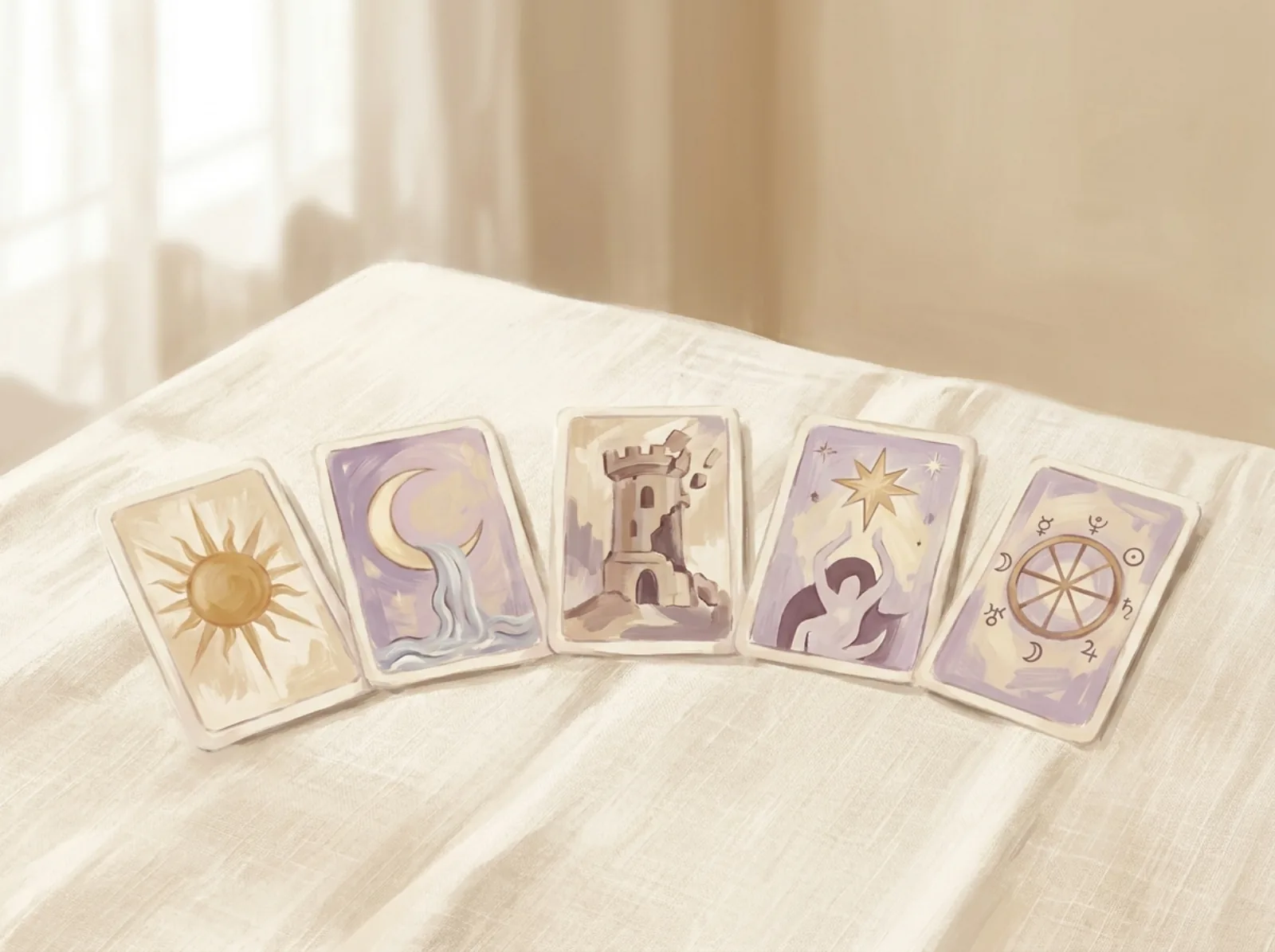
The reading that convinced me the Celtic Cross still works
A friend I will call Devon came over on a wet Tuesday last February with what she called a small career question. Forty minutes in it was clear the question was not small at all. She was two years into a role she had wanted her entire twenties and could not tell whether the exhaustion she felt was the normal weight of leadership or the quiet signal that she had outgrown the job. She had done three three-card pulls that week. All three had been vague enough to argue with. She wanted, in her words, something that would not let her wriggle out. Part of our tarot spread library. Part of our complete tarot spread library. Explore the full library. Part of our astrology library.
I laid the Celtic Cross. It took about twenty-two minutes to walk through, which is roughly ten times longer than she would have spent on a daily draw, and by minute nine she had gone very quiet. The position that stopped her was not the outcome card. It was the fourth position, the recent past, which held a card she had already turned up twice that month in other spreads. Seeing it sit in a labeled slot, in relation to nine other cards, made a pattern legible that had been drifting around her deck for weeks. See our best tarot app 2026 guide for a full breakdown.
I am telling this story because most guides to the Celtic Cross skip the part that actually matters. They list ten positions, sketch keywords, and move on. What they miss is why anyone chooses this specific layout over the dozens of simpler ones. The Celtic Cross is a slow spread. It rewards a well-formed question and it punishes a vague one. When it is the right tool it is genuinely the right tool, and when it is not it becomes an elaborate way to confuse yourself. See our guide. See our best AI astrology app guide.
This guide is the one I wish I had handed Devon before she arrived. It covers the layout position by position, the history that produced it, the two-part reading method that most beginners never learn, the misreadings I see most often as an editor at Raka, and the situations where you should put the deck down entirely and call someone with a professional license instead.
What is the Celtic Cross tarot spread?
The Celtic Cross tarot spread is a 10-card layout for reflecting on one specific question in depth. Six of the cards form a cross in the center of the reading and four are arranged in a vertical staff to the right. Each position asks a different question of the card that lands there, from the present situation and its immediate challenge through the querent's inner stance, the environment around them, their hopes and fears, and the trajectory the situation is currently pointing toward. It is the oldest published English-language spread in wide use.
To do a Celtic Cross tarot spread, you shuffle a full 78-card deck while holding one clear question, cut the deck, and then lay ten cards face-up in the fixed positions defined by A.E. Waite in 1910. You read the first six cards, the cross, as the shape of the situation in time. You then read the last four cards, the staff, as the querent's relationship to that situation. Finally you read the two halves against each other.
The spread is not a fortune-telling device. In a modern reflection-based practice, the ten cards function as ten different prompts that push you to look at the same question from ten different angles. The outcome position is best read as the direction things are trending if nothing changes, not as prophecy. This distinction is not a technicality. It is the entire difference between using tarot as a thinking tool and using it as a superstition.
The layout is popular for a reason. Ten positions give the reading enough surface area to catch nuance that a three-card pull will miss, but few enough that a careful reader can hold the whole picture in mind. It works well for questions about a specific relationship, a career fork, a creative project that has stalled, or a decision that has too many moving parts to weigh cleanly on paper.
The Celtic Cross is also, notably, a spread that many experienced readers eventually stop using. Not because it fails but because they discover more focused custom layouts for their most common questions. That trajectory is normal. Learning the Celtic Cross well is the foundation that lets you build your own spreads later with any confidence.
A short history: from Waite's 1910 manual to the modern deck
The Celtic Cross first appeared in print in A.E. Waite's The Pictorial Key to the Tarot, published in London in 1910, alongside the deck that would become the most influential tarot deck ever produced. Waite called it simply an ancient Celtic method of divination and gave no source. There is no evidence the layout is actually Celtic or actually ancient. It is almost certainly a synthesis Waite assembled from earlier occultist sources within the Hermetic Order of the Golden Dawn, dressed in a name meant to evoke antiquity for an Edwardian audience hungry for the mystical.
The deck that shipped with the book was illustrated by Pamela Colman Smith, an artist whose contribution was minimized on the box for the better part of a century. Modern scholarship has restored her name to the deck, and most contemporary editions are now published as the Rider-Waite-Smith or RWS deck. Every Celtic Cross reading you will see today, in any book or app, is anchored to the imagery Smith drew for the Minor Arcana in that 1909-1910 project. Rachel Pollack's Seventy-Eight Degrees of Wisdom, published in 1980, remains the definitive card-by-card commentary on those images.
Waite's original instructions are terse. He gives the ten positions, a short phrase for each, and a brief sample reading. The layout was refined significantly over the twentieth century by successive authors. Eden Gray in the 1960s reorganized the position labels into the versions most Americans learned first. Rachel Pollack in 1980 added the psychological reading of the staff that is now standard. Mary K. Greer's Tarot for Your Self, published in 1984, introduced the reflective self-reading approach that reframed the spread away from fortune-telling.
The most consequential modern reframing came from Benebell Wen in Holistic Tarot in 2015. Wen explicitly presents tarot as a tool for structured reflection and applied cognition, not prediction, and her treatment of the Celtic Cross treats the outcome card as a working hypothesis rather than a verdict. This is the position I take in this guide and the position Raka's app takes throughout its tarot flows. It is not the only defensible reading of the tradition but it is the one that lets tarot coexist honestly with therapy, coaching, and the ordinary business of adult decision-making.
One historical note worth keeping in mind. There is no single canonical order for positions three, four, five and six across the twentieth-century literature. Waite's original text is ambiguous about whether the past sits below or behind. Some lineages read position three as the foundation and position four as the recent past. Others reverse them. This guide uses the more common contemporary convention, but if you learned the layout a different way, your version is probably also historically grounded.
The ten positions explained
The Celtic Cross has ten fixed positions. Reading a card here means reading it through the lens of that specific position, not through general keywords alone. A Three of Swords in position two, the crossing card, means something different from a Three of Swords in position nine, hopes and fears. What follows is the position guide I give every new reader on the Raka editorial team.
Position one, the present situation. This card sits in the center of the cross and represents the heart of the matter as it stands right now. It is not the querent themselves and not the outcome. It is the current state of the specific question they asked. If the question is about a relationship, this card is the relationship in its present shape. Read it as neutrally as you can. Do not project the rest of the spread onto it yet.
Position two, the crossing card. This card is laid horizontally across position one, forming the small cross at the center. It represents the immediate challenge, the friction, the thing standing in the way. Crucially, position two is read upright regardless of the direction it was drawn in. Even a benevolent card here is a challenge, because in this slot it names what is complicating the situation. A Ten of Cups here does not mean happiness. It might mean that the pull toward a settled family life is precisely what is complicating the querent's career pivot.
Position three, the foundation. This card sits below the center and represents the deeper root of the situation. It is the substrate the current moment grew out of. Some readers treat this as the subconscious, some as the long history of the issue, some as the values quietly shaping the querent's response. All three readings are valid. Choose the one that fits the question.
Position four, the recent past. This card sits to the left of the center and represents what has just moved out of the active picture but is still influencing it. This is often where recurring cards from a querent's recent readings resurface. When they do, it is worth naming out loud. Position four is also where surprise and grief tend to show up, the events that reshaped the situation before the querent was ready.
Position five, the crown or possible outcome. This card sits above the center. In older readings this was often called the crown of the matter, the best case that is currently within reach. In psychological readings it is the conscious goal, what the querent is aiming for whether they have named it or not. Compare it later with position ten. When positions five and ten diverge sharply, that gap is usually the most useful thing in the reading.
Position six, the near future. This card sits to the right of the center and represents what is arriving next. Not fate, not a promise. The next beat of the story if the querent takes no dramatic action. This is where the cross ends and where the staff begins, and it is the position where readers most often overreach. Keep it small. It is the next scene, not the ending.
Position seven, self. First card of the staff, at the bottom. This is the querent as they are showing up to the situation, not as they wish they were. It is the internal stance, the posture, the way they are actually meeting the question. Position eight, environment, sits above it and represents the external field the querent is operating in: other people, institutions, circumstances they did not choose. Position nine, hopes and fears, sits above that and is deliberately double-natured, because at any given moment we are often both hoping for and fearing the same thing. Position ten, the outcome, sits at the top and represents the trajectory the situation is currently pointing toward. It is a hypothesis, not a sentence.
How do you do a Celtic Cross reading, step by step?
Here is the procedure I use for every Celtic Cross reading and the one Raka walks users through in the app. Follow it in order the first several times you lay the spread. You can improvise later once the sequence is muscle memory.
Step one, form the question. Write it down. A well-formed Celtic Cross question is specific, personal, and open-ended. Bad: will I be happy. Better: what do I need to understand about the tension between my current role and the direction I actually want to grow. The question is at least half the reading. If you cannot state it in one sentence, the layout will not save you.
Step two, prepare the space and the deck. Shuffle the full 78-card deck thoroughly while holding the question in mind. Some readers cut the deck three times with the non-dominant hand before dealing. There is no metaphysical requirement to do this. It functions as a small ritual that separates ordinary attention from reading attention, and that separation genuinely helps the interpretation that follows.
Step three, lay the cards. Deal ten cards face-down in the fixed positions, then turn them face-up one position at a time in the order given by Waite. Card one in the center. Card two laid across card one. Card three below. Card four to the left. Card five above. Card six to the right. That completes the cross. Card seven at the bottom of the staff, then eight, nine and ten stacked upward to the right of the cross. Do not turn everything face-up at once. Position by position is slower on purpose.
Step four, read the cross alone before touching the staff. Speak or write what you see in positions one through six as a single unfolding sentence: this is the situation, this is what is crossing it, this is what it grew out of, this is what has just passed, this is what is being aimed for, this is what is arriving next. Do not skip ahead. The cross should have narrative shape before the staff enters.
Step five, read the staff. Positions seven through ten describe the querent's inner posture, the environment, the pull between hope and fear, and the current trajectory. Read them upward, from self to outcome. Notice where the staff contradicts the cross. That contradiction is almost always the useful part of the reading.
Step six, name one specific reflection to sit with. This is the step most beginners skip. A Celtic Cross reading that ends without a concrete question to think about for the next week is a reading you will forget by Friday. Write down one sentence. Take it into the rest of your life. Come back to the spread in seven days and see what has actually shifted.
When should you use the Celtic Cross — and when should you not?
Use the Celtic Cross when the question is knotted enough that a three-card pull would flatten it. Career forks with more than one appealing branch. A relationship where both people are behaving well and it still is not working. A creative project that has stalled for reasons you cannot yet articulate. A decision where you can list the pros and cons on paper and still not feel any closer to knowing what you actually want. These are the questions the spread was built for.
Use it when you have twenty to forty uninterrupted minutes, a physical or digital notebook, and enough emotional bandwidth to sit with cards that may not say what you want to hear. Rushed Celtic Cross readings are worse than no reading at all. The point of a ten-card spread is that its own weight forces you to slow down. If you cannot honor that pace, use a smaller layout.
Do not use the Celtic Cross for yes-or-no questions. It is genuinely the wrong tool. A yes-or-no question flattens ten positions of nuance into a binary and the spread will resist. Use a single-card pull or a three-card past-present-future for those.
Do not use it as a substitute for professional advice. Tarot cannot diagnose illness, evaluate medication, assess legal exposure, or replace a licensed financial advisor. If your question is really about whether to leave a marriage that has become unsafe, whether a lump warrants a biopsy, whether to sign a contract you do not fully understand, or how to manage a mental-health symptom that is affecting your daily life, the honest answer is that this is not tarot's job. Call the appropriate professional. The spread can help you think about how you feel about the situation. It cannot make the decision for you and it should not be used to postpone one that is genuinely urgent.
Do not use it when you are too activated to accept a card you did not want. If you already know the answer you are hoping for and you are only picking up the deck to have it confirmed, the reading will either confirm it hollowly or contradict it and be dismissed. Neither is useful. Wait until you can sit with contradiction without needing to reshuffle.
How to read the cross and the staff together
Most beginner guides describe the ten positions and stop there. The harder skill, and the one that separates a memorable reading from a forgettable one, is reading the two halves of the spread against each other. The cross is the situation in time. The staff is the person inside the situation. They are almost never saying the same thing, and the gap between them is where the reading lives.
Start by comparing position five, the conscious goal, with position ten, the trajectory. When they agree, the querent is moving in the direction they think they are moving. That is worth naming, because it is not always the case. When they diverge, that gap is the single most useful piece of information the spread will offer. It usually means the querent is aiming at one outcome and their behavior is producing a different one.
Compare position seven, self, with position one, the present situation. If the situation looks stable but the querent is meeting it in a chaotic posture, the instability is coming from inside the room. If the situation looks turbulent but the querent is arriving grounded, they have more resource than they realize. Neither reading is a judgment. Both are useful data.
Notice how position nine, hopes and fears, colors positions five and ten. A hopeful outcome next to a fearful hopes-and-fears card often means the querent does not fully trust the outcome they are aiming for. A fearful trajectory next to a hopeful hopes-and-fears card sometimes means the querent is bracing for a worse outcome than the cards actually predict. In both cases the reading is inviting a specific conversation with the self that a shorter spread would not have surfaced.
The most common misreadings I see from beginners
The first and most damaging misreading is treating position ten as fate. In a reflection-based practice, the outcome card is a hypothesis about where things are pointing if nothing changes. It is not a verdict about what will happen. Reading it as fate turns tarot into superstition and, more practically, it makes the spread useless because the querent either accepts the outcome fatalistically or rejects the whole reading. Both responses skip the actual work.
The second misreading is over-weighting the Major Arcana. When cards like The Tower, Death, or The Wheel of Fortune appear in a Celtic Cross, beginners often let those cards drown the rest of the spread. Rachel Pollack is very good on this point in Seventy-Eight Degrees of Wisdom: the Majors describe large forces but the Minors describe how those forces are actually landing in a person's daily life. A Tower in position two is a real challenge, but a Five of Pentacles in position seven telling you how the querent is meeting that challenge is arguably more actionable.
The third misreading is ignoring the crossing card because it looks positive. Position two is always a challenge in this spread regardless of the card that lands there. This is a structural rule of the layout and it catches almost every new reader at least once. When a happy card lands in position two, the reading is inviting you to ask how a good thing in the querent's life is complicating the specific question they asked.
The fourth misreading is reading positions in isolation. The Celtic Cross is a sentence, not a list. If you read each card as a standalone sentence and then stop, you have done ten small readings and no Celtic Cross reading at all. The synthesis in step five above is the actual spread.
The fifth misreading is redealing when you do not like the cards. Every experienced reader has done this at least once. It does not work. The reading you got is the reading you got, and the reflection you owe yourself is why the cards you were hoping for did not arrive. That is often the most useful conversation the spread will produce.
A sample Celtic Cross reading (fictional client, anonymized)
To ground the method, here is a walk-through of a fictional but realistic reading. The client, whom I will call M., is a 34-year-old graphic designer in Manchester considering whether to leave a stable in-house role for a freelance career. She has been thinking about the move for eight months. Her question, refined at the start of the session, is: what am I not seeing clearly about the trade-offs of leaving my job to go independent this year? Any card names below are illustrative. The point is the method, not the specific draw.
Position one, the present situation, is the Four of Pentacles. The current shape of the question is a defensive grip on stability. Not shameful, but named. M. is not currently in expansion. She is in preservation mode.
Position two, the crossing card, is the Six of Cups. On its own the Six of Cups is warm and nostalgic. In position two it is a challenge. What is complicating M.'s decision is not fear of freelancing. It is her attachment to a version of the in-house role that existed three years ago and does not exist anymore. She is grieving a job she still technically has.
Position three, the foundation, is The Hierophant. The root of the situation is a deep-set belief about what a proper career looks like. Position four, the recent past, is the Eight of Cups. Something has already left. She has already emotionally departed from the role. She just has not acted on it yet. Position five, the conscious goal, is the Two of Wands, the classic card of surveying the horizon and choosing a direction. Position six, the near future, is the Page of Pentacles. A concrete small step is about to become available if she looks for it.
Now the staff. Position seven, self, is the Nine of Swords. She is arriving at this decision through anxiety and interrupted sleep. Position eight, environment, is the Three of Cups. Her external support system is genuinely there. Position nine, hopes and fears, is the Ten of Pentacles. She both hopes for and fears the version of stability that a successful freelance career would eventually produce, because it looks different from the stability she currently has. Position ten, the outcome, is The Star. The trajectory, if she keeps moving in the current direction, is toward renewal and a clearer sense of vocation.
Reading the two halves together: the cross describes a real decision with real terrain. The staff describes a person who is currently making that decision from an activated nervous system inside a supportive environment she is not fully using. Position five and position ten agree. She is aiming at renewal and she is trending toward it. The gap between her Nine of Swords inner state and her Three of Cups external environment is the specific work of the next month. The reflection she leaves with is not should I quit. It is how do I let the people already around me help me think about this without going it alone.
Variations: modernized layouts with the same bones
Several twentieth and twenty-first century variations rearrange the Celtic Cross without changing its underlying grammar. The most common is the Thoth Celtic Cross taught by lineages descended from Aleister Crowley, which uses the same ten positions but with slightly different names and a different position order for the past and foundation cards. Functionally the reading is the same. If you learned the layout inside a Thoth tradition, your version is not wrong.
A modern therapeutic variation, popularized in the wellness-tarot boom of the late 2010s, replaces position ten with a card labeled next step rather than outcome. This is not a purist choice but it is an honest one for readers who want to make explicit that the spread is producing a reflection prompt rather than a prediction. Raka uses this framing in the app's guided Celtic Cross mode and it noticeably reduces the fatalistic misreadings described earlier in this guide.
A stripped-down variation, sometimes called the Celtic Cross Lite, uses only the six cards of the cross and skips the staff. It is a legitimate spread for questions that are primarily about circumstance rather than the querent's inner posture. It is also the version I recommend when you have twenty minutes rather than forty and cannot honestly commit to the full layout. A six-card cross done well is better than a ten-card cross done in a hurry.
There is also a common expansion that adds a clarifier card drawn deliberately after the ten are laid, to speak to one specific position that feels opaque. Used sparingly this is fine. Used every reading it becomes a way of avoiding the position you did not like. If you find yourself pulling a clarifier every time, sit with the original card for a few days before drawing another one.
Using Raka's AI companion for Celtic Cross readings
Raka is Vyve Health Tech's tarot, astrology and numerology app, available on Google Play with an iOS and web version. Our Celtic Cross flow lays the ten cards in the traditional Waite order, walks you through the position meanings one at a time, and offers an AI companion that reads the spread as reflection prompts rather than prediction. The AI is explicitly not fortune-telling. It will not tell you what will happen. It will ask you what you notice.
The reason to use an app for this rather than a physical deck is not that the app is better. It is that the app is available at 11pm on a Sunday when you have a question that will not let you sleep, and a deck is not always to hand. Physical decks have a texture and slowness that no app fully replicates. Many of our most engaged users do both, drawing physically at home and using Raka when they are traveling or when they want a written record of the reading.
One feature we spent unusual effort on is the reading history. Every Celtic Cross reading is saved with the question you originally asked, the ten cards in position, and any notes you took during or after the session. The point is not the individual reading. It is the pattern across readings. When the same card keeps appearing in the same position across three or four readings on similar questions, that pattern is real information, and it is nearly impossible to see without a searchable record.
The app is also structured to hand you off when tarot is not the right tool. If your question is medical, legal, financial, or clinical, the flow will surface a clear note pointing you to the appropriate professional resource before laying any cards. This is a product choice, not a legal one. We think an app that pretends to answer questions it cannot answer is worse than one that says so plainly.
Ethics, boundaries, and when tarot is not the right tool
Tarot is a tool for self-reflection and creative introspection. It is not medical advice, therapy, financial planning, or legal counsel, and treating it as any of those things is genuinely harmful. This is the position taken by every contemporary tarot author cited in this guide, from Benebell Wen to Mary K. Greer, and it is the position Raka takes throughout the app.
If your Celtic Cross question is really a question about depression, self-harm, an eating disorder, panic, or another mental-health symptom that is affecting your ability to function, please stop the reading and contact a licensed clinician. In the United States you can reach the 988 Suicide and Crisis Lifeline. In the United Kingdom, Samaritans on 116 123. In Canada, Talk Suicide Canada on 1-833-456-4566. In Australia, Lifeline on 13 11 14. These are the honest referrals. The cards will still be there afterward.
If your question is really about a medical symptom, a legal exposure, or a significant financial decision, please consult a physician, a solicitor or attorney, or a licensed financial adviser respectively. Tarot can help you notice what you are feeling about the situation. It cannot evaluate the situation itself and it should not be used to delay a professional consultation that the circumstances actually require.
The Celtic Cross is a beautiful, old, capable spread. Used with a well-formed question, a clear head, and honest expectations, it can produce reflections that are genuinely difficult to reach any other way. Used carelessly it can waste an evening or, worse, become a way of postponing a conversation the querent already knows they need to have. The tradition is worth learning well. The IBISWorld Psychic Services industry report valued mystical services in the United States at roughly $2.3 billion in 2023, which is a great deal of money changing hands. Some fraction of that spending is producing genuine reflection. Some fraction is producing false certainty. Your job as your own reader, or as someone reading for a friend, is to be on the right side of that line.
Frequently asked questions
What is the Celtic Cross tarot spread?
The Celtic Cross tarot spread is a 10-card layout for reflecting on one specific question in depth. Six cards form a central cross showing the situation in time, and four cards form a vertical staff showing the querent's inner stance, environment, hopes and fears, and current trajectory. First published by A.E. Waite in The Pictorial Key to the Tarot in 1910, it is the oldest widely used English-language tarot spread and remains the most common layout for complex questions today.
How do I do a Celtic Cross tarot spread?
Write down one specific, open-ended question. Shuffle a full 78-card deck holding the question in mind. Deal ten cards face-down in the fixed Celtic Cross positions, then turn them face-up one at a time in Waite's original order. Read the six-card cross first as a single unfolding narrative in time, then read the four-card staff as the querent's inner relationship to that situation. Finish by naming one concrete reflection to sit with over the following week.
When should I use a Celtic Cross tarot spread?
Use the Celtic Cross when a question is knotted enough that a three-card pull would flatten it, you have twenty to forty uninterrupted minutes, and you can accept cards you did not want. It suits career forks, complicated relationships, stalled creative projects, and decisions with too many moving parts to weigh cleanly on paper. Avoid it for yes-or-no questions, medical or legal questions, or moments when you are too activated to sit with contradiction honestly.
How is the Celtic Cross different from a three-card past-present-future spread?
A three-card spread gives you a shape. The Celtic Cross gives you a landscape. Three cards show the arc of a situation over time in broad strokes and are ideal for quick daily reflection or yes-or-no framings. The Celtic Cross uses ten positions to show the situation, its immediate challenge, its foundation, the recent past, the conscious goal, the near future, the querent's inner stance, the environment, hopes and fears, and the current trajectory, all at once.
Can I do the Celtic Cross tarot spread online or with an app?
Yes. Raka's app on Google Play, iOS and web lays the traditional 10-card Celtic Cross in Waite's original order and walks you through each position with an AI companion that treats the reading as reflection rather than prediction. Every reading is saved with your original question so you can spot patterns across weeks. Apps do not replace the texture of a physical deck, but they are useful at midnight, while traveling, or when you want a written record of what you drew.
What should I do if I get a card in the Celtic Cross that I don't understand?
Sit with it before reaching for a keyword. Note the card, the position, and your first honest reaction. Compare it to the surrounding cards in the spread rather than reading it in isolation. Consult Rachel Pollack's Seventy-Eight Degrees of Wisdom or Benebell Wen's Holistic Tarot for grounded interpretations. Resist the urge to pull a clarifier card immediately. Some cards only make sense a week later, after the situation has moved and the image has had time to speak.
How often should I do the Celtic Cross tarot spread?
Less often than you probably want to. The Celtic Cross is a heavy spread and doing it daily dilutes both the ritual and your ability to notice patterns. Most experienced readers use it once every few weeks, or when a specific question has genuinely earned the depth. For daily reflection, use a one-card or three-card draw. Return to the Celtic Cross when the smaller pulls have started to circle the same theme without resolving it.