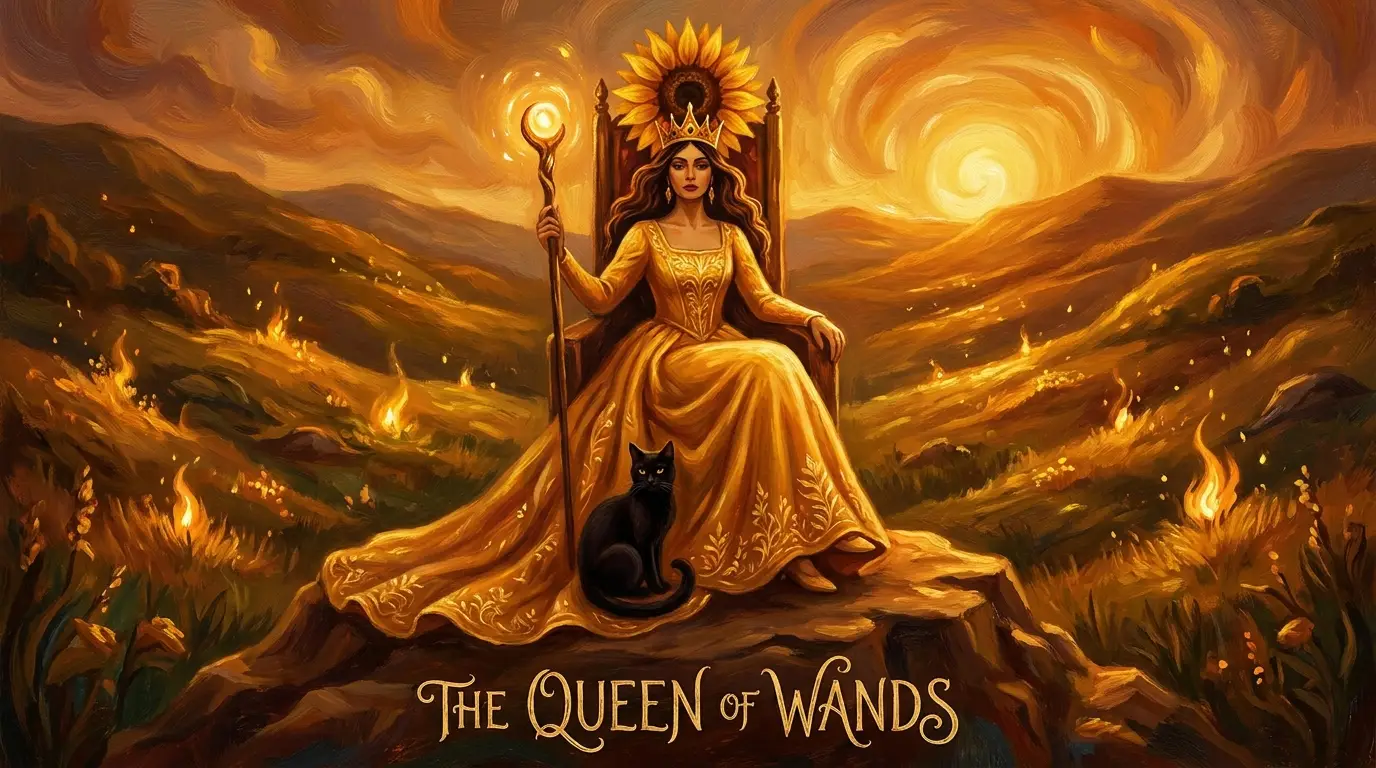
Queen of Wands yes or no: the direct answer
If you pulled the Queen of Wands and you just want the short version, here it is. Upright, the Queen of Wands is a strong yes for most yes-or-no tarot questions. She is the fixed-fire court card of the tarot — confident, creative, socially magnetic, and unmistakably in motion. When she shows up in response to a yes/no question, she is usually telling you that the energy around your situation is already aligned in your favor, that other people are more drawn to you than you realize, and that hesitation is doing more damage than the thing you are afraid of. Nine times out of ten, this card is nudging you toward the leap you already suspect you should take.
Reversed, the Queen of Wands does not flip cleanly to a no. That is a common misread. She more often becomes a hesitant yes, or a yes-with-conditions. The core answer is often still favorable, but something in your inner posture — jealousy, comparison to someone else, self-doubt, scattered focus, or a fear of being seen — is muddying the water. In a yes/no context, the reversed Queen tends to say some version of yes, but the yes is being blocked by you, not by circumstance. That is a very different message from a Tower or a Ten of Swords, both of which are far heavier no signals. Part of our card meanings library. See our related guide on free love tarot what is he thinking. See our related guide on free psychic chat. Try our 3 Card Tarot Spread guide.
The reason the Queen of Wands lands so consistently on the yes side comes down to her elemental makeup and her posture in the classic Rider-Waite-Smith imagery. Wands are the suit of fire, will, spirit, and creative drive. Queens are the mature feminine polarity of that element — receptive, magnetic, and capable of holding a room without needing to raise a sword. Put those together and you get a card that says the momentum you need is already inside you, and the outer world is far more open to your ask than your anxious brain is telling you it is. Part of our card meanings library. Try our Career Tarot Spread guide. Try our Celtic Cross Tarot Spread guide. Try our Decision Tarot Spread guide. Try our Horseshoe Tarot Spread guide.
That said, tarot is a reflection tool, not a fortune-telling machine. A yes from the Queen of Wands should be read as high-probability green light plus a call to actually act — not as a guarantee that reality will bend to your wish while you sit on your couch. The rest of this guide walks through how she reads in specific life areas, what changes when other cards land next to her, and where the yes/no format quietly breaks down and needs a more nuanced spread. (part of our tarot reference) Part of our card meanings library. Try our Love Tarot Spread guide. Try our One Card Tarot Pull guide. Try our Pentagram Tarot Spread guide. Try our Relationship Tarot Spread guide.
The Queen of Wands: card basics and symbolism
Before we go deeper into yes/no interpretation, it helps to be honest about what card we are actually reading. The Queen of Wands is one of the sixteen court cards of the Minor Arcana, sitting in the suit of Wands alongside the Page, Knight, and King. In the traditional Rider-Waite-Smith deck illustrated by Pamela Colman Smith and published in 1909 under the direction of A. E. Waite, she sits on a stone throne carved with two lions facing outward, holds a blooming sunflower in her left hand, holds a sprouting wand in her right, and has a black cat sitting alertly at her feet. Every one of those details is doing symbolic work. Try our Shadow Work Tarot Spread guide. Try our Situation Action Outcome Spread guide. Try our Tarot Spread For Anxiety guide. Try our Tarot Spread For Beginners guide.
Elementally, the Queen of Wands is associated with fixed fire — the same quality as the sun sign Leo in Western astrology. In the Golden Dawn's court card attributions, which Waite drew from, she governs the astrological span from the last decan of Pisces through the first two decans of Aries, giving her the ambitious ignition of Aries with the softer intuitive edge of Pisces. Practically, that means she is not the impulsive spark of the Knight of Wands or the executive control of the King. She is fire that has learned how to hold itself steady, warm a room, and light other people's candles without going out. Try our Tarot Spread For Clarity guide. Try our Tarot Spread For Grief guide. Try our Tarot Spread For Manifestation guide. Try our Tarot Spread For Self Love guide.
The symbols repay slow reading. The sunflowers behind her and in her hand track the sun — she orients toward warmth, visibility, and being seen. The lions on her throne are strength, courage, and the confidence to sit publicly in a position of authority. The black cat is the classic Rider-Waite-Smith wink at intuition, independence, and the shadow side of a very solar card — even the most confident queen has a private inner life. Her open-kneed posture, unusual for a queen in that era, is another quiet detail: she is grounded, receptive, and not making herself small. Part of our card meanings library. Try our Yes No Tarot Spread guide.
For yes/no reading purposes, all of this symbolism collapses into a single core message: the Queen of Wands is a card of aligned personal power expressed outward. She is not neutral, she is not withdrawn, and she is not conflicted. When a card that unambiguous shows up in a binary reading, the default interpretation is affirmative — and that is why traditional yes/no tarot tables, from Waite forward, have long placed her in the yes column. (part of our tarot reference) Part of our tarot library.
Upright Queen of Wands as a yes or no
Pulled upright as the answer to a yes/no question, the Queen of Wands is a confident, energetic yes. She is one of the most affirming court cards in the deck for questions about action, visibility, initiative, and self-expression. If you asked whether you should apply, launch, message, ask, audition, pitch, or step forward — she is almost always telling you to do it. The card carries a particular flavor of yes that is not just approval, it is encouragement. She is not saying you may proceed; she is saying you already have what this situation needs, and holding back is the only real risk in front of you.
It matters what kind of yes she is, though. The Queen of Wands is not the slow, considered yes of the Queen of Pentacles or the emotionally-charged yes of the Queen of Cups. Her yes is warm, social, and often visible to other people before it is visible to you. In practical terms, that means outcomes tied to this card often involve being noticed, being chosen, being remembered — the promotion where someone specifically thought of you, the reconnection where an old friend actually reached out first, the creative project that gets shared beyond the audience you expected. If your question has a public or interpersonal dimension, upright Queen of Wands leans especially strong.
There is also a subtle instruction embedded in the upright card that most quick yes/no guides skip. The Queen of Wands answers yes to people who are willing to actually inhabit her energy, at least for the duration of the situation. That means dressing for the interview, warming up before the audition, sending the message in your own voice instead of a hedged version of it, and showing up to the event rather than watching from your phone. She is not withholding the yes if you stay small — she is telling you that the yes is available, and the size of the outcome will scale with how fully you show up.
A useful gut check when you pull her upright is to ask yourself: what would I do in the next twenty-four hours if I fully believed this answer was yes? Whatever comes to mind is usually the correct next action. The Queen of Wands is a card of momentum, and momentum needs a step. If you sit with the reading for a week without moving, you are effectively converting a yes into a not-yet, which is functionally the same as the reversed reading we will cover next. See how Raka compares to other apps in our independent guide.
Reversed Queen of Wands as a yes or no
The reversed Queen of Wands is where a lot of readers and apps get sloppy. The lazy interpretation is to flip yes to no and move on. That is almost never right for this card. In practice, the reversed Queen of Wands most often means yes-but, or yes-eventually, or yes-if-you-address-something-first. The underlying answer is usually still favorable, but the card is flagging an internal obstacle that is scrambling the signal — jealousy, insecurity, comparison to someone you perceive as more successful, fear of being seen, or a scattered focus that is spreading your fire too thin to actually light anything.
One of the most common reversed readings is what old sources sometimes called the shadow queen — a version of you that is quietly convinced someone else deserves the outcome more than you do. If you have been scrolling the person you are competing with, or the ex your ex left you for, or the peer whose launch went better than yours, and then you pulled this card reversed, that scroll is the message. The reversed Queen is not telling you the answer is no. She is telling you that the person actually blocking the yes is currently the you who is spending energy tracking someone else's story instead of writing your own.
Another common flavor is over-extension. The Queen of Wands upright is fire that has learned to hold itself steady. Reversed, she can be fire that is burning too many places at once — five projects, three group chats, two side hustles, and no follow-through on any of them. In a yes/no context, this often reads as yes if you narrow your focus. The universe, or your unconscious, or the situation itself, is not saying no. It is saying you cannot land this outcome from a scattered posture. Pick one thing, close the other tabs, and the yes becomes available again.
There are rare cases where the reversed Queen of Wands does read closer to no, and it is worth naming them honestly. If the question is about a specific person and the surrounding cards are hostile — Five of Swords, Three of Swords, Seven of Swords, or the Devil reversed — the reversed Queen can indicate that the other party is operating from jealousy or ego, and the outcome you want is not going to come from them in the form you are hoping for. Even then, the more accurate read is usually not now or not from this source, rather than a flat no forever.
Queen of Wands yes or no in love and romance
For love questions, the Queen of Wands upright is one of the most affirming yes cards you can pull. She is passionate, magnetic, self-assured, and comfortable being desired. When she shows up as the answer to a romantic yes/no — will they reach out, are they interested, should I message first, is this attraction mutual, should I say yes to the date — the default reading is yes. Beyond simple yes, she is often flagging that the other person is more drawn to you than you have let yourself notice, and that your own self-doubt is louder in your head than in theirs.
In existing relationships, the Queen of Wands upright tends to say yes to questions about deepening, escalating, or reintroducing heat. She reads as a green light for moving in, planning a bigger trip together, initiating a difficult but generative conversation, or asking for something specific in the bedroom or the household division of labor. Her energy is not conflict-avoidant. She is the queen who will bring up the hard thing over dinner and still make you laugh before dessert. If you are asking whether your relationship can hold a real conversation, her upright answer is almost always yes.
Reversed in love, she rarely says the relationship is doomed. She more often names a specific pattern: jealousy of a partner's ex or coworker, comparison of your relationship to a friend's, or an insecurity spiral that is making you test the other person instead of trusting them. The reversed Queen of Wands in a love yes/no is often saying yes, this connection is real, but the version of you that is currently asking is not the version that can receive the answer well. The instruction is usually to regulate first, then re-ask — or to have the honest conversation with your partner about the insecurity rather than acting it out.
For single readers asking about a specific person, upright Queen of Wands is a strong yes on chemistry and often a yes on reciprocation, though she is less specific about long-term commitment than, say, the Ten of Cups or the Four of Wands. She tells you the door is open and the fire is real. Whether you two build something lasting inside that fire depends on cards that show up later in the spread, and on choices neither of you has made yet. As a first-card answer, though, she is telling you not to talk yourself out of what you already feel.
Queen of Wands yes or no in career and work
In career readings, the upright Queen of Wands is close to a home-run yes for questions about leadership, visibility, creative direction, and self-driven work. If you are asking whether to apply for the role that feels a size too big, whether to pitch yourself as the lead on a project, whether to start the newsletter or the studio or the consultancy, whether to speak on the panel, whether to negotiate up — she is almost always saying yes, and saying it with unusual clarity. She is the card of the person other people already picture at the front of the room.
She is particularly strong for questions about founding, launching, or going independent. The Queen of Wands has an entrepreneurial signature that shows up across contemporary readers from Rachel Pollack to Mary K. Greer to Benebell Wen — she is the queen who can hold a public-facing brand, absorb attention without collapsing under it, and translate personal magnetism into commercial traction. If you are on the fence about leaving a stable role for something more your own, and she is your yes/no card, the reading leans go. She does not, however, guarantee the venture will be easy or immediate; she guarantees you have the internal material to sustain it.
For questions about promotions, raises, and being chosen over peers, upright Queen of Wands is a favorable card, and often carries a specific instruction: ask directly. Her yes is more likely to land if you make your case in your own voice rather than waiting to be noticed. In a workplace yes/no, she is frequently the difference between the person who quietly hopes their manager will remember them at review time and the person who sends the calibrated email listing their wins. If she shows up upright, she is telling you that the second approach is not just allowed, it is what the situation is waiting for.
Reversed in a career context, she rarely means the role or opportunity is closed. She more often names imposter syndrome, comparison to a colleague, or a fear of being visible in a way that could invite criticism. The reversed reading is often yes, but you are the bottleneck. In a few contexts — particularly when Cups reversed or Swords cluster around her — she can point to a toxic team dynamic where a more senior woman is competing with you rather than championing you, and the honest answer becomes yes to your capability, no to this specific room. That distinction is worth sitting with before you accept a flat no from the card.
Queen of Wands yes or no in money and finances
Money questions are where the Queen of Wands is more conditional than most yes/no guides admit. Upright, she is a yes to income that flows from active effort, visibility, and self-driven work — freelance pipelines, sales, creative income, launches, negotiated raises, and any situation where being seen directly translates into being paid. She is not, however, a card of passive gain. She will not answer yes to a lottery question, a windfall question, or a will-they-just-give-it-to-me question with the same conviction she brings to a will-I-earn-it question. Read her as yes-if-you-work-it, not yes-if-you-wait.
For questions about launching a paid offer, raising rates, or asking for a specific number, upright Queen of Wands leans clearly yes. She has particular strength around price increases and self-valuation — if you have been quietly charging under market and you pull her when you ask whether it is time to raise, the answer is almost always yes and usually by more than you were planning. Her fire has a specific relationship to worth: she does not undercharge, and she is not persuaded by clients who try to bargain her down. In a rate-setting yes/no, she is nudging you toward the number that feels slightly uncomfortable to say out loud.
For investment or larger financial commitment questions, she is a softer yes and should be read alongside adjacent cards. A Queen of Wands next to the Eight of Pentacles or the Ace of Pentacles supports a yes on a considered investment in your own skill, business, or education. Next to the Seven of Swords, the Five of Pentacles, or the Moon, she can suggest that your enthusiasm is running ahead of your due diligence — the answer becomes yes to the direction, no to the specific vehicle. This is one of the clearest places where blind yes/no reading breaks down and even a two- or three-card pull is worth the extra minute.
Reversed in a money question, she rarely means bankruptcy or ruin. She more often signals overspending on visibility — money going out on brand, aesthetic, tools, and appearances without matching income coming in — or under-earning driven by an unspoken belief that charging more will make you unlikable. Reversed, the yes/no answer often becomes yes to the underlying financial move, but only after you get honest about which pattern is running. It is not a punishment card; it is a mirror card, and money mirrors tend to be uncomfortable in exactly the way they need to be.
Queen of Wands yes or no for reconciliation and exes
Reconciliation questions are one of the areas where the Queen of Wands is most nuanced, and where a lazy yes/no reading is most likely to mislead you. Upright, she is a moderate to strong yes on reconnection, but the yes has a specific texture — she says yes to a version of reconciliation where you show up as the more sovereign, less anxious, less bargaining version of yourself. She does not say yes to a reunion that requires you to shrink, plead, or explain yourself into acceptability. If your question is will they come back, and she shows up upright, the underlying answer is often yes if you stop chasing.
There is a genuine paradox in how she reads on ex questions. The Queen of Wands is deeply attractive to the people she has known, but she is also the card of not-waiting. Her energy pulls people back precisely because she has visibly moved on with her own life. In practical terms, the upright reading on a reconciliation yes/no is often yes, and it will land faster the less you are refreshing their profile. If that instruction feels annoying, that is usually a sign the card is naming the exact pattern you needed to hear.
Reversed in a reconciliation context, she is harder to read cleanly. She can indicate that the other person is still tangled in jealousy, ego, or a comparison narrative — sometimes about you, sometimes about a rebound partner, sometimes about their own life not looking the way they wanted it to when they walked away. The reversed answer is often yes on their feelings, no on their current capacity to act on those feelings well. That is a difficult truth to receive, and it is why a single-card yes/no on a real ex often deserves a follow-up three-card spread on timing and terms.
The honest guidance around Queen of Wands and reconciliation questions is that she is at her most useful when you use her to examine your own posture rather than to predict theirs. If she is telling you yes and instructing you to stop chasing, and you cannot bring yourself to actually stop, that friction is the reading. The card is doing its job — it is showing you where the yes is being blocked, and the block is almost never on the other person's side alone. Sit with that before you send the message.
Queen of Wands yes or no for pregnancy and fertility
Pregnancy and fertility questions are among the most sensitive yes/no queries readers get, and they deserve a careful, honest answer rather than a quick one. Traditionally, the Queen of Wands leans yes on pregnancy questions, and contemporary readers largely agree. She is a fire-suit court card associated with vitality, embodied confidence, and creative-generative energy, and her upright appearance in a will-I-get-pregnant or am-I-pregnant reading is generally read as favorable. She is not, however, one of the classic pregnancy signalers the way the Empress, Ace of Cups, or Ace of Pentacles are. Read her as leaning yes rather than a definitive yes.
Where the Queen of Wands is particularly strong on fertility questions is around active-cycle timing, IVF and IUI cycles, and situations where you have been asked to bring more agency to the process rather than wait passively. She is a card of engaged effort. If you have been doing the tracking, the appointments, the harder conversations with your partner, and the honest work of preparing your life for a child, and she shows up upright as your yes/no card, the reading is generally supportive of continuing that path. She will not, and cannot, replace medical evaluation, and any responsible reader will say so out loud.
For questions about a child's temperament or the parenting experience ahead, the Queen of Wands upright is often a warm reading. She frequently signals a child with a strong personality, high vitality, and an early appetite for attention and expression. That is neither a promise nor a prediction — it is a symbolic pattern many readers have noticed. Reversed, she can point to anxiety around your capacity to parent, comparison to other parents in your circle, or fear about how visible pregnancy or motherhood will make your body and your life. The underlying answer is often still yes, with an instruction to address the fear separately.
The single most important thing to say about the Queen of Wands and pregnancy questions is that tarot is not a diagnostic tool. It cannot confirm or rule out pregnancy, miscarriage risk, fertility outcomes, or anything else that a blood test, ultrasound, or clinician can address. If you are pulling cards on a real pregnancy question, use the reading as an emotional-processing tool, and use your medical team for the medical answer. Any reader or app that tells you otherwise is doing you a disservice, and it is worth being firm about that even when the cards look encouraging.
How adjacent cards change the answer
A single-card yes/no is a starting point, not an endpoint. The Queen of Wands can be a strong yes on her own, but the cards on either side of her — whether you pulled a three-card spread or clarifier cards after the initial pull — can meaningfully soften, sharpen, or reverse the reading. This is where most beginner readers plateau, and where the difference between a helpful reading and a shallow one shows up. A few of the most common combinations are worth knowing before you accept any single-card verdict.
The Queen of Wands next to the Sun, the Star, the Ace of Wands, the Three of Wands, or the Ten of Cups is one of the strongest yes combinations in the deck. This cluster reads as aligned confidence meeting genuine external opportunity, and it usually points to outcomes that exceed what you were originally hoping for. Next to the Empress, she strengthens on fertility, creative projects, and any question involving self-worth. Next to the King of Wands, she is a yes on partnership questions where both people are already in their own power — one of the healthier romantic combinations in the deck.
The Queen of Wands next to the Tower, the Ten of Swords, the Three of Swords, the Five of Cups, or the Devil is where the reading gets more careful. The Tower alongside her often keeps the yes but reframes it as yes-through-disruption — the outcome you want is coming, but it may require something in your current setup to break first. The Ten of Swords or Three of Swords beside her can soften the yes into a warning about grief or betrayal that is either still processing or still ahead. The Devil alongside her can point to a yes on the surface, no underneath — the situation looks appealing but has a hook in it worth examining.
The Queen of Wands next to other court cards is worth reading as a relationship dynamic rather than a modifier of yes. Beside the Queen of Cups, she may indicate you and another person are approaching the same situation with very different emotional gears. Beside the Queen of Swords, she can point to a dynamic where fire and air amplify each other productively or burn each other out, depending on the surrounding cards. In all of these cases, the yes/no answer becomes secondary to the real reading, which is about the people involved and how they are actually behaving toward each other.
Queen of Wands vs other yes/no cards
It helps to place the Queen of Wands on the broader spectrum of yes/no answers in the deck, because her yes has a specific flavor that other yes cards do not share. The Sun is the strongest single yes in tarot — clear, warm, unambiguous, and usually accompanied by a sense of relief. The Tower is close to the strongest single no, though it is more accurately a card of forced clearing than a simple refusal. The Ten of Swords, the Five of Cups, and the Three of Swords are the honest hard-no signals for love and career questions respectively. The Queen of Wands sits comfortably in the yes column, but she is a yes that requires participation, which is different from the Sun's yes that arrives regardless.
Among the four queens, she is the most action-oriented yes. The Queen of Cups is a yes filtered through feelings — favorable, but slower, and often requiring emotional processing first. The Queen of Swords is a conditional yes: yes if you can see the situation clearly, no if you are avoiding a truth. The Queen of Pentacles is a yes for practical, material questions — abundance, home, health, and long-term stability — with a slow-and-steady tempo that the Queen of Wands does not share. If you asked the same yes/no question and drew each queen in turn, you would get four legitimately different yeses.
Compared to the other Wands court cards, the Queen is the most sustainably positive yes. The Page of Wands is an exciting but early yes — the news is good but the situation is not fully formed yet. The Knight of Wands is a passionate yes with a real risk of burning out or moving too fast. The King of Wands is a strategic, executive yes that carries authority but can feel less warm. The Queen carries the same fire as the King but with more accessible, magnetic energy — which is why she is often the most reassuring card in the suit to pull as a yes/no answer.
Understanding these comparisons helps you resist the temptation to treat all yes cards as interchangeable. A Sun yes and a Queen of Wands yes will produce different next steps in your life. The Sun tends to say the outcome is essentially yours to accept; the Queen of Wands tends to say the outcome is yours to claim. If you notice which yes you tend to hope for, that itself is useful self-knowledge, and it is one of the things a well-designed yes/no reading — or a good AI reading in an app like Raka — should surface for you rather than paper over.
The honest limits of yes/no tarot
This is the section most tarot articles skip, and it is the section that matters most. Yes/no tarot has real limits, and pretending otherwise does readers a disservice. There is no credible research showing that tarot cards predict future events, influence outcomes, or provide medical, legal, or financial insight beyond what the reader already unconsciously knows. Card draws are, in the mechanical sense, random. Anything meaningful you get from a reading comes from the interpretation process — the way the images, symbols, and combinations prompt you to notice things about your own situation that you had been avoiding. That is genuinely valuable, but it is not fortune-telling.

This matters more for yes/no readings than for open spreads, because the binary format flattens exactly the nuance that makes tarot useful in the first place. A real decision — should I leave this relationship, should I take this job, should I try to get pregnant, should I confront my sibling — has fifteen relevant variables, most of which cannot be captured by a single card and none of which can be resolved by a yes or a no from a deck of pictures. Using yes/no tarot as your primary decision tool for something that consequential is not respecting the format's actual strengths, which lie in reflection and pattern recognition, not prediction.
The pragmatic way to use a Queen of Wands yes is as a data point on your internal landscape rather than a verdict on external reality. If you draw her upright on a career question and feel relief, that relief is telling you something about how you already feel about the opportunity. If you draw her upright and feel a strange dread instead of relief, that dread is also telling you something — and it is arguably more useful information than the card's face-value answer. The reading is doing its job either way, because it surfaced a feeling you needed to examine.
For real decisions, treat any yes/no tarot pull — Queen of Wands or otherwise — as a prompt to have a longer conversation with yourself, a trusted friend, a therapist, a doctor, a lawyer, an accountant, or whoever else is genuinely qualified to weigh in. That is not a knock on tarot; it is a way of using tarot with integrity. The Queen of Wands does not lose her value when you set expectations this honestly. She actually becomes more useful, because you are no longer asking her to be something she cannot be, and you are freed to receive what she is actually good at — which is showing you where your own fire has gone dim and inviting you to relight it.
How Raka's AI handles Queen of Wands queries
Raka is built as an AI-native tarot and astrology app, and one of the design goals from the beginning was to handle yes/no queries with more honesty than the typical horoscope app or single-card generator. When you draw the Queen of Wands in Raka's yes/no spread, the app does not just return a yes-or-no label and a stock paragraph. It reads the card in the context of the specific question you asked, the area of life you flagged, whether you drew upright or reversed, and — if you opted into it — your natal chart's fire placements, which can meaningfully change how the Queen of Wands lands for you personally.
Under the hood, the interpretation model is trained on Rider-Waite-Smith imagery and on a curated library of traditional and contemporary tarot sources — Waite's Pictorial Key, Rachel Pollack's Seventy-Eight Degrees of Wisdom, Mary K. Greer's Complete Book of Tarot Reversals, and Benebell Wen's Holistic Tarot among others. That grounding matters because it means Raka's readings do not just pattern-match on emoji-level card summaries. When the Queen of Wands shows up in a reversed reconciliation question, the app draws on the actual interpretive tradition for that combination, rather than defaulting to a generic reversed-means-negative script.
Raka is also intentionally cautious about the categories where yes/no tarot fails responsibly. If you ask a medical, legal, financial, or diagnostic question — anything involving pregnancy confirmation, illness, a specific investment, or a legal outcome — the app will surface the Queen of Wands' symbolic reading and pair it with a clear reminder that tarot is a reflection tool and that the question deserves a real professional. That guardrail is not a marketing move; it is written into the app's core prompt architecture, and it is one of the things clinicians and therapists in Raka's early testing group specifically asked us to keep visible rather than hide.
If you want to explore your Queen of Wands pull in more depth than a single-card yes/no allows, Raka offers follow-up spreads — a three-card timing spread, a five-card decision spread, and a full Celtic cross — that let you carry the Queen of Wands forward as the situation card and see what surrounds her. Those longer spreads are usually where the real answer to your question lives, and they are how the app is designed to be used for anything that actually matters. A yes/no draw is a starting point; the spreads are where you actually think.
Final thoughts and a next question to ask
If you came into this article wanting a fast answer, here it is one more time: the Queen of Wands is generally a strong yes for yes/no tarot questions, especially in love, creative work, career, and any area where confidence and visibility matter. Reversed, she leans to a hesitant yes rather than a flat no, usually flagging an internal obstacle rather than an external closed door. That is a reliable working answer for most contexts, and if that is all you needed, you can close this tab and act on it.
If you want to use the card well, though, the more interesting move is to ask a better second question. Instead of will they, try what would this look like if I trusted the yes. Instead of should I, try what is the smallest version of this yes I could act on today. Instead of does he still love me, try what am I not saying to myself about how I want to be loved. The Queen of Wands responds unusually well to that kind of reframing, because she is fundamentally a card about aligning outer action with inner truth. She rewards the readers who use her to get more honest, not the ones who use her to get more reassured.
It is also worth naming the boundary one more time. Tarot cards, including the Queen of Wands, cannot make your decisions for you, and they should not carry the weight of a decision that deserves a professional's input. Use her as a mirror, a nudge, and occasionally a gentle roast when you have been avoiding your own life. Use your doctor, your lawyer, your therapist, your accountant, or your trusted friends for the questions that actually need them. Doing both is not a contradiction; it is what mature tarot practice looks like.
Whatever your question was when you pulled her, the Queen of Wands is almost certainly telling you that you already have more of what you need than you are giving yourself credit for. That does not guarantee the outcome you are hoping for, and no honest article should tell you that it does. But it does mean that whatever you decide to do next, the version of you doing it has more fire, more magnetism, and more capacity than the anxious voice in your head has been letting you see. That, ultimately, is what this card is for.