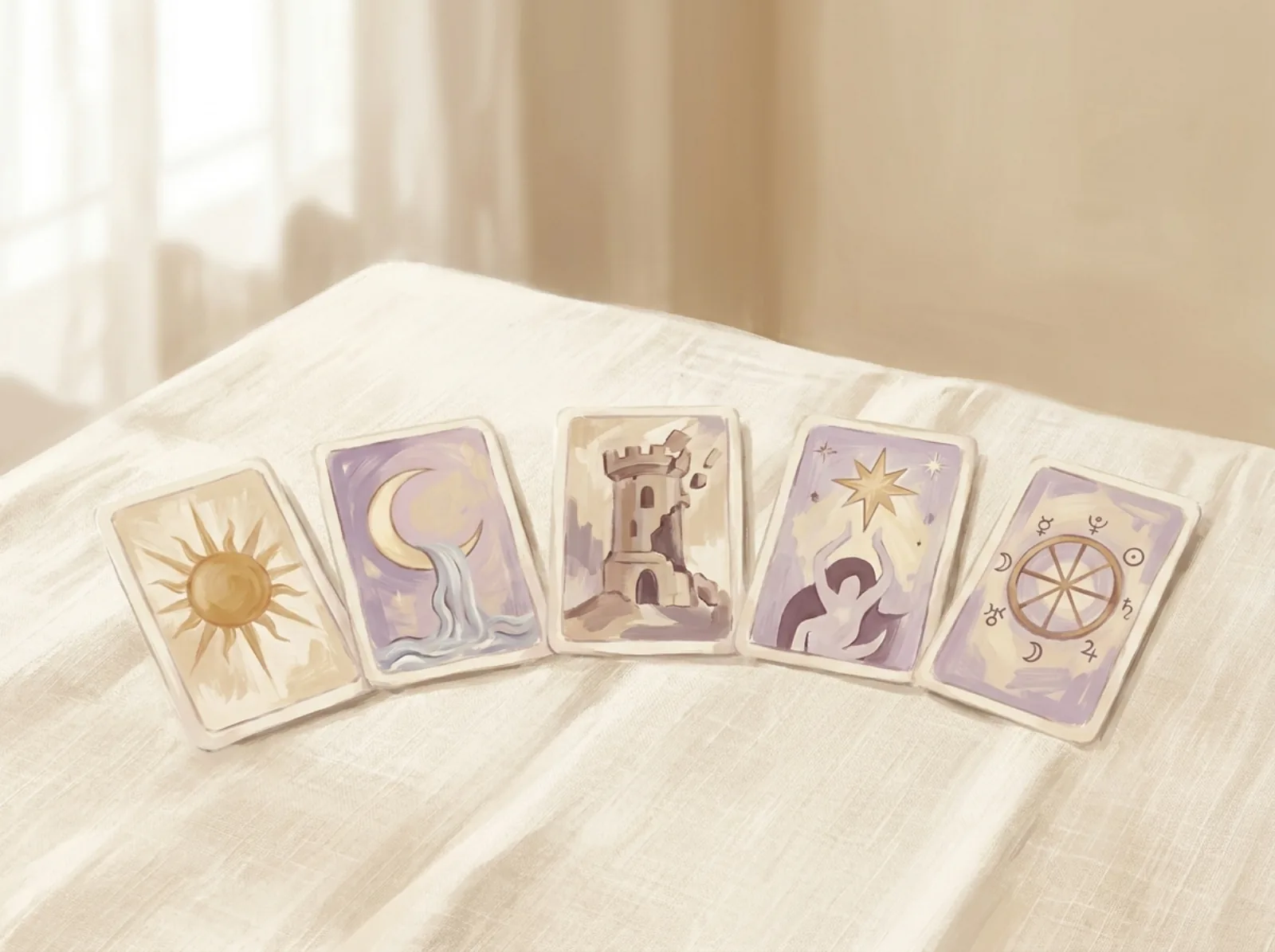
What The Sun Tarot Card Actually Means
The Sun is card XIX of the Major Arcana, and in most modern decks it does exactly what it says on the tin — it beams. In the Rider-Waite-Smith tradition (the deck most Western readers learn on), the Sun sits near the end of the Fool's journey, right between the Moon (XVIII) and Judgement (XX). That placement matters: the card is not the beginning of light, but the moment after doubt has finally cleared. Part of our card meanings library.
At its plainest, the Sun means clarity, warmth, vitality, and success that other people can see. It is the card of things becoming obvious. A situation you couldn't read for weeks suddenly makes sense. A creative project you sat on gets a green light. Someone you weren't sure about tells you plainly how they feel. The Sun is the card of the unambiguous. Try our 3 Card Tarot Spread guide. Try our Career Tarot Spread guide. Try our Celtic Cross Tarot Spread guide. Try our Decision Tarot Spread guide. Try our Horseshoe Tarot Spread guide. Try our Love Tarot Spread guide. Try our One Card Tarot Pull guide. Try our Pentagram Tarot Spread guide.
That plainness is deceptive, though. When I read for clients, the Sun is one of the cards people underestimate because it looks 'easy.' It isn't. The Sun asks you to be seen — not just to feel good in private, but to let your life become legible to others. Some people find that harder than any tower moment. This guide walks the card in depth: symbolism, upright and reversed meanings, love, career, health, spiritual, yes/no, timing, common combinations, spreads, and a journaling practice you can start tonight. Try our Relationship Tarot Spread guide. Try our Shadow Work Tarot Spread guide. Try our Situation Action Outcome Spread guide. Try our Tarot Spread For Anxiety guide. Try our Tarot Spread For Beginners guide.
One note before we begin: tarot in this guide is treated as a reflection tool, not a fortune-telling device. Nothing here replaces a therapist, doctor, lawyer, or financial adviser. If a reading brings up something heavy, please read the 'When to consult a professional' section near the end. Try our Tarot Spread For Clarity guide. Try our Tarot Spread For Grief guide. Try our Tarot Spread For Manifestation guide. Try our Tarot Spread For Self Love guide. Try our Yes No Tarot Spread guide.
Rider-Waite-Smith Imagery: Reading the Picture
The version of the Sun most people picture was painted by Pamela Colman Smith in 1909, working from instructions by the occultist Arthur Edward Waite. Smith was a Jamaican-British artist and stage designer whose visual choices — not Waite's text — are the reason the Rider-Waite-Smith deck became the world standard. Rachel Pollack, in her 1980 classic 'Seventy-Eight Degrees of Wisdom,' is emphatic on this point: Smith made the deck readable.
In the Sun card you see a large golden sun with a serene human face, alternating straight and wavy rays (traditionally read as intellect and feeling), a nude child riding a white horse, a red banner in the child's hand, four sunflowers behind a low garden wall, and, in most printings, a subtle band of yellow field. Every element is doing work.
The child is often read as the restored self — post-Moon (XVIII), you have integrated your shadows and can meet the world without armor. Nudity here is not sexual; it is nothing-to-hide. The white horse is unbridled instinct in service of consciousness. The red banner is embodied vitality — spirit made visible. Sunflowers turn toward light, and four of them nod to the four suits, the four elements, or simply completeness.
Mary K. Greer, in '21 Ways to Read a Tarot Card,' recommends actually describing the picture out loud before assigning a meaning. Try it. When you say 'a child is riding out from behind a walled garden into open sun,' the card starts to read itself: something protected is now going public. That is the Sun in one sentence.
The Sun Upright: Core Meanings
Upright, the Sun is the tarot's most straightforwardly positive card, and beginners are sometimes told to just write 'good things' and move on. Don't. The Sun has texture. Upright, it points to five overlapping themes: clarity, vitality, visibility, authenticity, and simple joy. Any given reading usually leans on one or two of them, and the surrounding cards tell you which.
Clarity is the intellectual layer. Something you couldn't see clearly — a relationship dynamic, a business decision, your own motives — is now in plain daylight. Vitality is the physical layer. Energy returns after a slump, a recovery accelerates, or you simply feel like yourself again in your body. Visibility is the social layer. Recognition arrives. You are noticed, credited, published, hired, chosen.
Authenticity is the psychological layer, and it is the one people miss. The Sun asks you to drop the performance. In the Rider-Waite-Smith image the child has no clothes because there is nothing left to hide. If you have been playing a role — the tough one, the fine one, the effortless one — the Sun says the role is more expensive than the truth. Joy, finally, is the somatic layer: warmth, ease, laughter that isn't earned by a joke.
In my experience with clients, when the Sun shows up in a spread that has otherwise been heavy for months, it is usually not signaling that the hard thing is over. It is signaling that you are strong enough to be seen inside it. That is a different message, and often a more useful one.
The Sun Reversed: What Actually Changes
Reversed cards spook new readers. They shouldn't. A reversed Sun is not a bad Sun; it is the same energy filtered through a cloud, a curtain, or a bad night's sleep. Benebell Wen, in 'Holistic Tarot,' frames reversals as intensity, timing, or direction shifts rather than opposites, and that framing works especially well here.
Reversed, the Sun most often means one of four things. First, delayed clarity: the answer is coming, but not this week. Second, dimmed confidence: you know the truth and you are shrinking from it — impostor feelings, dread of being seen, fear of the very success you asked for. Third, over-exposure: too much visibility, burnout from being 'on,' a project or relationship that has been over-shared and needs privacy. Fourth, false positivity: forcing sunshine, spiritual bypassing, refusing to feel the harder thing underneath.
The reversed Sun is rarely a stop sign. It is a dimmer switch. If you drew it after asking whether to launch something, the read is usually 'yes, but not with this energy, or not from this posture.' Ask what you are performing. Ask what would happen if you turned the volume down and let the work speak. Ask whether the delay is external (waiting on someone else) or internal (waiting on your own permission).
One caution: if the reversed Sun appears alongside cards of exhaustion or emotional flatness — Four of Cups, Nine of Swords, Ten of Wands — consider whether you are actually depressed rather than 'blocked.' Tarot is not a diagnostic tool. A pattern of low mood that lasts more than two weeks is a signal to talk to a clinician, not to shuffle again.
The Sun in Love and Relationships
Love readings are where the Sun shines hardest and where it is most often misread. Upright in a love spread, it favors honesty, warmth, ease, and public commitment — the relationship stops being a private negotiation and becomes something you and your partner can both name out loud. For couples, it can signal a genuine sunny stretch after a hard season, engagement, marriage, or a decision to move in. For a single person, it favors meeting someone who is unusually straightforward — not necessarily flashy, but hard to misread.
Where people go wrong is treating the Sun as a guarantee of romance. It is not a guarantee of romance; it is a guarantee of visibility. That means it can just as easily mean 'you will finally see this person clearly' — which sometimes leads toward commitment and sometimes toward a very clean, warm ending. The Sun is happy either way. Its job is to remove the fog.
For situationships and ambiguous entanglements, the Sun is often the card of the conversation you have been avoiding. Someone is about to be clear, and the clarity is the gift, whichever direction it points. Pair it with the Ace of Cups or Two of Cups and yes, a real opening is likely. Pair it with the Eight of Cups or the Tower and the sunshine is on the exit door.
Reversed in love, the Sun points to over-idealization ('everything is amazing' when it isn't), performative happiness on social media, or a partner who is warm in private and unavailable in public. It can also mean a genuinely good relationship going through a low-energy phase — not doomed, just tired.
The Sun in Career, Money, and Creative Work
For career questions, the Sun is one of the best cards in the deck. Upright, it favors visibility, recognition, promotion, published work, launched product, positive press, offers you can accept without a heavy negotiation, and creative projects that finally leave the drawer. If you have been building in private, the Sun is often the card of the reveal.
For money, the Sun is generally favorable but wants specifics. Paired with the Ten of Pentacles it points to long-term financial stability made visible. Paired with the Six of Pentacles it points to fair exchange — you will be paid for what you actually did. Paired with the Wheel of Fortune it points to a timing-driven windfall. Alone, the Sun says 'the pipe is open,' not 'the amount is huge.'
For creative and self-employed work — freelancers, founders, artists, indie developers — the Sun is the card of shipping. It is the card of the launch day, the release, the exhibit, the demo. If you have been circling a project for months, drawing the Sun in a 'what does this project need' position is usually the deck telling you the project is ready and you are the bottleneck.
Reversed in career, watch for three patterns: a launch that is technically successful but leaves you flat, recognition going to the wrong person or team, or a role where you are asked to be 'the face' in a way that costs more than it pays. None of these are catastrophes; they are cues to renegotiate visibility on your own terms.
The Sun for Health, Energy, and Recovery
Before this section, a boundary: tarot is not medicine. I do not use it to diagnose, and neither should you. What follows is how the Sun tends to show up around health themes as a reflection tool — not as a substitute for a clinician. If you have a concrete symptom, the actionable answer is always to see a professional, not to draw another card.
With that said, the Sun upright is one of the most encouraging cards to draw around health questions. It generally correlates with energy returning, recovery accelerating, symptoms clearing, sleep normalizing, and mood lifting. In fertility and pregnancy readings it has a long-standing association with healthy children and easy pregnancies — an association Rachel Pollack and other authors trace back to the child in the imagery, though I would treat that as a comforting symbolic layer, not a prediction.
For mental and emotional health, the Sun often marks the visible end of a hard chapter — the week you realize you have been laughing more, sleeping through the night, or answering messages again. It is a card of energy returning to the body. If you have been in a low period, drawing the Sun can be a useful cue to notice the small evidence of recovery that is already happening.
Reversed, the Sun around health tends to mean recovery is happening but slower than you want, a temporary energy dip, or — importantly — a warning against toxic positivity about a real symptom. If you or someone in your life is 'fine, fine, fine' about something that clearly is not fine, that is the reversed Sun asking for honesty. Take it to a doctor, not to the deck.
The Sun in Spiritual Readings and as a Yes/No Card
In an explicitly spiritual spread — questions about purpose, calling, or where you are in a personal-growth arc — the Sun upright is the card of integration made visible. It follows the Moon (XVIII), the card of confronting the unconscious, and precedes Judgement (XX), the card of a genuine call. In that sequence, the Sun is the moment you stop being defined by your wound and start being defined by what you built from it.
For shadow work — the practice of consciously exploring the parts of yourself you have disowned, a term borrowed from Jungian psychology — the Sun is a milestone card. It typically shows up not while you are in the shadow but after a real stretch of it. When it appears, it is worth pausing to name specifically what you have integrated, out loud or on paper. Naming is what makes the growth stick. Reversed in a spiritual reading, the Sun often points to spiritual bypassing — using 'love and light' language to avoid the harder work.
Yes/no readings are the most controversial format in tarot — many serious readers refuse them because they flatten a rich system into a binary. That said, if you are going to do them, the Sun is possibly the clearest 'yes' in the deck. Upright, it reads as an unambiguous yes — often a yes that arrives faster and more publicly than expected. Reversed, it softens to 'yes, but' or 'not yet,' and rarely converts to a hard no.
Timing with the Sun leans short and warm. Traditional correspondences link the card to the astrological Sun, which rules Leo (roughly July 23 to August 22 in the Northern Hemisphere) and generally to summer, midday, and Sundays. Many working readers also read the Sun as 'a matter of days' rather than months in a timing position. Treat all tarot timing as one data point, not a calendar — Mary K. Greer has written at length about how inconsistent it is between readers.
Common Card Combinations With The Sun
Cards read one another. A single card is a note; a spread is a chord. Here are combinations I see often and how I read them as a working editor and reader.
Sun + The Lovers: a relationship coming into the light, often a public commitment, an engagement, or a decision to make a private relationship official. If it is a work partnership, an aligned collaboration that others will notice. Sun + The World: completion made visible — a long project shipping to real recognition, a chapter closing on genuinely good terms, sometimes travel or relocation that suits you. Sun + The Star: a rare and lovely pairing — hope stabilizing into confidence, healing that becomes a source for others, creative work that lands.
Sun + The Tower: sudden clarity through disruption. Something you were hiding from yourself becomes undeniable. Painful in the short term, clarifying in the long. Sun + Death: a genuinely good ending, or a rebirth arriving with sunlight — usually a much softer read than Death alone. Sun + The Moon: the story of the deck itself — confusion giving way to clarity. Very often a reading about a truth finally landing.
Sun + Ten of Cups: emotional fulfillment made visible in family, home, or chosen family. Sun + Ten of Pentacles: financial and material stability that others can see. Sun + Three of Wands: a launch or venture that succeeds beyond the local audience. Sun + Eight of Wands: fast, public news — often positive. Sun + Nine of Swords: a specific and useful pairing — the anxiety you have been rehearsing at 3 a.m. is unfounded, and daylight will show you that.
Tarot Spreads That Highlight The Sun
Some spreads simply make the Sun more legible when it appears. If you want to work with this card intentionally, here are four practical spreads, from beginner to intermediate.
First, the classic three-card past-present-future. When the Sun lands in 'future,' it is usually pointing to a genuine improvement in visibility, energy, or clarity — but only if you follow through on what 'present' is asking. When the Sun lands in 'past,' it can mark a peak you are still comparing the present to; ask whether you are missing today because you are grieving yesterday's high.
Second, a simple 'what to embrace / what to release' two-card pull. If the Sun shows up in 'embrace,' the answer is usually to let yourself be seen more, publish the thing, take the credit, say the honest sentence. If it shows up in 'release,' the read is often to release the performance of happiness and let something real in.
Third, a five-card Sun-specific spread I use with clients: (1) Where is the light already, that I am not seeing? (2) What am I ready to reveal? (3) What is my fear of being visible? (4) What does 'success I can enjoy' actually look like for me? (5) A permission the Sun would grant me right now. This works whether or not the Sun literally appears in the pull.
Fourth, the Celtic Cross — the ten-card standard that Waite documented in his 1910 'Pictorial Key to the Tarot.' When the Sun lands in position 6 ('immediate future') or position 10 ('outcome'), it is one of the more reliable positive signals in the entire deck. When it lands in position 4 ('foundation'), it can point to an unusually stable, sunny base — which is worth honoring rather than taking for granted.
What To Do Right Now: A 7-Step Sun Practice
If you drew the Sun today, or if you are working with this card as a study focus for the week, here is a practice you can complete in about forty minutes. It is not a ritual and it does not require belief. Treat it as structured self-reflection.
1. Sit with the card. Print or pull up a Rider-Waite-Smith Sun. Look at it for one full minute without reaching for meaning. Notice one detail you have never noticed before. Write it down.
2. Name the fog. In one sentence, write what you have not been able to see clearly in the last month. Be specific. Not 'my life' — 'whether my manager actually respects my work.'
3. Name the truth underneath. If the fog lifted, what would you already know? Write the first sentence that arrives, even if it is uncomfortable. This is the Sun's actual message.
4. Locate one small piece of visibility. What is one action, this week, that would let one other person see what you actually think, feel, want, or have built? Not a public post — one honest sentence to one person.
5. Locate one performance to drop. What have you been performing — fineness, effortlessness, positivity, expertise — that is more expensive than the truth would be?
6. Write a permission slip. In your own handwriting: 'I have permission to ____.' Fill it in with something the Sun is asking of you specifically. Keep it somewhere you will see it.
7. Set a re-check date. Put a date on the calendar — seven or fourteen days out — to reread what you wrote today. The Sun is the card of things becoming visible over time; giving yourself a check-in is how you notice the movement.
How The Sun Compares to Other 'Positive' Cards
The Sun is often lumped in with the Star, the World, the Ten of Cups, and the Ten of Pentacles as 'the good cards.' They are all favorable, but they mean different things. Understanding the differences will sharpen every reading you do.
The Star (XVII) is hope after a hard thing. It is quieter than the Sun, more private, and usually earlier in a recovery arc. The Star is the moment you can breathe again; the Sun is the moment other people can see that you are breathing again. If the Star is candlelight in the tent, the Sun is walking out of the tent into morning.
The World (XXI) is completion and integration on a bigger scale. Where the Sun is often about one project, one relationship, one clarity, the World is about a whole chapter closing. The Sun can arrive many times in a life; the World arrives at the end of each major cycle. Together they are one of the most rewarding pairs in the deck.
The Ten of Cups is emotional fulfillment specifically inside chosen family, home, and long-term love. The Ten of Pentacles is generational or long-term material stability. Both are gorgeous cards but domain-specific. The Sun is more general and more public — it is not tied to home or money, but to the fact of being seen.
One more comparison worth making: the Sun versus the Ace of Wands. Both are fiery and vital, but the Ace of Wands is a spark — the beginning of something creative — while the Sun is the sustained blaze. If you pull them together, the reading is usually 'the spark you had is real and will build.'
How to Journal With The Sun
Journaling is where casual tarot becomes a genuine reflection practice. Mary K. Greer, whose '21 Ways to Read a Tarot Card' is the standard modern text on this, recommends writing with the card rather than about it — treating the card as a conversation partner rather than a subject. Here is a Sun-specific journaling protocol you can rotate through.
Weekly prompt 1: Where in my life is the light stronger than I am admitting? We often minimize evidence of goodness because we are braced for the next hard thing. The Sun asks you to inventory what is already working. Write for ten minutes without editing. Try the Raka app to explore this in more depth.
Weekly prompt 2: Who benefits from me being small, and what would change if I stopped? This is uncomfortable and useful. The Sun's reversed shadow is dimming — sometimes we dim for other people's comfort. Naming that is the beginning of not doing it anymore.
Weekly prompt 3: If I were being fully honest — not brutal, but honest — what one thing would I say this week, and to whom? The Sun favors clarity spoken out loud, in the actual voice, to the actual person. Journaling is the rehearsal.
Weekly prompt 4: What am I ready to publish, share, or make visible in some form? 'Publish' is loose here — it can mean a real post, a message to a friend, a piece of work sent to one person, a decision spoken to your partner. Momentum comes from making the private public in small, chosen ways.
If you keep a tarot journal, dating each entry and rereading a month later is where the practice compounds. You will start to see your own patterns — which is what tarot, honestly, is for.
When to Consult a Professional (and When Tarot Is Enough)
Tarot is a mirror. It is not a therapist, doctor, lawyer, or financial adviser, and the Sun card is not a diagnosis of anything. This section exists because responsible tarot writing has to include it.
If a reading — Sun or otherwise — brings up persistent low mood, hopelessness, thoughts of self-harm, or a level of anxiety that is disrupting your sleep or work for more than two weeks, please talk to a licensed mental-health professional. In the US, the 988 Suicide and Crisis Lifeline is available by call or text; the UK Samaritans line is 116 123; Canada has 9-8-8; Australia has Lifeline at 13 11 14. These are real, free, and staffed by people trained for exactly that call. Try best tarot app to explore this in more depth.
If a reading raises a physical health concern, that is a signal to book an appointment, not to draw another card. The Sun 'looking good' for your health does not mean you should skip a screening; the Sun 'looking off' does not mean anything is medically wrong. Use the actual clinician.
For financial and legal decisions, the same principle holds: use the deck to notice your own resistance, avoidance, or clarity, and then take the actual question to a qualified adviser. Tarot is a genuinely useful reflection tool for adults. It is not a substitute for the disciplines that exist to protect you.
Used inside those limits, the Sun is one of the most quietly generous cards in the deck. It does not promise you an easy life. It promises you a visible one — and reminds you, on the days you need reminding, that being seen inside your real life is one of the actual points.