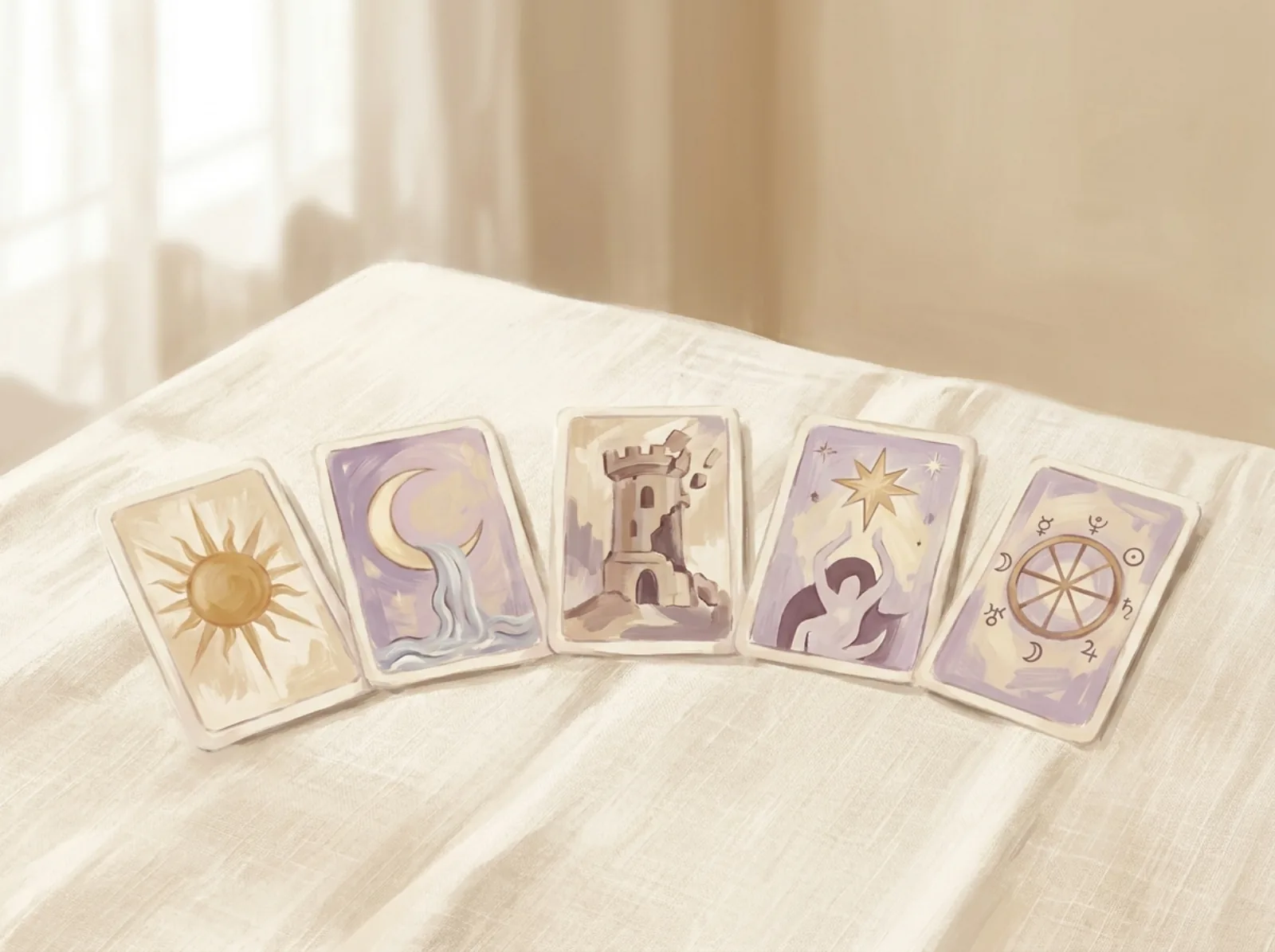
The Star Tarot Card Meaning at a Glance
The Star is the seventeenth card of the Major Arcana, numbered XVII, and it sits between The Tower (XVI) and The Moon (XVIII) in the Fool's Journey. If The Tower is the lightning strike that collapses a false structure in your life, The Star is what you feel three mornings later, when the smoke has cleared and you notice, almost with surprise, that you are still here and the sky is still working. Part of our tarot reference library.
At its core, The Star means hope, renewal, calm clarity, and quiet faith in yourself and in something larger than yourself. It is one of the most gentle cards in the deck, but do not mistake gentle for weak. The Star asks you to keep pouring your energy out generously even after you have been hurt, and to trust that what you give will not empty you. Try our 3 Card Tarot Spread guide. Try our Career Tarot Spread guide. Try our Celtic Cross Tarot Spread guide. Try our Decision Tarot Spread guide. Try our Horseshoe Tarot Spread guide. Try our Love Tarot Spread guide. Try our One Card Tarot Pull guide. Try our Pentagram Tarot Spread guide.
In most modern Rider-Waite-Smith-based decks, when The Star appears in a reading it is asking you to lower your guard just enough to be seen, to reconnect with a longer-term vision that survived whatever recent disruption you have moved through, and to make one small, honest step toward that vision this week. Try the Raka app to explore this in more depth. Try our Relationship Tarot Spread guide. Try our Shadow Work Tarot Spread guide. Try our Situation Action Outcome Spread guide. Try our Tarot Spread For Anxiety guide. Try our Tarot Spread For Beginners guide. Try our Tarot Spread For Clarity guide.
As an editor, I read for people going through breakups, career pivots, and identity shifts every week, and The Star is easily the card readers most often say they wanted to see. That is not a coincidence. It is the card of permission to hope again. Try our Tarot Spread For Grief guide. Try our Tarot Spread For Manifestation guide. Try our Tarot Spread For Self Love guide. Try our Yes No Tarot Spread guide.
The Rider-Waite-Smith Imagery: What You Are Actually Looking At
The version of The Star most people know was drawn by Pamela Colman Smith in 1909 under the direction of the British occultist Arthur Edward Waite, and first published in London by William Rider and Son. Pixie Smith, as she was known, was a working illustrator and set designer, and her scenic instincts shape every card in the deck. When you look at The Star, you are looking at a small stage.
A nude woman kneels at the edge of a pool. Her left knee rests on the land and her right foot rests on the water — a detail Waite spends time on in his 1910 book The Pictorial Key to the Tarot. She holds two vessels. From one she pours water onto the earth, where it separates into five streams, often read as the five senses. From the other she pours water back into the pool.
Above her head, one large yellow eight-pointed star is surrounded by seven smaller white stars. In the background a tree rises with a bird — often identified as an ibis — perched in its branches, a nod to the Egyptian god Thoth and to sacred knowledge. The landscape is open, calm, and lit as if by early dawn.
The nudity is deliberate. After the exposure of The Tower, The Star is the moment you stop pretending. Nothing is hidden, nothing is armored. The message is that when you are willing to be honest with yourself about what you actually feel and want, you become a channel for something clearer to move through you.
Modern tarot author Rachel Pollack, in her landmark book Seventy-Eight Degrees of Wisdom, describes The Star as an image of the psyche opened to the cosmos after the collapse of ego defenses. That is a useful sentence to sit with. The imagery is not decoration. It is a prescription.
The Star Upright: Full Meaning
Upright, The Star means renewed hope, calm optimism, healing after a difficult chapter, creative flow, spiritual reconnection, and quiet confidence in your longer-term direction. It often turns up when you have already done a lot of the hard emotional work, even if you cannot yet see the results. It is the card of interior spring.
One of the most useful ways to read upright Star is as guidance rather than promise. It is not telling you that everything is fixed. It is telling you that your compass is working again. You can trust the small pull in your chest that says this direction, not that one. You are permitted to want what you want without needing to justify it out loud.
In readings, upright Star often shows up alongside cards about slow rebuilding — the Four of Wands, the Six of Cups, the Ace of Cups, the Nine of Pentacles. When it appears in an outcome position, it usually points to an outcome where you feel more like yourself than you have in a while, even if the external circumstances are still in motion.
It is also the card of being seen kindly. That might be a specific person who finally understands you, a therapist who names the pattern you could not name, or a wider audience beginning to recognize your work. The Star has a public dimension to it. It says light travels.
As Mary K. Greer notes in her long body of tarot writing, hope is not passive on this card. Upright Star is not sitting on a cloud waiting. She is kneeling, working, pouring. Hope on The Star is a labor.
The Star Reversed: Full Meaning
Reversed, The Star tends to mean disillusionment, hopelessness, creative block, disconnection from your own guidance, or hope that has slipped into escapism and wishful thinking. Sometimes it means you have been pouring out your water for so long that the pool has run dry and you need to stop, refill, and reassess who has been drinking from you.
There is a subtler reversed reading that comes up often in my client work: The Star reversed as spiritual bypassing. That is when you use hope, positivity, or spiritual language to skip past a feeling that actually needs to be felt. If you find yourself saying everything happens for a reason before you have actually cried about the thing, this card is calling you back to honesty.
Reversed Star can also signal a crisis of faith in yourself. You know the direction you should be moving but you have lost trust that you are the person who can move it. In career readings that can look like impostor syndrome; in love readings it can look like settling; in creative readings it can look like abandoning a project you were quietly right about.
The remedy the card itself suggests is small and physical. Get near water. Sleep. Look at the actual night sky. The Star reversed is rarely fixed by more thinking. It is usually fixed by re-entering your body and re-entering your life at a scale you can manage today.
If reversed Star shows up alongside cards like the Five of Cups, the Eight of Swords, or the Nine of Swords, and you are noticing persistent hopelessness in your actual life, please treat that as information and consider reaching out to a licensed therapist or a crisis line in your country. Tarot is a mirror, not a substitute for care.
The Star in Love and Relationships
In love, upright Star is one of the more tender cards you can pull. For someone single, it often points to a period of emotional healing where you are becoming genuinely available again — not performing readiness, actually feeling it. New connections that begin under this card tend to move slowly and honestly, and they often start in contexts related to purpose, creativity, or community rather than pure hookup energy.
For someone partnered, upright Star usually signals a repair phase. If you have moved through conflict, betrayal, or a long stretch of disconnection, this card says the possibility of quiet trust is real. It rewards vulnerability. That does not mean dumping everything on your partner at once; it means naming one true thing and letting it land.
Reversed in love, The Star can point to keeping someone on a pedestal, staying in a relationship because of who you hope they will become rather than who they are, or losing hope in partnership itself after a hard chapter. It is worth asking, gently: what am I imagining about this person that I have not actually verified with them?
The Star also shows up around long-distance connections, reunions, and situations where a relationship has to be rebuilt from a very different starting point than it began. It is the card of Yes, we can start again, but as different people this time.
One practical journal prompt for love readings with The Star: What would I risk being seen wanting, if I trusted the person on the other side to be gentle with the answer?
The Star in Career, Money, and Creative Work
For career, upright Star is one of the strongest purpose-and-visibility cards in the deck. It often appears when your work is finally beginning to align with what you actually value, and when other people are starting to notice. It favors mission-driven roles, creative work, healing professions, teaching, writing, and anything with a public or humanitarian dimension.
In money readings, The Star is generally hopeful but not fast. It is not the Nine of Pentacles or the Ten of Pentacles arriving with a bag of cash. It is more like a stable, slow rebuild after a period of scarcity — a raise that reflects your real worth, a business that starts to pay for itself, a debt that finally becomes manageable. It rewards long horizons.
For creatives, upright Star is close to a green light. It is the card of the idea that will not leave you alone, and it usually shows up as a nudge to actually start, share, or publish the thing. If you have been sitting on a manuscript, a portfolio, a demo, a business plan, this card is asking, what are you waiting for?
Reversed in career, The Star can mean burnout, loss of faith in your industry, undervaluing your work, or chasing recognition in a field that no longer fits you. It can also flag a version of imposter syndrome where you have real skill but have decided in advance that you are not the person who gets to do this. That decision is the actual block.
A quiet Star-in-career move for this week: name one specific person or platform where you would be willing to be more visible, and take exactly one small action toward that visibility today.
The Star in Health, Spirituality, and Personal Growth
In health readings, upright Star is traditionally associated with recovery, replenishment, and gentle nervous-system regulation. It often appears after an illness, injury, or exhausting stretch, and it points to slow, sustainable practices — sleep, hydration, sunlight, gentle movement, being near water — rather than dramatic overhauls. Nothing on this card asks you to grind.
A necessary caveat: tarot is not a diagnostic tool. If a physical or mental health issue is on your mind, please treat The Star as encouragement to actually book the appointment you have been avoiding, not as a substitute for one. Some of the best readings I have witnessed ended with the querent picking up the phone to call a GP or a therapist. That is The Star working as intended.
Spiritually, The Star is one of the clearest guidance cards in the deck. It is often read as a signal that your connection to whatever you consider sacred — a specific tradition, the natural world, a creative source, a sense of your future self — is opening back up after a period of doubt. You may find prayer, meditation, or ritual practices easier to return to right now.
For personal growth, this card rewards honesty over performance. It asks what you would want if you stopped optimizing for other people's approval. In client sessions I have watched people cry, quietly, at that question. The tears are usually the answer.
If you have moved through grief, addiction recovery, or a long depressive episode, The Star can appear as a marker: something in you has genuinely shifted. Honor that. Also, keep your professional support in place. Renewal is real and it is also fragile.
The Star as a Yes/No Card and Its Traditional Timing
For yes/no readings, The Star is generally read as a soft yes — a yes with patience attached. It is not the immediate, forceful yes of the Sun or the Ace of Wands. It is closer to yes, if you keep showing up honestly. Reversed, it usually reads as no, or not yet, especially if the question was based on hope alone rather than on any real signal from the situation.
For timing, most traditional systems associate The Star with the astrological sign of Aquarius, which runs roughly from January 20 to February 18 in the tropical zodiac. Readers using this system will often say events described by The Star are pointing to Aquarius season, or to the next time Aquarius is emphasized in the sky.
A second common timing convention places The Star at roughly one lunar cycle out — about 28 to 30 days — because of the card's association with the number seventeen and with nighttime, moonlit imagery. In practice this is a guideline, not a guarantee. Tarot timing is famously fuzzy and works better as a rhythm than as a deadline.
A more useful timing question when The Star appears is: what would I need to feel ready? The card tends to describe situations that ripen when you are internally aligned rather than externally rushed. If a decision feels forced, The Star is usually asking you to slow down by one beat.
The Star vs The Sun, The Moon, and The Wheel of Fortune
The Star is easiest to understand when you place it beside its neighbors. The Sun (XIX) is joy that has arrived — warm, obvious, celebratory, often social. The Star (XVII) is the private, quieter cousin: hope that is still being built, felt at night rather than at noon. If The Sun is a wedding, The Star is the moment two people first admit, in the dark, that they are in love.
The Moon (XVIII), which sits directly between them, is confusion, intuition, dreams, and the parts of the psyche that resist easy language. The Star to Moon to Sun progression is one of the most beautiful arcs in the Major Arcana: honest hope, then the murky descent into the unconscious, then integrated daylight joy on the other side.
Compared to The Wheel of Fortune (X), The Star is much less about external turns of luck and much more about your own steadiness inside change. The Wheel says the situation is moving. The Star says you can move with it without losing yourself. Together they are a strong pair for major life transitions.
The Star also invites comparison to the Ace of Cups (new emotional beginnings) and the Six of Cups (memory, innocence, returning to something old with fresh eyes). Where those cards focus on a specific emotional current, The Star widens the lens to your overall relationship with hope itself.
If you draw The Star with any of these cards, do not read them in isolation. Ask which relationship is playing out: healing after collapse, hope after confusion, or personal steadiness inside a larger turn of fortune.
Common Star Combinations With Other Tarot Cards
The Star + The Tower: healing after a genuine collapse. Not a small argument, an actual structural change — a job loss, a breakup, a move, a health event. This pairing says you are past the worst of it and rebuilding on more honest ground. It is one of the most encouraging two-card sequences in the deck for anyone in recovery of any kind.
The Star + The Fool: a new beginning that is aligned with your longer-term vision rather than an impulsive escape. Together they are a strong signal to actually launch the thing — the business, the move, the message, the profile. There is faith on both cards. Very little is being asked of you except that you begin.
The Star + Three of Swords: heartbreak that is finally beginning to heal, or a hard truth that ultimately restores your integrity. This is a common combination in breakup readings six to twelve months after the fact. The pain is real, and it is also information you needed.
The Star + Ten of Pentacles: long-term stability being rebuilt around values you actually hold. Often family-related. Sometimes about buying a home, planning for children, or repairing a legacy relationship. The Star softens the sometimes-cold energy of the Ten of Pentacles into something warmer.
The Star reversed + Seven of Cups: escapism, fantasy substituting for action, too many hopeful options and no chosen one. The remedy is to pick one and start. Any one. The choice is more important than getting it exactly right.
Tarot Spreads That Highlight The Star
The Celtic Cross remains the most common spread for a reason: with ten positions covering situation, challenge, past, future, conscious mind, subconscious, self, environment, hopes and fears, and outcome, it gives The Star room to speak in whichever position it falls. The Star as hopes and fears position, in particular, is a fascinating conversation — sometimes what you hope for is also what you are quietly afraid of. Try top tarot app 2026 to explore this in more depth.
A simpler three-card past-present-future spread will often bring The Star into sharp relief. When The Star sits in the future position, treat it less as a prediction and more as an invitation: this is available to you if you keep moving in the direction of your own honesty.
For self-reflection with The Star specifically, try a five-card Star spread: 1) What am I finally ready to hope for again? 2) What do I need to stop pouring energy into? 3) What do I need to start pouring energy into? 4) Who or what is the guiding star I have been ignoring? 5) What one honest action would I take this week if I trusted myself completely?
In year-ahead readings, drawing The Star as your card of the year is a meaningful signal. Chani Nicholas, in her writing and teaching, often reminds readers that a Major Arcana year card is less a forecast and more a curriculum. Your Star year is a year of learning to hope on purpose.
For couples or close friends, a shared three-card spread — one card for each person and one for the connection — can be revealing when The Star lands in the connection position. It usually points to a relationship in which you help each other believe in yourselves. That is worth protecting.
What To Do Right Now If You Just Pulled The Star
If you have just pulled The Star and you want a concrete next step, here is a short, honest sequence you can follow today. It is designed for reflection, not prediction, and it should take you roughly thirty minutes.
1) Write down the exact question you were holding when you drew the card, in one sentence. Not the polished version. The real one. 2) Describe the imagery of The Star in your own words for two minutes without looking anything up. Notice which detail your attention keeps returning to — the water, the stars, the nudity, the pool, the bird. That is your entry point.
3) Answer three questions in your journal: What have I recently survived? What do I want that I have been embarrassed to admit? What is one small action, doable this week, that honors that want? 4) Identify one person you would trust with your honest answer to question two, and decide whether to tell them. You do not have to. But knowing the name matters.
5) Go outside tonight, even for two minutes, and look at the actual sky. If it is cloudy or urban and you cannot see stars, that is fine — the point is the gesture. The Star is asking you to remember that you exist inside a much larger context than your current problem. 6) Drink a glass of water. This sounds like a joke. It is not. The card is called The Star and it is soaked in water imagery for a reason. Your nervous system will thank you.
7) In seven days, come back to what you wrote and ask what has actually shifted. Small is fine. Small is the whole point.
How to Journal With The Star: Prompts and Practice
Journaling is where tarot stops being entertainment and starts being useful. In her book Tarot for Your Self, first published in 1984 and still widely taught, Mary K. Greer built much of the modern journaling-with-tarot tradition, and The Star is one of the best cards in the deck to practice with because it invites honesty rather than analysis.
Try a weekly Star check-in for one month. Each week, draw The Star intentionally from your deck (yes, on purpose — this is a study, not a divination), place it in front of you, and answer three questions in writing: What did I hope for this week? What did I actually do about it? Where did I abandon myself, if anywhere, and how do I want to repair that?
For a deeper single session, try a letter exercise. Write a one-page letter from your future self — five years out — back to you today, in the voice of someone who has fully embodied Star energy. What do they thank you for? What do they gently ask you to stop doing? What do they want you to know about the road between here and there?
Contemporary tarot author Benebell Wen, in Holistic Tarot, emphasizes tracking your readings over time so you can see your own patterns instead of relying on memory. Even a simple spreadsheet — date, question, cards drawn, one-line reflection — will teach you more about your relationship with The Star in six months than any book will.
The goal of journaling with this card is not to predict what will happen. It is to notice, in writing, that you are the one making it happen, one small honest action at a time.
The Star Across History, Culture, and Modern Practice
The image of a woman pouring water beneath stars is very old. Similar figures appear in the Renaissance tarocchi decks of northern Italy in the fifteenth century, and the number seventeen has long been linked to esoteric traditions concerning hope and cosmic order. Waite and Smith did not invent The Star. They translated an older iconography into a form that has since become the visual standard for most Western tarot.
Since 1909, the Rider-Waite-Smith deck has been reissued and reinterpreted more times than any other tarot deck in English. Pamela Colman Smith herself, despite drawing all seventy-eight images, was paid a flat fee and died in relative obscurity in 1951. Modern scholarship and the ongoing Pamela Colman Smith Commemorative Set have begun to restore her name to the work, and it is standard now among careful tarot writers to name her alongside Waite.
According to Pew Research Center's 2018 report on Americans' religious and spiritual practices, roughly six in ten US adults reported holding at least one New Age belief, including belief in psychics, astrology, reincarnation, or spiritual energy in physical objects. Tarot sits comfortably inside that landscape as a reflective practice for millions of readers who may or may not identify as religious.
Contemporary tarot is being written by a broad range of voices — Rachel Pollack, Mary K. Greer, Benebell Wen, Jessica Dore, Chani Nicholas, and many others — and The Star has been consistently read across their work as a card of grounded, embodied hope rather than airy optimism. That consensus is unusual, and it is worth taking seriously when you interpret this card in your own life.
A final note on positioning: tarot is a tool for self-reflection and creative thinking, not a source of medical, financial, legal, or mental-health advice. If you are navigating a serious decision, use The Star as a mirror for your own values, and consult a licensed professional in the relevant field for the specifics. That is not a hedge. That is how the card actually wants to be used.