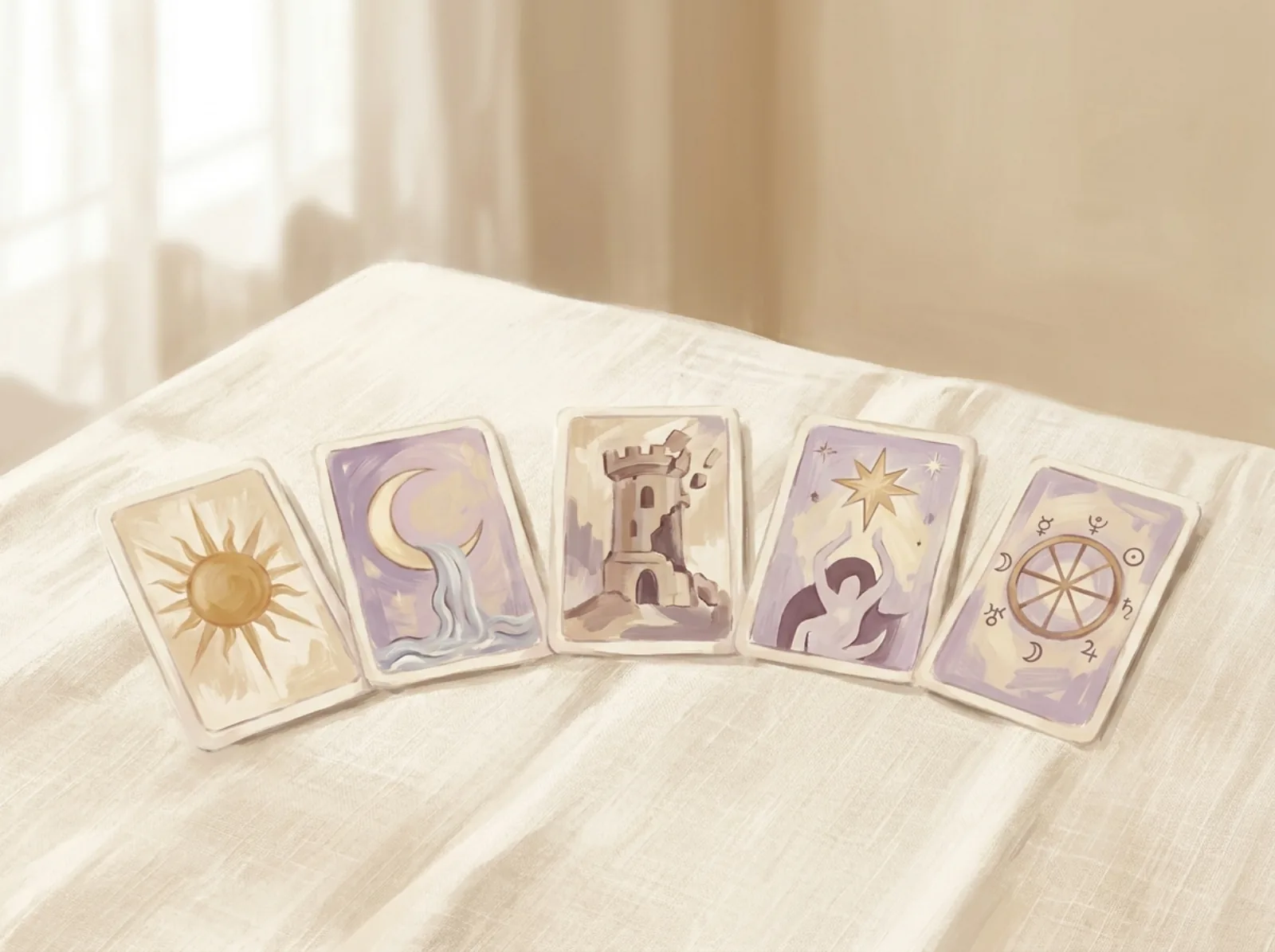
The World Tarot Card Meaning at a Glance
The World is the twenty-second card of the Major Arcana and the twenty-first numbered card (0 through XXI). It is the last stop on what tarot readers call the Fool's Journey — the narrative arc that runs from the innocent Fool (0) all the way to the dancing figure who closes the deck. Where The Fool begins with a leap, The World lands. It is completion, integration, and the quiet dignity of a cycle actually finished rather than abandoned. Part of our card meanings library.
In one sentence: The World tarot card meaning is the successful closing of a long chapter, and the moment your inner life and outer life finally sync up. That is why so many readers describe pulling this card as feeling seen. It does not promise you a lottery win or a soulmate at the door. It acknowledges that something you have been building — a degree, a business, a marriage, a version of yourself — is now recognizably real. Try our 3 Card Tarot Spread guide. Try our Career Tarot Spread guide. Try our Celtic Cross Tarot Spread guide. Try our Decision Tarot Spread guide. Try our Horseshoe Tarot Spread guide. Try our Love Tarot Spread guide. Try our One Card Tarot Pull guide.
Because it is the final Major Arcana card, The World also carries the weight of every card before it. The Fool's naivety, the Magician's tools, the Lovers' choice, the Tower's collapse, the Star's rebuilding — all of it condenses into this single figure. When you receive The World in a reading, you are not being told the future. You are being asked to notice what you have already survived. Try our Pentagram Tarot Spread guide. Try our Relationship Tarot Spread guide. Try our Shadow Work Tarot Spread guide. Try our Situation Action Outcome Spread guide. Try our Tarot Spread For Anxiety guide. Try our Tarot Spread For Beginners guide. Try our Tarot Spread For Clarity guide.
For newer readers, it helps to hold two ideas at once: The World is one of the most objectively positive cards in the deck, and it is also a graduation, which means the school year you loved is ending. Most people meet it with a strange mix of pride, grief, and readiness. That mixture is the card doing its job. Try our Tarot Spread For Grief guide. Try our Tarot Spread For Manifestation guide. Try our Tarot Spread For Self Love guide. Try our Yes No Tarot Spread guide.
Rider-Waite Imagery: What You Are Actually Looking At
The version of The World most modern readers picture is the one painted by Pamela Colman Smith for Arthur Edward Waite's 1909 Rider-Waite-Smith deck. Waite designed the symbolism; Smith, a working artist and mystic in her own right, gave every card its face. It is worth naming her, because for most of the twentieth century her work was uncredited despite being the visual grammar the entire modern tarot industry is built on.
In the center of the card stands a nude or lightly draped figure, often read as androgynous or hermaphroditic. This is deliberate. Waite, drawing on esoteric Christian and Hermetic sources, wanted a figure that had integrated the masculine and feminine within themselves — the alchemical marriage completed. The figure dances inside a laurel wreath, an ancient Greek and Roman symbol of victory awarded to athletes, generals, and poets.
In each hand the dancer holds a wand or baton. Two wands, not one, echoing the Magician at the start of the Major Arcana who held a single wand pointed at heaven. The World says: you now hold both. Above and below, receiving and giving, inner and outer. The mastery the Magician promised has become embodied.
In the four corners you will see an angel, an eagle, a bull, and a lion. These are the four fixed signs of the zodiac — Aquarius, Scorpio, Taurus, Leo — and also the four evangelists in Christian iconography, the four elements, and the four directions. On The Wheel of Fortune (card X) they appear reading books; on The World they appear again, but now they are witnesses. What was theoretical at the Wheel has become lived.
The wreath itself often has a subtle infinity twist at the top and bottom, tied with red ribbon. That shape is important: The World is not a finish line, it is a lemniscate. One cycle ends, another begins, and the dancer inside is the constant.
The World Upright: Meaning in Detail
Upright, The World tarot card meaning is completion in its cleanest form. A project delivered. A degree earned. A move finalized. A version of yourself you have been becoming for a long time is now the version you actually are. Readers sometimes describe the sensation as landing — you look around and realize you are, in fact, home.
It is also the classic card of travel, particularly international travel or travel that changes you rather than simply relocates you. The globe is in the name. Study-abroad programs, immigration, a job in a new country, a long-planned trip that finally happens after years of postponement — all of these can show up under The World.
In personal growth terms, this is the card of integration. You have taken the fractured pieces from earlier chapters — the tower moments, the hermit years, the lovers' choices — and stitched them into a self that hangs together. Rachel Pollack, in her influential book Seventy-Eight Degrees of Wisdom, describes The World as the point where the individual becomes aware of participating in something larger without losing themselves. That is a useful frame.
One caveat: upright, The World rewards you for the work you have already done. It rarely arrives before the work. If you draw this card and cannot immediately name what is completing, sit with the reading longer. Something is finishing that you may have been too close to see.
The World Reversed: What It Is Trying to Tell You
Reversed, The World is less a bad card than an incomplete one. The most common reading is: you are almost there and you know it. The dissertation is 90% written and unfinished. The relationship is in the last, hardest year before it either commits or ends. The move is booked but not begun. Something is being delayed — sometimes by circumstance, more often by you.
The second common reading is the shortcut. You closed the chapter, but you skipped a step. You graduated without doing the emotional work the degree was supposed to represent. You ended the relationship without the conversation. You launched the business without fixing the founder split. Reversed, The World asks whether the ceremony was real or performed.
A third reading, less discussed but common in my experience with clients, is the graduation you are avoiding. Sometimes you are being asked to acknowledge that a chapter is done and you do not want to admit it, because acknowledging it means starting the next Fool's Journey from scratch. The card reversed can be gentle here — it is not scolding you, it is naming what you already know.
Practical advice for a reversed World: ask yourself what feels 90% done. Then ask what the missing 10% is. Then ask, honestly, whether you are the one holding it up.
The World in a Love Reading
In a love reading, The World upright is one of the most mature cards in the deck. It rarely describes the giddy first month or the dopamine spike of a new match. It describes a relationship that has become itself. Two people who have moved through the Lovers' choice, survived a Tower moment or two, done the Hermit work individually, and arrived at partnership. Marriage, cohabitation, blended families, or simply a chosen commitment that both people take seriously — this is World territory.
For singles, The World can indicate the completion of a chapter of solo work — you have healed, dated, journaled, therapized enough — and are genuinely ready for partnership rather than performing readiness. It can also indicate meeting someone abroad, through travel, or from a very different cultural background from your own.
Reversed in love, the reading shifts. A long relationship is unfinished business — either heading toward commitment neither party will say out loud, or heading toward an ending neither party will schedule. It can also describe a partner who is physically present but emotionally still finishing an earlier chapter, sometimes with an ex, sometimes with a version of themselves.
A note on framing: no card in any deck should be used to decide whether to leave, stay, or reconcile with a partner. Tarot is a reflection tool. Use The World here as a prompt — what does completion actually look like for us? — not as a verdict.
The World in a Career Reading
In career readings, The World upright is graduation energy. A promotion that recognizes years of quiet work. A project finally shipped. A qualification finally earned. A business that has passed the survival stage and is now, unambiguously, a real business. Freelancers often pull this card the month they realize they can actually pay their bills from their own work.
It is also strongly associated with international work — a role that involves travel, a remote job with a foreign employer, an expansion into a new market, or an offer to relocate for work. If you have been quietly praying for a global expansion of your career, The World tends to arrive around the moment it becomes plausible.
Reversed, career World often points to a role you have outgrown. The salary is fine, the colleagues are fine, and something in you knows the chapter is finished. It can also describe a business or project that is stuck at the final 10% — the launch that keeps slipping, the certification you keep not scheduling, the resignation letter in drafts.
As a career action prompt, this card asks you to complete before you start. Finish the current role well. Deliver the final project. Have the conversation. Then move. The World rewards the closure, not the abandonment.
The World in Health, Spiritual, and Shadow Work
In health-related reflection questions, The World upright generally reads as integration and wholeness — recovery from a long illness or injury reaching its natural conclusion, a treatment protocol working, or a body that has been through something and is genuinely on the other side. It is also the card of the mind-body-spirit alignment cliché actually being true for once — sleep, movement, and mood in reasonable agreement. Reversed, it can point to a recovery that is 90% but not 100%, or a healing process where one dimension has lagged behind the others.
It is important to be extremely clear here: tarot cards do not diagnose, treat, or predict medical conditions, and neither does this article. The World in a health reflection is a journaling prompt about your relationship to your body and your recovery, nothing more. Any persistent physical symptom, any mental health concern that is affecting your daily functioning, any medication question, and any decision about starting or stopping treatment belongs with a licensed physician, therapist, or psychiatrist — not with a card.
Spiritually, The World is the closest the Major Arcana comes to a moment of enlightenment — though most serious tarot writers, including Mary K. Greer in her Tarot for Your Self, are careful to describe it as a stage of integration rather than a final destination. You have completed one turn of the spiral. The next turn is beginning at a higher elevation, but it is still a turn.
For readers doing shadow work — the ongoing practice of noticing the parts of yourself you have hidden from — The World can signal that a specific shadow piece has been genuinely integrated. Not just named in a journal, but lived out. The pattern that used to run you no longer runs you. You still notice it. It no longer decides.
Reversed in spiritual readings, The World often names a bypass. A spiritual identity worn as costume. A tradition adopted without depth. It is not a scolding card, but it is a card that asks you to be honest about how much of your practice you have actually lived through and how much you have merely aestheticized.
The World as a Yes/No Card and Its Timing
As a yes/no card, The World reads as a strong yes — one of the clearest yeses in the Major Arcana, second perhaps only to The Sun. If you have asked whether something will complete, whether the offer will come through, whether the trip will happen, whether the project will land, the answer is generally yes. That said, The World is a specific kind of yes. It is a yes that arrives on the other side of work. It is not a yes to a shortcut, a scheme, or a rescue.
Reversed as a yes/no card, the answer is soft: not yet, or yes but with a delay, or yes but only if you finish what is currently unfinished. It is rarely a hard no. It is more often a redirect. As always, one-card yes/no readings are the shallowest form of tarot and should be used lightly — if a question matters enough to ask, it deserves at least a three-card spread and a real conversation with yourself about what you actually want the answer to be.
On timing, tarot is famously unreliable, and any reader who tells you otherwise is overselling. That said, some associations for The World are consistent across most traditions. The card is often read as pointing to the end of a 9–12 month cycle — a full pregnancy of time, so to speak — or to the closing of a calendar year.
Astrologically, The World is associated with Saturn, planet of structure, time, and the reward that comes for finishing what you started. This links it loosely to Saturn-return-style chapters (roughly ages 27–30 and 56–60), to Capricorn season (late December through mid-January in the Northern Hemisphere), and to any point when Saturn is prominent in your natal chart. Numerologically, XXI reduces to 3 (2+1), which is often associated with creative fruition and the completion of a triadic cycle — some readers use this to time the card to three weeks, three months, or the third of something.
The most honest answer about timing: The World shows up around the point when a long chapter is close enough to completion that you can see the end. If you cannot see the end, the card is likely describing a chapter you have not yet identified as ending.
The World Compared to Adjacent Cards
It helps to understand The World by contrast. The Sun (XIX) is joy in its purest form — success without the weight of completion. The Sun says the day is good. The World says the era is over. Pull them together and you have a genuinely golden reading; pull The World alone and you have a more solemn one.
Judgement (XX), which sits just before The World, is the calling. It is the moment you realize the chapter has to end. The World is the actual closing. Together they often describe a decision that has been made and is now being executed. Judgement without The World can indicate a call you have not yet answered.
The Fool (0) is the mirror card. The Fool begins the journey with nothing but a small bag and a leap. The World ends the journey with everything integrated. When both appear in a reading, you are being told that one full cycle is closing and another is beginning immediately — you are graduating and enrolling in the next school on the same day.
Compared to the Ten of Pentacles — the other classic completion card — The World is spiritual and internal, while the Ten of Pentacles is material and generational. The Ten of Pentacles is the family estate, the paid-off house, the wedding on the lawn. The World is you, standing inside your own life, aware that you are the one who built it.
And compared to the Three of Cups, another celebratory card, The World is a solitary dance. The Three of Cups is your friends at the bar; The World is you, alone in your kitchen at midnight, realizing you actually made it.
Common Combinations With Other Cards
The World + The Fool: a full cycle completing and a new one beginning immediately, usually with more courage than the last one required. Classic career pivot, relocation, or life-stage shift.
The World + The Sun: pure celebration reading. Something genuinely good is landing. Weddings, births, launches, moves that were long-planned and now real. Try best tarot app to explore this in more depth.
The World + Death: not a scary combination. Death is transformation; The World is completion. Together they describe a chapter that is not only ending but genuinely composting into the next one. Often shows up around midlife pivots.
The World + The Tower: a completion arriving through collapse. A chapter you were not going to end voluntarily is being ended for you, and on the other side of the rubble, integration. Hard, but ultimately not cruel.
The World + Eight of Cups: a chosen departure. You are walking away from something complete, not something failed. This combination often reassures people who feel guilty about ending things that were, technically, working.
The World + Ten of Pentacles: the material and spiritual completion aligning. Legacy energy. A generational chapter closing well.
The World reversed + Four of Cups: the graduation you are refusing to accept because you are still looking backward at the chapter you were more comfortable in.
Tarot Spreads That Highlight The World
The Celtic Cross, the ten-card workhorse of English-language tarot since the early 20th century, is the classic spread where The World shows up in the outcome position (card 10). When it lands there, it generally confirms that whatever situation you asked about is heading toward genuine completion — not just a temporary resolution.
A three-card past/present/future spread with The World in the future position is one of the most reassuring pulls in tarot. It is worth pausing before you celebrate, though, and asking: what am I willing to complete to get there? The World in the future is rarely a passive prediction; it is a description of where the current trajectory ends if you keep walking.
For year-ahead readings, particularly around New Year or your birthday, drawing The World as your year card is a strong signal that the coming twelve months are about closing a long chapter cleanly. It pairs beautifully with a year-ahead journaling practice — you can ask, each quarter, what you are actively finishing.
A simple three-card spread I recommend specifically for working with The World: (1) What am I completing? (2) What am I being asked to acknowledge about the work I did? (3) What am I being invited to begin? This structure honors the card without turning it into a fortune-telling exercise.
What To Do Right Now If You Just Pulled The World
If The World just showed up in your reading, here is a numbered practice you can do in the next 30 minutes.
1. Name the chapter that is closing. Write it down in one sentence. Not a vague sentence. A specific one. "My twenties." "The startup I built for four years." "The version of me who was still trying to please my mother." If you cannot name it, sit with the card for another 24 hours and try again — the card is often ahead of your conscious awareness by a week or two.
2. List, without editing, three things this chapter gave you that you will actually miss. Not three things you are grateful for in the abstract. Three things you will miss. This is the grief part of graduation, and skipping it is how people end up circling back to closed chapters years later.
3. List three things you are ready to leave behind. Say them out loud. This part matters. The World is embodied; the practice should be too.
4. Ask what the next Fool's Journey is asking of you. Not the entire five-year plan. Just the first small leap. What is the equivalent of stepping off the cliff with a small bag? Write it in one sentence.
5. Do one concrete thing today that acknowledges the completion. Book the flight. Send the resignation email. Frame the diploma. Buy yourself dinner alone. Delete the ex's number. The World is a physical card; it asks for a physical gesture.
6. Optional but recommended: mark the date somewhere. Six months from now, you will want to remember the day you actually acknowledged this chapter closing. It matters more than you think.
How to Journal With The World
Journaling with tarot is one of the most durable applications of the deck, and The World is one of the richest cards to journal with because it holds so much retrospective weight. Mary K. Greer, whose Tarot for Your Self is arguably the standard text on tarot journaling, recommends dialoguing with the card as if it were a person — writing questions to it and answering in the card's voice. The World responds well to this.
Prompts that work well: What am I being asked to acknowledge is over? What did I learn in this chapter that I will carry into the next? Who did I become that I could not have imagined at the start? What am I quietly proud of that no one has congratulated me for? What am I grieving that I have not admitted I am grieving?
A longer practice, best done once a year: pull out every journal, calendar, and camera roll from the last twelve months. Write a two-page letter to yourself twelve months ago, from the version of you standing at The World now. Tell them what happened. Tell them what they got right. Tell them what surprised you.
For consistent tarot-based reflection practice, many readers use structured apps or physical journals with prompt libraries. If you want a mobile-first, private reflection space that pairs your card of the day with journaling and reading history — Raka is built for exactly this kind of self-guided work, without turning tarot into fortune-telling.
History, Authorship, and How To Read Responsibly
Tarot as we know it today is a European invention, most likely originating in 15th-century Italy as a card game (tarocchi) played by wealthy families like the Visconti-Sforzas. Its use for divination and self-reflection came later, primarily through 18th and 19th-century French and English occultists. The Rider-Waite-Smith deck, published in 1909 by the Rider Company in London, was Arthur Edward Waite's attempt to create a deck whose Minor Arcana were fully illustrated with narrative scenes — a decision Pamela Colman Smith executed with such craft that her images remain the visual reference point for most decks published since.
Modern tarot literature owes enormous debts to writers like Rachel Pollack (Seventy-Eight Degrees of Wisdom, 1980), Mary K. Greer (Tarot for Your Self, 1984), and Benebell Wen (Holistic Tarot, 2015). Each treats tarot as a psychological and reflective tool rather than a fortune-telling apparatus, and each is worth reading if you want to deepen your practice beyond one-card daily pulls.
It is worth saying clearly: no reputable modern tarot writer will tell you the cards predict a fixed future. Pew Research's 2018 report on New Age beliefs found that roughly six-in-ten U.S. adults hold at least one belief associated with New Age spirituality, including practices like tarot — but the framing among serious practitioners is overwhelmingly reflective rather than deterministic. The cards describe patterns and prompt questions. They do not make decisions for you.
Tarot is not a substitute for medical, psychological, financial, or legal advice. If you are dealing with a health issue, a mental health crisis, a serious financial decision, or a legal question, please consult a licensed professional. The World tarot card meaning, at its best, is a mirror. Mirrors are useful. They are not doctors, therapists, accountants, or lawyers.
Read gently, journal often, and trust yourself more than any card.