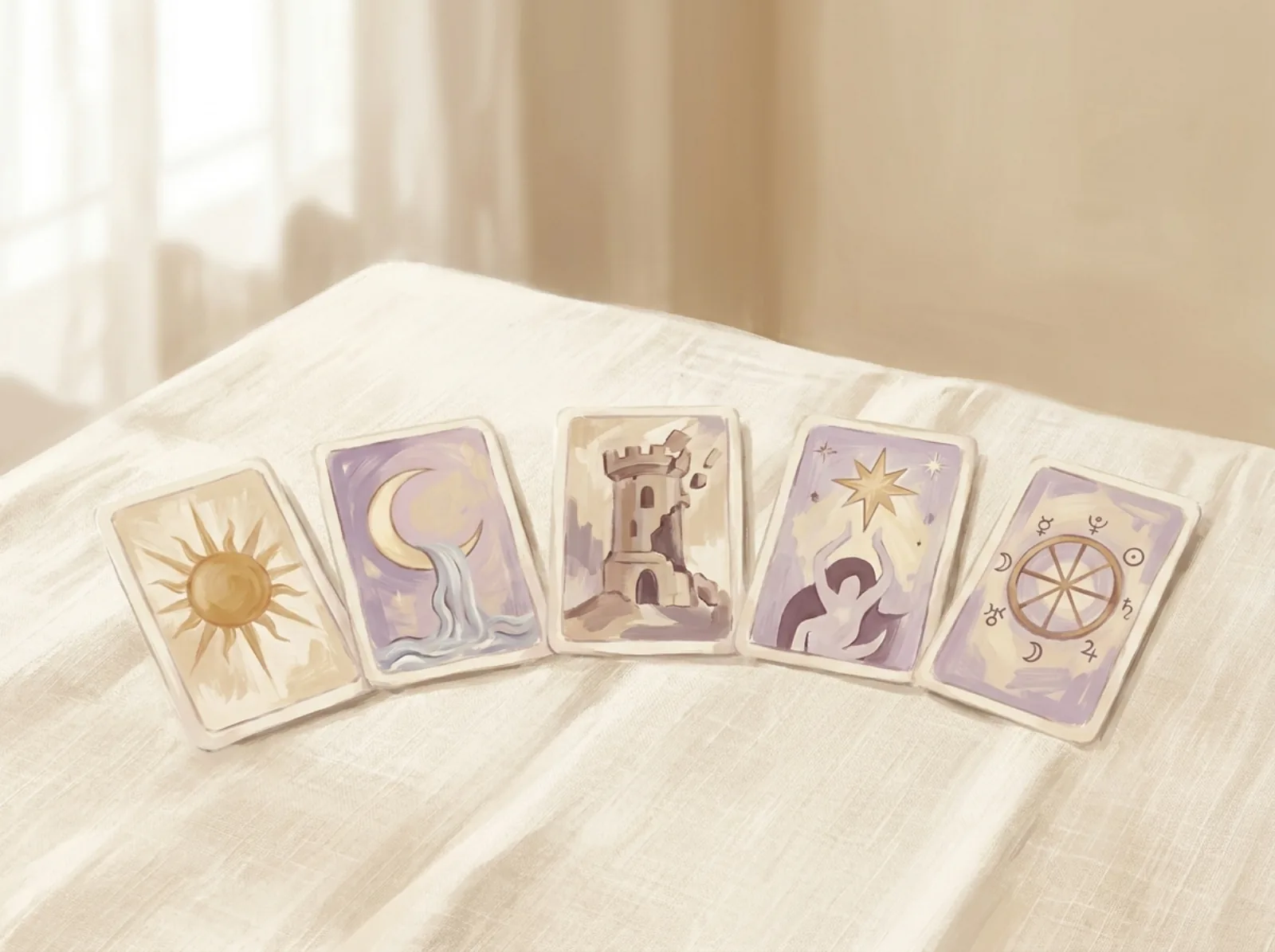
What a Decan Actually Is
A zodiac sign covers 30 degrees of the ecliptic. Split that into three equal pieces and you get three decans of 10 degrees each. Do that for all 12 signs and the full 360 degree wheel breaks into 36 decans. That is the whole structural idea. The complication (and the fun) comes from what each of those 36 slices means. Part of our astrology library.
Why 10 degrees instead of some other number
The number is not arbitrary. The Egyptian priest-astronomers who originated the system tracked 36 distinct star groups rising on the eastern horizon, each separated by about 10 days (and therefore 10 degrees of celestial longitude). When Hellenistic astrology absorbed the Egyptian framework around the 2nd century BCE, that 10 degree grid came with it. The number stuck because it worked, not because anyone picked it off a shelf.
Three decans per sign, in order
The three decans inside a sign are usually called the first, second, and third decans, running in the direction the sun travels through the sign. For a tropical zodiac, the first decan of Aries runs March 21 to roughly March 30, the second from March 31 to April 9, and the third from April 10 to April 19. Those dates shift by a day or two each year depending on when the sun actually hits each degree, so your natal chart (with the degree listed) is always more reliable than a calendar. See our best natal chart app guide.
- First decan (0 to 9.99 degrees): Carries the pure flavor of the sign plus its primary planetary ruler.
- Second decan (10 to 19.99 degrees): Blends the sign's energy with a sub-ruler from the next sign of the same element.
- Third decan (20 to 29.99 degrees): Blends with the sub-ruler of the third sign of that element.
That blending rule is the triplicity rulership system, and it is the engine under the hood. Section two is just that engine, written slowly.
The Triplicity Rulership System, Explained Without the Jargon
Here is the one idea that unlocks everything else. The zodiac has four elements (fire, earth, air, water) and each element contains three signs. Those three signs are called a triplicity. The three decans inside any sign are sub-ruled, in order, by the planetary rulers of the three signs of that element.
Fire triplicity example
Fire signs: Aries, Leo, Sagittarius. Their rulers are Mars, Sun, Jupiter. So the Aries decans are sub-ruled by Mars (first), Sun (second), Jupiter (third). The Leo decans are sub-ruled by Sun (first), Jupiter (second), Mars (third). The Sagittarius decans are sub-ruled by Jupiter (first), Mars (second), Sun (third). Same three planets, rotating through, always starting with the sign's own ruler. Memorize that pattern once and you can reconstruct any triplicity from scratch.
All four triplicities at a glance
- Fire (Aries, Leo, Sagittarius): Mars, Sun, Jupiter rotating.
- Earth (Taurus, Virgo, Capricorn): Venus, Mercury, Saturn rotating.
- Air (Gemini, Libra, Aquarius): Mercury, Venus, Saturn (modern astrologers often add Uranus) rotating.
- Water (Cancer, Scorpio, Pisces): Moon, Mars (modern: Pluto), Jupiter (modern: Neptune) rotating.
Why this matters: a Leo born August 15 is a Mars-flavored Leo (third decan), while a Leo born July 25 is a pure Sun-ruled Leo (first decan). Both are Leos. Only one of them will relate to a column that opens with "you crave attention this week." The other is probably picking a fight somewhere.
Egyptian Origins: How 36 Star Groups Became the Decan System
The decans did not arrive fully formed in a Greek textbook. They were working astronomy for roughly 2,000 years before Western astrology got hold of them. In ancient Egypt, priests at temples like Dendera and Esna tracked 36 small star groups that rose on the eastern horizon in sequence throughout the year, one new group every 10 days or so. These were called the baktiu-ua in the earliest sources, which later Greek writers translated as the dekanoi, meaning simply "those of ten."
What the Egyptians actually used them for
The practical function was timekeeping. Each decan served as a kind of stellar clock hand: priests would note which decan was rising at a given hour of the night and use that to divide the darkness into measurable segments. The Egyptian 10 day week (three per month, 36 per year, with five extra days tacked on at year's end) is the civil calendar version of that same star list. Timekeeping first. Omen reading came later.
How they met Greek astrology
When Alexandria became the intellectual engine of the Hellenistic world after 300 BCE, Greek, Babylonian, and Egyptian star knowledge got mixed together in the city's libraries and schools. The Greeks already had the 12 sign zodiac inherited from Babylon. The Egyptians had their 36 decan list. Someone (we do not know exactly who) matched them up: three decans per sign, 36 total, each with a planetary ruler drawn from the Chaldean order. By the time Dorotheus of Sidon wrote his Carmen Astrologicum in the 1st century CE, the system was essentially the one we still use. Astro.com's historical primer and the AstroTwins both have readable walk-throughs if you want more lineage detail.
A Tour of All 36 Decans
What follows is a one line sketch of each of the 36. Think of it as a map legend, not a reading. Your own chart will add nuance that no general paragraph can.
Fire signs
- Aries I (Mar 21-30, Mars): the pure spark, impatient and brave.
- Aries II (Mar 31-Apr 9, Sun): the leader-Aries, visible and warm.
- Aries III (Apr 10-19, Jupiter): the philosophical Aries, restless for meaning.
- Leo I (Jul 23-Aug 1, Sun): the archetypal Leo, radiant and self-possessed.
- Leo II (Aug 2-11, Jupiter): the generous Leo, broad and expansive.
- Leo III (Aug 12-22, Mars): the fierce Leo, more edged and physical.
- Sagittarius I (Nov 22-Dec 1, Jupiter): the pure seeker, big ideas and big appetites.
- Sagittarius II (Dec 2-11, Mars): the warrior-Sagittarius, direct and competitive.
- Sagittarius III (Dec 12-21, Sun): the teacher-Sagittarius, visible and bright.
Earth signs
- Taurus I (Apr 20-29, Venus): the sensual archetype, slow and pleasure-first.
- Taurus II (Apr 30-May 10, Mercury): the thoughtful Taurus, Venus plus a sharper tongue.
- Taurus III (May 11-20, Saturn): the strategic Taurus, patient to the point of stubborn.
- Virgo I (Aug 23-Sep 1, Mercury): the analytical pure-Virgo, clean lines and clear thought.
- Virgo II (Sep 2-11, Saturn): the structural Virgo, methodical and committed.
- Virgo III (Sep 12-22, Venus): the aesthete-Virgo, careful about beauty as well as precision.
- Capricorn I (Dec 22-31, Saturn): the archetypal climber, disciplined by default.
- Capricorn II (Jan 1-10, Venus): the diplomat-Capricorn, warmer and more social.
- Capricorn III (Jan 11-19, Mercury): the strategist-Capricorn, cerebral and sharp.
Air signs
- Gemini I (May 21-31, Mercury): the pure communicator, quick and curious.
- Gemini II (Jun 1-10, Venus): the charming Gemini, social and image-aware.
- Gemini III (Jun 11-20, Saturn/Uranus): the eccentric Gemini, more thoughtful or more rebellious depending on the chart.
- Libra I (Sep 23-Oct 2, Venus): the pure Libra, aesthetic and relational.
- Libra II (Oct 3-12, Saturn/Uranus): the principled Libra, more structural about fairness.
- Libra III (Oct 13-22, Mercury): the clever Libra, verbal and strategic.
- Aquarius I (Jan 20-29, Saturn/Uranus): the pure Aquarius, principled and self-contained.
- Aquarius II (Jan 30-Feb 8, Mercury): the Aquarian communicator, idea-first.
- Aquarius III (Feb 9-18, Venus): the humanitarian Aquarius, warmer and more relational.
Water signs
- Cancer I (Jun 21-Jul 1, Moon): the pure Cancer, feeling-first and protective.
- Cancer II (Jul 2-11, Mars/Pluto): the intense Cancer, more guarded and more penetrating.
- Cancer III (Jul 12-22, Jupiter/Neptune): the dreamy Cancer, large-hearted and imaginative.
- Scorpio I (Oct 23-Nov 1, Mars/Pluto): the archetypal Scorpio, focused and intense.
- Scorpio II (Nov 2-11, Jupiter/Neptune): the philosophical Scorpio, searching for the big truth under things.
- Scorpio III (Nov 12-21, Moon): the emotional Scorpio, moody and tidal under the fixed surface.
- Pisces I (Feb 19-28, Jupiter/Neptune): the pure Pisces, imaginative and permeable.
- Pisces II (Mar 1-10, Moon): the deeply feeling Pisces, maternal and intuitive.
- Pisces III (Mar 11-20, Mars/Pluto): the fierce Pisces, surprisingly direct underneath the softness.
Why Horoscope Columns Suddenly Feel More Accurate When You Use Your Decan
If you have ever read a sun sign horoscope and thought this is nothing like me, your decan is probably why. A column aimed at "Taurus" has to speak to all 30 degrees of the sign, which means it either flattens everyone or picks a flavor and leaves two-thirds of readers behind. A column that references the second decan of Taurus (the Mercury-flavored one) can be specific without being wrong, because it is already filtering.
Which modern astrologers write with decans in mind
Chani Nicholas, the AstroTwins, and CafeAstrology all use decans explicitly in horoscope writing, sometimes labeled and sometimes just baked in. Astrology.com and Chani's app will often break down weekly readings by decan group inside each sign, which is a quiet upgrade most readers never notice but immediately feel.
How to use decans with any column
You do not need the writer to label their decans. Read your sun sign column, then read the column for the sign that rules your decan's sub-ruler, and notice which one lands harder. For a third decan Aries (sub-ruled by Jupiter), the Sagittarius column will often hit truer than the Aries one. For a second decan Capricorn (sub-ruled by Venus), the Taurus column will quietly carry more of your week. It is not magic. It is just a better filter.
How to Find Your Own Decan
The fastest route is a free natal chart generator. Astro.com (the Swiss free chart) and CafeAstrology both give you the exact degree of your sun, moon, and rising. Once you have those, decan math is simple arithmetic.
The 10 degree rule
- Sun, moon, or rising at 0 to 9 degrees 59 minutes: first decan.
- Sun, moon, or rising at 10 to 19 degrees 59 minutes: second decan.
- Sun, moon, or rising at 20 to 29 degrees 59 minutes: third decan.
Which decan to pay attention to first
Most people start with sun decan because the sun is the easiest to find in a chart and the easiest to feel in daily life. If you already know your rising sign, your rising decan is arguably more important for day to day interactions, because the rising is the mask you present to the world and the lens through which strangers meet you. Your moon decan governs emotional and private processing, which is where decan nuance tends to be most quietly accurate.
What to do with the information
Write all three down. Sun decan, moon decan, rising decan. Then write the sub-ruling planet for each. That six-item list (three decans, three planets) is a far better daily astrology toolkit than "I'm a Scorpio" ever was, and it fits on a sticky note. Raka's natal reflection flow uses roughly this format when it builds your opening prompt pack, which is why decan math is worth doing even if you never read another horoscope column.
Famous Faces of Each Decan Group
Celebrity examples are only useful as mnemonics (public figures are not the sum of their birth charts), but they can make decan flavor stick in a way an abstract description cannot. Here are a few recognizable names per decan group, pulled from public birth records.
Fire decan examples
- Aries first decan (Mars-ruled): Reese Witherspoon (Mar 22), Mariah Carey (Mar 27).
- Aries second decan (Sun-ruled): Robert Downey Jr. (Apr 4), Pharrell Williams (Apr 5).
- Aries third decan (Jupiter-ruled): Emma Watson (Apr 15), Jennifer Garner (Apr 17).
- Leo first decan (Sun-ruled): Jennifer Lopez (Jul 24), Daniel Radcliffe (Jul 23).
- Leo second decan (Jupiter-ruled): Barack Obama (Aug 4), Chris Hemsworth (Aug 11).
- Leo third decan (Mars-ruled): Madonna (Aug 16), Jennifer Lawrence (Aug 15).
Earth and water decan examples
- Taurus first decan (Venus-ruled): Jack Nicholson (Apr 22), Jessica Alba (Apr 28).
- Taurus third decan (Saturn-ruled): Mark Zuckerberg (May 14), Cate Blanchett (May 14).
- Virgo second decan (Saturn-ruled): Beyoncé (Sep 4), Freddie Mercury (Sep 5).
- Cancer first decan (Moon-ruled): Lionel Messi (Jun 24), Lana Del Rey (Jun 21).
- Scorpio first decan (Mars/Pluto): Julia Roberts (Oct 28), Katy Perry (Oct 25).
- Pisces first decan (Jupiter/Neptune): Rihanna (Feb 20), Steve Jobs (Feb 24).
Air decan examples
- Gemini second decan (Venus-ruled): Angelina Jolie (Jun 4), Marilyn Monroe (Jun 1).
- Libra third decan (Mercury-ruled): Kim Kardashian (Oct 21), Snoop Dogg (Oct 20).
- Aquarius third decan (Venus-ruled): Jennifer Aniston (Feb 11), Michael Jordan (Feb 17).
Notice how three different Aries (Reese, Robert Downey Jr., Emma Watson) read as three distinctly different kinds of famous person. That is decan flavor doing exactly what it is supposed to do.
Decans vs. Dwads vs. Individual Degrees
Decans are the entry point to a whole family of sub-divisions, and students usually meet all three in the same week and get confused. Here is the clean version.
Decans
36 total. Each is 10 degrees. Three per sign. Sub-ruled by planets via the Chaldean triplicity order. This is the system this article is about.
Dwads (or dwadashamsas)
144 total. Each is 2.5 degrees. Twelve per sign. Each dwad is sub-flavored by one of the 12 signs in zodiacal order, starting with the sign itself. The first dwad of Leo is Leo-of-Leo, the second is Virgo-of-Leo, the third is Libra-of-Leo, and so on. Dwads are a Vedic import that modern Western astrologers (including Chani Nicholas in some writings) have adopted for finer natal work.
Individual degrees
360 total. Each degree carries its own symbolic image, most famously through the Sabian Symbols system developed by Elsie Wheeler and Marc Edmund Jones in 1925. If your sun is at 7 degrees Virgo, your Sabian Symbol is "a harem," which is as weird as it sounds and often more revealing than you'd expect. Degree work is the deepest zoom on this ladder and worth exploring once decans feel familiar.
Using Decans for Self-Reflection, Not Fortune Telling
Here is the part I care about most. The decan system is a self-knowledge tool. It is good at describing how your energy tends to show up and bad (actively bad) at telling you what is going to happen on Thursday. Any source that treats a decan as a predictive instrument is misusing it.
Three journaling prompts for your sun decan
- Prompt one: "My decan's sub-ruler is [planet]. Where in my life this week did that planet's energy show up loudest, and did I welcome it or resist it?"
- Prompt two: "My decan places me closer to [the triplicity sibling sign]. What does that neighbor sign ask of me that my pure sun sign would not?"
- Prompt three: "If I had to name one quality my decan amplifies that my family or friends consistently point out, what is it?"
Where Raka fits
Raka is built for exactly this kind of use. Your natal pack inside the app reads your sun, moon, and rising decans and generates reflection prompts (not predictions) that give you something concrete to notice over a week. We never promise what will happen. We ask better questions and let you answer them. If you want prediction, I would send you to a licensed professional in whatever actual domain of your life needs attention. If you want a mirror, this is one.
Three Decan Myths Worth Deleting
Any system that has been circulating for 2,000 years picks up some bad folklore. Three of the most common decan myths worth clearing out before you start reading seriously.
Myth one: your decan can override your sun sign
No. Your decan modifies your sun sign the way an adjective modifies a noun. A Mars-flavored Capricorn is still, categorically, a Capricorn. The adjective adds texture; it does not replace the subject.
Myth two: cusp babies are "between" decans
Also no. If your sun is at 29 degrees Leo, you are a third decan Leo. If your sun is at 0 degrees Virgo, you are a first decan Virgo. There is no overlap zone. The confusion comes from people mixing up decan boundaries with sign cusps, which are a separate (and also widely misunderstood) phenomenon.
Myth three: decans are a modern invention
Modern horoscope columns absolutely use decans more visibly than they used to, but the system itself predates Western astrology by at least a thousand years. The Egyptians were tracking those 36 star groups before Rome existed. CafeAstrology and Astro.com both document the lineage well; it is older than almost anything else you will read in a sun sign column.
Learn the structure, pick one decan (start with your sun), and sit with it for a season. That is the whole method. The 36 faces are not a shortcut to self-knowledge, but they are an unusually good lens for noticing patterns you already live.
Frequently asked questions
Are decans the same as dwads or degrees in astrology?
No, and the three get mixed up constantly. A decan is a 10 degree slice (3 per sign, 36 total). A dwad is a smaller 2.5 degree slice (12 per sign, 144 total). An individual degree is a single 1 degree point on the wheel with its own symbolic image in the Sabian Symbols system. Decans are the broadest of the three sub-divisions and the one most beginners meet first, usually through modern horoscope columns that read sun sign plus decan.
If I'm a Leo born on August 15, which decan am I?
You are a third decan Leo, which runs roughly August 13 to 22. In the Chaldean triplicity order used by most Western astrologers, the third decan of Leo is sub-ruled by Mars, so your Leo flavor tends to be more direct, physical, and competitive than the earlier Leo decans. Exact decan assignment depends on the degree of your natal sun, not just the calendar date, because sign cusps shift slightly year to year.
Do astrologers actually agree on which planet rules which decan?
They agree on the Chaldean order (the triplicity system this article uses), which has been consistent since Hellenistic times. The main modern disagreement is whether to add outer planets (Uranus, Neptune, Pluto) as secondary rulers of the air and water decans. Traditional astrologers stick with the seven classical planets. Modern Western astrologers often layer the outer planets in. Both are internally consistent, so pick the one whose language resonates and read it that way.
Can decans predict what will happen to me?
No, and I would be careful of any source that promises they can. Decans describe tendencies, textures, and themes you may notice in yourself. They are self-knowledge tools, not fortune telling. Decisions about your career, relationships, health, money, or legal situations deserve real human advisors (and real humans in your life), not a 10 degree slice of a chart.
Why do some horoscope columns describe me more accurately than my friend who shares my sign?
Decans are usually the reason. A well written column that references the second decan of Taurus will land differently than one aimed at the first decan, even though both readers are technically Taurus. If you consistently feel like generic horoscopes miss you, try reading your rising sign decan and your moon sign decan instead of only your sun. The specificity usually jumps.
Where did the 36 decan system actually come from?
The system comes from ancient Egypt, where priest astronomers tracked 36 star groups (one rising on the eastern horizon roughly every 10 days) to tell time at night and mark the civil calendar. Hellenistic astrologers in Alexandria later married that star list to the 12 sign zodiac, which produced the three decans per sign structure Western astrology still uses. Astro.com and CafeAstrology both have good primers if you want to go deeper on the lineage.
How can I use decans in a daily journaling practice?
Start with the sub-ruler of your sun decan and spend a week paying attention to how that planet's themes show up. If your decan is Mercury flavored, notice communication patterns, overthinking, or when you talk yourself out of things. If it is Mars flavored, track where you push versus where you pull back. Raka's reflection prompts can anchor the week with one question a day, and you keep the actual noticing. That is where the insight lives.