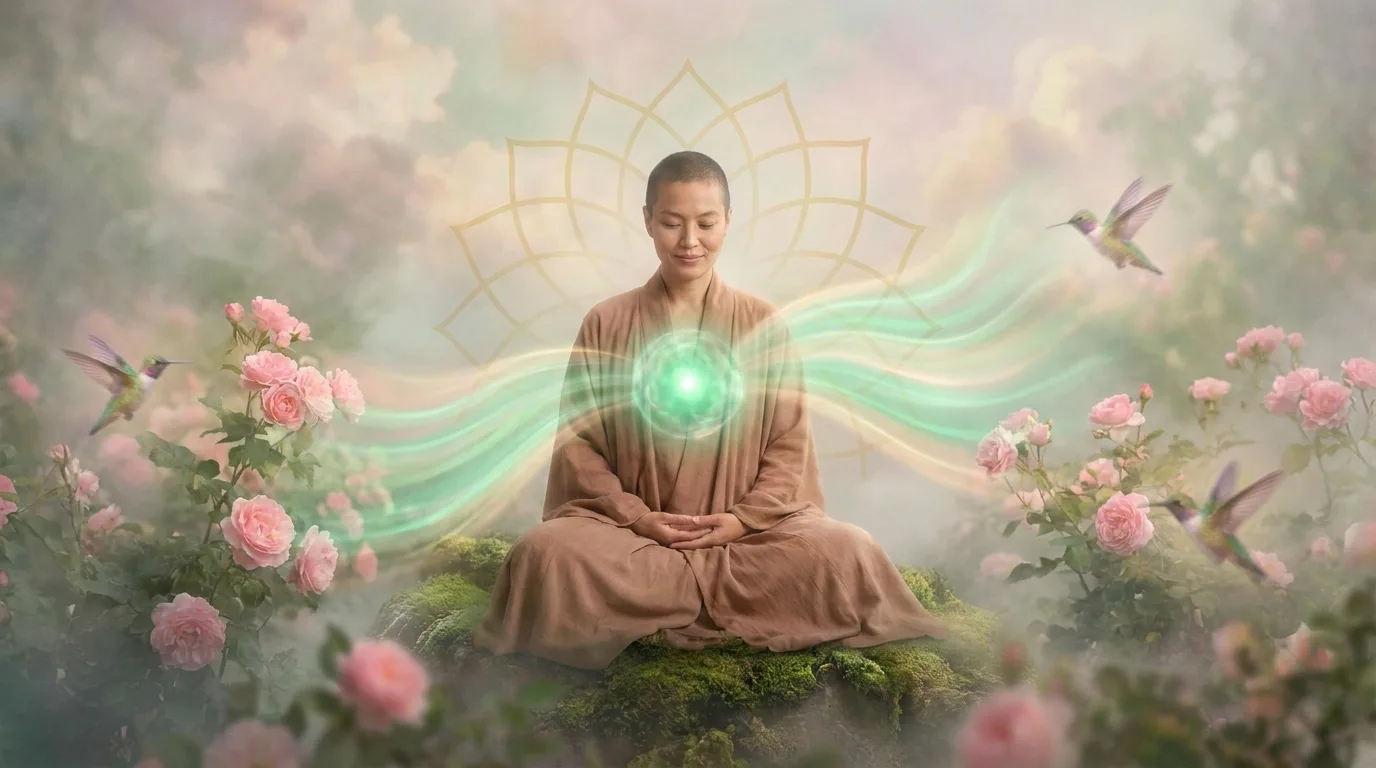
What the Heart Chakra Actually Is (and Isn't)
The heart chakra, known in Sanskrit as Anahata, is the fourth of the seven main energy centers described in classical Tantric and Hatha Yoga texts. The word Anahata translates roughly as 'unstruck' or 'unbeaten,' pointing to the yogic idea that at the very center of a human being there is a sound or vibration that arises without any two things striking together. It is, in the tradition, the sound of pure presence. Part of our chakras library.
Physically, Anahata is located at the center of the chest, roughly behind the sternum, not on the left side where the anatomical heart sits. It is associated with the color green (with a secondary pink or rose glow in many modern lineages), the element air, the seed syllable or bija mantra 'Yam,' and the thymus gland, which regulates immune function and is anatomically close to that region.
It is important to be honest about what this framework is. Chakras are not organs, and no peer-reviewed medical study has ever imaged one. They are a symbolic map, developed over roughly a thousand years in South Asian contemplative traditions, that gives you a vocabulary for how emotional patterns tend to cluster in the body. As psychologist and chakra scholar Anodea Judith writes in her foundational Western text Wheels of Life, they are best understood as 'a formula for wholeness,' not a diagnosis.
That distinction matters. Using Anahata as a lens for self-inquiry is genuinely useful. Using it as a substitute for cardiology, therapy, or grief counseling is not. In my experience with clients, the people who benefit most from chakra work are the ones who hold it loosely, as one map among several, and who keep their doctor and therapist in the loop.
The Anahata Symbol, Color, and Correspondences
The traditional Anahata symbol is a twelve-petaled lotus surrounding two interlocking triangles that form a six-pointed star. The downward-pointing triangle represents matter and the feminine principle descending; the upward-pointing triangle represents spirit and the masculine principle ascending. Where they meet at the heart, they are said to be in perfect equilibrium. This is one reason Anahata is often described as the seat of balance in the whole chakra system. See how Raka compares to other apps in our independent guide.
The primary color is a clear, spring-leaf green, chosen because green sits in the middle of the visible spectrum, just as the heart sits in the middle of the seven chakras. Many modern Western teachers, including Caroline Myss in Anatomy of the Spirit, add a soft rose-pink as a secondary color for the more relational, tender qualities of the heart.
The element is air. Anahata governs breath, expansiveness, movement, and the sense of touch. When Anahata is contracted, people often report shallow breathing, tight shoulders, and a physical guardedness in the upper body. When it is open, the breath naturally deepens and the chest feels warm. Try best tarot app to explore this in more depth.
The seed mantra is 'Yam,' pronounced with a soft, humming ending, and the associated animal in the classical texts is the black antelope or gazelle, symbolizing swiftness, sensitivity, and grace. The ruling deity in the Tantric imagery is often Vayu, the wind, or a form of the god Ishana, though you do not need to hold any religious belief to work with the symbolism.
The endocrine correspondence, in the modern Western synthesis, is the thymus gland. The thymus is largest in childhood and shrinks with age, which some contemporary teachers, including Donna Eden in Energy Medicine, connect symbolically to the way many adults become progressively more defended around the heart.
Signs Your Heart Chakra Is Blocked or Overactive
In chakra theory, a center can be under-active (deficient), over-active (excessive), or balanced. This is more useful than the binary 'open or blocked' language you see on social media, because the same underlying wound can express in either direction.
A deficient Anahata often shows up as emotional coldness, difficulty naming feelings, a preference for logic over intuition, chronic loneliness even in relationships, fear of intimacy, hyper-independence, and a subtle sense that other people are exhausting. Physically, people often describe a hollow or caved-in feeling in the upper chest and a tendency to hold the shoulders forward.
An excessive Anahata, by contrast, tends to look like codependency, losing yourself in other people, chronic caretaking at your own expense, jealousy, possessiveness, martyr patterns, and giving so much that you end up resentful. It can also present as a kind of spiritual bypassing, an insistence on unconditional love and forgiveness that skips over legitimate anger.
Grief that will not integrate is a heart-chakra signature in almost every lineage. So is a specific quality of resentment: not sharp anger, which lives lower in the body, but a slow, corrosive bitterness that colors how you see everyone. In my experience with clients, this is the single most common Anahata pattern in adults over forty.
Physical correlates people often report include chest tightness without cardiac cause, upper back pain between the shoulder blades, shallow breathing, and frequent respiratory infections. These are worth noting as reflection cues, but any persistent chest pain, shortness of breath, or palpitation is a reason to see a physician, not a spiritual teacher. Try Raka to explore this in more depth.
Signs of a Balanced Heart Chakra
A balanced Anahata does not mean you feel loving all the time. It means your capacity for connection is intact and flexible. You can love without losing yourself, set limits without shutting down, grieve without collapsing, and forgive without pretending nothing happened.
People in a balanced heart state tend to describe a specific physical quality: an easy, unforced fullness in the chest, deep and quiet breathing, warm hands, and a face that softens rather than braces when someone is telling them something hard. There is a kind of unhurried attention that other people can feel across a room.
Emotionally, the marker is not the absence of difficult feelings but a willingness to have them. Balanced Anahata can hold grief and gratitude at the same time. It can be angry with someone it loves. It can say no to a friend and still care about them. This is what the Buddhist teacher Sharon Salzberg, in her book Lovingkindness, calls 'the strong back and soft front' quality of a mature heart.
Relationally, you notice that you are neither losing yourself in other people nor walling them out. You can receive love, which is often harder than giving it. You can be alone without being lonely and with others without being drained. You feel a general goodwill toward strangers, which the Dalai Lama has repeatedly described as the closest thing to a portable happiness practice.
Why Anahata Is the Bridge of the Chakra System
The seven-chakra map is not a random list. It moves from the most physical and survival-oriented at the base to the most subtle and transpersonal at the crown. Muladhara, at the base, is safety and belonging. Svadhisthana, at the sacrum, is pleasure and creativity. Manipura, at the solar plexus, is willpower and identity. Then Anahata. Then Vishuddha at the throat, Ajna at the brow, and Sahasrara at the crown.
Anahata sits precisely in the middle. Three chakras below, three above. This is why it is called the bridge or the hinge of the system. The lower three chakras are concerned with the individual self: survival, pleasure, and personal power. The upper three are concerned with something beyond the self: expression, intuition, and unity. The heart is where the personal opens into the transpersonal.
Practically, this has a real consequence. If you try to force open the upper chakras, chasing intuitive gifts or spiritual experiences, without a stable heart, you tend to become either grandiose or destabilized. Anodea Judith calls this 'skipping the middle,' and warns against it repeatedly. A stable heart is the ground floor of any real intuitive development.
It also means the heart is where most integration work happens. You cannot think your way from ego to spirit. You feel your way, and the organ of that feeling, in the yogic map, is Anahata. Every serious contemplative tradition, from Christian mysticism to Sufism to Mahayana Buddhism, agrees on this point, even where they disagree on almost everything else.
How to Open Your Heart Chakra Right Now: A 10-Step Practice
This is a sequence you can do in about fifteen minutes, anywhere private. It is designed for a moment when your heart feels contracted, guarded, grieving, or numb. It is not a substitute for therapy or medical care.
1. Sit or lie down somewhere you will not be interrupted. Loosen anything tight around your chest. 2. Place both hands, one on top of the other, over the center of your sternum. Feel the physical warmth of your palms through your shirt. 3. Take three slow breaths, letting the exhale be longer than the inhale, and let your shoulders drop each time. 4. Silently name what is actually in your heart right now. Not what you think should be there. The real thing. Grief. Resentment. Numbness. Tenderness. Whatever it is.
5. Say to yourself, silently or aloud, 'This is what is here right now, and it is allowed to be here.' Notice any resistance. 6. On the next few inhales, imagine breathing directly into the space beneath your hands, as if the chest itself were the lung. Let the breath be soft, not forced. 7. On the exhales, hum the sound 'Yam' quietly, feeling the vibration in your sternum. Do this for eight to twelve breaths.
8. Bring to mind one specific person, including possibly yourself, and silently offer them a simple phrase: 'May you be safe. May you be at ease. May your heart be held.' Do not force feeling. The intention is enough. 9. Return your attention to your hands on your chest. Notice if anything has softened, opened, or moved, without needing it to. 10. Before you get up, write down one sentence about what you noticed. That sentence, over weeks, becomes a real map of your heart.
Yoga Poses That Open Anahata
The heart chakra responds strongly to postures that expand the front of the chest, lengthen the space between the collarbones, and release the upper back. In modern hatha yoga, these are broadly called heart-openers. They should always be balanced with counterposes that gently round the spine, because forcing open a chronically guarded chest can trigger real emotional release, which is fine, but should not be surprising.
The core postures worth learning are Bhujangasana (Cobra), Ustrasana (Camel), Setu Bandhasana (Bridge), Matsyasana (Fish), and Anahatasana, which is literally named 'melting heart pose' and involves kneeling with your hips over your knees and your chest sinking toward the floor with the arms extended.
For less flexible bodies, or for a chest that is armored from years of desk work, a supported version is more useful than a deep one. Lie on your back with a rolled blanket or bolster placed lengthwise along your spine, so that your chest is gently arched open and your arms can fall out to the sides. Stay for five to ten minutes with slow breathing. Do not underestimate this pose. It is arguably the single most effective daily heart-opener for adults in office jobs.
Pranayama, or breath work, is equally important. Ujjayi breath (a slight constriction at the back of the throat producing a soft ocean sound) directly engages the muscles around the heart. Alternate nostril breathing (Nadi Shodhana) is often used before heart-focused practices because it balances the two hemispheres and settles emotional reactivity.
If you have any cardiac history, high blood pressure, glaucoma, or a recent injury to the neck or lower back, some of these postures need modification. A qualified yoga therapist, ideally one credentialed through IAYT (International Association of Yoga Therapists), is the right person to consult.
Foods, Crystals, and Essential Oils That Support the Heart Chakra
The dietary correspondences for Anahata cluster around green foods and around foods that are grown above the ground, in the air, matching the chakra's element. Leafy greens (spinach, kale, chard, arugula), broccoli, green apples, kiwi, green tea, and fresh herbs like basil, parsley, and cilantro are traditional supports. So are foods rich in nutrients that genuinely support cardiovascular health: fatty fish, walnuts, flaxseed, olive oil, dark chocolate in modest amounts, and legumes.
This is one place where the symbolic and the scientific quietly agree. The Mediterranean dietary pattern, which the American Heart Association has consistently recommended, overlaps substantially with what chakra literature has called heart-supportive food for centuries. That is a coincidence worth noticing, but not one to overinterpret.
Crystals traditionally associated with Anahata include rose quartz (for tenderness and self-compassion), green aventurine (for resilience and optimism), malachite (for releasing old grief, though it is toxic if ingested and should never be used in water elixirs), emerald, and jade. The mechanism, in the tradition, is resonance with color and vibration. There is no peer-reviewed evidence that crystals emit healing frequencies. What is well documented is that a small tactile object you associate with a specific intention can serve as a useful ritual anchor, which is a real psychological effect.
For essential oils, rose (particularly rose otto), geranium, bergamot, ylang-ylang, and jasmine are the classic Anahata oils. Rose in particular has been used in devotional and heart-focused practice across Persian, European, and South Asian traditions for centuries. Diffuse a few drops during meditation, or dilute properly in a carrier oil before applying to the chest. Never apply undiluted essential oils to skin, and check for interactions if you are pregnant or on medication.
Heart Chakra Meditation and Mantra
The core meditation for Anahata is straightforward: attention on the center of the chest, breath drawn subjectively into that space, and repetition of the seed mantra 'Yam,' either aloud or silently. Ten to twenty minutes a day, sustained over weeks, is more effective than an occasional hour-long session.
A slightly more structured version, drawn from Anodea Judith's work, adds visualization. On the inhale, imagine a soft green light gathering at your chest. On the exhale, imagine that light expanding outward, first filling your body, then the room, then the space around you. This is a compressed form of what the Tibetan Buddhist tradition calls tonglen or 'giving and receiving' practice.
Loving-kindness meditation (metta), taught most accessibly in the West by Sharon Salzberg and Jack Kornfield, is arguably the most researched heart practice available. Studies by Barbara Fredrickson at the University of North Carolina, published in the Journal of Personality and Social Psychology in 2008, found measurable increases in daily positive emotions and life satisfaction in participants who did metta practice for as little as seven weeks.
The phrases are simple. 'May I be safe. May I be happy. May I be healthy. May I live with ease.' You extend the phrases first to yourself, then to someone you love easily, then to a neutral person, then to someone difficult, and finally to all beings. The order matters. Starting with yourself is not optional. Most Western practitioners find this the hardest step, which is diagnostic in itself.
Affirmations and Journal Prompts for the Heart
Affirmations for Anahata work best when they are believable. A statement your nervous system rejects as a lie does nothing useful. Start with what the psychologist Kristin Neff, whose research on self-compassion at the University of Texas at Austin is the strongest empirical work in this area, calls a 'moderate reach': something you almost believe.
Useful phrases include: 'I am allowed to feel what I actually feel.' 'I can love people without losing myself.' 'Forgiveness is a direction, not a deadline.' 'I do not have to earn my own tenderness.' 'It is safe to let people see me.' Choose one, not five. Repeat it, hand on chest, morning and evening for a week.
Journal prompts that reliably move Anahata material include: Who am I still angry with, and what would it cost me to keep carrying that? What did I need as a child that I never got, and how am I still trying to get it from adults now? Where in my life am I giving from resentment rather than generosity? What is one thing I have never forgiven myself for, and is that punishment still serving anyone?
Write by hand if you can. The pace of handwriting slows the mind enough that real material tends to surface. Set a timer for twelve minutes and do not stop moving the pen. What comes out in the last two minutes is usually what you actually came to write.
Heart Chakra vs. Throat Chakra vs. Solar Plexus: What's the Difference?
People often confuse the heart chakra with its immediate neighbors. Understanding the differences sharpens self-diagnosis considerably.
The solar plexus chakra (Manipura), just below the ribs, governs personal power, willpower, identity, and boundaries. When Manipura is weak, people often mistake it for a heart problem, because they cannot say no and end up depleted in relationships. The fix is not more heart-opening. It is more boundary work. Opening a heart that has no boundaries just leaks faster.
The throat chakra (Vishuddha), at the base of the neck, governs authentic expression. When Vishuddha is blocked, people can feel love clearly but cannot articulate it, or they express affection through service and never through words. That is often experienced as a heart issue by their partners. It is actually a throat issue.
Compared to both, Anahata is specifically about the capacity for connection: the willingness to be moved, the ability to receive, the tolerance for tenderness. If your issue is 'I do not know what I want,' that is often more Manipura. If your issue is 'I cannot say what I feel,' that is often more Vishuddha. If your issue is 'I do not know how to let this person in,' or 'I cannot forgive,' or 'I feel numb,' that is Anahata.
The three centers work as a triad. Modern Western teachers, including Caroline Myss and Anodea Judith, both stress that trying to work on the heart in isolation almost always fails. You need enough personal power underneath it (Manipura) and enough voice above it (Vishuddha) for a heart practice to translate into real relationships.
Timing: When to Do Heart Chakra Work
There is no universally correct time to do this work, but there are windows where it lands more deeply. After a breakup, a bereavement, a betrayal, or a long stretch of caregiving, Anahata is already stirred and available. Practices done in these windows tend to integrate faster because the defenses are already softened.
Astrologically, transits involving Venus (relationships, values, receiving) and the Moon (feelings, attachment, mothering) tend to activate heart material. Venus retrograde, which happens roughly every eighteen months, is a widely recognized window for revisiting past relationships and forgiveness work. This is a reflection cue, not a prediction. Nothing is guaranteed by a transit.
Seasonally, spring is the traditional heart season in several systems. In Traditional Chinese Medicine, spring is associated with the wood element and the liver, which houses the emotional charge that, when released, allows the heart (a summer organ in that map) to open. In practical terms, many people find spring easier for heart work than winter, when the body is naturally more contracted.
Daily, early morning and just before sleep are the two most useful windows. Morning practice sets the emotional tone for the day. Evening practice, especially journaling and a few minutes of hand-on-chest breathing, allows the day's residue to settle before it becomes tomorrow's tightness. Fifteen minutes twice a day for six weeks will do more than a weekend workshop.
Integrating Chakra Work with Therapy and Medicine
The honest position is this: chakra work is a self-reflection and contemplative practice. It is not a treatment for depression, complex PTSD, cardiovascular disease, panic disorder, or unresolved trauma. Used as a substitute for evidence-based care, it can cause real harm. Used as a complement, it can add depth that clinical work alone sometimes lacks.
In my experience with clients, the most effective combination is a licensed therapist doing the primary trauma or relational work, a physician monitoring anything physical, and chakra-informed practices serving as a daily contemplative frame that gives the clinical work a symbolic vocabulary. Somatic Experiencing, Internal Family Systems, and EMDR all have documented efficacy and pair naturally with heart-centered practice.
According to the CDC's 2023 National Health Interview Survey, roughly one in six US adults reported using yoga in the past twelve months, and more than one in ten reported using meditation. That is a large enough share of the population that most therapists have at least some familiarity with contemplative language. If yours does not, it is reasonable to bring them a short summary of what you are practicing and why.
Warning signs that require professional help rather than more meditation include: persistent chest pain, shortness of breath, palpitations, panic attacks, suicidal thoughts, grief that does not lift after six months, dissociation, or the sense that meditation itself is destabilizing you. Meditation-related adverse events are real and documented, particularly for people with trauma histories. Willoughby Britton's Varieties of Contemplative Experience project at Brown University has catalogued them extensively. Slow down, seek a trauma-informed clinician, and do not push through.
A Realistic Timeline: What to Expect Over Weeks and Months
People often ask how long it takes to 'open' the heart chakra. The honest answer is that Anahata is not a lock. It is a habit of relating, and habits change on their own timelines. That said, there are some rough patterns worth naming.
In the first two weeks of consistent daily practice, most people notice small physical changes first: slower breathing, softer shoulders, a tendency to sigh audibly for no reason. Emotional shifts usually lag the physical ones by ten days to three weeks. Do not interpret the initial lack of dramatic feeling as failure. The body is preparing the ground.
Between weeks three and eight, buried material tends to surface. Old grief, unexpected tears in ordinary moments, memories of specific people you had not thought about in years. This is normal and, in most contemplative traditions, considered a sign the practice is working. It is also the point at which many people quit. If you have a therapist, this is when their support becomes most useful.
By three to six months of consistent practice, most people describe a durable shift: a slightly slower reactivity in conflict, more capacity to sit with other people's pain without absorbing or fixing it, a felt sense that the chest is a place they live rather than a place they guard. This is what a functioning Anahata actually looks like day to day. Not bliss. Just presence.