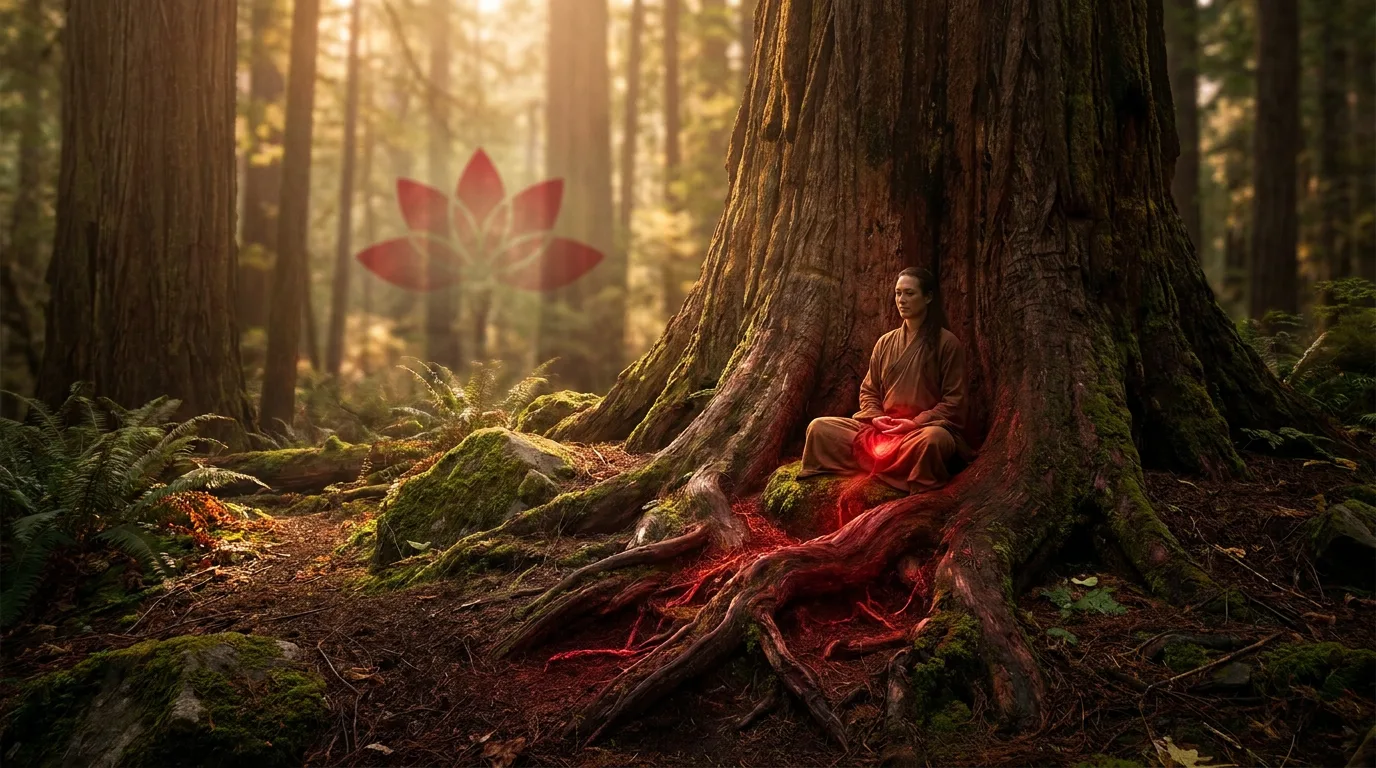
What the Root Chakra Actually Is (and What It Isn't)
The root chakra is the first of seven energy centers in the classical chakra system, called Muladhara in Sanskrit — literally 'root' (mula) and 'support' (adhara). It sits at the base of the spine, roughly at the perineum, and in most modern teachings it is associated with the color red, the earth element, and the seed sound (bija mantra) LAM. Its endocrine correspondence is often mapped to the adrenal glands, the little walnut-shaped organs that sit on top of your kidneys and drive your fight-flight-freeze response. Part of our chakras library.
Here is what the root chakra is not: it is not a literal organ, it is not something a scan can measure, and it is not a fortune-telling device. The chakra system is a symbolic map — a psychosomatic vocabulary for talking about how safety, embodiment, and belonging show up in your body. Treat it the way you'd treat the enneagram, attachment styles, or the four humors of pre-modern medicine: a useful lens for self-reflection, not a diagnosis.
In the classical Tantric texts where chakras originate — the Sat-Chakra-Nirupana (16th century) and earlier commentaries — Muladhara is described as a four-petaled lotus and the seat of what is called 'kundalini' energy. Modern Western teachers have re-framed this vocabulary for a psychological, somatic-therapy audience. The most widely cited English-language bridge is Anodea Judith's Wheels of Life (Llewellyn, 1987) and her follow-up Eastern Body, Western Mind, which explicitly maps each chakra to a developmental life stage.
In Judith's framing, the root chakra corresponds to your first year or so of life — the era when your nervous system learned, before you had language, whether the world was a safe place to land. That's why root chakra work so often looks less like chanting and more like patient, boring, repetitive practices that teach your body a new answer to the question 'am I safe here?'
So when you read the rest of this guide, hold two things at once: take the framework seriously enough to actually practice with it, and lightly enough that you're not outsourcing your medical or mental health decisions to a lotus with four petals. See how Raka compares to other apps in our independent guide.
Muladhara's Correspondences at a Glance
Every chakra in the classical model comes with a set of correspondences — a kind of index card of associations that make the concept easier to work with in practice. Memorizing these isn't the point; using them as anchor points for attention is. When you sit down to meditate and you know the root chakra is red, earthy, and located at your pelvic floor, your imagination has somewhere to go.
Sanskrit name: Muladhara. Location: base of the spine, perineum, pelvic floor. Element: earth. Color: deep red (some traditions add a smoky black-red). Bija mantra (seed sound): LAM, chanted on a low, resonant tone. Associated sense: smell. Endocrine mapping: adrenal glands. Body regions: legs, feet, hips, base of the spine, large intestine, immune system.
The organizing themes of Muladhara are safety, survival needs, physical embodiment, boundaries, belonging to a tribe or family, financial baseline, and what somatic therapists call 'felt sense of ground.' Rights and identity, in Judith's mapping, are 'the right to be here' and 'the right to have.' Developmental era: roughly conception through the first year of life.
For quick reference, know the six that sit above it: Svadhisthana (sacral, water, orange, VAM), Manipura (solar plexus, fire, yellow, RAM), Anahata (heart, air, green, YAM), Vishuddha (throat, ether, blue, HAM), Ajna (third eye, light, indigo, OM), and Sahasrara (crown, thought, violet-white, silence). Root chakra work is the foundation; without it, work on the upper chakras tends to feel airy or dissociative.
Signs Your Root Chakra Is Out of Balance
In the chakra framework, each center can be described as underactive (depleted, contracted, avoidant), overactive (grasping, rigid, over-controlling), or in balance. The point of naming symptoms isn't to hand you a self-diagnosis — it's to help you notice a pattern you may have been living inside without a name for it.
Signs of an underactive root chakra often include: chronic low-grade anxiety, a floaty or spacey quality of attention, difficulty finishing what you start, avoiding the details of adult life (taxes, admin, appointments), feeling disconnected from your body, restlessness in stillness, disordered eating patterns, and a persistent sense of not quite belonging anywhere — even in your own home.
Signs of an overactive root chakra look different: rigidity, hoarding (of money, food, objects, or information), workaholism justified as 'security,' controlling behavior in relationships, difficulty trusting anyone, fear-based decision-making, sluggishness, and using stability as an excuse to never take a risk. Somatically, this often shows up as a locked pelvis, tight hip flexors, and low-back stiffness.
Balanced Muladhara feels ordinary in the best sense: you feel at home in your body, money is a practical problem rather than an identity crisis, you can rest without guilt, you can act without paralysis, and you have a felt sense of 'I have a right to be here' that doesn't require anyone else's approval.
One clinical note worth stating plainly: many of these symptoms overlap with anxiety disorders, trauma responses, and thyroid or adrenal medical conditions. If you have been chronically unable to sleep, chronically dissociated, or your baseline anxiety is interfering with work or relationships, please treat 'my root chakra is off' as a poetic first draft of the problem — and book a licensed therapist or physician for the second draft.
What to Do Right Now: A 15-Minute Root Chakra Reset
If you're reading this because something feels off today — you're wired, scattered, dread-scrolling, avoiding a task — this is the section for you. Everything here is free, requires no equipment, and can be done in a small apartment. Do the whole sequence once and notice how you feel; that's the whole assignment.
Step 1 (2 minutes). Take off your shoes and socks. Stand with your feet hip-width apart on the floor. Press the four corners of each foot down — big toe mound, pinky toe mound, inner heel, outer heel. Micro-bend the knees so they aren't locked. Notice the floor pushing back up into you. This is Tadasana, mountain pose, and it is the entire root chakra in one shape.
Step 2 (3 minutes). Slow the exhale. Inhale for a count of four through the nose; exhale for a count of six or eight through the nose. Long exhales are the fastest lever you have on your parasympathetic nervous system — this is well established in vagal-tone research (see Stephen Porges, The Polyvagal Theory, 2011). Do about fifteen rounds.
Step 3 (3 minutes). Sit or squat. If you can, drop into Malasana (yogi squat) with your feet flat and heels down. If your heels lift, put a rolled towel under them. Rest your elbows inside your knees. Breathe into the pelvic floor. This is a root chakra pose in the most literal sense — you are rooting the base of your spine toward the earth.
Step 4 (2 minutes). Chant LAM. Sit comfortably, take a deep inhale, and on the exhale hum a low 'laaaammm' until your breath runs out. Feel the vibration in your pelvis and lower belly. Repeat seven times. If chanting isn't your thing, hum any low note — the vagal-tone benefit comes from the vibration and long exhale, not the specific syllable.
Step 5 (3 minutes). Journal one sentence in response to each of these prompts: 'Where in my life do I feel unsafe right now?' 'What is one small promise I can keep to myself today?' 'What is one thing that is actually working?' Close the notebook. Drink a glass of water. Eat something with weight to it — nuts, a boiled egg, a piece of dark bread. You're done.
Step 6 (2 minutes). Go do the small thing you promised yourself. Even if it's tiny. The root chakra, more than any other, is built by kept promises to yourself — that's the whole trust foundation.
Yoga Poses That Activate the Root Chakra
Root chakra yoga isn't fancy. There are no arm balances, no inversions, no advanced binds. The point is to spend time with your legs, feet, hips, and pelvic floor — the physical territory of Muladhara — in shapes that ask you to be heavy, slow, and grounded rather than light and expansive.
Tadasana (Mountain Pose) is the foundation. Stand tall, feet hip-width, press down through the four corners of each foot, engage the quadriceps, lengthen the tailbone toward the floor. Hold for one to three minutes. It looks like nothing. It is one of the most demanding poses in the entire canon when you actually do it.
Malasana (Garland or Yogi Squat) opens the hips and drops the pelvic floor toward the earth. If your heels don't reach the floor, prop them. Hold two to three minutes. Utkatasana (Chair Pose) fires up the legs and teaches the pelvis to bear weight. Virabhadrasana I and II (Warriors) build a strong stance and a sense of taking up space.
Prasarita Padottanasana (Wide-Legged Forward Fold) grounds the crown of the head toward the earth — the crown chakra literally bowing to the root. Balasana (Child's Pose) is the classic 'I need to feel held' pose; rest your forehead on the mat and let gravity do the work. Savasana at the end is not optional — it's where the nervous system files the whole practice.
In my experience with clients, the mistake people make is treating a root chakra practice like a workout. Speed and effort are not what you're after. You are teaching your nervous system that it is safe to slow down and take up space. If a shape makes you want to move faster or bail out, that is exactly the shape to hold for another three breaths.
Foods and Nutrition to Support Muladhara
The food side of chakra work is symbolic and practical at the same time. Symbolically, root chakra foods are red, they grow in or close to the earth, and they take some effort to digest — they ask your body to do the grounding work of assimilation. Practically, stable blood sugar and adequate protein are the least glamorous, most effective anti-anxiety interventions most people never bother with.
The classic 'root chakra' food list includes root vegetables (beets, carrots, sweet potatoes, parsnips, turnips, radishes, onions, garlic, ginger), red foods (tomatoes, red apples, pomegranates, strawberries, raspberries, red bell peppers), and protein-rich foods with weight to them (eggs, beans, lentils, nuts, seeds, and — if you eat them — meat, fish, and bone broth).
Warm, cooked, seasoned foods generally serve Muladhara better than raw, cold, or highly processed foods, especially in winter or when you already feel scattered. A roasted root-vegetable bowl with olive oil, salt, and a soft-boiled egg is a more grounding lunch than a cold smoothie, even if the smoothie is 'healthier' on paper.
Watch stimulants. Excessive caffeine, sugar, and alcohol all destabilize the same nervous-system baseline the root chakra represents. You don't have to give any of them up — just notice that a third espresso on top of pre-existing anxiety is a root-chakra tax, not a productivity tool.
None of this is a medical eating plan. If you have blood-sugar issues, an eating disorder history, or are on medication that interacts with food, please work with a registered dietitian rather than a chakra list from the internet.
Crystals, Essential Oils, and Sensory Anchors
Crystals and essential oils don't do anything measurable to your energy field in the way marketing copy sometimes implies — there is no peer-reviewed study showing that red jasper in your pocket changes your cortisol. What they do reliably is give your attention an anchor: a physical object you touch, smell, or see that reminds you which practice you're inside. That's not nothing. Ritual objects have been part of human self-regulation for as long as we've been human.
For the root chakra, the traditional crystal associations are red and black stones: red jasper, garnet, ruby, carnelian (technically more sacral but often included), hematite, black tourmaline, obsidian, smoky quartz, and bloodstone. A common practice is to hold one during meditation, place one on your lower belly during savasana, or simply keep one on your desk where you'll see it.
Essential oils associated with Muladhara are earthy, resinous, and woody: vetiver, patchouli, cedarwood, frankincense, myrrh, sandalwood, and clove. Diffuse them during practice, add a drop (properly diluted in a carrier oil) to the soles of the feet, or simply open the bottle and inhale for three slow breaths. Smell is the sense mapped to the root chakra in the classical system, which is why olfactory anchors feel disproportionately grounding.
Other sensory anchors that serve the root chakra: a heavy blanket, warm bath water, walking barefoot on grass or sand ('earthing'), weighted socks, a hand on your own lower belly, drumming or bass-heavy music, and the smell of soil, wood smoke, or rain on pavement. Notice which of these calms you fastest — that's your personal root chakra toolkit.
A word on 'earthing' or grounding-by-barefoot-contact: a handful of small studies (see Chevalier et al., Journal of Environmental and Public Health, 2012) have suggested modest effects on inflammation and sleep, but the research base is thin. Treat it as a pleasant, free practice with plausible benefits, not a proven medical intervention.
Meditation, Mantra, and Affirmations for the Root Chakra
A root chakra meditation is deceptively simple. Sit with your sit-bones actually on something — a cushion, a chair, the floor. Feel the contact. Bring your attention to the base of the spine and the pelvic floor. Breathe slowly. That's it. You don't need visualization, though a slow rotating red disc at the base of the spine is the traditional image if your mind wants a picture.
For a mantra practice, chant LAM. Take a full breath in through the nose, then chant 'LAAAMM' on the exhale, letting the 'mm' vibrate through the pelvis and lower belly. Seven, twenty-one, or one hundred and eight rounds are traditional counts. If chanting aloud isn't possible, sub-vocalize — mouth the syllable and feel it internally.
Affirmations to pair with the practice, spoken slowly and only if they feel at least 51% true: 'I have a right to be here.' 'I am safe in this body.' 'I have what I need.' 'The earth supports me.' 'I can trust myself to keep my word to me.' 'I belong to my own life.' Say them out loud. The vagus nerve responds to your own voice more than to your inner monologue.
In my experience with clients, the affirmation that actually cracks something open is rarely the poetic one. It's the boring one — 'I have what I need for today' — repeated on a walk, out loud, until the nervous system stops arguing back. If a phrase feels like a lie, soften it: 'I am learning that I have what I need for today' is a legitimate affirmation. Truthful is more important than beautiful.
A very short daily practice beats a beautiful weekly one. Five minutes of LAM chanting and slow breathing every morning for a month will do more for your root chakra than one three-hour workshop and then nothing.
Root Chakra vs. the Six Others: How They Compare
The seven chakras function as a developmental ladder in the modern Western reading of the system. Each one has its own concerns, its own imbalances, and its own practices — but they build on each other. Working on the throat chakra when the root is depleted is a bit like painting the fifth floor of a house whose foundation is cracked. Try top tarot app 2026 to explore this in more depth.
Root (Muladhara): safety, survival, belonging, embodiment. Sacral (Svadhisthana): emotion, pleasure, creativity, sexuality, flow. Solar Plexus (Manipura): personal power, will, self-esteem, agency. The lower three are the 'earthly' chakras — they deal with being a body-having, feeling, willing self in the world. Most Western adults have significant work to do here before the upper chakras become interesting rather than escapist.
Heart (Anahata): love, compassion, connection, grief. It is the bridge between the lower three (personal) and upper three (transpersonal). Throat (Vishuddha): expression, truth-telling, communication. Third Eye (Ajna): perception, intuition, discernment. Crown (Sahasrara): meaning, connection to something larger than the self.
How does root chakra work compare to sacral chakra work in practice? Root work is about weight, stillness, and staying; sacral work is about flow, pleasure, and moving. Root work is grounding; sacral work is opening. If you feel anxious and floaty, start with root. If you feel numb and pleasureless, sacral is often the next stop.
How does chakra work compare to somatic therapy (Peter Levine's Somatic Experiencing, Bessel van der Kolk's work in The Body Keeps the Score, 2014)? They rhyme. Both take the body seriously as the site of nervous-system regulation. Chakras give you a symbolic vocabulary and a set of rituals; somatic therapies give you a clinical container. They coexist well; they don't replace each other.
How does it compare to purely cognitive approaches like CBT? CBT works top-down on thought patterns. Root chakra work works bottom-up on the body. For chronic anxiety with a strong somatic component — the racing heart, the tight chest, the wired-and-tired baseline — bottom-up work often unlocks what top-down alone couldn't.
How Long Does Root Chakra Healing Take?
You will find articles online claiming a 21-day, 40-day, or 90-day chakra cleanse. Ignore the numbers. The honest answer is that root chakra healing is not a project with a completion date; it is a practice you fold into your life. What you can reasonably expect from consistent daily practice is a felt shift in three phases.
The first two to three weeks are noticing. You will start to catch, in real time, when you're leaving your body — the moment you dissociate into your phone, the moment your shoulders creep up, the moment your stomach clenches before an email. This awareness by itself is not fixing anything, but it is the essential first move.
Weeks four to twelve are re-patterning. This is where daily short practices begin to compound. Your baseline resting state shifts a notch. You notice that you can sit with an uncomfortable feeling for thirty seconds longer than you could last month before reaching for a distraction. Sleep often improves. Digestion sometimes does.
Beyond three months, root chakra work becomes structural. Life decisions start to reflect it: you renegotiate a relationship that made you feel unsafe, you build an emergency fund, you leave a job that had you dissociating five days a week, you finally see a therapist. The lotus does not open on a schedule. But the conditions for it to open become part of how you live.
One caveat. If you have complex trauma, meditation and inward-facing practices can occasionally destabilize before they stabilize. This is well documented (see David Treleaven, Trauma-Sensitive Mindfulness, 2018). Go slowly, keep your eyes open if closing them is too much, and consider working with a trauma-informed teacher or therapist rather than doing it alone from YouTube.
Root Chakra Through the Seasons and Life Stages
The root chakra is the earth chakra, and it responds to the earth's own rhythms. Autumn and winter are natural root-chakra seasons in the northern hemisphere: the sap draws down, the trees put energy into roots, everything slows. This is the time of year to lean into heavier foods, longer sleeps, more Malasana, more time with your hands in soil if you can arrange it.
Spring and summer bring an upward, expansive energy that lives more in the heart and throat chakras. That's not a problem — but if you find yourself burning out every summer, over-committing, and crashing in October, consider that your root chakra didn't have time to store energy through the fallow months. Rest is a root chakra practice.
Life stages matter too. Muladhara is developmentally mapped to the first year of life, but it comes online again at every major transition: leaving home, becoming a parent, losing a parent, moving countries, changing careers, entering a chronic-illness diagnosis, retiring. Anything that shakes your basic sense of 'where do I belong and how am I safe here' is root-chakra territory.
In perimenopause and menopause specifically, hormonal shifts often unmask root-chakra fragility that hormones were compensating for. Sleep becomes unreliable, anxiety spikes, and the ground feels less solid. This is a moment where grounding practices — heavy blankets, protein, walking on the earth, boring routines — matter more, not less. (For medical questions about perimenopause, please see a menopause-literate physician; the chakra framework complements medical care, it does not replace it.)
In grief, the root chakra takes a direct hit. When someone or something that constituted 'home' for you is gone, your body loses a piece of its felt sense of safety. Grief-informed root chakra work is very simple: eat, sleep, walk outside, keep small promises. It is not glamorous. It works.
Combining Root Chakra Work with Therapy and Medical Care
This is the section you should read even if you skip everything else. The chakra system is a wellness and self-reflection framework. It is not a substitute for mental health care, medical care, or financial planning. It is best used as a complement — a set of practices that help you show up to the actual work of your life.
See a licensed mental health professional if any of the following apply: your anxiety is interfering with work, sleep, or relationships; you are dissociating regularly; you have thoughts of self-harm; you have a trauma history and inward-facing practices are destabilizing you; you feel persistently unsafe in your own body; or you simply want a trained human companion for the work. In the US, Psychology Today's therapist directory is a solid starting point; in the UK, BACP; in Canada, CRPO or CCPA; in Australia, the APS.
See a physician if you have persistent digestive issues, chronic fatigue, unexplained low-back pain, hormonal symptoms, or any of the physical symptoms often attributed to 'root chakra imbalance.' Many of these have straightforward medical explanations that respond well to treatment — and 'my root chakra is off' can become an accidental excuse to avoid a doctor's visit that would actually help.
In my experience, the clients who make the most progress with chakra work are the ones who are also in therapy, also seeing their GP, and also handling their money like adults. The practices are additive, not replacement. Chanting LAM is not a substitute for filing your taxes; both help you feel safer. Try Raka to explore this in more depth.
Finally: be skeptical of anyone — teacher, healer, app, book, or podcast — who tells you their program will fix your root chakra in a fixed number of sessions for a large payment. That is a marketing structure, not a healing structure. Real Muladhara work is mostly free, mostly boring, and mostly consists of small kept promises to yourself over long stretches of ordinary time.
A Simple 4-Week Root Chakra Practice You Can Actually Do
Here is a minimalist four-week structure that assumes you have a real job, real responsibilities, and about fifteen minutes a day. Do this consistently for a month before you decide whether it does anything. Consistency beats intensity every time in nervous-system work.
Week 1 — Attention. Every morning, spend five minutes in Tadasana with slow nasal breathing. Every evening, write one sentence answering 'where did I leave my body today?' No practice change is required; you are just watching. This is the noticing phase and it is not optional.
Week 2 — Add breath and mantra. Keep Tadasana. Add ten rounds of 4-count inhale, 6-count exhale, then seven rounds of LAM chanting. Total time: about ten minutes. In the evening, add a second journal question: 'what small promise can I keep to myself tomorrow?' Then keep it the next day.
Week 3 — Add movement. Once every two or three days, do a longer twenty-minute practice: Tadasana, Warrior I and II each side, Malasana, Balasana, Savasana. Continue the daily short practice on the other days. If you already have a yoga practice, tag a five-minute Malasana onto the end of it.
Week 4 — Add environment. Look at your physical space with fresh eyes. Is there a place where you can sit or squat comfortably every day? A weighted blanket you never use? Root-vegetable groceries you're not buying? A pair of shoes you can slip off to stand barefoot? Root chakra work is 40% practice and 60% environment. Adjust two things.
At the end of four weeks, sit down with your journal and ask: what feels different? What doesn't? What's one thing I want to keep? What's one thing I want to change? That's the whole methodology. Repeat as needed for the rest of your life.