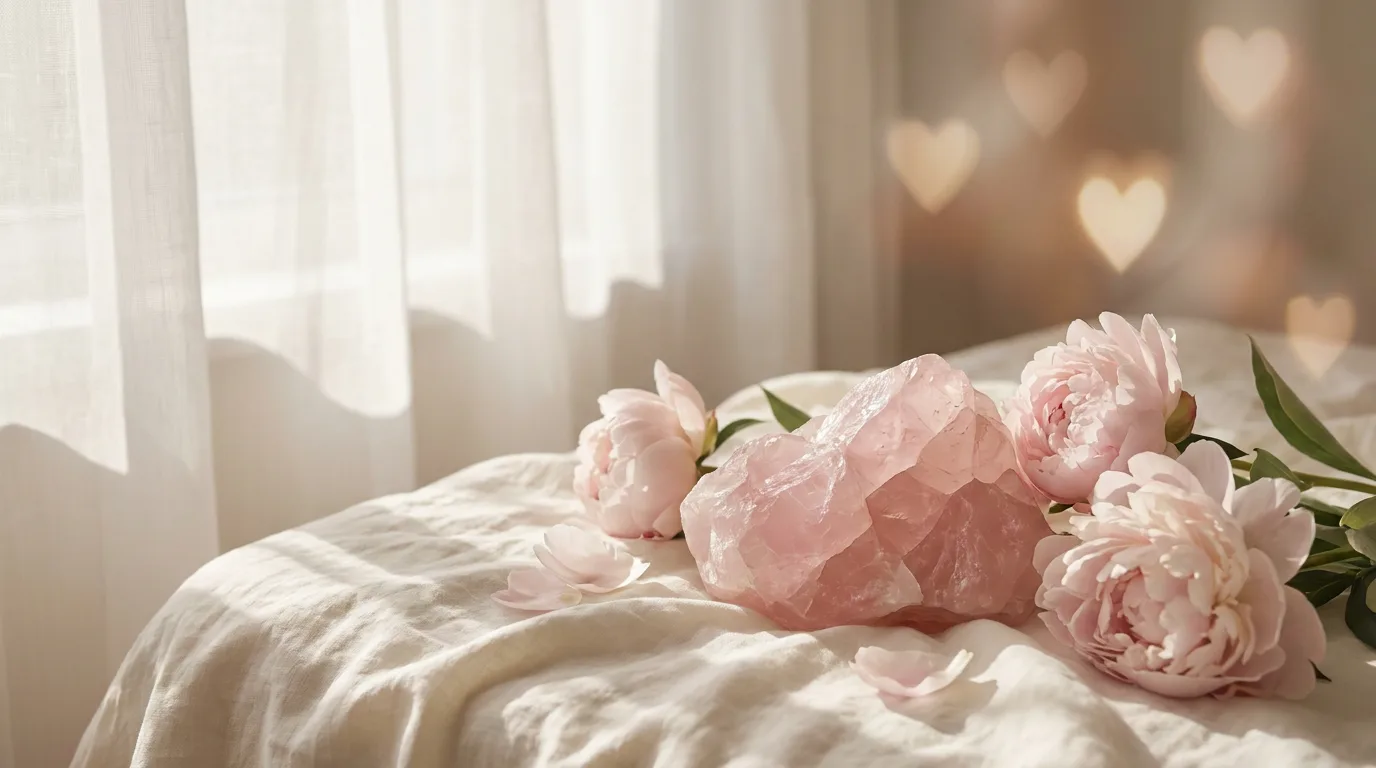
What Rose Quartz Actually Is: A Straight Definition
Rose quartz is the pink-to-rose-red variety of macrocrystalline quartz, a mineral with the chemical formula SiO₂ — the same silicon dioxide that makes up clear quartz, amethyst, and citrine. It sits at 7 on the Mohs hardness scale, which means it will scratch glass and steel but is softer than topaz or corundum. That hardness is why it survives centuries of tumbling, carving, and wear as jewelry without shattering. Part of our crystal healing guide library.
The pink color has puzzled mineralogists for decades. Most common massive rose quartz — the cloudy pink chunks you see in shops — gets its blush from microscopic fibrous inclusions of a dumortierite-like mineral, according to research published in the American Mineralogist by Goreva, Ma, and Rossman in 2001. Rarer transparent 'pink quartz,' which forms in true crystal points, is instead colored by trace phosphate and aluminum sensitized by natural radiation.
That distinction matters if you are buying. Massive rose quartz almost never grows in classic six-sided crystal terminations; it forms as anhedral (shapeless) masses in the cores of pegmatites, the coarse-grained igneous rocks where oversized crystals cool slowly from mineral-rich fluids. If a vendor offers you a perfect pink quartz 'point' at a cheap price, you are almost certainly looking at dyed clear quartz or heated glass.
In folk-metaphysical and modern crystal-healing traditions — which are a set of belief systems, not established science — rose quartz is called the stone of unconditional love, self-worth, and emotional healing. That association is what people are usually asking about when they type 'rose quartz meaning' into a search bar, and it is what most of this guide unpacks. I will be honest throughout about which parts are geology, which are tradition, and which are personal ritual. See how Raka compares to other apps in our independent guide.
In my work with clients at Raka, rose quartz is the single most-asked-about stone after amethyst. Part of that is Instagram aesthetics. Part of it is that pink is genuinely disarming — it is hard to be defensive while holding a soft warm stone the color of a peony. That psychological softening is probably doing more of the work than any 'energy,' and that is worth saying out loud.
The Mineralogy: Composition, Formation, and Where It Comes From
Quartz is the second most abundant mineral in Earth's continental crust, so rose quartz is not rare in the scientific sense — but gem-quality material with strong even color absolutely is. The stone crystallizes late in the cooling of granitic pegmatites, silica-rich melts that trap volatile elements as they harden. It is typically the last mineral to form in the pegmatite core, filling voids left by feldspar and mica.
The commercially important deposits sit in a few well-mapped regions. Brazil, particularly Minas Gerais and Bahia, produces enormous massive-rose blocks and is the largest global supplier. Madagascar contributes both massive rose and some of the finest gem-clear pink quartz, mostly from the Antananarivo and Fianarantsoa provinces. South Dakota's Black Hills produced classic North American material, and India, Namibia, and Mozambique round out the significant sources.
Star rose quartz — the kind that shows a soft six-rayed star (asterism) when a cabochon is lit from above — is a subset caused by aligned inclusions of that dumortierite-like fiber. Robert Simmons and Naisha Ahsian document this variety in The Book of Stones as scarce but not impossible to find at reputable dealers. Genuine asterism is one of the few visual tests that is very hard to fake.
Rose quartz can fade. The color center is unstable under prolonged UV exposure and above roughly 250°C, which is why leaving a rose-quartz sphere on a sunny south-facing windowsill for a year can leave you with a pale beige stone. This is a real, testable geological fact, and it is worth knowing before you decide where to display yours.
History Across Cultures: Three Traditions That Used It
Rose quartz beads dating to roughly 7000 BCE have been recovered from sites in Mesopotamia, in what is now Iraq, making it one of the oldest documented decorative stones in continuous use. Whether these beads carried a specific spiritual meaning is unknowable — no contemporary written source explains them — but their presence in burials suggests personal value.
In ancient Egypt, rose quartz facial masks and small carvings have been found in tombs dating to roughly 3000 BCE. George Frederick Kunz, the American mineralogist and Tiffany & Co. gem buyer whose 1913 book The Curious Lore of Precious Stones is still cited by historians, argued that Egyptians used the stone as a beauty aid, believing it prevented wrinkles. Whether it worked is another question; that they believed it did is well documented.
The Romans adopted rose quartz for seals and signet-style intaglios, and Pliny the Elder mentions pink varieties of crystallus in his Natural History (77 CE). Roman goldsmiths mounted small rose-quartz cabochons in rings meant to signal ownership rather than romantic sentiment. The love-token association that dominates today is largely a nineteenth- and twentieth-century Western development. Try best tarot app to explore this in more depth.
Greek mythology attaches rose quartz to the story of Aphrodite and Adonis: one telling has Aphrodite cut herself on a thorn while running to her dying lover, and their mingled blood stained white quartz pink. This is folklore, not history — but the fact that this particular myth attached to this particular stone reveals how long the human imagination has coded rose quartz as a stone of love and grief entwined.
In East Asian traditions, particularly Chinese folk practice, rose quartz was carved into figurines of Guanyin, the bodhisattva of compassion, and used decoratively rather than as a healing stone in the modern Western sense. The stone's association with compassion in that context is more iconographic than energetic — the color simply suited the subject.
Color Varieties and How to Tell Real from Fake
Rose quartz shows a real range. On one end you have very pale, almost peach-toned massive material — easy to mistake for morganite in poor light. On the other end sits deep 'strawberry' rose quartz, sometimes so saturated it looks nearly red under strong light. Between those extremes are the everyday tumbled pieces most people own: cloudy, translucent, and evenly pink.
The three colored subtypes worth knowing are: standard massive rose quartz (opaque to translucent, dumortierite-inclusion coloring), transparent pink quartz (rare, crystalline, phosphate-aluminum coloring), and star rose quartz (asterism from oriented fibers). A fourth marketing term, 'strawberry quartz,' usually refers to a different stone entirely — quartz with red hematite or lepidocrocite inclusions — and should not be confused with rose.
Fakes and misrepresentations are common. Watch for these signals: perfectly clear pink crystal points at a low price (usually dyed clear quartz or glass); uniform bright bubblegum-pink cheap beads (often dyed howlite or reconstituted stone); heavy weight relative to size (glass); and visible internal bubbles under a jeweler's loupe (glass or resin). Real rose quartz feels cool, is slightly cloudy, and shows uneven color distribution.
One practical test: run a fingernail lightly across the surface. Real quartz will not scratch — your nail is Mohs 2.5, quartz is 7. Glass sits at Mohs 5.5 to 6, so a steel needle applied to an inconspicuous spot will scratch glass but not quartz. Do this at home before you argue with a seller. If you buy from an established mineral dealer with locality data on the label, most of these concerns disappear.
Metaphysical Properties: What Practitioners Actually Claim
In folk-metaphysical practice — again, a belief system, not established science — rose quartz is associated with four overlapping themes: self-love, romantic love, emotional healing after grief or heartbreak, and interpersonal compassion. Judy Hall, whose Crystal Bible (2003) is one of the most cited modern references in the field, calls it 'the stone of unconditional love' and links it to opening the heart at every level.
Robert Simmons, in The Book of Stones (co-authored with Naisha Ahsian, 2005), takes a slightly different angle, emphasizing rose quartz as a stone that helps release pent-up emotion — grief, resentment, fear — rather than one that simply 'attracts love.' His framing tends to land better with people who find affirmation-heavy language grating.
Neither author claims rose quartz cures disease. Both frame it as a support for emotional work — a physical anchor for the intention, more than a source of measurable healing. That framing is worth adopting whether or not you accept the underlying premise, because it stays honest about what the stone can and cannot do.
The most common practitioner claims you will encounter are: eases anxiety around vulnerability, supports self-forgiveness, helps in setting kinder boundaries, softens tone in difficult conversations when carried, and supports recovery from breakups or bereavement. Treat each as a hypothesis to test in your own life rather than a guarantee.
The Chakra and Zodiac Associations Explained Plainly
Rose quartz is the stone most consistently paired with the fourth chakra, Anahata, or the heart chakra. In the yogic system this energy center is associated with love, empathy, forgiveness, and the capacity to give and receive. The stone's color match to the traditional green-pink coloring of Anahata is one reason for this pairing; the folk-love associations reinforce it.
Some practitioners also link rose quartz to the higher heart or thymus chakra, an energy center between the heart and throat associated with compassion and spiritual love. This is a more recent Western addition to the chakra map and does not appear in classical Sanskrit sources. Use the higher-heart framing if it helps you locate the sensation; ignore it if the standard heart-chakra framing is enough.
In astrology, rose quartz is most often associated with Taurus and Libra, the two signs traditionally ruled by Venus. Taurus channels Venus's earthy, sensual, relationship-with-body dimension; Libra channels Venus's relational, aesthetic, partnership dimension. Rose quartz suits both because it holds those Venusian themes without leaning too far into either.
Cancer, ruled by the Moon, is a secondary common association because of the sign's emphasis on emotional attunement and nurture. Astrologer Chani Nicholas has written broadly about Venusian self-worth work; while she does not centrally endorse crystal correspondences, the themes she raises around Venus placements map naturally onto how people use rose quartz.
None of this is deterministic. If you are a Capricorn Sun who finds rose quartz comforting, the stone does not care about your birth chart. Astrology-crystal correspondences are a menu of suggestions for people who like structured practice, not a rulebook.
How to Cleanse, Charge, and Set an Intention
Cleansing in the crystal-work sense means resetting the stone before use, not scrubbing it. Common methods include running the stone under cool tap water for a minute, passing it through the smoke of a herb bundle (rosemary and cedar are ethical substitutes for white sage, which has faced overharvesting and cultural-appropriation concerns per the United Plant Savers watch list), placing it on a selenite slab overnight, or ringing a singing bowl or bell nearby.
Two methods to avoid: salt water and prolonged direct sunlight. Salt water can slowly etch quartz surfaces and, over time, dull the polish; salt is fine as long as the stone is placed on top of dry salt in a bowl rather than submerged. Sunlight will fade rose quartz color noticeably within months — moonlight is the traditional charging equivalent and does no damage.
Charging is the ritual step of associating the cleaned stone with an intention. Hold the stone in cupped hands, breathe slowly for a minute or two, and state — out loud or internally — what you want this stone to remind you of. 'This stone reminds me to be gentler with myself when I make a mistake' is a good example. Vague intentions like 'attract love' tend to slip out of your working memory within days; specific behavioral ones stick.
How often to cleanse is personal. A useful heuristic: cleanse after any conversation or environment where the stone was present during heavy emotion, and once a month otherwise. If you notice you have stopped reaching for the stone or it feels 'flat,' that is your cue to reset the ritual — whether or not you believe anything metaphysical is happening, the reset restores your relationship to the object.
What To Do Right Now: A Five-Step Starter Ritual
If you already have a rose quartz on hand — or you are about to buy one — here is a concrete sequence you can run in about fifteen minutes. This is the same starter I give clients who ask where to begin.
1. Rinse the stone under cool tap water for thirty seconds. Dry it with a soft cloth. This is the cleansing step; it also serves as a small transition ritual that tells your nervous system something new is starting.
2. Sit somewhere quiet with the stone in your non-dominant hand (right hand if you are left-handed, left hand if you are right-handed). Some traditions consider the non-dominant hand more 'receptive.' You do not have to believe it — the asymmetry alone signals your body that this is not a normal moment.
3. Take five slow breaths, counting four seconds in and six seconds out. This is a physiologically grounded down-regulation pattern documented in respiratory-vagal research. Do not rush it.
4. Name one specific thing you want to be gentler with yourself about in the coming week. Not a category — a specific instance. 'When I open my inbox Monday morning and feel behind, I want to breathe once before reacting.' Say it out loud if you can.
5. Put the stone somewhere you will physically see it during that trigger moment — on your desk, in a pocket, next to your bed. The stone's actual job is to interrupt an automatic response with a moment of noticing. That interruption is where any real behavior change comes from.
Run this weekly for a month before deciding whether the practice is useful to you. One session tells you nothing; a sustained four-week trial gives you data.
How to Wear or Carry It: Jewelry, Pockets, and Placement
The three most common ways to keep rose quartz on your body are as a pendant worn over the sternum (closest to the heart-chakra region), as a bracelet on the non-dominant wrist, or as a small tumbled stone carried in a front pocket or the coin compartment of a wallet. Each has slightly different practical trade-offs.
Pendants are the classic choice for heart-chakra work because they physically sit over the anatomical heart. Choose a chain long enough that the stone rests at or just above the sternum. Silver settings are the traditional pairing for rose quartz's soft, cool energy; gold works too but shifts the aesthetic toward warmer, more Venusian associations.
Bracelets are the most conspicuous and therefore the best reminder. Every time you glance at your wrist during the day — dozens of times, if you check your phone often — you get a subtle prompt. The downside is that bracelets take physical wear; rose quartz beads can develop micro-scratches over months and will fade if you work outdoors.
Pocket carry is the most private and, in my experience with clients, often the most effective. There is no aesthetic performance involved. You reach into your pocket during a hard meeting, feel the cool weight, and it becomes a purely internal cue. If you are new to crystal practice and self-conscious about it, start here. Try Raka to explore this in more depth.
Using Rose Quartz in Meditation and Journaling
For seated meditation, hold the stone in cupped palms at the level of your solar plexus, or place it on the sternum if you are lying on your back. The tactile weight gives the mind a physical anchor, which is particularly useful for people who find breath-only meditation slippery. This is not mystical — it is basic sensory-grounding practice, well-documented in mindfulness research.
A ten-minute rose quartz meditation to try: settle, close your eyes, feel the stone in your hands, and mentally send a specific person — including yourself — the phrase 'may you be well, may you be at ease.' This is a stripped-down loving-kindness practice (metta) adapted from the Theravada Buddhist tradition. The stone becomes a physical placeholder for the intention.
For journaling, place the stone on the page beside you and use it as a pause cue. Every time you feel resistance to writing something honest, put your non-dominant hand on the stone for one breath, then keep writing. Julia Cameron's 'morning pages' practice pairs particularly well with this — the stone acts as a small permission slip to continue past self-censoring.
Do not turn the stone into a task. If a session feels forced or performative, put the stone away and come back another day. The stone's value is entirely in what it prompts you to notice; if it is not prompting anything, it is just a decorative object, which is also completely fine.
Rose Quartz vs Other Pink Stones: A Practical Comparison
Rose quartz is the entry-level pink stone in most collections, but it is far from the only one, and understanding the alternatives sharpens your sense of what rose quartz specifically is for. The four stones people most often confuse or substitute are rhodochrosite, rhodonite, pink tourmaline, and morganite.
Rhodochrosite (manganese carbonate, Mohs 3.5-4) is softer, more saturated pink with characteristic white banding. Practitioners associate it with recovering childhood emotional wounds and inner-child work — a more targeted, sometimes more intense stone than rose quartz. It is also more fragile and less suitable for daily wear.
Rhodonite (manganese silicate, Mohs 5.5-6.5) is pink to red with black manganese-oxide inclusions. Metaphysically it is often paired with forgiveness work, particularly around resentment. If you find rose quartz too gentle for a specific grievance you are trying to release, rhodonite is a common step up.
Pink tourmaline (Mohs 7-7.5) is transparent to translucent and often carries a slightly cooler, more electric pink. It is more expensive and traditionally associated with heart-opening work at a subtler, more energetic level. Tourmaline sourcing has serious ethical issues in some regions — particularly parts of the Democratic Republic of the Congo — that buyers should investigate.
Morganite (a variety of beryl, Mohs 7.5-8) is a gem-grade peachy-pink stone often set in engagement rings as an alternative to diamond. It shares rose quartz's Venusian associations but reads as more polished, more 'presentation' pink. Rose quartz stays the workhorse of the group — approachable, affordable, and honest about being a folk-tradition stone.
Ethical Sourcing: The Uncomfortable Part
Crystal buying has an ethics problem that the wellness industry largely does not talk about. The Guardian, the BBC, and a 2019 investigation by New Republic have all documented labor and environmental concerns in artisanal crystal mining in Madagascar, Brazil, the Democratic Republic of the Congo, and Myanmar. Rose quartz is directly affected because Madagascar and Brazil are the two largest suppliers.
The two specific issues to know about: first, artisanal small-scale mines in Madagascar frequently employ children and pay pennies per kilogram; second, environmental degradation from unregulated pit mining damages watersheds and topsoil. This is not universal — there are ethical mines and cooperatives — but it is common enough that 'no traceability' should read as a red flag.
Practical questions to ask sellers: where specifically was this mined (country and region), what is the cooperative or mine name, and can you show a supplier receipt or chain-of-custody document. Reputable mineral dealers who buy directly at trade shows like Tucson can usually answer within a sentence or two. If a seller cannot answer or gets defensive, buy from someone else.
For related stones, the concerns are worse. Congolese tourmaline has been linked to conflict financing in some documented cases; certain Myanmar rubies are subject to US sanctions for the same reason. Rose quartz is generally less fraught than those, but 'generally less fraught' is a low bar. The Responsible Jewellery Council maintains a supplier certification framework worth checking against for higher-value purchases.
When to Skip the Stone and Call a Professional
Rose quartz is a self-reflection aid, not a treatment. If you are experiencing symptoms of clinical depression, generalized anxiety, PTSD, suicidal ideation, disordered eating, or any physical health condition, no crystal practice substitutes for licensed care. This is not a legal disclaimer buried in fine print; it is a genuine boundary of what any object like this can do.
The 2001 study by Christopher French and colleagues at Goldsmiths, University of London, published in the British Journal of Health Psychology, tested whether people could distinguish between real quartz and glass fakes based on 'crystal sensations.' They could not. The reported effects tracked expectancy — what participants believed they were holding — not the material itself. That is a finding worth sitting with honestly.
The healthiest way to hold both facts at once: the physical stone has no demonstrated intrinsic power, and the ritual of using it can still meaningfully support emotional practice, because ritual, tactile grounding, and repeated intention-setting are all documented drivers of behavior change. You do not need the mystical claim to make the practice useful.
In the US, the National Alliance on Mental Illness helpline (1-800-950-NAMI) and the 988 Suicide and Crisis Lifeline are free and confidential. In the UK, Samaritans (116 123). In Canada, Talk Suicide Canada (1-833-456-4566). In Australia, Lifeline (13 11 14). If a rose quartz practice ever starts feeling like it is standing in for real support you need, please make the call.
Building a Long-Term Relationship With the Stone
A stone gets more useful the longer you use it, in the same way a well-worn journal does. It accumulates associations. The rose quartz you carried through a specific hard year eventually holds a felt memory of that year, and picking it up months later reactivates the emotional work you did with it. This is basic associative learning, and it is one of the strongest reasons to stick with a single stone rather than rotating a large collection.
Consider naming yours or giving it a designated storage spot. A small dish on a shelf, a specific pouch in a drawer. The container matters because it turns picking the stone up into a small deliberate act rather than a habitual one. Deliberate acts trigger reflection; habitual ones do not.
Retire a stone when its associations become uncomfortable — a rose quartz you carried through a difficult relationship may not be the right one for the next chapter. Traditional practice is to return a retired stone to the earth (a garden, a park, a river) or to gift it to someone else without loading them with the backstory. There is nothing wrong with quietly moving on from a stone.
In my experience with clients, the people who report the most from rose quartz are the ones who treat it as a modest, long-term companion — an object that reminds them of a small daily commitment to self-compassion — rather than as a spiritual amplifier that promises transformation. The modest version is also the honest version, and it is the one that actually works.