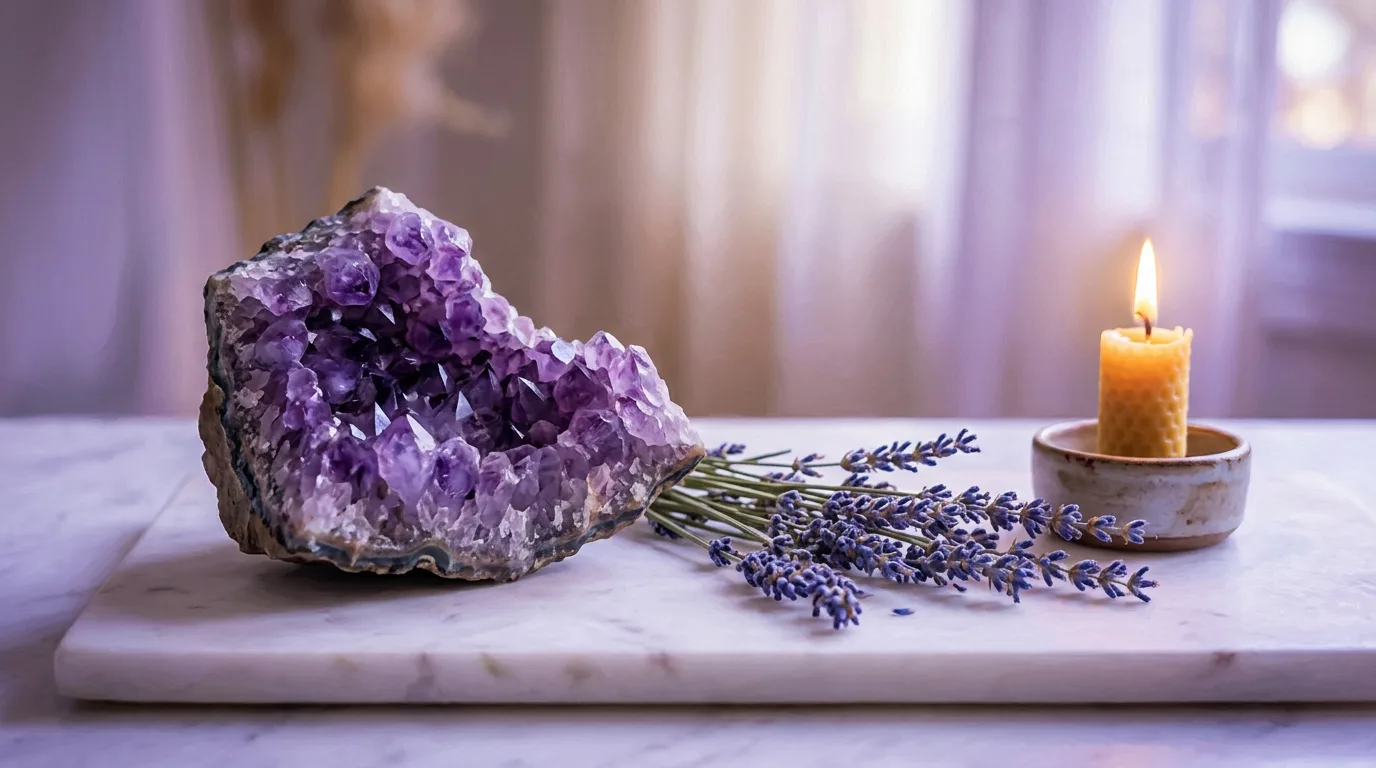
What Amethyst Actually Is: A Straight Answer Before the Folklore
Amethyst is the purple, violet, or lavender variety of the mineral quartz. Its chemical formula is SiO2 — silicon dioxide — the same as clear rock crystal, rose quartz, citrine, and smoky quartz. What sets amethyst apart is a specific combination of trace iron (Fe) inside the crystal lattice plus natural gamma radiation from surrounding rock over geologic time. That combination shifts the iron into a color center that absorbs light in the yellow-green range and lets purple through to your eye. Part of our crystal meanings library.
On the Mohs scale of mineral hardness, amethyst sits at 7. That means it scratches glass, resists most household wear, and is durable enough for daily jewelry — but it is softer than sapphire, ruby, or diamond, and it can chip on a hard corner impact. Its specific gravity is around 2.65, and it forms in the trigonal crystal system, usually as six-sided prisms tipped with pyramid-like terminations inside volcanic cavities called geodes.
So before we get anywhere near chakras, moon water, or Greek myth, this is the honest starting point: amethyst is a common, well-understood silicate mineral. It is beautiful because of a quiet interaction between iron and radiation over millions of years. Everything else that has been layered on top of that — meaning, symbolism, ritual — is human. That does not make it worthless. It makes it worth understanding clearly.
Amethyst Meaning Across History: Greeks, Egyptians, and Medieval Europe
The word amethyst comes from the ancient Greek amethystos, roughly 'not drunk' or 'not intoxicated.' Greek and Roman drinkers wore amethyst amulets and carved wine cups from the stone in the belief that it would keep them clear-headed. Ovid tells a version of the origin myth in his Metamorphoses in which a maiden named Amethystos is turned to quartz by Artemis to protect her from Dionysus, and the god pours wine over the stone in remorse, staining it purple. It is myth, not history — but it is why 'sobriety and clear thinking' became amethyst's oldest symbolic job.
Ancient Egyptian craftspeople carved amethyst into scarabs and amulets as early as the Middle Kingdom, roughly 4,000 years ago, and pieces have been recovered from graves at Naga-ed-Der and elsewhere. The stone was valued alongside carnelian and lapis lazuli and appears in inventories linked to royal jewelry. Egyptians did not have the Greek sobriety myth, but they clearly considered amethyst precious and protective. See how Raka compares to other apps in our independent guide.
In medieval Europe amethyst became a bishop's stone. Purple was the color of ecclesiastical authority, and the Catholic Church associated amethyst with piety, celibacy, and spiritual sobriety. Bishops still traditionally wear an amethyst ring on the right hand. Until large deposits were discovered in Brazil in the 18th and 19th centuries, amethyst was rare enough to sit in the 'cardinal gems' category alongside diamond, ruby, sapphire, and emerald. When Brazilian mines flooded the market, its status as a luxury gem collapsed and it became affordable — a shift that quietly shaped how the modern crystal world uses it.
Across each culture the shared thread is clarity: clarity of mind against drunkenness, clarity of soul against distraction, clarity of purpose in leadership. That thread is worth keeping when you work with the stone today. It is not primarily a 'romance' or 'money' crystal in traditional lore — it is a stone of composure.
Color Varieties and Geological Origin: From Lavender to Deep Purple Geodes
Amethyst is not one color. Depending on iron concentration, temperature history, and how much natural radiation the crystal absorbed underground, it ranges from a pale rose-lavender ('Rose de France') to a saturated reddish-purple traditionally called 'Deep Siberian' — a grade name kept alive from 19th-century Russian mines even though the material now comes almost entirely from other regions. Try best AI tarot app to explore this in more depth.
Uruguayan amethyst tends to be very dark, with tight crystal formation and strong blue-purple flashes; Brazilian amethyst from Rio Grande do Sul is often lighter and more lilac; Zambian amethyst leans toward a reddish-purple with high transparency and is prized for faceting. 'Chevron amethyst' interleaves purple bands with milky white quartz. 'Amethyst-citrine' or ametrine, mined mainly in Bolivia, shows both purple and golden zones in one crystal because different sections of the stone cooled or were irradiated differently.
Heat treatment matters here. If you apply enough heat to amethyst, the iron color center collapses and the stone turns yellow to orange — that heat-treated material is what is sold in most jewelry as 'citrine.' Natural citrine exists but is uncommon; most 'citrine' on the market is baked amethyst. This is not fraud when it is disclosed, but it is useful to know when you are choosing stones and when you read older crystal books that treat citrine as a distinct energetic sibling.
Most of the amethyst you will ever touch grew inside a basalt lava flow. Roughly 130 million years ago, during the breakup of the supercontinent Gondwana, enormous flood basalts erupted across what is now southern Brazil, Uruguay, and parts of Namibia and Argentina. As the lava cooled, trapped gas pockets left hollow cavities. Silica-rich groundwater then percolated through the basalt over millions of years, depositing quartz crystals on the cavity walls. Where iron was present and natural radioactivity from surrounding rock provided the right dose, amethyst grew.
When miners crack open one of these cavities they find a geode: a rocky exterior lined with a forest of purple crystal points pointing inward. Some Uruguayan geodes are small enough to hold; some Brazilian 'amethyst cathedrals' from the Ametista do Sul region stand taller than a person and weigh several tons. Amethyst also occurs in hydrothermal veins and in granite pegmatites in Zambia, Madagascar, Russia, the United States, Canada (Thunder Bay, Ontario has the largest amethyst mine in North America), Mexico, and India. For a technical overview, mineralogists Cornelis Klein and Barbara Dutrow's Manual of Mineral Science remains a standard reference on quartz-family minerals and color centers.
Metaphysical Properties: What the Crystal Tradition Says (Honestly)
Modern crystal literature — the lineage that runs from Melody's Love Is in the Earth through Judy Hall's The Crystal Bible to Robert Simmons and Naisha Ahsian's The Book of Stones — is remarkably consistent about amethyst. Across these authors, amethyst is described as a stone of the higher mind: calming, protective, associated with meditation, dream recall, intuition, and the transformation of lower impulses into steadier awareness. Judy Hall in particular calls amethyst 'a natural tranquilliser' and highlights its long folkloric association with sobriety and addiction recovery.
I want to be direct with you about what these claims are and are not. They are folk beliefs and modern interpretive tradition. There is no peer-reviewed clinical evidence that amethyst emits a measurable energetic field, alters brain chemistry, cures insomnia, or heals disease. When you read a crystal book saying amethyst 'raises your vibration,' treat that as symbolic language inside a spiritual tradition, not as a physics claim.
With that honesty in place, the traditional attributions of amethyst — clarity, composure, restraint from overindulgence, deeper sleep, more vivid dreams, protection of one's emotional field — line up remarkably well with the mental posture that a calm meditative object supports. Holding a cool, weighty, beautiful stone and slowing your breath for two minutes does change your nervous system state. It does not need mystical claims to be useful. In my experience with clients, the people who benefit most from amethyst are the ones who use it as a physical anchor for a reflection practice, not the ones waiting for the crystal to do the work for them.
Amethyst, the Chakras, and the Third Eye
In the chakra system inherited from Tantric yogic tradition and popularized in Western crystal work primarily through Anodea Judith's Wheels of Life and Eastern Body, Western Mind, amethyst is associated with the sixth chakra (ajna, the third eye, between the brows) and the seventh chakra (sahasrara, the crown, at the top of the head). These two centers are traditionally linked to insight, intuition, perception beyond immediate sensory data, and the felt sense of connection to something larger than the individual self.
The color logic is direct: the third eye is usually pictured as indigo and the crown as violet or white, and amethyst is the most common purple stone in the crystal cabinet. Practitioners place a piece on the forehead during a lie-down meditation, hold it in the palm during breathwork, or keep a cluster on a bedside table with the intention of supporting dreamwork.
Crown-chakra work in general asks for a lighter touch than root-chakra work. If your daily life is chaotic, ungrounded, or emotionally scattered, most experienced teachers will point you toward hematite, black tourmaline, or smoky quartz first and bring in amethyst only after some stability is in place. Amethyst rewards a nervous system that is already willing to slow down; it is less useful as an emergency intervention.
Zodiac and Birthstone Associations
Amethyst is the modern February birthstone, a designation formalized in 1912 by the American National Association of Jewelers (now Jewelers of America) when the industry standardized a single monthly list. That link long predates the industry chart — medieval and Renaissance lapidaries also assigned amethyst to February and to the sign Pisces, which begins in the second half of that month.
In contemporary Western astrology, amethyst is most often associated with Pisces (dreamy, intuitive, imaginative) and Aquarius (independent, future-oriented, cerebral). Some writers also connect it to Sagittarius, drawing on the traditional link between the sign and the color purple. These pairings are symbolic and interpretive, not observational science; treat them as story rather than mechanism.
If you were not born in February and are not a Pisces or Aquarius, none of that disqualifies you from working with amethyst. Birthstone systems are cultural conventions, useful mainly as a starting point when you have no other intuition about which stone to choose. Pick the amethyst that draws your eye in the shop, or that a trusted friend gave you, over the stone a chart tells you to want.
How to Use Amethyst Right Now: A Numbered Starter Ritual
If you have just brought an amethyst home and want a simple, non-magical, actually-useful way to begin working with it, do these steps in order. This is a mindfulness protocol with a stone as its focal object; it does not require you to believe anything in particular.
1. Rinse the stone under cool running tap water for thirty seconds. This is the physical reset — you are literally washing off shop dust and other people's fingerprints. 2. Dry it and hold it in your dominant palm. Notice its weight, temperature, and the way it warms against your skin. Give this a full minute without doing anything else. 3. Set one clear intention out loud. Not a wish — a direction. Example: 'When I hold this stone, I am practicing coming back to the present moment.' 4. Choose a location: bedside table for sleep and dream work, desk for focus, meditation cushion for practice, pocket or pouch for a portable anchor.
5. Once a day for the first week, hold the stone for two minutes and take slow breaths — roughly four seconds in, six seconds out. That's it. 6. At the end of the week, write two or three sentences about what, if anything, has shifted in your attention, mood, or sleep. This is your data. 7. Every two to four weeks, cleanse the stone using one of the methods in the next section, and repeat the intention if it still feels true or adjust it if it doesn't. 8. When the ritual starts to feel automatic, that's a signal to deepen the practice, not to buy another crystal.
Cleansing and Charging Amethyst: What Works, What to Skip
'Cleansing' in the crystal tradition means clearing the stone of energetic residue picked up from previous handling, environments, or your own difficult days. Whether you take that literally or read it as a symbolic reset ritual for yourself, the practical methods are the same. Safe options for amethyst include: rinsing under cool running water for one to two minutes, smoke-cleansing with cedar, palo santo, or mugwort in a well-ventilated room, resting the stone on a bed of dry sea salt (not in salt water, which over time can dull polished pieces), and placing it on a larger clear quartz or selenite plate overnight.
Charging traditionally means placing the stone somewhere its associated energy is amplified. Moonlight, especially full moon, is the most common method for amethyst — set it on a windowsill overnight. Do not charge amethyst in direct sunlight for extended periods. Sunlight fades amethyst's color permanently. This is not folklore; it is well-documented mineralogy. The same iron color center that gives amethyst its purple is destabilized by prolonged UV exposure, and antique amethyst window displays are visibly paler than the same material kept in a drawer.
Skip any method that involves harsh chemicals, ultrasonic jewelry cleaners on cracked or included stones, or leaving the stone in salt water for days. Skip anyone selling you an expensive proprietary 'crystal cleansing spray' — running water and honest attention do the same job. As with all crystal practice, the ritual is a container for your own presence; the stone is the excuse to slow down.
Meditation, Sleep, and Dream Work With Amethyst
Amethyst is one of the most commonly recommended stones for meditation because it is visually calming, cool to the touch, and traditionally associated with the higher mind. A basic practice: sit comfortably with the stone in your left palm (the receptive hand in most traditions), close your eyes, and take slow breaths for five to ten minutes. When your mind wanders — which it will — notice the weight of the stone and return to the breath. That is the entire practice. Consistency matters more than duration.
For sleep and dream work, place a small tumbled amethyst on your nightstand or under your pillow (a small one, so you do not wake up on a hard edge). Some practitioners keep a small journal beside it and write down anything they remember on waking, even a fragment. Research on dream recall, including work summarized by Harvard psychiatrist Deirdre Barrett in The Committee of Sleep, shows that simply intending to remember dreams and writing them down immediately on waking substantially increases recall over a few weeks. The stone is a cue for that intention, not a mystical dream generator.
If you struggle with insomnia serious enough to affect your daily functioning, please see a physician or a sleep specialist. Amethyst is a companion to a healthy sleep hygiene practice — dark room, cool temperature, no screens for the last hour, consistent wake time — not a substitute for medical care.
Wearing and Carrying Amethyst: Jewelry, Pockets, and Home Placement
Because amethyst is a 7 on the Mohs scale, it holds up well as a daily-wear stone in rings, pendants, earrings, and bracelets, though softer settings (a bezel rather than exposed prongs) will protect the corners of a faceted stone. A pendant near the throat or heart is a traditional placement for a stone associated with the upper chakras. A ring on the non-dominant hand is often chosen when the wearer wants the stone to influence how they receive rather than how they act.
A tumbled amethyst in a jeans pocket or a small pouch in a bag is the most portable option. The stone becomes a tactile check-in: when your fingers brush it during the day, take one intentional breath. Over a few weeks that pairs the sensation with the pause, and the stone does what a good habit anchor does — it makes the desired behavior easier to remember.
For the home, common placements include the bedroom (for sleep and dream work), a meditation corner, a home office (for focus), or the entryway (traditionally, an amethyst geode near the door is said to hold a calm atmosphere in the room). Larger clusters and geodes are visually impressive but also expensive and heavy, and they do not do more spiritual work than a well-chosen tumbled stone. Choose the size you actually want to look at every day.
Ethical Sourcing and Spotting Fakes: Buy Well or Not at All
The crystal industry is largely unregulated. Stones travel long, opaque supply chains from mine to wholesaler to shop, and the retail price rarely reflects the labor conditions at origin. Some crystals are associated with well-documented human-rights concerns: much of the world's cobalt and some tourmaline comes from artisanal mines in the Democratic Republic of the Congo where child labor and unsafe conditions have been reported by Amnesty International. Some Madagascan rose quartz and labradorite has been linked to informal mining with minimal safety or environmental protection.
Amethyst is generally on the better end of the crystal supply chain. The largest sources — Uruguay, southern Brazil, and Zambia — operate a mix of large mechanized mines and smaller artisanal cooperatives, and Uruguay in particular has relatively strong labor and environmental regulation compared with the wider crystal industry. Even so, no origin story is guaranteed clean by geography alone. Before you buy, especially for larger pieces, ask the seller three questions: Where was this stone mined? Do you know the name of the mine or cooperative? Is any of your supply certified fair-trade or traceable? A seller who cares will have partial answers and will admit what they do not know.
Most 'fake' amethyst on the market is actually one of three things: glass, synthetic hydrothermal quartz grown in a lab, or heavily included natural quartz dyed or coated purple. Lab-grown amethyst is chemically identical to natural amethyst — SiO2 with iron impurities — and is genuinely difficult to distinguish without gemological equipment. Whether that matters to you is a personal question. Some people feel a lab-grown stone carries the same meaning; others want the geologic backstory.
Practical checks you can do at home: real amethyst is cool to the touch and warms slowly; glass warms almost instantly against your skin. Natural amethyst is often unevenly colored, with lighter and darker zones or subtle inclusions; glass and dyed stones are usually suspiciously uniform. Rub the stone against a smooth ceramic tile — real quartz will not scratch, glass often will. For higher-value purchases — a large geode, a faceted stone over a carat or two, jewelry priced accordingly — buy from a dealer who discloses treatment and origin, and ask for a certificate from a recognized lab such as the GIA (Gemological Institute of America). If the price feels too low for the size and saturation, something is not being disclosed.
Amethyst Compared With Other Crystals: When to Choose Which
It helps to place amethyst next to the stones it is most often confused with in practice. Clear quartz is the neutral amplifier — it is used to boost intention and to program with a specific goal. Amethyst is more specifically calming and reflective; you reach for it when the issue is 'my mind is loud' rather than 'I need more energy behind this project.'
Rose quartz shares amethyst's soft, receptive quality but is associated with the heart chakra, self-compassion, and relational healing. If the theme is loneliness, grief, or a hard conversation with someone you love, rose quartz is the more traditional companion. Amethyst is chosen for internal composure; rose quartz for opening softness toward others.
Selenite, technically a variety of gypsum rather than quartz, is often paired with amethyst for cleansing work. Where amethyst calms, selenite is described as clearing — think of selenite as the plate you set the amethyst on to reset it between sessions. Black tourmaline and hematite are chosen when the issue is grounding, protection, or feeling scattered; those are root-chakra jobs and amethyst is not the right tool.
Citrine — real natural citrine or heat-treated amethyst sold as citrine — is chosen for warmth, confidence, and 'putting yourself forward' energy, the opposite end of the emotional spectrum from amethyst's introspection. Lapis lazuli overlaps with amethyst in the third-eye/insight zone but leans toward truth-telling and communication rather than composure. Knowing what a stone is for keeps you from asking any single crystal to do everything.
When Crystal Work Is Not Enough: The Professional-Help Caveat
I want to close with something that is easy to lose in a long article about a beautiful stone. Amethyst is a support for reflection. It is not a treatment for anxiety, depression, PTSD, addiction, insomnia disorder, or any other diagnosable condition, and no responsible crystal author claims otherwise. If any of those are part of your life right now, please treat this article as an interesting side interest and put the primary weight of your care on a qualified professional: a physician, a licensed therapist, a psychiatrist, a certified addiction counselor, a sleep specialist.
The traditional folkloric link between amethyst and sobriety is genuinely old and genuinely meaningful as a symbol. It is not a treatment plan. In the United States, the SAMHSA National Helpline (1-800-662-4357) provides free, confidential, 24/7 referral for substance use and mental health services. In the UK, Mind (mind.org.uk) offers similar signposting. In Canada, Wellness Together Canada; in Australia, Beyond Blue.
The most durable version of a crystal practice — the version that stops being a phase and becomes a quiet lifelong companion — is one that sits alongside good medical care, honest relationships, sunlight, movement, and sleep. The stone is a reminder of intention. The life is the work.