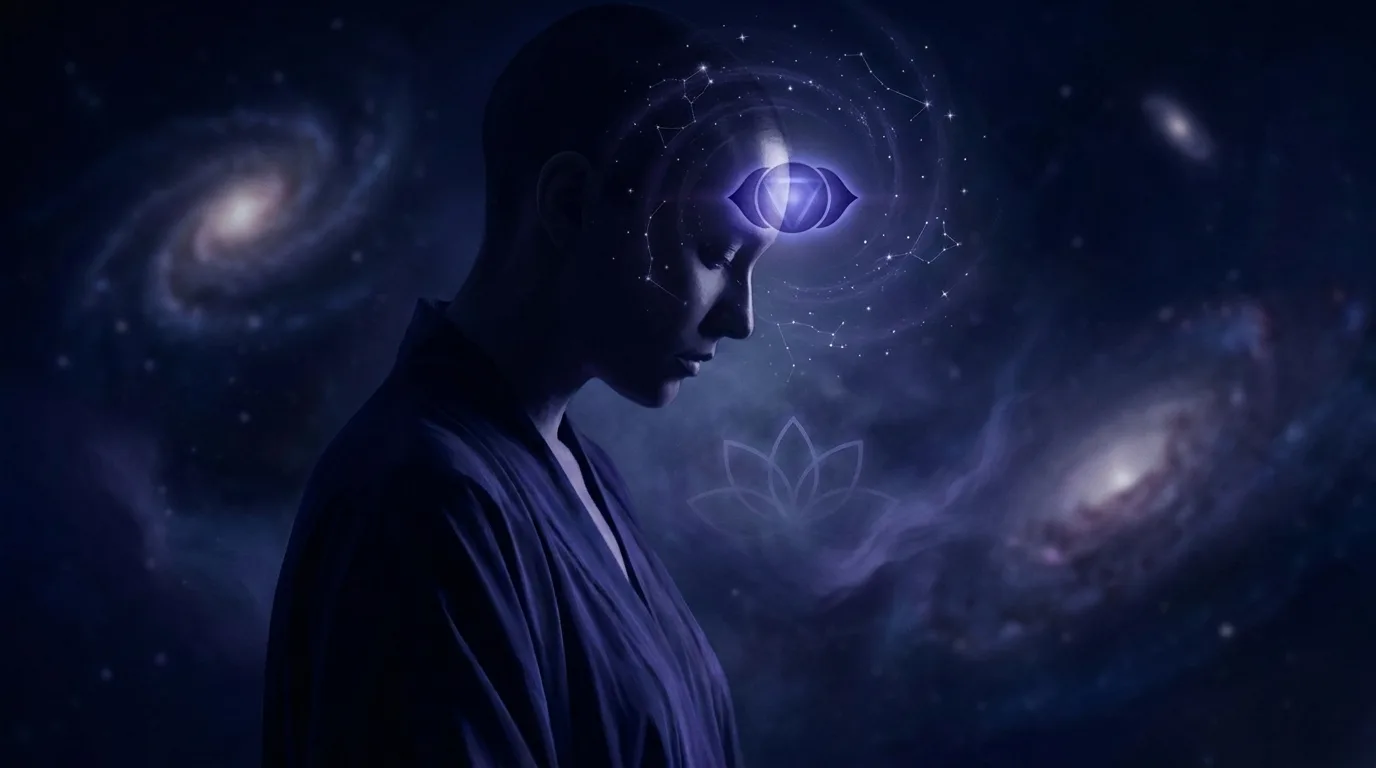
What the Third Eye Chakra Actually Is (and Isn't)
The third eye chakra — Sanskrit Ajna, meaning 'to perceive' or 'to command' — is the sixth of the seven main energy centers described in tantric yoga texts that reached the West largely through Sir John Woodroffe's 1919 translation The Serpent Power. It sits at the center of the forehead, just above and between the brows, and is traditionally depicted as a two-petaled indigo lotus containing the seed sound Om. In modern Western frameworks, particularly Anodea Judith's foundational work Wheels of Life (1987), Ajna is the seat of inner vision, imagination, pattern recognition, and the capacity to see beyond immediate sensory input.
It's helpful to be honest about what this framework is. Chakras are not anatomical structures. If a surgeon opens your forehead, they will not find a lotus. What the chakra system offers is a symbolic, embodied map — a way of describing clusters of experience (intuition, groundedness, self-worth) and locating them in the body so you can work with them somatically rather than only intellectually. Treat it as a language for self-reflection, not a physiology textbook. Part of our chakras library.
That distinction matters because a lot of third eye content online promises literal clairvoyance, prophecy, or contact with entities. In my experience working with clients on chakra-based practices, the people who benefit most are the ones who drop the supernatural framing and use Ajna work to train something more modest and more useful: the muscle of noticing. Noticing the pattern before the crisis. Noticing the small voice that said 'don't take this job' three weeks before you regretted it. Noticing the difference between anxious thought and genuine knowing.
So when you read the rest of this guide, hold the framework loosely. Ajna is a lens, not a laser. It sharpens perception. It does not download the future.
The Full Correspondence Chart at a Glance
Every chakra in the traditional seven-chakra system carries a set of correspondences — a color, an element, a bija (seed) mantra, an associated gland, and a governing theme. These are learning devices, refined over centuries by teachers like Swami Satyananda Saraswati and modernized by Western authors including Anodea Judith and Caroline Myss. For Ajna, the standard correspondences most Western practitioners work with are as follows.
Sanskrit name: Ajna. Location: center of the forehead, slightly above the brow line. Color: indigo, sometimes rendered as deep violet-blue. Element: light (some traditions say 'no element' because Ajna transcends the material). Bija mantra: Om or Aum, occasionally Ksham in older texts. Associated endocrine glands: the pineal and pituitary, both of which sit deep in the brain and regulate circadian rhythm and hormonal cascades respectively. Symbol: a two-petaled lotus flanking a downward triangle. Sense: none directly — Ajna is said to govern the sixth sense, intuition itself.
Themes it governs: perception, insight, imagination, memory, dreaming, discernment, the capacity to hold paradox, and what tantric texts call viveka — the ability to distinguish real from false. Its shadow expressions are cynicism (nothing is real), delusion (everything is a sign), rumination, and analysis paralysis. Its healthy expression looks like clear thinking that includes gut feel, decisions that hold up over time, and a mind that can go quiet on command. See how Raka compares to other apps in our independent guide.
One caveat worth naming: the color indigo was assigned to Ajna by early 20th-century Theosophists like C.W. Leadbeater, not by the original Sanskrit sources. Traditional texts often describe Ajna as luminous white or moonlike. The indigo association is Western and modern. Both work as visualization tools; just know the lineage.
Signs Your Third Eye Chakra Is Underactive
An underactive or 'blocked' Ajna, in the framework used by teachers like Anodea Judith, tends to show up as a life lived entirely on the surface. You react to what's in front of you but can't zoom out. You make the same relational mistake three times and only spot the pattern on the fourth. You dismiss dreams as noise, gut feelings as anxiety, and any hint of intuition as unscientific — which itself is a kind of scientism that ignores how much real cognition happens below conscious awareness.
Concretely, watch for: chronic difficulty visualizing (some people genuinely cannot form mental images, a trait called aphantasia — that's a neutral variation, not a blockage); a sense that you're going through the motions; distrust of your own judgment even when you're usually right; needing external validation for every decision; feeling numb during moments others describe as beautiful or moving; disconnection from dreams to the point you don't remember any; and a rigid, literal, either-or way of processing information.
Physically, some practitioners report brow-line tension, a dull ache behind the eyes after screen time, sinus issues, or a sense of pressure at the forehead. These are also, importantly, symptoms of eye strain, dehydration, sinus infection, tension headache, or migraine. If they persist for more than two weeks or come with vision changes, please see a doctor before you see a healer. Ajna work is complementary, not diagnostic.
The most quietly common sign I see: people who are extraordinarily competent in analytical domains but cannot answer the question 'what do you actually want?' The signal from the deeper self has gotten drowned out by decades of prioritizing what makes sense over what feels true. Try Raka to explore this in more depth.
Signs Your Third Eye Chakra Is Overactive
The opposite imbalance is less talked about but just as common, particularly in spiritual communities. An overactive Ajna, in the same symbolic framework, looks like a mind that has slipped its moorings. Everything is a sign. Every dream is prophetic. Every coincidence is the universe speaking. Every unusual sensation is a psychic download. The person becomes increasingly hard to talk to about ordinary things because ordinary things have stopped feeling real.
Signs to watch: obsessive focus on symbols, numerology, or synchronicities to the point of losing functional decision-making; vivid intrusive imagery, especially at night; feeling constantly 'plugged in' to something you can't turn off; nightmares or lucid dreams that leave you exhausted; a growing dismissal of physical needs (sleep, food, exercise, taxes, relationships with non-spiritual friends); and increasing certainty that you have unique insight others lack.
Overactivity is often what happens when someone opens Ajna aggressively — through intense meditation retreats, heavy psychedelic use, or nonstop consumption of esoteric content — without simultaneously strengthening the root chakra (Muladhara), the body's grounding center. In the tantric model, the upper chakras only stabilize if the lower ones can hold them. A tree with a huge crown and shallow roots falls in the first storm.
If any of this rings loudly true, especially with intrusive imagery, derealization, or an inability to function, please loop in a mental health professional. Spiritual bypass — using spiritual concepts to avoid psychological reality — is well-documented in the clinical literature, notably in John Welwood's essays and Robert Augustus Masters' 2010 book Spiritual Bypassing. Ajna work should make you more available to your life, not less.
What Modern Science Says About the Brow Region
The pineal gland, which sits deep in the center of the brain roughly behind the third eye point, has fascinated Western thinkers since Rene Descartes famously called it 'the principal seat of the soul' in his 1649 Treatise of Man. What we now know is more prosaic and more interesting: the pineal produces melatonin in response to darkness and regulates the sleep-wake cycle. It responds to light through a neural pathway from the retina via the suprachiasmatic nucleus, and it calcifies with age in most people — a process visible on standard head CT scans.
Some contemporary spiritual writers have leapt from 'pineal responds to light' to 'the third eye literally sees.' That leap is not supported by neuroscience. What is supported is that consistent darkness exposure at night, morning sunlight exposure, and reduced blue light before bed improve melatonin function and, in turn, sleep architecture and dream vividness — all of which, in the chakra framework, would be described as 'supporting Ajna.' The behaviors overlap even when the explanations diverge.
The pituitary gland, also associated with Ajna in most Western chakra maps, is the endocrine 'master gland,' regulating growth hormone, cortisol via ACTH, thyroid via TSH, and reproductive hormones. It is genuinely central to how you feel and function. Chronic stress dysregulates the HPA axis (hypothalamus-pituitary-adrenal), which in the chakra language would be called 'Ajna and root chakra imbalance simultaneously,' and in medical language is called burnout or adjustment disorder.
The point isn't that chakra language and neuroscience are the same. They're not. The point is that the practices traditionally used to 'balance Ajna' — dark room time, meditation, sleep hygiene, quieting sensory input — happen to be practices with real, measurable neurological benefits. A 2014 JAMA Internal Medicine meta-analysis by Goyal et al. found meditation programs produced small but reliable improvements in anxiety, depression, and pain. You don't have to believe in energy centers for the practices to work.
What to Do Right Now: A 7-Step Third Eye Reset
If you've read this far and you want to actually try something today, here is a concrete sequence you can complete in under an hour. It's designed as a reset, not a lifetime practice — do it once and see what you notice. Nothing here requires belief; it requires attention.
1. Reduce inputs for the next two hours. Close news, social media, group chats. No podcasts, no music with lyrics. Your Ajna is overwhelmed by signal; give it silence. 2. Drink a full glass of water. Dehydration causes low-grade brow tension that mimics 'blockage.' 3. Sit somewhere you can see out a window. Look at the furthest point you can see — a distant building, a tree line, the horizon. Hold your gaze there for 60 seconds. Modern eyes rarely look past a screen; long-focus gazing physically relaxes the ciliary muscles around your eyes and, subjectively, opens perception.
4. Try trataka (candle gazing). Light a candle at eye level about arm's length away. Look at the flame without blinking for as long as comfortable — usually 30 to 90 seconds is plenty for a first try. Close your eyes. Watch the afterimage of the flame appear on the inner screen behind your closed lids. This is not mystical; it's a well-documented visual phenomenon and a classic Ajna practice described in the Hatha Yoga Pradipika. 5. From that quiet, ask one honest question you've been avoiding. Not 'what should I do' — that engages the analytical mind. Ask 'what am I not letting myself see?' Wait. Don't force an answer.
6. Write for ten minutes without stopping. Whatever comes. The goal isn't insight, it's drainage — clearing the surface layer of chatter so the deeper signal can move. 7. Before bed, put your phone in another room and sleep in as much darkness as possible. If your dreams feel more vivid or accessible in the morning, that's the practice working. Write anything you remember in three lines before you touch your phone.
One session won't rewire your intuition. But it will show you, honestly, whether these practices produce a felt shift for you — which is the only test that matters.
Foods, Yoga, and Breath That Support Ajna
The traditional food list for Ajna emphasizes indigo and purple foods on the visual-correspondence logic that like supports like. That includes blueberries, blackberries, purple grapes, eggplant, purple cabbage, plums, and black currants. Beyond the color symbolism, these foods are genuinely rich in anthocyanins, a class of flavonoids that a 2012 study in Annals of Neurology (Devore et al.) associated with slower rates of cognitive decline in older women. Omega-3 rich foods — wild salmon, walnuts, flax, chia — support brain and pineal health more directly.
Two things to reduce, in the traditional framework: excess caffeine, which spikes cortisol and dysregulates the HPA axis; and heavily processed sugar, which produces the energy crashes that make intuitive listening nearly impossible. This isn't food moralism. It's noticing that most people who complain of foggy thinking are running on caffeine and sugar and asking Ajna to compensate. It won't. Try best tarot app to explore this in more depth.
Yoga poses classically associated with the third eye include child's pose (balasana) with the forehead pressed gently to the mat, which stimulates the brow point directly; dolphin pose, an inversion that brings blood flow to the head; wide-legged forward fold (prasarita padottanasana); rabbit pose (sasangasana); and eagle pose (garudasana), which requires cross-body focus. If you're new to yoga, start with child's pose held for five minutes with slow breathing. That alone is a meaningful Ajna practice.
For breath, alternate nostril breathing (nadi shodhana) is the classical Ajna pranayama. Close your right nostril with your thumb, inhale through the left for four counts, close the left with your ring finger, exhale through the right for four, inhale right, exhale left. Continue for five minutes. A 2013 study in the International Journal of Yoga (Sinha et al.) documented measurable improvements in autonomic function and cognitive performance from regular nadi shodhana practice. Simple, ancient, and testable.
Crystals, Essential Oils, and Affirmations
Crystals traditionally associated with Ajna are indigo and violet stones: lapis lazuli (the classic third eye stone, used in Egyptian ceremonial jewelry for millennia); sodalite for clarity of thought; amethyst for calming an overactive mind; fluorite for mental focus; and clear quartz as an amplifier. It's worth being honest that there is no scientific evidence crystals emit or channel energy in the way spiritual literature describes. What they do reliably provide is a tactile anchor for practice — holding a stone during meditation is a body-based cue that says 'we're doing the work now,' and that ritual anchor has real behavioral value.
If you'd like to try, choose one stone that visually pulls you. Cleanse it however feels right (running water, moonlight, incense smoke — pick a ritual, not a rule). Hold it at the brow point during a five-minute meditation. Notice what you notice. If nothing happens, nothing happens. That's also information.
Essential oils traditionally used for the third eye include frankincense (used in contemplative traditions across cultures for at least three millennia), sandalwood, clary sage, juniper, and lavender for its calming properties. A drop diluted in carrier oil, gently pressed to the brow point (not near the eyes), can serve as a scent-anchor for meditation. As with crystals, the mechanism is largely associative and ritual — smell is powerfully linked to the limbic system and to memory, which is why a consistent meditation scent trains the nervous system to drop into practice faster over time.
Affirmations for Ajna, if you use them, work best when they're specific and honest rather than magical. Try: 'I trust what I already know.' 'I can see the pattern.' 'I let myself perceive what's actually here.' 'My imagination is a resource, not a distraction.' Say them aloud, slowly, once. Repeating an affirmation thirty times mechanically often does less than saying it once with full attention.
Third Eye vs. Crown vs. Throat: How Ajna Compares
Ajna is easy to confuse with the two chakras that flank it. The throat chakra (Vishuddha, Sanskrit for 'purification,' blue, seed sound Ham) governs expression — the ability to speak your truth, listen deeply, and align what you say with what you feel. The crown chakra (Sahasrara, 'thousand-petaled,' violet or white, no bija in most traditions) governs connection to something larger than the self — meaning, transcendence, unity. Ajna sits between them and does the perceiving that speech expresses and that transcendence rests on.
A useful way to distinguish them in practice: if you have a felt sense of what's true but cannot say it, that's often a throat block, not an Ajna block. Ajna gave you the perception; Vishuddha is where it's getting stuck. If you can see clearly and speak clearly but feel isolated, disconnected from purpose, or nihilistic about meaning, that's often Sahasrara territory, not Ajna. Ajna's specific job is the perception itself — the moment of noticing before the noticing is named or shared.
Comparatively, Ajna is also often confused with the solar plexus chakra (Manipura, yellow, seed sound Ram), which governs willpower, personal agency, and gut instinct in the visceral sense. The distinction matters: gut feelings (Manipura) are somatic and immediate — you feel them in your stomach. Ajna insights are quieter, more visual, more pattern-like — you 'see' rather than 'feel.' Both are forms of intuition, but working with them requires different practices. Manipura wants breath of fire and core work; Ajna wants stillness and darkness.
And Ajna differs from the heart chakra (Anahata, green, seed sound Yam) in a way people often miss: Anahata knows what you love. Ajna knows what's true. Sometimes those align beautifully. Sometimes they don't, and Ajna is the chakra that will tell you that the person you love is not good for you. Ajna work can be uncomfortable for this reason. It sharpens seeing, and seeing sometimes costs.
When It Matters Most: Timing Ajna Work in Your Life
There are seasons of life when third eye work tends to land with unusual force. Major transitions — a divorce, a job loss, a health scare, a move, the end of a decade — often crack open a felt need for deeper perception. This isn't mystical. It's that transitions make the pattern visible; you can suddenly see the shape of the last chapter now that it's ending. Ajna practices during transition don't create the seeing so much as give the seeing somewhere to land.
Ages 27 to 30 (sometimes called the Saturn Return in astrological language) and the mid-forties often bring a natural intensification of Ajna themes: 'is this the life I meant to build?' 'what have I been ignoring?' 'what did I know at nineteen that I stopped listening to?' If you're in one of those windows, structured reflection practice — journaling, therapy, dream work, chakra meditation — tends to be more available and more useful than in stable stretches.
Time of day also matters. The traditional windows for Ajna practice are the brahma muhurta (roughly 4 to 6 AM, before the mind has fully engaged the day's demands) and the hour after sunset, when the brain's shift into melatonin production begins. If those windows don't work for your life, the more important variable is consistency — the same twenty minutes every day beats an occasional dawn ritual.
Menstrual cycle matters if that applies to you. The luteal and menstrual phases (roughly the second half of the cycle) tend to bring heightened intuitive access and vivid dreams, an observation supported both by traditional women's mystery teachings and by contemporary work like Alisa Vitti's In the FLO (2020). Track it for three months and see if your best insights cluster. This isn't destiny; it's data about your own system.
Integrating Ajna Work With Therapy
Chakra work and therapy are not competitors, and treating them as either-or costs people a lot. In my experience, the clients who make the deepest progress are the ones running both tracks — a therapist for the psychological and relational work, a meditation or somatic practice for the embodied, contemplative work. Each catches what the other can't. A therapist may not have language for the felt sense of a stuck energy at the brow; a meditation teacher is not trained to work with childhood trauma or a psychiatric condition.
The signal that you need clinical support alongside (or instead of) chakra practice: persistent hopelessness, thoughts of self-harm, dissociation that lasts more than moments, intrusive imagery you cannot slow down, panic attacks, or any physical symptom (headaches, vision changes, numbness) that persists more than two weeks. These are not spiritual emergencies to be worked through with breathwork alone. They're medical or psychological events. Please see someone qualified.
Trauma-informed therapy — particularly modalities like EMDR, somatic experiencing (Peter Levine's work, especially Waking the Tiger), and internal family systems (Richard Schwartz) — dovetails unusually well with chakra frameworks because both take the body seriously as a site of meaning. A somatic therapist who is chakra-literate is worth searching for if you have the resources. If you don't, a good regular therapist plus a solid meditation practice will get you most of the distance.
Be wary of anyone — spiritual teacher, energy worker, or otherwise — who tells you their work replaces medical or psychiatric care, or who discourages you from seeking clinical support. That is a serious red flag. Genuine Ajna teachers are usually the first to say: yes, and see a doctor.
Common Pitfalls and Honest Cautions
The first pitfall is treating opened intuition as omniscience. A stronger felt sense is genuinely useful. It is also fallible. You will 'know' things that turn out to be projections, wishful thinking, or misread patterns. The mature Ajna practice includes calibration — noticing when your intuition was right, when it was wrong, and building the meta-skill of when to trust it. Journal your intuitive hits and misses for three months if you want to actually improve, rather than just feel more confident.
The second is spiritual bypass — using Ajna practices to skip over the psychological work of grief, anger, or relational rupture. If your meditation practice keeps you calm but your marriage is falling apart and you refuse to look at your part in it, meditation has become an avoidance tool. Robert Augustus Masters and John Welwood have both written extensively on this pattern. The remedy is not less meditation; it's meditation plus honest inventory plus, often, professional help.
The third is confusing content with capacity. Reading twelve books on the third eye chakra will not open your third eye. Twenty minutes of daily practice for six months will. Chakra literature is deep and rewarding, but it is not itself the work. Anodea Judith's Eastern Body, Western Mind and Wheels of Life are foundational; Caroline Myss's Anatomy of the Spirit is a widely-read complement. Read one, practice for a season, then read another. Not the reverse.
The fourth is buying too much stuff. The industry around chakras — crystals, oils, courses, retreats — is enormous and largely unregulated. The Global Wellness Institute pegged the wellness economy at over $6.3 trillion in 2023. You do not need to spend money to work with Ajna. A quiet room, a candle, a notebook, and consistent time will do more than any $300 course. Buy things that support existing practice; do not let purchased things become the practice.
A Simple 21-Day Third Eye Practice You Can Actually Sustain
If you want to commit to something modest and see what happens, here is a three-week protocol structured to build gradually. Week one: five minutes of morning silence before touching your phone. Sit up in bed, hands on knees, eyes soft or closed, attention resting at the brow point without straining. When thoughts come, note them and return. That's it. No candle, no crystal, no mantra. Baseline.
Week two: add three minutes of nadi shodhana (alternate nostril breathing) after the silence, and three lines of morning-page journaling — whatever's on the surface, unfiltered. Also this week, one evening trataka session: five minutes of candle gazing, three nights out of seven. Keep the phone out of the bedroom overnight. Notice what your dreams do.
Week three: extend morning silence to ten minutes. Add one honest question per morning after the breathing, written at the top of the journal page: 'what am I not letting myself see today?' Write for five minutes in response. Nothing profound required. Continue evening trataka three nights. Sunday of week three: review the twenty-one days. What patterns showed up in your journaling? What decisions did you make differently? What dreams do you remember?
At the end of twenty-one days you will know, empirically, whether this practice does anything meaningful for you. That's the standard I'd hold any spiritual practice to. Not 'does it feel deep?' but 'over three weeks, did I make better decisions, sleep better, react less, and see myself more clearly?' If yes, continue. If no, try something else. Your Ajna, if it's working, will tell you which.