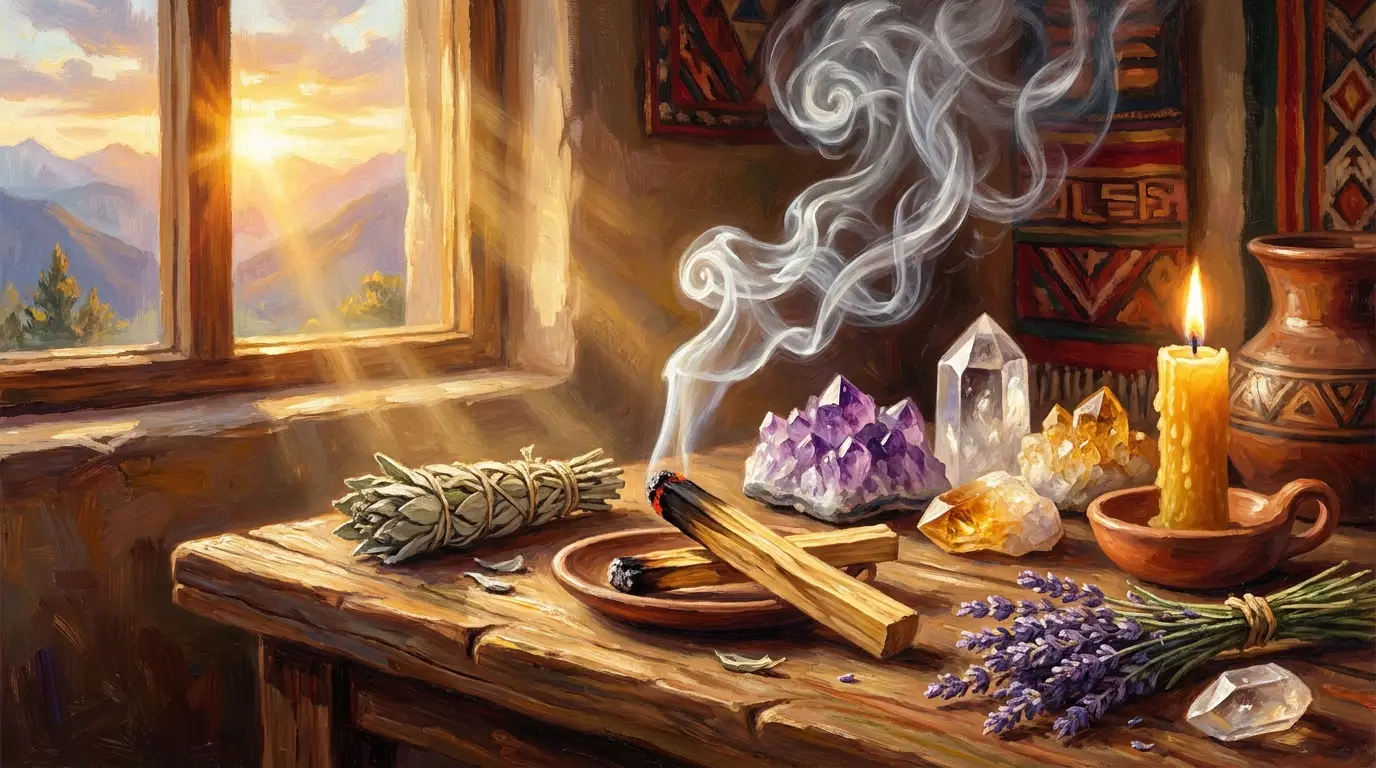
What Palo Santo Actually Is
Palo santo is the Spanish common name — literally holy wood — for Bursera graveolens, a small deciduous tree in the same botanical family as frankincense and myrrh. It grows in the seasonally dry tropical forests that stretch along the Pacific coast of South America, most abundantly in Ecuador and Peru, with smaller populations in Venezuela, Colombia, and the Galápagos. The trees are unremarkable-looking: modest height, pale bark, small yellow-green leaves that drop in the dry season. What sets the species apart is what happens inside the heartwood after the branch has died.
When a Bursera graveolens branch falls and lies on the forest floor for a period of two to four years, a chemical process takes place. The living sap dries and concentrates, and the wood accumulates a dense cocktail of aromatic terpenes — chiefly limonene (which gives citrus peel its scent), alpha-terpineol, menthofuran, and small amounts of dozens of related compounds. This is why the wood must age. A freshly cut branch produces very little of the characteristic sweet smoke; the fragrance is a product of natural post-mortem chemistry, not the living tree. Part of our spiritual practice guide library. See our related guide on hole in the ear spiritual meaning. See our related guide on groundhog spiritual meaning. See our related guide on spiritual meaning of umbilical cord around neck.
The distinction matters both ecologically and practically. Ethically harvested palo santo is, by definition, a byproduct of the forest's own dying-and-composting cycle rather than an act of logging. Harvesters walk the forest, identify branches that have fallen and aged appropriately, cut them into transportable lengths, and bring them out. Freshly felled wood is not only illegal to export under Ecuador's regulatory regime; it also does not smell right. This is one of the more helpful facts for consumers: a suspiciously green or damp stick that smells faintly grassy rather than sweetly resinous is a red flag. See our related guide on spiritual meaning of a cat staring at you. See our related guide on raccoon spiritual meaning. See our related guide on jumping spider spiritual meaning.
Botanically, Bursera graveolens is related to a much larger family of aromatic trees. Its cousins include the frankincense trees (Boswellia) of the Arabian Peninsula and Horn of Africa, the myrrh trees (Commiphora) of the same region, and the copal trees used ceremonially throughout Mesoamerica. All of these produce fragrant resinous compounds as a defense against insects and pathogens. What we treat as sacred wood is, in the tree's own biological logic, an immune response — which is a reminder that most of what humans call sacred plants are, at root, chemically interesting. Part of our spiritual practice guide library.
A 500-Year History in the Andes
Ceremonial use of palo santo predates the Spanish arrival in South America and belongs to the older layer of Andean and coastal Indigenous cosmologies. Archaeological and ethnobotanical work indicates that peoples across the region — including groups ancestral to today's Kichwa and Manteño communities — burned aromatic woods for both practical and ritual purposes for well over five centuries before contact. When Spanish chroniclers arrived in the sixteenth century, they encountered the practice already deeply embedded in local healing culture, and the Spanish name palo santo reflects their attempt to Christianize a tradition they did not fully understand.
In Andean healing systems, the wood is not treated as generic incense. It is one instrument in a broader practice often called a limpia — a cleansing — conducted by a specialist practitioner (variously called a curandero, maestro, or yachak depending on region and community) for a person carrying illness, grief, misfortune, or spiritual disturbance. Palo santo smoke typically appears alongside other elements: sound, water, tobacco, flowers, prayer, and sometimes plant medicines. Its role is to open and close ritual space, not to do the whole job by itself.
Post-conquest, the practice syncretized with Catholicism in ways that are still visible today. In many Ecuadorian and Peruvian towns, palo santo is burned in home altars alongside crucifixes and images of saints. On All Saints' Day and during Holy Week, it is used to fumigate churches. This layering is not a corruption of an older practice; it is how living traditions work. The wood has been continuously in ceremonial use, with meaning shifting and accreting, for the entire recorded history of contact between Andean and European Christian worlds. Part of our spiritual practice guide library.
The relevant thing for anyone reading this from the United States, United Kingdom, Canada, or Australia is that palo santo did not arrive on Western shelves out of a vacuum. It came out of a very specific cultural context that includes Indigenous cosmology, Catholic devotion, mestizo folk healing, and the labor of rural harvesters in Ecuador and Peru. Buying a stick means participating, in a small way, in that supply chain. That is neither a reason to avoid it nor a reason to be flippant about it — it is simply worth knowing. Part of our spiritual practice guide library.
How to Burn Palo Santo Properly?????
The traditional method is simple and specific. Hold a stick of palo santo at roughly a forty-five degree angle to a flame — a candle, a match, or a lighter — with the tip pointing downward into the fire. Wait 30 to 60 seconds. The wood will catch and produce a small flame of its own. Once that flame is established, blow it out. What remains is a slow-burning ember at the tip that releases the characteristic sweet, resinous smoke. This is the working state of a palo santo stick: smoldering, not flaming. Part of our spiritual practice guide library.
Once lit, use the smoke deliberately. Waft it with your free hand, a feather, or simply move the stick slowly through the space. Traditional practice moves clockwise around a room, pays attention to doorways and corners, and often passes the smoke around the person or persons involved in the ceremony. If you are using it for a personal ritual, you might trace it around your body from head to feet, or over an object — a deck of cards, a journal, a piece of jewelry with meaning — that you are marking as significant. The gesture is what carries the meaning; the smoke follows.
After 30 to 90 seconds, rest the stick on a fireproof dish. A small ceramic bowl, an abalone shell, a stone coaster — any non-flammable surface works. The ember will typically self-extinguish within a few minutes without further attention. If it does not, tap the burnt tip gently against the dish to knock off the ash, which usually kills the ember cleanly. Never leave a smoldering stick unattended and never place it on wood, paper, or plastic. Fire safety is not an aesthetic afterthought; palo santo is combustible.
One stick lasts far longer than most people expect. A four-inch stick used for one short session per day will last a month or more before it becomes too short to hold safely. This durability is part of the ethics: treating each stick as a long-term companion rather than a single-use votive respects the labor and ecological cost involved in getting it to you. When a stick becomes too short to hold, save the stub. Small fragments can be added to a small brazier or heat-safe dish and warmed gently for a final burn.
The Science of the Smoke
From a chemistry standpoint, palo santo is unusually well characterized for a folk-medicinal wood. Multiple laboratory analyses of the essential oil distilled from aged Bursera graveolens heartwood have found that limonene is the dominant terpene, typically making up between 40% and 60% of the volatile fraction. Limonene is the same compound that gives lemon and orange peels their scent. It is one of the most-studied naturally occurring aromatic compounds in the world, appearing in everything from citrus fruits to household cleaners.
Alongside limonene, the essential oil contains alpha-terpineol, menthofuran, carvone, and smaller amounts of germacrene, pulegone, and various sesquiterpenes. Some of these compounds have demonstrated antimicrobial, insect-repellent, and mild anti-inflammatory activity in laboratory settings. This is not a mystical claim; it is the mundane fact that many aromatic plant compounds interact measurably with biology. It is also why palo santo has a long practical use as a mosquito deterrent in South American homes — the same chemistry that reads as pleasant to humans reads as unwelcome to biting insects.
What the chemistry does not do is prove that palo santo does anything beyond what its scent and smoke can be shown to do. There is no laboratory-detectable substance called negative energy that limonene binds to. Claims that palo santo raises a room's electromagnetic frequency or measurably shifts ionization have not been substantiated in any peer-reviewed setting. Sellers who make those claims are speaking metaphorically at best and marketing at worst. Being clear-eyed about this does not diminish the practice; it simply keeps the practice honest.
What the scent does reliably do is act as a powerful attentional cue. Olfaction is unusual among human senses in that it routes directly through the limbic system, the brain's emotional processing region, before it reaches the cortical areas responsible for conscious analysis. This is why a smell can trigger a memory or a mood shift with remarkable speed. A consistent ritual scent — used repeatedly at the start of meditation, prayer, journaling, or reflection — becomes a conditioned signal that tells the nervous system it is time to settle. That is a real effect, and it is nothing to dismiss.
Does Palo Santo Actually Work? An Honest Look
This is the question most guides skirt, so let us take it directly. If work means does burning palo santo physically remove a metaphysical substance called negative energy from a room, then the honest answer is: there is no evidence for the existence of such a substance, and therefore no evidence that palo santo, sage, incense, prayer, or anything else can move it. That is not a dismissal of spiritual practice; it is simply refusing to overclaim on your behalf. Any writer who promises you invisible spiritual physics is either not being careful or not being truthful.
If work means does burning palo santo reliably shift my mental and emotional state in useful ways, then the honest answer is: yes, quite well, for reasons that are unmysterious. Ritual, scent, breath, and attention are ancient and effective tools for regulating the nervous system. A brief cleansing ceremony is functionally similar to what a psychologist would call a transition ritual — a small, patterned action that helps the mind move from one mode into another. The mechanism is not magic; it is behavior and neurochemistry. That does not make it less valuable.
There is also a third answer worth taking seriously. Cultural traditions carry accumulated human wisdom that does not always translate cleanly into laboratory categories. When Andean healers burn palo santo during a limpia, they are working within a symbolic system that has been refined over many generations. Even a skeptic can grant that such systems tend to encode real observations about attention, relationship, grief, and change — observations that Western science is often still catching up to. Respecting a tradition does not require literalism about every metaphor inside it.
Where does that leave a Raka reader in Los Angeles or London or Melbourne who is thinking about lighting a stick before a tarot pull? Somewhere useful, we would argue. You can burn palo santo, appreciate that its power lies in ritual and scent rather than in spiritual physics, respect the community it came from, and let it be a tool that helps you focus. That is a coherent, adult position. You do not have to choose between credulity and cynicism; both are, in the end, lazier than paying honest attention.
Sustainability and Ethical Sourcing
This is the section most consumer guides underplay, and it should not be underplayed. Bursera graveolens is currently classified as of Least Concern by the International Union for Conservation of Nature at the species level. That designation is real and worth respecting, but it masks meaningful regional differences. In Ecuador, the harvest is tightly regulated by the Ministry of Environment, harvesters must be licensed, and only naturally fallen deadwood aged two to four years may be collected and exported. In parts of Peru, enforcement has historically been weaker, and populations near villages and roads have been depleted by unregulated cutting.
The rise in Western demand over the past fifteen years is not a minor pressure. Ecuador's official export figures have run into the hundreds of tonnes annually in recent years, and unregulated harvest — including illegal cutting of living trees — has been documented by researchers in both Ecuador and Peru. If demand continues to grow without corresponding investment in reforestation and community-led management, the species could shift from stable to vulnerable within a generation. This is not alarmism; it is the predictable pattern for every commercially popular aromatic plant, from sandalwood to agarwood, that has passed through this same window.
What does ethical sourcing look like in practice? Look for sellers who name the country of origin (Ecuador is currently the strictest regulator), state clearly that their wood comes from naturally fallen branches, publish any harvest permits or Ministry of Environment documentation, and — ideally — show the human faces of their harvesters. Small importers who work with a single named cooperative in Ecuador's Loja or Manabí regions are generally more traceable than large wholesalers. Suspiciously cheap bulk lots, unlabeled bags, and wood that smells green or grassy are all warning signs.
There is also a legitimate question about whether to use palo santo at all, and reasonable people arrive at different answers. Some practitioners have shifted to home-grown sage, rosemary, or juniper for daily practice and reserve palo santo for meaningful occasions. Others buy less, use it more slowly, and prioritize provenance. A small number step away entirely on ecological grounds. All of these are defensible positions. What is not defensible is buying without asking any questions at all, because the market responds to what consumers tolerate. If you use palo santo, use it like it costs something — because it does.
Cultural Context and Appropriation
Palo santo occupies a different cultural position from some other sacred plants, and being precise about the difference matters. Unlike white sage in many Native North American traditions, palo santo does not generally have closed-ceremony status; that is, Andean communities have not, on the whole, said that outsiders should not use it. It has been an item of commerce and exchange for centuries. That is one reason it has become widely available in a way that some other ceremonial plants explicitly should not be.
That said, not closed is not the same as context-free. Palo santo comes from living Andean and mestizo traditions that continue today in Ecuador and Peru. Curanderos and maestros still conduct limpias; families still keep sticks by their home altars; the harvest still feeds rural communities where the income matters. Buying palo santo without any of that in mind — as if it were merely a scented lifestyle product — is not exactly appropriation in the sharp sense, but it is a kind of flattening that makes the tradition invisible. That flattening is worth resisting on both ethical and simply factual grounds.
There is a middle way, and it is not complicated. Learn a little about where the wood comes from. Buy from sellers who pay their harvesters fairly and name the region. Read about Andean healing traditions from Andean and diaspora authors when you can find them — they are increasingly available in English. If you feel called to teach or write about the practice yourself, credit the tradition. If you use palo santo alongside a tarot deck or a natal chart, keep in mind that you are combining tools from at least three cultural streams, and that combination is your responsibility to hold thoughtfully.
One final note. Some Andean writers have pushed back against the specific way palo santo has been marketed in the wellness industry — the language of vibes, the assumption of interchangeability with any other incense, the disconnection from the tree, the land, and the people. That pushback is worth listening to even if you continue to use the wood. It is not a demand to stop; it is a request to pay attention. Paying attention costs nothing and generally makes the practice deeper, not shallower.
Palo Santo vs. Sage vs. Other Cleansing Tools
The most common comparison is palo santo versus white sage, and it is worth drawing carefully. White sage (Salvia apiana) is a shrub native to a narrow band of Southern California and northern Baja. It has deep ceremonial significance in several Native Californian traditions, and many Indigenous elders have explicitly asked that non-Native people not use it, both for cultural reasons and because commercial demand has led to serious over-harvesting on public lands. If a reader is choosing between the two on ethical grounds, palo santo — from a documented ethical source — is generally the less fraught choice.
The scent profile is different too. Sage smoke is drier, sharper, and more herbaceous. Palo santo is sweeter, warmer, with citrus and pine notes. Practitioners often describe sage as a scent that clears and palo santo as a scent that settles — one that says reset and one that says arrive. Neither is objectively better, and many people who work with both use them for different moments. A sage bundle for a decisive change; a palo santo stick for a slow evening's reflection. (part of our spiritual_signs)
Beyond these two, the family of cleansing tools includes garden sage (Salvia officinalis) and rosemary bundles, which many practitioners now grow at home; frankincense and myrrh resins burned on charcoal, which carry their own long liturgical histories in Christian, Jewish, Islamic, and older Mediterranean traditions; Japanese and Tibetan incense sticks, which offer consistency and low ethical friction if the ingredient list is clean; and various copal resins from Mesoamerican traditions. Each has its own scent, its own cost, and its own context.
There is no obligation to pick just one. Many long-term practitioners keep a small kit — palo santo, resin, a home-grown herb bundle, a beeswax candle — and choose based on the moment and the intention. If you are just starting, one well-sourced tool is enough. Add slowly, learn each one, and let the practice grow rather than trying to acquire it all at once. Ritual objects work best when they are known intimately, not when they are collected. (part of our spiritual_signs)
Weaving Palo Santo Into Daily Reflection
The most sustainable use of palo santo is not the occasional dramatic ceremony; it is the small, repeated act. Lighting a stick briefly at the beginning of a journaling session, before opening a tarot deck, at the start of a Sunday planning hour, or as a signal that the workday has ended — these small uses turn the wood into a punctuation mark in the week. Over time, the scent becomes a conditioned cue: your nervous system learns that this smell means slow down and pay attention, and it responds accordingly.
One useful pattern is to pair palo santo with a specific reflective practice rather than treating it as ambient scent. Light the stick, blow it out, waft the smoke briefly, then set it down and immediately begin the practice — a five-minute breath count, a page in a journal, a card pulled from a deck, a natal chart glance. The tightness of the pairing matters. If palo santo becomes background scent for scrolling on your phone, it stops functioning as a ritual object and becomes ordinary air freshener. The distinction is entirely in the discipline of the pairing.
Many Raka users report that palo santo works particularly well before a numerology reflection or a birth-chart study session, where the goal is to sit with material that is easy to skim past quickly. The moment of lighting the stick, waiting for the flame, blowing it out, and letting the smoke settle takes perhaps a full minute. That minute is the point. It is a small ceremony of arrival — a way of telling yourself that the next fifteen minutes are for reflection rather than distraction. Any object that reliably buys you sixty seconds of attention is doing serious work.
There is also seasonal and life-stage rhythm to consider. Some practitioners burn palo santo daily during periods of transition — a job change, a move, the end of a relationship, the beginning of a new project — and rarely otherwise. Others reserve it for weekly or monthly moments: full moons, new moons, Sunday evenings, birthdays, anniversaries of significant losses. The wood does not need to be used often to be meaningful. What matters is that when you do use it, you use it with attention. Frequency without attention is worse than rarity with presence.
Palo Santo and Tarot: Setting the Reading Space
A tarot reading is, at its core, a structured act of attention. You lay cards in a pattern, you look at them, and you use the images and their traditional meanings as prompts to reflect on a question in your life. Anything that helps you settle into that attention with more focus and less distraction is genuinely useful. Palo santo, used briefly at the start of a reading, is one of the oldest and most reliable versions of that anything. The gesture of lighting, wafting, and setting down the stick is functionally identical to what any therapist would call a grounding ritual.
In the Raka reading experience, we do not sell mystical certainty. The app treats each spread as a reflection tool — the cards are prompts, the interpretations are frameworks, and the reader remains the sole author of the meaning that emerges. Adding a small physical ritual to that digital experience closes a gap that pure screens can never quite close. The wood is warm in your hand, the flame is bright, the scent fills the room briefly. These are analog anchors for a digital practice, and they matter more than the mysticism-versus-skepticism debate usually admits.
A useful practice: before opening a new spread, light the stick, blow it out, hold the smoldering stick above the deck for a few seconds, and set it down. Take three breaths before you cut the cards. That whole sequence takes perhaps ninety seconds. What it does is separate the reading from whatever came just before it in your day — the email, the traffic, the conversation, the news. The reading gets clean psychic space to happen in. When you finish, blow gently on the ember to make sure it is out and rest the stick on the same dish where the reading took place. That closing gesture matters too.
One thing worth avoiding: layering palo santo with every other spiritual signifier — crystals, candles, oils, feathers, altars — until the ritual becomes theater. The wood works best when it has room to be itself. A clean surface, a simple flame source, a fireproof dish, and the deck are usually enough. Simplicity is not less spiritual; it is often more. If your practice starts feeling more like set dressing than reflection, strip it back. The tools are servants of attention, not substitutes for it.
Palo Santo, Astrology, and Numerology in the Raka Ecosystem
Astrology and numerology are, in Raka's framing, symbolic languages for self-observation. A natal chart is not a fortune; it is a map of tendencies and questions that a person can spend a lifetime reading and re-reading. A life-path number is not a fate; it is a starting frame for asking what patterns show up repeatedly in your choices. Both practices reward slow, repeated attention — the same slow attention that a small ritual object like palo santo helps cultivate. This is why the pairing is not a marketing accident. It is a real fit.

A useful pattern for chart work: on the day you decide to sit with a specific placement in your Raka natal chart — say, the meaning of your rising sign, or a particular aspect between two planets — begin the session by lighting palo santo, blowing it out, and setting it down beside the phone or laptop. Read slowly. Take notes. Let the smoke drift while you work. When the ember burns out, that is a reasonable natural boundary for the session. Chart work benefits enormously from having an ending, and letting a physical object mark that ending saves you from the endless scroll.
For numerology, the pattern is similar but often shorter. A daily number practice — reflecting for five minutes on the meaning of the day's number relative to your life path — pairs nicely with a very brief burn. Twenty seconds of smoke, a page in a small notebook, and the practice is complete. Over months, this kind of tiny consistency compounds. The scent becomes the container in which the reflection happens, and the numbers stop being abstract categories and start being lived observations about how your weeks and months actually feel.
Raka's 90-lesson course, built to walk a beginner from complete unfamiliarity to competent self-reading across tarot, astrology, and numerology, is well suited to being paired with a small opening ritual. Lesson by lesson, day by day, the cumulative effect of a consistent scent and a consistent attentional posture is significant. The AI reading coach inside the app can hold the interpretive weight; the palo santo, the deck, the notebook, and the room hold the physical and sensory weight. Both matter, and neither replaces the other.
Safety, Storage, and Common Mistakes
Palo santo is combustible, and every year people damage furniture or start small fires by treating it casually. Always burn it over a fireproof dish. Never lay a smoldering stick on wood, paper, cloth, plastic, or a painted surface. Keep it away from curtains, bedding, and anything flammable within arm's reach. If you have pets or small children, burn palo santo only in a room they cannot enter or on a shelf they cannot reach, and never leave a smoldering stick unattended even for a few minutes. See how Raka compares to other apps in our independent guide.
Ventilation matters. All combustion produces particulates, and burning any wood or incense indoors adds particulate matter to your air. Traditional practice uses small amounts — a stick smolders for a minute or two, not for an hour — and this brevity is part of what keeps it healthy. Open a window during and after a burn. Do not use palo santo in poorly ventilated spaces, and be especially cautious around people with asthma, COPD, or other respiratory conditions. Pregnant people should consult their doctors before regular use; there is no strong evidence of harm, but there is also no strong evidence of safety, and caution is warranted.
Storage is simple. Keep your palo santo in a dry, cool place, ideally in an airtight container once opened. The essential oils that give the wood its scent slowly evaporate over years, so tightly sealed storage preserves the fragrance longer. Avoid direct sunlight and humidity. Old sticks that have lost their scent can sometimes be revived by leaving them briefly in the sun or gently warming them, but wood that smells muted has genuinely lost some of its aromatic potency. In practice, a well-stored stick keeps its scent for at least two or three years.
Common mistakes to avoid: buying wood that smells suspiciously faint or grassy rather than sweet (it may be under-aged or adulterated); trying to make one stick burn continuously for a long ceremony (it will not, and the wood is not meant to); using palo santo as a substitute for cleaning a physically dirty space (smoke is not sanitation); and buying enormous bulk quantities on impulse. A single stick, respected, lasts a long time. A closet full of unlabeled bulk wood usually reflects a supply chain no one wants to think about too hard.
Where and How to Buy Palo Santo Ethically
The market for palo santo has grown rapidly over the past fifteen years, and the quality and ethics of what is available vary widely. In the United States, United Kingdom, Canada, and Australia, you will find palo santo at everything from herbal apothecaries and small ceremonial-supply shops to large national wellness chains and generalist online marketplaces. Price is a rough but imperfect signal; the very cheapest sticks are almost always poorly sourced, but expensive sticks are not automatically ethical. Documentation matters more than price.
When evaluating a seller, look for four specific things. First, the country and ideally the region of origin should be named — Ecuador (Loja, Manabí, El Oro provinces) is currently the strictest regulator, and Peruvian wood should come with clearer sourcing statements than usual. Second, the seller should state explicitly that their wood is from naturally fallen branches, not living trees. Third, any mention of harvest permits, Ministry of Environment certification, or a named cooperative is a strong signal. Fourth, if the seller can show you the humans involved in the harvest — photographs, names, stories — the supply chain is at least visible enough to trust.
Warning signs run in the opposite direction. Unlabeled bulk bags of loose sticks, prices dramatically below the market range, sellers who cannot name the country of origin, wood that smells green or grassy rather than sweet, and marketing language that leans heavily on vague spiritual claims without any provenance information are all reasons to keep shopping. On large marketplaces like Amazon or Etsy, favor sellers who take the time to publish a real sourcing statement over those who rely on stock photography and generic descriptions. A small, careful supplier is almost always a better bet than a large impersonal one.
Finally, remember that ethical consumption of palo santo is not only about where you buy but how much you buy. A pound of sticks is a great deal of wood — many months or even years of practice for a single user — and buying in that volume as a beginner almost guarantees waste. Start with one or two sticks. Use them slowly. If you find the practice meaningful and want to continue, deepen your relationship with a specific ethical supplier and buy from them in modest quantities as needed. The tree, the harvesters, and your own attention all benefit from this kind of restraint.