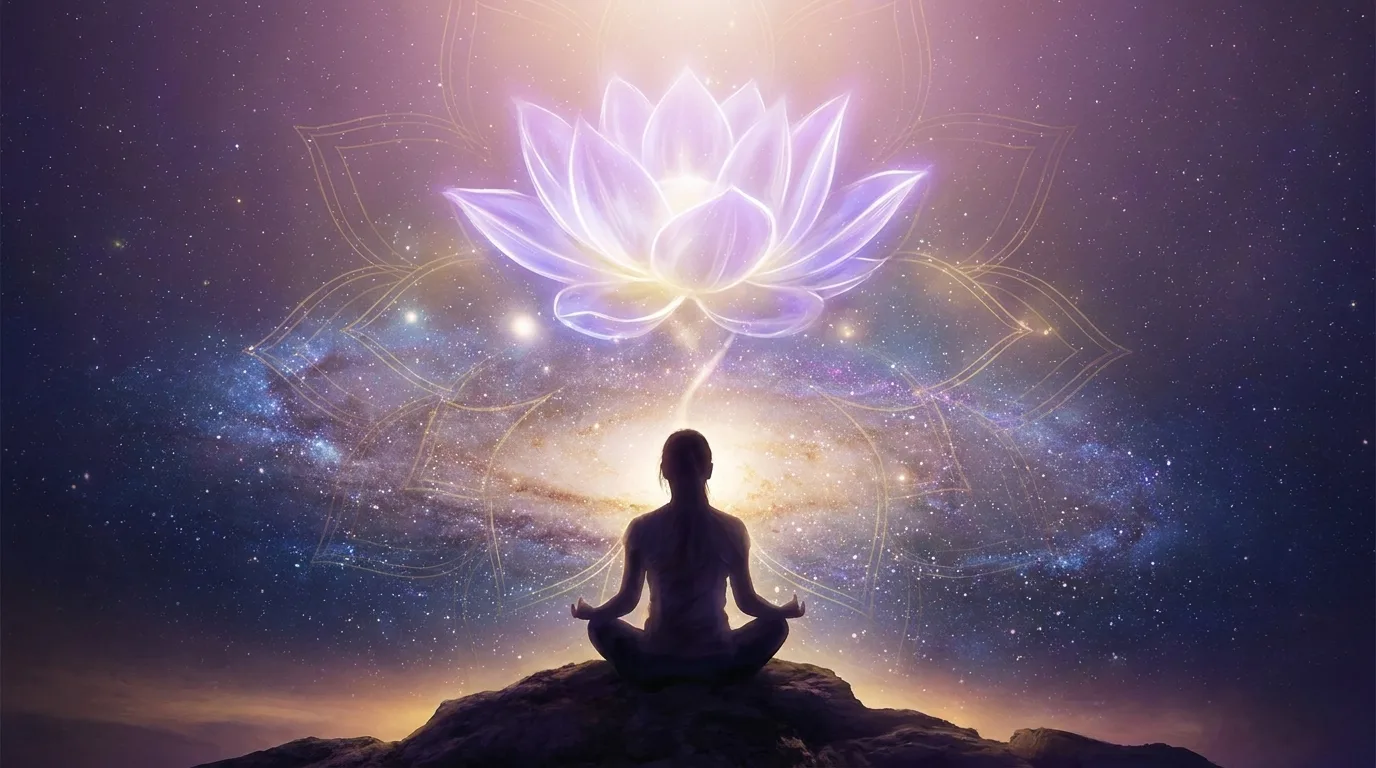
What the Crown Chakra Actually Is (Sahasrara, Defined)
In the classical yogic map of subtle energy, the crown chakra is the seventh and highest of the seven primary chakras. Its Sanskrit name is Sahasrara, which translates roughly to 'thousand-petaled,' a poetic image referring to the thousand-petaled lotus said to bloom at the crown of an awakened being. Located at the top of the head — or, in some lineages, just above it — Sahasrara is traditionally associated with pure consciousness, the transpersonal, and the point where individual awareness meets whatever you understand as greater than yourself. Part of our chakra system library.
Unlike the lower chakras, which are tied to specific physical functions and emotional themes (Muladhara for safety, Svadhisthana for pleasure, Manipura for will, Anahata for love, Vishuddha for expression, Ajna for perception), Sahasrara is less a personality center and more an aperture. It is where you meet meaning, silence, and mystery. Its element is not earth or water but thought itself — some teachers describe it as 'no element at all,' the space in which the other elements arise.
The crown is typically depicted as violet, white, or a shimmering rainbow of colors, sometimes as golden light. Its bija (seed) mantra is Aum (Om), the universal sound. Its associated endocrine gland in most modern Western chakra literature is the pineal gland, though some teachers pair the pineal with the third eye and the pituitary with the crown. Either way, this is the region that regulates circadian rhythm, melatonin production, and, in poetic language, your relationship to time itself.
When Anodea Judith mapped the chakras onto Western developmental psychology in Wheels of Life (1987) and Eastern Body, Western Mind (1996), she framed Sahasrara as the culmination of the developmental arc — the capacity for meaning-making, philosophical inquiry, and connection to something greater than the self. It is worth reading her books directly if this framework interests you; her scholarship is one of the most careful bridges between yogic tradition and Western psychology available in English.
The Seven-Chakra System in Plain English (So You Know Where Sahasrara Sits)
To understand the crown, it helps to see the whole ladder. The seven-chakra system, as it is most commonly taught in the West, goes bottom to top: Muladhara (root, base of spine, earth, red, safety), Svadhisthana (sacral, below the navel, water, orange, pleasure and creativity), Manipura (solar plexus, upper abdomen, fire, yellow, will and power), Anahata (heart, center of chest, air, green, love and connection), Vishuddha (throat, throat, ether, blue, voice and truth), Ajna (third eye, between the brows, light, indigo, intuition and insight), and finally Sahasrara (crown, top of head, thought or consciousness, violet or white, unity).
Each chakra has a corresponding endocrine gland in the popular Western mapping: adrenals for root, gonads for sacral, pancreas for solar plexus, thymus for heart, thyroid for throat, pituitary for third eye, and pineal for crown. This mapping is not medical — it is a framework for self-reflection that borrows the language of anatomy to make an old system tangible. See how Raka compares to other apps in our independent guide.
The important thing to notice is that Sahasrara sits at the end of a developmental line. If your root feels shaky — if you don't feel safe in your body or in your life — the crown often feels out of reach. That's why most experienced teachers, Anodea Judith very much included, will tell you not to start your practice with the crown. Start at the base. Come up slowly.
In my experience working with clients around chakra language, the people who most want to fix the crown are usually the people whose lower chakras are asking for attention first. A restless crown chakra is often a message from a hungry root or an exhausted solar plexus. The crown is the last floor of the building, not the foundation.
The Physical, Symbolic, and Sensory Attributes of Sahasrara
Let's put the crown chakra's classical correspondences in one place, because you'll see them repeated across serious chakra literature — from Judith's Wheels of Life to Harish Johari's Chakras: Energy Centers of Transformation. Location: top of the head, or approximately four finger-widths above it in some tantric texts. Element: pure consciousness, sometimes described as thought or 'no element.' Color: violet, white, or the full-spectrum shimmer of a rainbow. Bija mantra: Aum (Om), often held silently rather than chanted aloud when working with the crown.
Petals: one thousand, arranged in twenty layers of fifty — a mathematical image meant to suggest infinite unfolding rather than a literal anatomy. Associated sense: none, or 'beyond sense.' The lower chakras each govern a specific sensory faculty (smell at the root, taste at the sacral, sight at the solar plexus, touch at the heart, hearing at the throat, intuition at the third eye). Sahasrara is where sensing itself dissolves into knowing.
Endocrine correspondence: pineal gland, a small pinecone-shaped structure at the center of the brain that produces melatonin and regulates circadian rhythm. Modern research on the pineal — for instance, the work summarized in the NIH's overviews of melatonin function — treats it as a real biological rhythm-keeper, not a mystical organ. The symbolic pairing with the crown chakra is metaphorical, honoring the pineal's role in the felt sense of day, night, dreaming, and time. Try Raka app to explore this in more depth.
Archetype: the sage, the mystic, the surrendered elder. Shadow archetype: the disembodied intellectual who lives entirely in ideas and can't fold laundry. Right: the right to know. Demon (in Judith's mapping): attachment. Developmental stage: adulthood and beyond, the years when meaning-making becomes the central psychological task.
Signs Your Crown Chakra May Feel Out of Balance
Chakra language is metaphorical, so 'imbalance' here means 'a cluster of experiences that this framework organizes usefully' — not a diagnosis. With that caveat firmly in place, here are the patterns most chakra teachers associate with a strained or shut-down crown. On the depleted or 'closed' end: chronic cynicism, a flat feeling that nothing means anything, difficulty imagining a future worth wanting, spiritual disconnection or a sense of being 'cut off from source,' rigid materialism that refuses even the possibility of mystery, and a bone-deep exhaustion that sleep doesn't touch.
On the overactive or 'ungrounded' end: spiritual bypassing (using meditation or mantra to avoid ordinary human problems), obsessive study of esoteric material with no lived practice, disassociation, headaches or a persistent sense of pressure at the crown, insomnia that feels 'wired' rather than tired, and grandiose spiritual identity — the sense that you are somehow above ordinary life or ordinary people. Both extremes are versions of the same underlying imbalance: a broken relationship between the personal and the transpersonal.
Physically, teachers often associate crown chakra strain with headaches, migraines, sleep disturbance, sensitivity to light, and neurological symptoms. This is where I want to be very clear: these are also symptoms of many treatable medical conditions. If you have persistent headaches, sleep disruption, or any neurological changes, please see a physician before you reach for a crystal. The chakra framework can be a useful lens on your inner life; it is not a substitute for a medical workup.
A gentler diagnostic question, borrowed loosely from Judith's clinical work: when was the last time you felt genuine awe? Not curated Instagram awe — actual, involuntary, breath-catching awe. If you can't remember, your crown may be asking for attention. Awe is one of the crown's native emotions, and its absence over long stretches is worth noticing.
Signs Your Crown Chakra Feels Balanced
A balanced crown does not look like enlightenment. It looks like ordinary life, held with a kind of quiet spaciousness. The people I've met who seem to have a genuinely open crown share a few traits: they are curious without being credulous, they hold their beliefs firmly but not defensively, they can sit with the unknown without needing to resolve it, and they treat their own inner life as one voice in a larger conversation rather than the only voice in the room.
You'll notice a working crown in small ways. A moment of stillness on a walk when the light hits the leaves and you actually stop. The capacity to read something you disagree with all the way through without your body tensing up. A willingness to say 'I don't know' without shame. A sense of gratitude that isn't performed. A relationship with silence that doesn't feel like loneliness.
You'll also notice it in your relationship to meaning. A balanced crown lets you make meaning without demanding certainty. You can hold a spiritual framework — whether that's a formal religion, a personal cosmology, or a working relationship with mystery — while also acknowledging that other people, thoughtfully, hold other frameworks. Rigidity is a symptom of an underactive crown; grandiosity is a symptom of an overactive one; humility with backbone is the middle path.
In practical terms, a balanced crown tends to correlate with better sleep, an easier time meditating, a felt sense that your life belongs to something larger than your calendar, and the capacity to make decisions from values rather than fear. It's a subtle center. You will rarely feel it directly; you'll feel the absence when it collapses and the ease when it opens.
What to Do Right Now: A Ten-Minute Crown Chakra Practice
If you want a practice you can do today, in the next ten minutes, before you close this tab, here it is. Nothing in it is medical, and none of it will make you enlightened. It is a small, honest reset for a busy nervous system that has forgotten how to be quiet.
Step 1. Find a chair with a straight back or sit cross-legged on the floor with a cushion under your hips. Set a timer for eight minutes. Turn your phone face-down. Step 2. Sit tall. Let the crown of your head lift toward the ceiling, as if a string were pulling it gently upward. Soften your jaw, your throat, your shoulders. Rest your hands, palms open, on your thighs. Step 3. Breathe naturally for one minute. Do not try to change the breath; just notice it. Feel where it moves in your body.
Step 4. On your next inhale, silently sound the syllable Om in your mind, drawing it from your belly up through the length of your spine to the crown. On the exhale, let the sound dissolve into silence at the top of your head. Repeat for five minutes. If you lose track, don't punish yourself — just start again. Step 5. For the last two minutes, stop the mantra. Sit in the silence it leaves behind. Silently ask, 'What am I open to today?' Do not answer. Just listen.
Step 6. When the timer sounds, place both palms lightly on the top of your head for three breaths. Feel the warmth. Say, silently or aloud, 'Thank you.' Then get up and do the next ordinary thing on your list. That last step matters. The crown chakra opens through practice, but it integrates through ordinary life. Meditation without dishes is not a spiritual path.
Meditation Practices for Sahasrara
Beyond the ten-minute reset above, there are several traditional practices associated with the crown. Silent seated meditation is the most direct. In the classical yogic literature, Sahasrara is not reached by doing more; it is reached by doing less. Shamatha (calm abiding) meditation, as taught by teachers like Pema Chödrön in When Things Fall Apart, works well here — you rest attention on the breath and, when the mind wanders, return without judgment. Over months, this quiets the noise that keeps the crown feeling stuck.
Mantra practice is a second door. Aum (Om), the crown's seed syllable, can be chanted aloud, whispered, or repeated silently. Traditionally it is held in the awareness for extended periods rather than treated as a magic word. Some practitioners work with the fuller So Hum mantra ('I am that'), which invites the personal 'I' to soften into the impersonal 'that' — a movement the crown chakra is said to embody.
Yoga nidra, sometimes called 'yogic sleep,' is a third practice worth trying. In a guided yoga nidra, you lie down and follow a teacher's voice through a body scan and a series of visualizations. Research summarized by the U.S. National Center for Complementary and Integrative Health suggests that meditation and mindfulness practices, broadly, are associated with improvements in stress and sleep — modest, real, and worth taking seriously. Yoga nidra is one of the most accessible forms.
For those with a contemplative bent, the Christian practice of centering prayer (developed by Trappist monk Thomas Keating and outlined in his book Open Mind, Open Heart) offers a strikingly similar structure: silent sitting, a chosen sacred word, and a gentle return whenever the mind wanders. The crown chakra is not exclusive to any tradition. It is the aperture that all the mystical traditions, in their different vocabularies, have circled around.
Yoga Poses That Support the Crown
Physically, the crown chakra is worked with inversions and stillness — poses that shift blood flow toward the head and postures that ask you to sit quietly for long periods. Sirsasana (headstand) is the classic. In it, the weight of the body rests through the crown, and the practitioner's ordinary orientation to gravity flips. Headstand should be learned with a qualified teacher; done wrong, it can strain the neck. Never learn it from an internet article, this one very much included.
A safer inversion for most bodies is Viparita Karani, or legs-up-the-wall pose. Lie on your back with your hips near a wall and your legs resting up against it. Rest your arms out to the sides, palms up. Stay for five to fifteen minutes. This gentle inversion calms the nervous system, supports lymphatic drainage, and gives the crown a quiet, sustained shift in circulation. It is often the most useful crown-chakra posture for beginners.
Balasana (child's pose) is another crown-supportive posture. Kneel, sit back on your heels, and fold forward with your forehead resting on the mat or a block. The crown of the head touches the earth — a beautifully literal gesture of surrender. Stay for ten to twenty breaths. Rabbit pose (Sasangasana) is a more advanced option that places direct pressure on the crown; approach it slowly, and skip it if you have neck or eye conditions.
Finally, don't underestimate seated meditation itself as a physical crown practice. Sukhasana (easy pose) or Padmasana (lotus pose), held with an erect spine for twenty minutes, is a demanding posture. The body learns stillness. The crown learns space. In my experience, more consistent crown chakra opening happens on the meditation cushion than in dramatic inversions.
Foods, Fasting, and the Crown
The lower chakras are traditionally supported by robust, earthy foods — root vegetables for Muladhara, warming spices for Manipura, hearty grains for grounding. The crown chakra is different. Because Sahasrara is associated with consciousness rather than substance, many teachers suggest that the crown is supported not by adding foods but by lightening the load. Fasting, particularly gentle intermittent fasting under medical supervision if you have any conditions, is the traditional crown-chakra practice.
When you do eat, teachers often recommend the lightest, most water-rich foods: fresh fruit, salads, herbal teas, clear broths. Some contemporary sources suggest 'purple' foods for the crown — blueberries, blackberries, purple grapes, eggplant, purple cabbage — following the color-symbolism logic. There is no clinical evidence that eating a blueberry opens the crown chakra, but there is good evidence that a diet rich in whole plant foods supports overall brain health, which is a related concern.
Coffee, alcohol, heavily processed foods, and sugar are commonly cited as crown-chakra disruptors. The plausible mechanism is not mystical — it is that these substances disrupt sleep, mood, and cognitive clarity, which in turn make quiet meditation and contemplative practice harder. If you're serious about a crown chakra practice, notice how you feel after a large late meal or three glasses of wine. Practice will tell you what your body wants.
Very important caveat: fasting is not appropriate for everyone. If you have a history of eating disorders, if you are pregnant or nursing, if you have diabetes, or if you take medications that require food, do not fast without talking to your doctor first. Skipping breakfast in service of your chakra practice is not spiritual if it destabilizes you. The crown asks for lightness, not deprivation.
Crystals, Essential Oils, and Sensory Supports
Crystals commonly associated with the crown chakra include amethyst (violet quartz, the most classical crown stone), clear quartz (the amplifier, associated with clarity and unity), selenite (white, associated with lightness and connection to spirit), and Herkimer diamond (a high-clarity quartz variety). The traditional practice is not complicated: hold the stone, place it on your body during meditation, keep it on your altar. There is no scientific evidence that crystals emit measurable healing energy. They are meditation tools — objects that focus your attention.
Essential oils traditionally paired with the crown include frankincense (used in contemplative practice across cultures for millennia), sandalwood (grounding and elevating at once), lotus (rare and expensive, and the classical crown scent), and cedarwood. Diffuse them during practice, or place a single drop of a properly diluted oil on your temples or the top of your head. As with crystals, the mechanism is not magical. Scent is one of the most direct pathways to memory and mood; a consistent smell paired with a consistent practice builds an association that supports focus.
Sound is another sensory support. Chanting Om, listening to Tibetan singing bowls tuned to the crown chakra (traditionally the note B), or sitting with drone music can shift your state in minutes. There is real research on binaural beats and music-based interventions for stress; the evidence is modest but not nothing. Experiment carefully; if something calms your nervous system reliably, it is doing useful work regardless of whether the mechanism is 'energetic.'
Color is the simplest sensory support of all. Spend time with violet or luminous white — a candle, a scarf, a piece of art. Sit in a patch of sunlight. Notice what it feels like to give your visual field to a color associated with quiet and elevation. None of these tools do the work for you. They set a stage. The practice itself is still yours.
Affirmations and Journaling Prompts for the Crown
Affirmations for the crown chakra work best when they are quiet, spacious, and not overly performative. Try one of these, sitting for two minutes with each, and see which one your body actually softens around. 'I am open.' 'I trust what I don't yet understand.' 'I belong to something larger than myself.' 'I am connected to all that is.' 'I release attachment to knowing.' 'My mind is a room with the windows open.' Try best tarot app to explore this in more depth.
Notice what happens when you try one. If you feel resistance, that's information, not failure. An affirmation that lands with a slight resistance is often the most useful one to sit with. If everything feels too easy or too flat, try a more challenging version. The point is not to talk yourself into believing something. The point is to notice, with kindness, what your relationship to that idea actually is.
For journaling, try these prompts, one per week, giving each one twenty minutes of unedited writing: 'What do I believe about meaning?' 'When have I felt genuine awe in the past year?' 'What am I certain of that I might not be?' 'What is my relationship to silence?' 'If there is something greater than me, what shape does it take in my actual life?' 'What am I afraid to not know?'
Writing at this altitude is not comfortable. You may find yourself resisting the prompts, changing the subject, or getting sleepy. That's normal. The crown is a subtle center; it doesn't respond to demands. It responds to sustained, patient, honest attention. Journaling this way is not a magical practice. It is a slow accumulation of self-knowledge that, over months, opens something.
Crown Chakra vs. Third Eye: The Comparison That Matters Most
The chakra people most often confuse with Sahasrara is Ajna, the third eye. They sit near each other, both are associated with cool colors and mental faculties, and both get lumped together as 'the spiritual chakras.' They are not the same. Ajna is about perception — the capacity to see clearly, both literally and intuitively. Its element is light. Its work is insight, discernment, and the pattern-recognition that separates truth from noise. Sahasrara is about unity — the dissolution of the separate self into a felt sense of belonging to something larger.
Practically, third-eye work looks like sharpening your intuition, learning to trust your own perceptions, working with visualization, and studying symbols. Crown work looks like sitting in silence, releasing the need to know, and cultivating the capacity for awe. Ajna asks, 'What do you see?' Sahasrara asks, 'What lies beyond seeing?' Both matter. In most maps, you cultivate Ajna before Sahasrara, because you need clear perception before you can rest in what perception cannot reach.
You can also usefully compare Sahasrara to Anahata, the heart chakra. Anahata is the center of the seven-chakra system — three below, three above, love in the middle. Some teachers argue that the heart, not the crown, is where the transpersonal actually lives in embodied life. Sahasrara without Anahata can become cold, abstract, and detached. Anahata without Sahasrara can become sentimental, boundaryless, and lost in feeling. They stabilize each other.
And compare Sahasrara to Muladhara, the root. This is the most important pairing. The crown and the root are opposite ends of the same axis. A robust crown chakra practice always includes attention to the root — bodily safety, financial stability, community, home. Skipping the root to work on the crown is the single most common mistake in Western chakra work. If your crown feels stuck, look down. Your foundation may be asking for care.
When to See a Professional (and Why Chakra Work Isn't Therapy)
Chakra work is a self-reflection framework. It is not therapy, not medicine, not a substitute for either. If you are struggling with persistent depression, anxiety, disordered eating, addiction, trauma responses, suicidal thoughts, or any pattern that is interfering with your ability to work, sleep, or connect with people you love, please talk to a licensed mental health professional. A good therapist will not laugh at your chakra practice; many therapists incorporate contemplative frameworks into evidence-based care. But therapy does something that self-guided reflection can't, and it belongs in the picture.
If you have unexplained headaches, sleep disturbance, dizziness, neurological changes, vision changes, or any physical symptoms that concern you, please see a physician. The 'crown chakra symptoms' lists that circulate online often overlap almost exactly with the symptoms of migraines, sleep disorders, thyroid conditions, and neurological issues. Rule out the treatable medical thing before you reach for the spiritual explanation. That's not a failure of faith. That's respect for your body.
For deep spiritual crises — what William James called 'the sick soul' and what contemporary teachers sometimes call 'spiritual emergence' or 'dark night of the soul' — consider working with a spiritual director, a chaplain, or a therapist trained in transpersonal or contemplative psychology. Organizations like the Association for Transpersonal Psychology and the Spiritual Directors International directory can help you find qualified practitioners. Real spiritual growth often includes difficult passages, and having a trained witness matters.
In my experience with clients, the people who make the most durable progress with chakra work are the ones who also have other supports in place — a therapist, a doctor, a spiritual community, close friends. Chakra practice is one thread in a larger fabric. It's a beautiful thread. It is not the whole cloth.
How to Integrate Crown Chakra Practice Into a Real Life
Most articles about the crown chakra promise transformation. This one promises something quieter: a workable, honest practice that fits into a real life with a job, dishes, obligations, and grief. Start small. Ten minutes a day, five days a week, of one practice — meditation, journaling, or a single yoga pose — will do more for your crown than a weekend of intensive workshops.
Build in the boring parts. Sleep at consistent times. Get sunlight in your eyes within an hour of waking (a practice supported by circadian research from labs like Andrew Huberman's at Stanford, though you should read the primary literature rather than the podcasts). Move your body in a way you enjoy. Eat food that leaves you clear-headed. These are not glamorous crown-chakra practices, but they support the pineal gland, the nervous system, and the meditative capacity that Sahasrara work depends on.
Keep a light hand. The crown chakra is not a project to complete. It is a subtle center that opens over years, quietly, in response to consistent attention. If you try to force it, you will hit the same wall every meditator eventually hits: the harder you grip, the further away it goes. When you notice yourself striving, the practice is to soften. Every time. Without exception.
Finally, remember why this framework exists at all. The chakra system is not a checklist for spiritual achievement. It is an ancient map that helps you notice what you are experiencing and gives you a vocabulary for tending to it. Use it that way. Read Anodea Judith's Wheels of Life. Read Harish Johari for the traditional roots. Sit with your teachers in whatever tradition draws you. And then, mostly, live your life — with the crown of your head lifted gently toward the sky, the soles of your feet firmly on the ground, and your heart in the middle, keeping time.