Quick Answer: What 224 Means
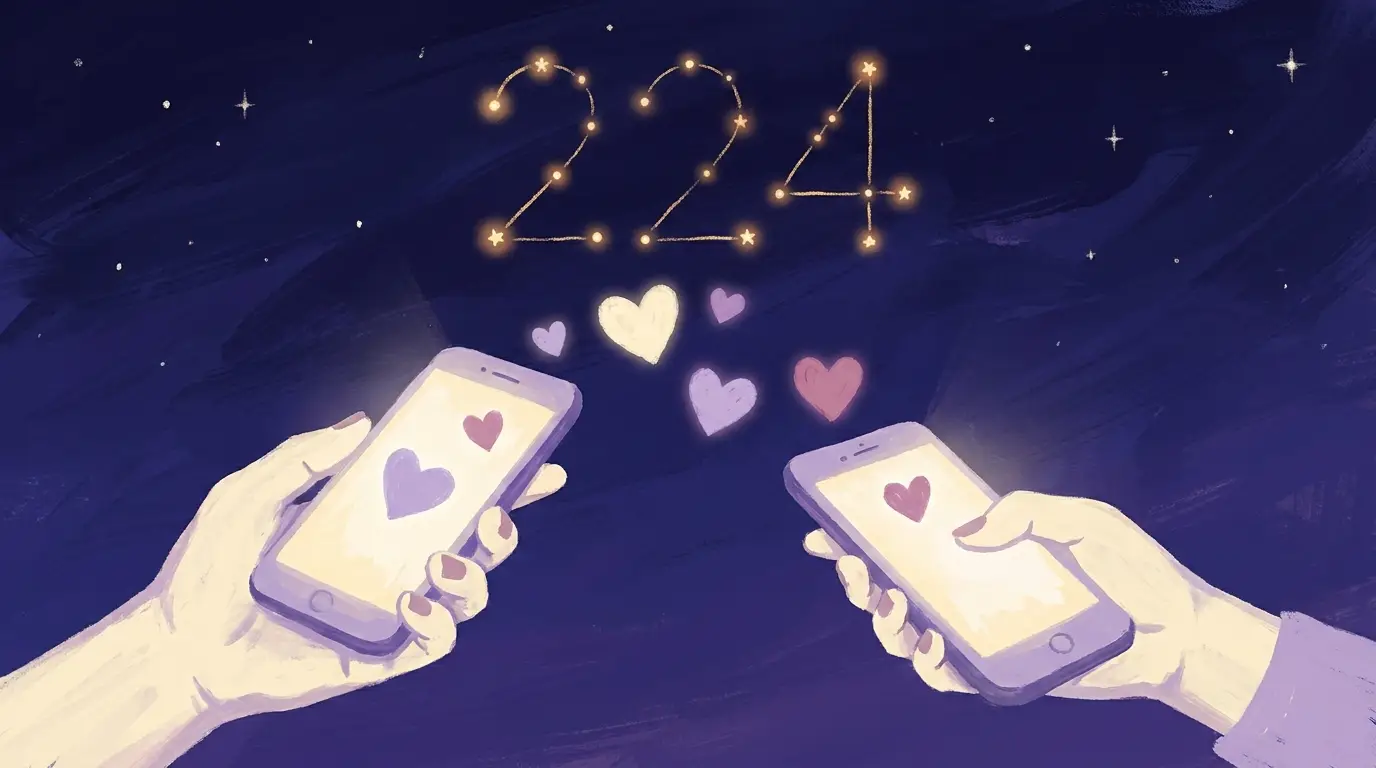
224 is shorthand for the phrase today, tomorrow, forever. Each digit stands for a slice of time in a promise: the first 2 is today, the second 2 is tomorrow, and the 4 is forever. Sent between partners, it means the sender is committing to the relationship across the immediate present, the near future, and the long horizon at once. It functions the same way as three-word phrases like always and forever, but it collapses that idea into a handful of taps on a keypad. (part of our spiritual_signs) Part of our numerology guide library.
The code is used most often in romantic contexts, but it also shows up between very close friends, between parents and adult children, and in memorial contexts where someone wants to say a bond does not end. The register is warm and unambiguous. Nobody sends 224 casually. Because the payload of the message is heavy, most people who use it do so at moments they want to mark, not as filler between grocery updates and meme forwards. Part of our numerology guide library. Part of our numerology guide library. Part of our numerology guide library.
224 is not sarcasm, not a code word for anything explicit, and not a phone number reference. A small subset of readers first encounter it and assume it must be a hidden meaning code because it looks compact, but there is no double layer. The literal expansion — today, tomorrow, forever — is the whole message. Once you know the key, every future 224 you see in a caption, a locket engraving, or a text thread reads cleanly. See how Raka compares to other apps in our independent guide. Part of our numerology guide library.
If you saw 224 in a specific place and want to skip straight to context, the section on texting etiquette covers how to interpret one that landed in your inbox and how to respond without overthinking it. The rest of this guide walks through history, the wider family of numeric love codes, an honest angel-number section, and a reflection practice you can build around any short symbol you care about.
How the Code Breaks Down: 2, 2, 4
The mechanics of 224 are straightforward once you see the mapping. Two, two, four maps onto today, tomorrow, forever in the same one-to-one way that 143 maps onto the letter counts of I (1), love (4), you (3). English-speaking senders in the pager era liked codes that either counted letters, counted words, or gestured at a familiar phrase with a small mnemonic hook. 224 belongs to the mnemonic branch. The digits do not count letters. They are labels for three time buckets that together cover an entire lifetime with the receiver.
The word forever gets the 4 for a specific reason that people sometimes miss. Four is the smallest number that reads as stable in most numeric-symbol systems, from the four seasons to the four cardinal directions to the four legs of a chair. In the pager era, senders looking for a digit that felt permanent tended to reach for 4 before 7 or 9, which carry more mystical or ambiguous connotations. Four is the plain-boots choice, and that plainness is why it works for the forever slot. Try sign compatibility to explore this in more depth.
Today and tomorrow share the 2 because they are neighbors on the timeline. Repeating the 2 emphasizes continuity — the sender is not just saying I will love you tomorrow but I will love you tomorrow the same way I love you today. The doubled digit does the emotional work that a comma does in the spoken phrase. Say today, tomorrow, forever out loud and the two front words feel like a pair before the final beat lands. The code preserves that rhythm.
There is a version of the same idea written as 224 4 you, which pushes the meaning further into an explicit direction. That extension is less common but occasionally appears in older text archives and on jewelry from the 2000s. If you inherit or find engraved objects with 224 4U on them, the reading is today, tomorrow, forever for you, which is a slightly warmer variant of the base code. Modern usage almost always drops the 4U and lets 224 stand alone.
Pager and SMS History: Where 224 Came From
Numeric love codes were born on pagers. Before smartphones, before even reliable SMS, tens of millions of people in North America and the UK carried alphanumeric pagers whose screens could display digits and, on more expensive models, short text. Because most senders were calling into a paging service from a landline and punching in a callback number, an entire culture developed around numeric messages that meant more than a phone number. 143, 831, 224, 07734 flipped to spell hello, and a long list of other codes filled the gap that text messaging would later close.
224 specifically appears in archived pager-code lists from the mid 1990s. It was never as universal as 143, which had spread from lighthouse and maritime signal traditions decades earlier, but it circulated widely in high school and college communities in the United States and Canada from roughly 1995 through the early 2000s. When early SMS on non-QWERTY feature phones made typing a full sentence painful — because each letter took multiple keypad presses — those same numeric codes migrated straight into text messages and stayed there.
The rise of full QWERTY smartphones in the late 2000s did not kill numeric codes. It changed their purpose. Once anyone could type today, tomorrow, forever in under two seconds, the code became optional rather than efficient. What kept it alive was nostalgia, aesthetic compactness, and the intimacy of shared shorthand. Couples who had used 224 in college kept using it a decade later because it was theirs. Younger users adopted it as retro-cool, the same way they adopted flip phone photography and early-web fonts.
Today the code appears most often in three places. It shows up in text threads between partners who established it as their private code years ago. It appears in captions on shared photos on Instagram and TikTok, where it works as a soft signal to a specific person without being a public declaration. And it appears on physical objects — jewelry, tattoos, framed prints — where its brevity makes it easier to engrave than a full phrase. The history is not glamorous, but it is durable, and the code has outlived the technology that produced it.
How to Actually Use 224 in a Text Today?????
The simplest way to use 224 is to send it at the end of an already warm exchange with someone you love. It works as a sign-off, not an opener. If your partner sends a photo of the sunset from a work trip, you can reply with a heart, a short line, and 224 as a period. If you are wrapping up a difficult conversation with reconciliation, 224 works as a promise stamped on the end of the thread. Sending it out of the blue to someone who does not know the code produces confusion, not romance, so consider whether the receiver has the key.

A common pattern in long-distance relationships is to send 224 as the last message before sleep on nights when you are in different time zones. The code compresses the three lines of thought — I loved you today, I will love you tomorrow when we wake up in different places, and none of this changes the long picture — into three digits that fit on a lock screen preview. Partners who do this consistently often report that the ritual matters more than the words. The receiver knows the message is coming and knows what it means, and that predictability is its own form of care.
There is also a version of 224 that is used to repair. If an argument has ended but neither person wants to reopen it, 224 sent hours later reads as a reset. It is not an apology and does not replace one, but it signals that the sender still holds the long view of the relationship even when today was hard. Some couples use a slight variation — sending 224 with a small heart or a specific emoji — as a private tag that the reset is genuine rather than pro forma. The variation matters because it separates the reset use from the default warm-note use.
Avoid using 224 as a first-date message, an early-relationship declaration, or a friendship gift when the friend has not established the code with you. The gap between the intended weight and the receiver's reading is where numeric codes stop landing. Send it into a container that already holds today, tomorrow, and forever, and it will read exactly as you mean. Send it into a container that only holds today, and it will read as pressure or as premature emotional escalation. The code is not shy, and that lack of shyness is what makes context matter.
The Family: 143, 831, 520, and Friends
224 has cousins. The most famous is 143, which counts the letters of I love you — one letter, four letters, three letters. 143 traces back to lighthouse keeper folklore about a light flashing in the pattern one, four, three as a signal from Minot's Ledge Light off the Massachusetts coast, though the origin is more legend than confirmed fact. What is confirmed is that 143 was already a common pager code by the early 1990s and has stayed in circulation ever since. It reads as slightly more classic and slightly less committed than 224.
831 packs the same phrase differently — 8 letters, 3 words, 1 meaning. The 831 encoding is a favorite for people who like a small metadata joke inside the code, because it comments on the phrase rather than counting it. It emerged later than 143, most likely in the mid 1990s, and it has the flavor of a coder's love note. It is also popular on jewelry because the digits form a visual sequence that engraves cleanly. Between 143 and 831 you can already see the two main design traditions of numeric love codes: literal counting and structural counting.
520 is a Mandarin-language code that has crossed into English-speaking cultures through K-pop, C-drama, and gaming communities. The digits five, two, zero are pronounced in a way that sounds close to the phrase I love you in Mandarin, which is why May 20 (5/20) has become an informal love-confession day in parts of East Asia and increasingly in diaspora communities in Canada, Australia, and the United States. English-language users often send 520 alongside 143 or 224 to signal that they are drawing on multiple traditions at once. There is no single canonical romance-code alphabet, and mixing is normal.
Other members of the family include 459, which in older keypad ciphers stands for I love you because 4-5-9 correspond to the keypad letters of I, L, and Y; 637, sometimes decoded as always and forever through a similar letter-count logic; and 381, which some users read as I love you emphasized. Not all of these are widely known, and some appear on lists that recycled from earlier lists without users ever adopting them. 224 sits comfortably in the middle of the pack — well known enough to be understood by anyone who grew up with pager or early SMS culture, and specific enough that using it feels like a real choice.
Is 224 an Angel Number? Honest Answer
224 is not a canonical angel number in the way 111, 222, 333, and their siblings are. The angel-number framework that circulates in modern spiritual communities descends primarily from the writing of Doreen Virtue in the late 1990s and early 2000s, and while that framework assigns meanings to three-digit and four-digit sequences, 224 does not appear on the short list most practitioners cite. If you are searching for 224 because you keep seeing it and want to know if the universe is trying to tell you something, the honest answer is that the tradition is thinner than the search results suggest.
That said, some readers who work with an expanded angel-number system read 224 by combining the meanings of its parts. In that system, 2 tends to be read as balance, partnership, and diplomacy; 4 tends to be read as foundation, structure, and stability. Combining a double 2 with a 4 produces a reading like partnership built on stable ground or the balance between two people that is meant to last. That reading is coincidentally almost identical to the today, tomorrow, forever slang meaning, which is either a poetic accident or a sign that both traditions gravitate toward the same emotional territory.
Where to be careful is in claims that seeing 224 on a clock or license plate is a specific message from a specific spiritual source. There is no evidence for that kind of directed communication, and treating a repeating number as a personal signal can drift into confirmation-bias territory where the reader notices only the hits and ignores the countless times a random three-digit sequence appeared and meant nothing. A grounded practice notices the number, asks what the person is thinking about at the moment they see it, and treats the noticing as data about the observer rather than about the universe.
If you use angel numbers as journaling prompts rather than as predictions, 224 is a reasonable prompt to sit with. The question it invites is whether the partnerships in your life have the structure to hold the long view — whether the person you are choosing today is someone you can still choose tomorrow and forever. That question is worth asking regardless of whether you believe the number came from anywhere in particular. Raka's approach to angel numbers is to treat them as attention hooks, not signals, and to build the reflection around the observer's own life.
A Numerology Lens on the Digits
Numerology approaches numbers differently from slang or angel systems. In Pythagorean numerology, the two most common analytical moves are reducing multi-digit numbers to a single root and reading the character of each digit in the sequence. For 224, the reduction path is 2 + 2 + 4 = 8. Eight in Pythagorean numerology carries themes of material stability, cyclical return, authority, and consequence. It is the number of things built to hold weight over time. When a numerologist reads a sequence that reduces to 8 in a romantic context, the read is often about durability and shared responsibility rather than about romance in the honeymoon sense.
The character of each digit adds a second layer. Two is the number of pairs — the meeting of self and other, the tension and resolution of two energies that need each other. Doubled two intensifies that theme. Four is grounded and practical, the number of structure, ritual, and daily rhythm. Read together, 2-2-4 outlines a partnership that repeats a bond every day and turns that repetition into a foundation. That reading rhymes strongly with the slang meaning, which is why numerologists who see 224 in a client's chart or on a wedding date often nod at the coincidence.
This lens does not require belief in anything mystical. Numerology is a system of associations that emerged over centuries and now functions the way tarot functions — as a structured vocabulary for talking about human experience. Reducing 224 to 8 does not tell you whether your relationship will last. It gives you a prompt about durability that you can accept, reject, or examine. The value is in the examination, not in the answer. A partner who reflects on whether their bond has the structure to survive weight is doing useful work regardless of whether they credit a numeric framework for the prompt.
Inside the Raka app, the numerology module reads dates, names, and short sequences like 224 through both the reduction lens and the character lens. The 90-lesson course walks through the same logic in slow steps so that by lesson 30 or 40 a user can pick up a sequence like 224, decode it, and articulate the associations without needing the app. That transfer is the goal. Codes and traditions are worth learning when they hand you a set of prompts you can carry into any conversation with a partner, a friend, or yourself.
Texting Etiquette: When to Send, When to Skip
The core rule for sending 224 is match the weight of the code to the weight of the container. Sending 224 into an established relationship is warm; sending it into a new one is heavy. Two months of dating is generally too early. Six months in, if the relationship has hit its first real conflict and survived, the code starts to fit. The exact timeline varies, and there is no universal calendar, but the felt sense is that 224 should confirm a promise the two of you have already made in some form, not introduce one.

Reading a received 224 is easier than sending one. If someone you love sent it, they are telling you they are here today, they plan to be here tomorrow, and they intend the long view. A good response is warm and equally short. Sending 224 back is common and correct. Sending a heart, a specific word from your own shorthand, or a longer note that names something concrete about the relationship also works. The one response that misfires is over-analysis, sending a paragraph that asks whether they meant it the way you think they meant it. If the container is right for the code, trust that.
There are situations where 224 does not land. In the aftermath of a betrayal, when trust is being rebuilt, sending 224 can feel like skipping steps. The code assumes a today, tomorrow, and forever that both parties still believe in, and rebuilding is precisely the phase where those tenses are under construction. Better to send a more specific line during rebuilds — a concrete plan for tomorrow, a small acknowledgement of today's work — and reserve 224 for later, once the ground can hold it again. This is not a rule from a magazine. It is what actually happens when the code lands wrong.
Finally, avoid using 224 as a public declaration when the private version has not been established. Posting 224 in a caption before you have said today, tomorrow, forever to the person in some form reverses the order. Codes work as compression of things that already exist. They do not work as substitutes for the original conversation. A partner who first learns about your feelings through a public numeric caption has been handed a puzzle rather than a message. Say the words to them first. Post the code after.
224 on Jewelry, Tattoos, and Anniversary Gifts
Jewelry has been the second home of numeric love codes since long before the digital era, and 224 fits the medium well. Three digits engrave cleanly on the inside of a ring band, on a pendant, or on a bracelet clasp, and they carry more meaning than a single initial without demanding as much space as a full phrase. Couples marking a first anniversary, a re-commitment, or a milestone often choose 224 because it reads as personal without being showy. From the outside, the piece looks like any other engraved jewelry. To the wearer, the digits carry the whole promise.
Tattoos are more delicate. A 224 tattoo is compact, easy to place on the wrist, ribcage, or ankle, and reads well in small type. The one caution around tattoos is that they should mark meaning that has already stabilized, not meaning that is still forming. A tattoo commemorating a five-year marriage or a decade of friendship is different from a tattoo commemorating the excitement of a new relationship, and the code is the same in both cases. If you are considering a 224 tattoo, the question worth sitting with is whether the number will still tell the truth about your life a decade from now. If yes, the tattoo lands. If maybe, wait.
Anniversary gifts are a natural container for 224. First anniversaries often use paper as the traditional material, which fits printed art with the digits worked into the design. Fifth anniversaries use wood, which fits laser-etched wooden boxes or picture frames. The code is agnostic about the material and works across every year of the traditional gift list. Small businesses on Etsy and elsewhere sell 224-themed prints, keychains, and personalized items, which have kept the code in modest but steady circulation for the last decade. The market is small, but it is stable, which is a good sign that the code has staying power.
The interesting failure mode for 224 gifts is over-explaining. If you give someone a piece of jewelry engraved with 224 and immediately hand them a printed card explaining that it means today, tomorrow, forever, you have used the wrong container for the explanation. The point of the code is that the two of you know what it means. If they will not know, tell them the phrase in your own words as part of giving the gift, then let the code itself do the memory-holding work later. Codes are containers for shared knowledge, and shared knowledge cannot be established by a card that arrives with the object.
Does Sending Codes Actually Deepen a Relationship?
The honest answer is that codes are small and do small work. There is no research showing that sending 224 nightly makes a relationship last longer than a comparable relationship without the code. What the practice does provide, when it works, is a low-cost ritual that both partners recognize. Rituals in relationships tend to help modestly. They give structure to affection that might otherwise get squeezed out by logistics, and they signal reliability in a form that is easy to notice and easy to miss when it stops. Small daily signals matter more than most people expect, and 224 is a well-designed small daily signal.
At the same time, codes cannot carry weight they are not designed for. Sending 224 to a partner who feels unheard on a bigger issue does not fix the bigger issue. Ritual affection is not a substitute for the harder conversations, and a code that starts to feel like a stand-in for engagement rather than an expression of it will start to grate. If the receiver responds to 224 with a cool acknowledgement or a change of subject, the code has probably drifted out of alignment with the state of the relationship, and it is worth stepping back to check the container.
The skeptical case against numeric love codes generally is that they are performative rather than substantive. That criticism is fair when the codes are used as public displays of a relationship that is quietly struggling. It is unfair when the codes are used privately, between partners who also have the harder conversations, as one strand in a much broader fabric of care. The frame that keeps codes healthy is that they are a garnish. They add texture to a meal that stands on its own without them. When the meal does not stand on its own, no garnish rescues it.
People who work with symbols and traditions for a living tend to arrive at the same conclusion. Symbols are tools. They work when they are used to draw attention to something real, and they misfire when they are used to invent something that is not there. 224 is a good tool. It draws attention to a specific promise about time. Whether that promise is real is a question the two people involved answer with their behavior over months and years, not with the code itself. If the behavior is there, the code makes it easier to notice. If the behavior is not, the code cannot fake it.
Common Misreads and What 224 Does Not Mean
The most common misread is treating 224 as a coded reference to a phone number, area code, or address. 224 is a valid North American telephone area code (Illinois), and some readers who see 224 on caller ID or on a business card assume the digits carry the same meaning as the slang. They do not. The area code assignment is a bureaucratic decision made by the North American Numbering Plan Administration and has no relationship to the today, tomorrow, forever phrase. If someone calls you from a 224 number, they are calling from northeastern Illinois, not sending a love note.
A second misread is assuming 224 is an angel number with a fixed spiritual meaning. As covered earlier, 224 has been folded into some expanded angel-number lists, but the tradition is thinner than the confident tone of many articles suggests. Treating a slang code and a spiritual signal as interchangeable dilutes both. A partner who sends you 224 is almost certainly sending the slang meaning. If you have been noticing 224 on receipts and clocks and want to explore the noticing, the useful practice is journaling about what was on your mind at the moment, not searching for a definitive external meaning.
A third misread is expecting the code to work universally. Not everyone knows what 224 means, and the older you get, the less reliable the shared context becomes. Users in their forties and fifties who came up through pager culture often recognize it immediately. Users in their twenties may or may not, depending on where they encountered the code. If you send 224 to someone who does not have the reference, they will either ask, guess, or ignore, and the message you thought you sent will not have arrived. The etiquette section covered this, but it bears repeating in the misread frame.
The final misread is decoding 224 as a covert message with layered meaning. In some pockets of the internet, users have suggested that 224 secretly means something explicit, something threatening, or something occult. There is no evidence for any of those readings. The code is genuinely as simple as its expansion. Today, tomorrow, forever. If you receive a 224 in a context that feels off — from a stranger, in a professional setting, or with no accompanying warmth — the correct move is to ask the sender what they meant. The code cannot survive a context where warmth is missing, and the appropriate response is a plain question rather than a decoding project.
How Raka Uses 224 as a Reflection Prompt
Raka is an AI-native tarot, astrology, and numerology app, and one of its practical uses is turning small symbols like 224 into structured reflection. Rather than treating the code as a message from outside, Raka's AI reading coach treats it as a prompt from inside — a hook the user has noticed, which points at a topic worth examining. The user opens the app, taps the reflection module, enters 224, and the coach walks through a short sequence of questions grounded in numerology, tarot association, and the user's natal chart data.

The typical flow looks like this. First, the coach mirrors back the slang meaning so the user has the cultural context. Second, it offers the numerology reduction — 2 + 2 + 4 equals 8 — and the character read of each digit, so the user has a vocabulary for what durability and partnership might mean in their specific situation. Third, it references the user's natal chart if they have entered it, checking for aspects that connect to themes of stability and long-form commitment. The output is not a prediction. It is a set of prompts. The user closes the app with three or four questions to sit with, not a verdict about their relationship.
The 90-lesson numerology course inside Raka builds the reader's capacity to do this kind of decoding without the app. Early lessons cover the digits and their traditional associations. Middle lessons cover reduction, sequencing, and the character of doubled and tripled digits. Later lessons connect numerology to tarot and to the astrological placements a user is most likely to encounter in their own chart. By the end of the course, a user who encounters 224 in a text or a caption can read it with the same three-layer approach the app uses, then close the app and think for themselves.
This is deliberate design. Symbols and codes work best when they hand the user a way of thinking rather than a fixed answer. The Raka team treats every symbol on the blog — including 224, and including every angel number and slang code covered in the wider guides — as a doorway into a reflection practice, not as a portable prediction. If the practice deepens the user's attention to their own life, the symbol has done its job. The code was always a container. What matters is what the container holds.
Numeric Love Codes Across English-Speaking Cultures
Numeric love codes are not evenly distributed across English-speaking cultures. In the United States, 143 and 224 have the deepest roots, with 831 close behind and 459 recognized by a smaller subset of users. Regional pager culture, high school and college texting habits, and specific R&B and hip-hop lyrics that referenced 143 across the 1990s and 2000s kept the codes alive in the American vernacular. The result is that a US-based reader between roughly twenty-five and fifty is likely to recognize at least one of these codes even if they have never used it themselves.
In the United Kingdom, numeric love codes have a slightly shallower presence. Pager culture in the UK was less pervasive than in North America, and SMS culture developed with a different set of shortenings — abbreviations like l8r, gr8, and cba took the linguistic space that numeric codes filled elsewhere. British readers are more likely to encounter 143 and 224 through American media than through native usage, but the codes are understood in most digitally literate British households. The soft romantic register of 224 in particular translates without friction across the Atlantic.
Canada tracks close to US usage patterns, with the added element that Canadian users are often exposed to Mandarin-language codes like 520 through immigrant and diaspora communities in Toronto, Vancouver, and Montreal. This exposure has produced a Canadian usage pattern where a single text might mix 224 and 520 as a small multilingual romantic gesture. Australian usage sits somewhere between UK and US patterns, with a stronger presence of internet-native abbreviations and a smaller regional numeric-code tradition. Younger Australian users encounter 224 mostly through TikTok and Instagram captions rather than through pager-era transmission.
What all four cultures share is that the codes function as private-in-public language. They allow a caption, a jewelry engraving, or a text preview to say a warm thing without saying it in a form that requires context from strangers. That property is culturally translatable. A caption that reads 224 alongside a photograph tells the intended reader the whole message and tells everyone else nothing. That property is why the codes have survived the death of the pager and the rise of full-keyboard smartphones. Compression and privacy are still useful, and codes still do that job better than plain sentences can.
Frequently Asked Questions
This section addresses the questions that come up most often when readers first encounter 224. The full FAQ list appears in a separate block below and covers the definitional, cultural, and practical angles most searchers care about. If your question is not covered there, the etiquette and misreads sections above address most of the edge cases, and the Raka app's reflection module can walk through personal-situation questions in a longer format.
A recurring meta-question is whether decoding a slang code takes the romance out of it. The answer, in the same way it applies to jokes and to poetry, is that explanation and experience live on different tracks. Knowing that 224 means today, tomorrow, forever does not stop a well-timed 224 from landing. It sharpens the landing. Codes work best between people who both know the key, and the moment of knowing is not a spoiler — it is the price of admission.
Another recurring question is whether it is worth learning several codes or just one. There is no wrong answer, but the practical case for learning a small handful — 143, 224, 831, and 520 — is that they cover almost every context in which a numeric love code is likely to appear in an English-speaking user's life. Four codes is enough to read almost every caption, engraving, and thread you will encounter, and it is small enough to hold in memory without effort. Beyond that handful, the codes become obscure enough that the sender is either quoting a specific subculture or improvising, and asking is a reasonable response.
The final question worth flagging here is whether readers should worry about the code aging out. Numeric love codes have survived several generations of communication technology, and there is no sign that 224 in particular is fading. If anything, the retro appeal of pager-era compression seems to be growing, and younger users are adopting the codes as aesthetic choices rather than practical shortcuts. The code is safe to use. It is likely to still mean today, tomorrow, forever ten years from now, which is a small piece of continuity that fits neatly with the meaning itself.