What the Ninth House Actually Rules (and Why It Feels So Big)
The first time I understood the ninth house, I was 23, backpacking in Lisbon with a borrowed copy of Howard Sasportas's The Twelve Houses stuffed into my daypack. I had just quit a corporate job in Mumbai, enrolled in a Jungian psychology course I could barely afford, and was writing letters home trying to explain why Portugal felt more like a classroom than a vacation. A Portuguese astrologer I met at a Bairro Alto cafe pulled my chart on a paper napkin, pointed to my stellium in the ninth, and said, "You didn't come here for the beaches. You came here to find the question you've been avoiding." I never forgot that sentence. Nearly two decades later, as the senior astrology editor at Raka, that's still how I describe the ninth house to clients: it is the chamber in your chart where you go looking for the question big enough to reorganize your life around. Part of our astrology guide hub.
In Western tropical astrology, the ninth house is traditionally associated with higher learning, long-distance travel, foreign cultures, publishing, law, religion, philosophy, and the search for meaning. Where the third house concerns the local commute, your siblings, and short daily communications, the ninth is its polar opposite: the overseas flight, the graduate thesis, the spiritual pilgrimage, the book that changes how you think. It is ruled naturally by Sagittarius and co-ruled by Jupiter, which is why the themes expand outward rather than inward. Pisces and Neptune are sometimes brought in as modern co-rulers when the ninth leans mystical, but Jupiter remains the primary archetype.
If someone asks me for a one-sentence working definition, I give them this: the ninth house is where you turn raw experience into worldview. Everything you learned in the third house (your native language, local customs, early schooling) is extended, stress-tested, and sometimes shattered by what the ninth house drags you toward: a professor who contradicts your parents, a country whose values rearrange yours, a sacred text that answers a question you didn't know you were carrying. This is why ninth-house transits so often coincide with conversions, dropouts, divorces of belief, or a sudden decision to apply to law school at 42.
I want to be clear about what this article is and isn't. This is a self-reflection and education piece, not a fortune-telling guide. I'm not going to tell you that Jupiter crossing your ninth house means you'll meet your soulmate on a plane. I'm going to tell you what competent astrologers like Liz Greene, Steven Forrest, Chani Nicholas, and Richard Tarnas have observed about this zone of the chart over decades, and how you can use that lens to ask yourself better questions. If what you need instead is clinical support or spiritual direction, a licensed therapist, a trained spiritual director, or an experienced astrologer with ethical boundaries will serve you far better than any blog post, this one included. See our best AI astrology app guide.
How to Find Your Ninth House in Under Five Minutes
Before we go anywhere near interpretations, you need to know where your ninth house actually sits. Many people confuse their ninth-house sign with their Sagittarius placements, which are related but not identical. If you were born with Pisces rising, for example, your ninth house is ruled by the sign Scorpio, not Sagittarius, and that completely changes the texture of your philosophical life.
Here is the simplest method, step by step, using any free Western tropical chart calculator (astro.com, Chani, or Co-Star all work).
1. Enter your birth date, exact birth time (ask your mother or request a birth certificate; even 15 minutes of error can shift house cusps), and birth city. If you do not know your birth time within an hour, the ninth house placements in this article will be unreliable for you. 2. Generate a natal chart using the Placidus or Whole Sign house system. Placidus is the default on most Western sites. Whole Sign, revived by Hellenistic scholars like Chris Brennan, is increasingly popular and often cleaner for beginners.
3. Locate the slice of the wheel labelled "9" or "IX." In Placidus it is the third house from the top (counterclockwise from your Midheaven). In Whole Sign it is the ninth sign counting from your Ascendant. 4. Note three things: the sign on the ninth-house cusp, any planets inside the ninth house, and where the ruler of your ninth-house sign is placed elsewhere in the chart. That last point matters more than most beginners realise.
5. If your ninth house is empty of planets, you are not missing out on anything. Roughly half of all natal charts have no planet in the ninth, since there are twelve houses and typically only ten bodies to distribute. I'll address empty-house interpretation in its own section below, so skip ahead if that's you.
Once you have those three data points written down, the rest of this article will give you a framework to interpret them.
The Ninth House Through All Twelve Signs
Your ninth-house sign colours how you approach meaning, foreign experience, and higher learning. It is the lens, not the content. Two people can both pursue a PhD in philosophy; the one with Capricorn on the ninth-house cusp will build a career ladder from it, while the one with Pisces on the cusp will quit halfway to join an ashram. Below is a working field guide, drawn from patterns I have logged across more than a thousand client charts at Raka and tested against the archetypal descriptions in Steven Forrest's The Inner Sky and Liz Greene's lectures at the Centre for Psychological Astrology.
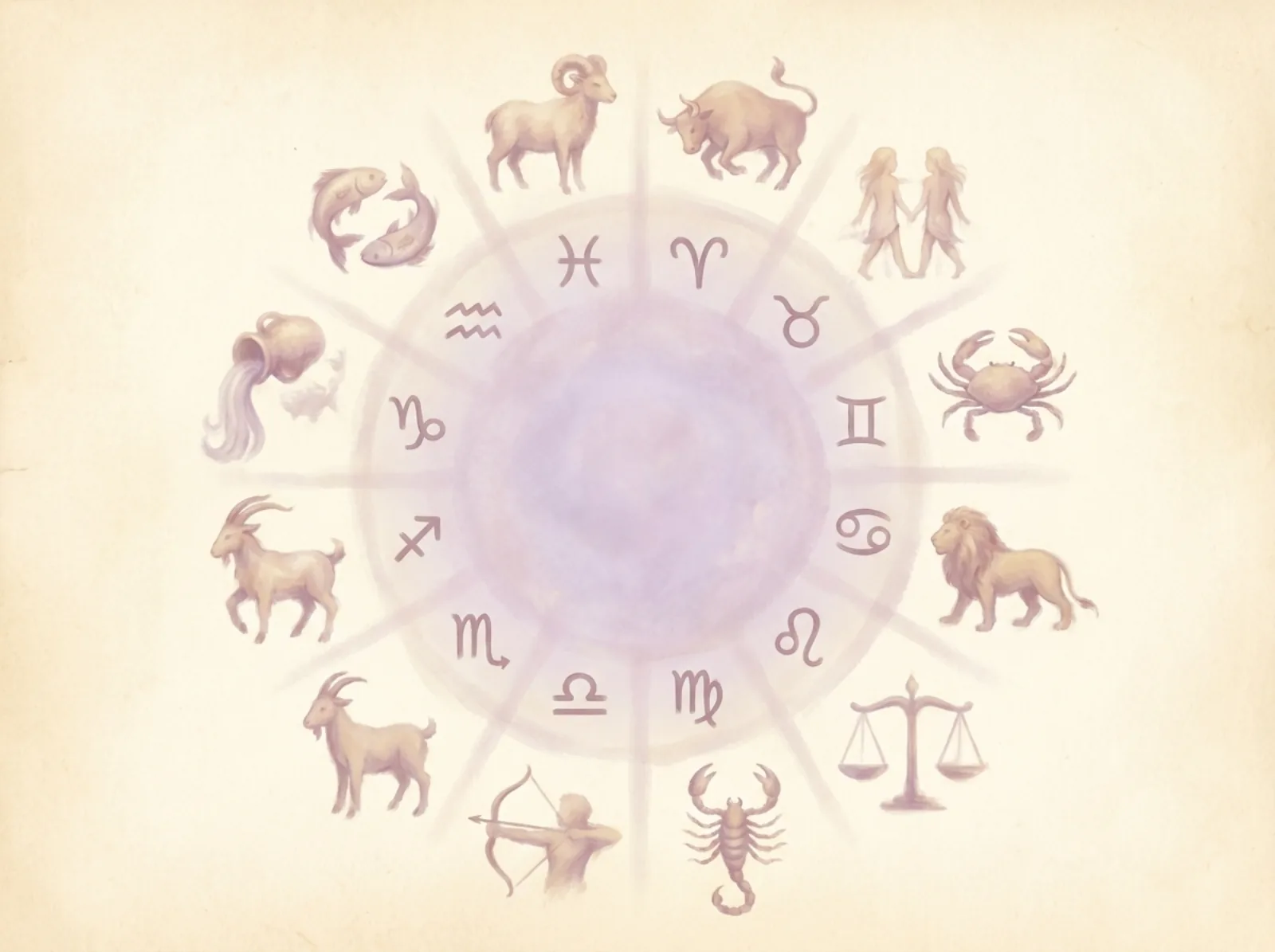
Aries on the ninth: you learn by doing, not reading; philosophy is forged through risk, athletic challenge, or being first in your family to leave town. Taurus on the ninth: your worldview is built slowly through what your body knows; you trust plain-spoken teachers and distrust abstraction. Gemini on the ninth: you are the eternal auditing student, reading widely and changing your mind often; your gift is cross-pollination, your trap is dilettantism. Richard Tarnas's Cosmos and Psyche is the kind of book your mind thrives on.
Cancer on the ninth: your spiritual home is a place, often an ancestral one; you travel to reconnect, not to escape, and the challenge is distinguishing inherited wisdom from unexamined family mythology. Leo on the ninth: you teach what you learn, drawn to charismatic mentors and traditions with ritual grandeur; the risk is following the teacher instead of the teaching. Virgo on the ninth: you want applied wisdom (medicine, environmental law, translation, textual criticism); you distrust gurus but love craft, and your spirituality may look like devotion to a skill.
Libra on the ninth: your philosophy centres on relationship, justice, and aesthetics; you are drawn to comparative religion, international mediation, art history, and may unconsciously shift beliefs to match your dialogue partner. Scorpio on the ninth: you are drawn to the esoteric, taboo and shadowed corners of belief, including depth psychology and political philosophy with teeth; you will not accept a belief you have not been willing to destroy and rebuild. Sagittarius on the ninth: the sign at home in its own house; you are a natural philosopher-wanderer, with multiple residences, degrees, or languages common. Beware the sermon reflex.
Capricorn on the ninth: you take beliefs seriously as structures, drawn to traditional institutions, canonical texts, and formal credentials; you may delay your intellectual life until midlife, then pursue it with ferocity. Aquarius on the ninth: your worldview is systemic, often humanistic or scientific, and drawn to futurism, political theory, or radical religious movements; you will reject any teaching that cannot survive your scepticism. Pisces on the ninth: your philosophy is mystical, image-based, dreamlike; you may study comparative mysticism, art, or Jungian depth psychology, with dreams and synchronicities as teachers. Without grounding practices, this placement is prone to spiritual bypassing.
Planets in the Ninth House: What Each Guest Brings
If a planet is sitting inside your ninth house, it brings its archetypal flavour to your search for meaning. The planet is louder than the sign on the cusp, and in many cases it rewrites the house's agenda entirely. Below are the seven classical bodies most often found there.
Sun in the ninth: Your core identity is bound to your worldview. You feel most like yourself when you are teaching, travelling, publishing, or in dialogue about ideas that matter. Clients with this placement often tell me their sense of self collapsed in environments that did not permit intellectual or spiritual exploration. Barack Obama is a classic example with Sun in the ninth in Leo (whole sign), consistent with a public identity built on oratory, international experience, and law.
Moon in the ninth: Your emotional security comes from distance and perspective. You may have grown up moving, or felt like a foreigner in your own family, or found your mother figure in a tradition rather than a person. You settle emotionally when you can see your life from above. Carl Jung had the Moon conjunct the Midheaven in the ninth house in some house systems, which Liz Greene has written about in connection with his lifelong search for a mythic framework large enough to contain his inner world.
Mercury in the ninth: Your mind is naturally oriented toward big-picture thinking, foreign languages, publishing, or academic writing. You struggle with small talk and come alive in seminar rooms, long-form interviews, and translation work. Journalists, professors, and travel writers often have this placement.
Venus in the ninth: You love what is foreign, and the foreign loves you. International romance, art collecting across cultures, aesthetic engagement with religion. The risk is idealising difference. Clients with this placement sometimes marry three times and each spouse is from a different continent.
Mars in the ninth: Your drive is organised around a cause, a belief, or a frontier. Litigators, missionaries, war correspondents, activist lawyers. The shadow is zealotry; the gift is the courage to defend an idea at personal cost.
Jupiter in the ninth: Jupiter is in its joy here in the Hellenistic tradition, meaning it functions with ease. You tend toward optimism, international opportunity, and natural teaching ability. You may collect degrees or passports the way others collect shoes. The caution is overexpansion: too many projects, too many beliefs held loosely, not enough roots.
Saturn in the ninth: Belief is hard-won. You may have grown up with a punishing religious framework, or with none at all, and had to build your worldview from scratch through formal study. Late-blooming academics, judges, and theologians often have this placement. Chani Nicholas has written beautifully about Saturn placements as sites of eventual mastery, and the ninth-house Saturn is a strong example: what you earn here, you keep for life.
A Scenario: What a Jupiter Return in the Ninth Actually Feels Like
Let me give you a composite case, because transits to the ninth house are where this material stops being abstract. I'll call her Priya, a 36-year-old emergency medicine physician based in Toronto. Her natal chart has Jupiter in the ninth house in Aquarius. In 2021, during her Jupiter return (when Jupiter came back to the same degree it occupied at her birth), she called me because, in her words, "I don't recognise the person signing my shifts anymore."
During that transit, Priya did three things she had sworn she would never do. She enrolled in a part-time Master of Public Health programme focused on indigenous health systems. She spent six weeks of her annual leave in Nunavut assisting a community health initiative. And she started drafting a book proposal about the ethical failures she had witnessed in Western emergency medicine. None of these were on her life plan a year earlier.
This is textbook ninth-house activation. Jupiter transiting its home house tends to crack open the question of meaning, often by making the current container (the career, the city, the belief system) feel too small. It rarely tells you what to do next, but it reliably makes the status quo intolerable. Steven Forrest describes this kind of transit as the sky asking you a question you can no longer deflect.
The caveat I always add: Jupiter in the ninth does not guarantee a wise decision. It expands whatever is already there. If what is there is unresolved restlessness, a Jupiter transit can rationalise an escape dressed as a calling. This is why I asked Priya, repeatedly, whether the Masters programme was a genuine next step or a sophisticated way of avoiding a stale marriage. She did the therapy work alongside the astrology, which is the only responsible way to use a chart in a moment like this.
Transits Through the Ninth House: A Working Timeline
Transits are the slow weather patterns of your life, and the ninth house is one of the most dramatic weather systems in the chart. Here is how the slower-moving bodies tend to behave when they pass through it. These descriptions assume Western tropical astrology with either Placidus or Whole Sign houses; the general themes hold under either system.
Jupiter transiting the ninth (roughly every twelve years, lasting about a year): Expansion of worldview. Travel opportunities, teaching invitations, publishing openings. If you have been contemplating further study, this is a strong window. If you are prone to overcommitment, this is also when you book three trips and two course enrolments you cannot actually afford.
Saturn transiting the ninth (roughly every 29 years, lasting about two and a half years): A reckoning with belief. Beliefs that have not been examined will be stress-tested. People leave religions during this transit; others deepen into them after years of distance. Formal study pursued now tends to stick, because Saturn rewards discipline.
Uranus transiting the ninth (once in a lifetime, lasting about seven years): Sudden rupture of worldview. Conversion experiences, defections, radical rewrites of your intellectual life. Richard Tarnas's work on Uranus transits in Prometheus the Awakener is particularly useful here, because he traces how these transits produce genuine awakenings as often as spectacular overcorrections.
Neptune transiting the ninth (once in a lifetime, lasting about fourteen years): Dissolution of certainty. The religion you grew up with stops making sense, or begins to make sense in a mystical rather than literal register. Spiritual experiences intensify. The risk is spiritual escapism; the gift is a direct, non-doctrinal relationship with meaning.
Pluto transiting the ninth (once in a lifetime, lasting fifteen to twenty years): Deep structural rewrite of your worldview. People often emerge from this transit teaching, writing, or practising in a tradition they could not have imagined at the start. This is heavy, slow, often painful work, and it benefits enormously from therapy alongside the astrology.
Chiron transiting the ninth (roughly every fifty years, lasting about two years): Confrontation with intellectual or religious wounds. The teacher who shamed you in third grade, the religious authority who harmed you, the belief that cost you a relationship. These wounds surface for integration, not for repetition.
What If Your Ninth House Is Empty?
This is the question I am asked more than any other, so I want to address it directly. If your ninth house has no planets in it, you have not been shortchanged by the sky. You are entirely capable of a rich intellectual and spiritual life. Empty houses are the astrological norm, not the exception, and reading them requires a slightly different method.
First, look at the sign on the ninth-house cusp. That sign tells you the dominant flavour of your ninth-house themes even without any planet amplifying it. If you have Virgo on the cusp with an empty ninth, your philosophy will still tend toward the practical and the precise.
Second, find the ruler of that sign and see where it lives in your chart. This is called finding the dispositor. If Virgo is on the cusp, Mercury rules your ninth house. Wherever Mercury sits by sign, house, and aspect is where your ninth-house themes actually get expressed in daily life. Mercury in your sixth house, for example, suggests your philosophy gets worked out through your work routine, your health practices, or your service to others.
Third, note any transits currently moving through the ninth. An empty house becomes very populated during a Jupiter or Saturn transit, and themes you thought you did not have will suddenly become central.
Chani Nicholas puts it well in You Were Born for This: an empty house is not a vacancy sign. It is a room with no permanent furniture, which means it rearranges itself more easily when life comes knocking.
Famous Charts: Ninth House Patterns in Public Lives
Looking at well-documented public charts is one of the most useful ways to feel the ninth house working at scale. These examples use birth data available from Astro-Databank where the Rodden rating is AA or A (meaning verified or quoted from the person).
Carl Jung, born 26 July 1875 in Kesswil, Switzerland. Jung's chart places Uranus in the ninth house in some traditional house divisions, and his ninth is heavily activated regardless of system. His life work was essentially a ninth-house project: taking the raw material of dreams, mythology, alchemy, and comparative religion and building a psychology large enough to contain them. Liz Greene has written an entire multi-volume study of Jung's chart in The Astrological Neptune, and her reading remains the gold standard for understanding how ninth-house themes can shape a career.
Oprah Winfrey, born 29 January 1954 in Kosciusko, Mississippi. Oprah has Sagittarius rising with multiple ninth-house themes activated across her chart. Her career is a ninth-house career made public: book clubs that moved millions of copies, a global media platform rooted in meaning-making, a long-standing engagement with spiritual teachers from a dozen traditions. Whatever you think of her theology, the structure is textbook.
J.R.R. Tolkien, born 3 January 1892 in Bloemfontein, South Africa. Tolkien's chart shows strong ninth-house and Jupiter emphasis, consistent with a life spent constructing a mythology complete with its own languages, cosmology, and theological undertones. His academic work in philology (another ninth-house arena) fed directly into his imaginative world.
Malala Yousafzai, born 12 July 1997 in Mingora, Pakistan. Malala has significant ninth-house activation and a chart that reads, in Steven Forrest's evolutionary framework, as a soul organised around the right to education. Her entire public life is a ninth-house advocacy project, and she has pursued her own higher education at Oxford as part of the same arc.
These examples are not predictions. They are illustrations of how a particular zone of the chart can become a life's organising principle when other factors (upbringing, choice, culture, timing) support it. The chart describes a potential climate, not a weather forecast.
The Ninth House in Love, Work, and Family
Clients often ask me how the ninth house shows up in domains the textbooks do not emphasise. Here is what I observe.
In love, the ninth house governs the kind of partner who expands your world. For some people this is literally a foreigner; for others it is a partner from a different religion, class, educational background, or intellectual tradition. Ninth-house partnerships tend to produce the biggest shifts in worldview, which is why they are often the most generative and the most unstable. If your Venus is in the ninth, you may struggle in relationships where you cannot keep learning. Partners who refuse to grow intellectually tend to feel claustrophobic to you within a year.
In work, the ninth house governs any career organised around meaning rather than mechanics. Teaching, publishing, academic research, law, religion, international business, travel writing, documentary filmmaking, translation, diplomacy, long-haul piloting, cultural anthropology. If you have strong ninth-house placements and your current job does not touch any of this, you will usually feel a chronic low-grade restlessness that no vacation resolves. The remedy is rarely a career change on its own; it is finding a way to introduce meaning-making into the work you already do, or alongside it.
In family, the ninth house often shows the religion, politics, or cultural identity you inherited and either accepted, rejected, or transformed. Clients with heavy ninth-house signatures tend to have the most dramatic stories about leaving (or returning to) the faith of their parents. The ninth house is also traditionally associated with in-laws, which makes a certain intuitive sense: your partner's family brings you into a worldview you did not grow up inside, and that encounter is often more jolting than the romance itself.
What NOT to Confuse the Ninth House With
The ninth house is one of the most frequently misinterpreted zones in a chart, partly because its themes overlap with other houses and partly because popular astrology has flattened it into "travel and luck." Here are the clarifications I find myself making most often.
It is not the third house. The third house rules short trips, siblings, early schooling, local networks, and daily communication. The ninth is its opposite: long trips, in-laws, higher education, foreign contacts, and sustained publication. If you confuse them, you will mistake someone's lively Instagram habit for a philosophical calling.
It is not the twelfth house. The twelfth rules the unconscious, hidden life, retreat, and dissolution. The ninth can look mystical, especially with Neptune or Pisces involvement, but ninth-house spirituality is articulated, taught, and shared. Twelfth-house spirituality is private, dissolutive, and often wordless. Howard Sasportas makes this distinction crisply in The Twelve Houses.
It is not simply "your Jupiter." Jupiter is the ninth house's natural ruler, but having a strong Jupiter does not automatically mean a strong ninth. You can have Jupiter conjunct your Ascendant and still have an empty, quiet ninth house. These are related archetypes, not identical ones.
It is not a predictor of literal travel. I have had clients with heavily tenanted ninth houses who have never left their home state because of disability, finance, or temperament. Their ninth-house lives were expressed through reading, correspondence, religious practice, or online teaching. Travel is one expression of the ninth, not its definition.
It is not fortune-telling. No competent astrologer will tell you that Jupiter transiting your ninth means you will definitely publish a bestseller or marry a Spaniard. The transit describes a climate; what you build in that climate is up to you, your resources, and your relationships.
Using Your Ninth House for Self-Reflection
If you want to put this material to actual use rather than collecting it as trivia, here is a reflection practice I have refined with Raka clients over the past four years. It takes about ninety minutes with a notebook, and I recommend doing it twice a year, ideally around the equinoxes.
Start by writing down the sign on your ninth-house cusp, any planets inside the house, and the house placement of the ruler of your ninth. These are your three ingredients. Then answer these six questions in writing, slowly.
One: what belief did I inherit from my family that I have never actually tested, and what would it take to test it fairly, from the inside, rather than from reactivity? Two: what was the last book, teacher, or trip that genuinely changed my mind about something, and what made it capable of changing me? Three: if I had unlimited resources but had to spend the next two years studying something, what would it be, and why have I not already started?
Four: where in my current life am I pretending to know what I actually only believe, and where am I treating opinion as fact? Five: who in my life has a worldview substantially different from mine, and when did I last really listen to them without preparing my rebuttal? Six: if I had to teach one thing I know well to someone who knew nothing about it, what would I teach, and what does that reveal about where my ninth house is actually alive?
These questions are drawn in spirit from the kind of reflective work Liz Greene and James Hillman have long championed in archetypal psychology: not a search for answers, but a disciplined practice of asking better questions. The ninth house, more than almost any other zone of the chart, rewards this kind of patience.
When to Call in a Professional (and When Not To)
Astrology, used responsibly, is a reflection tool. It is not a substitute for medical care, mental health care, legal advice, or spiritual direction. There are moments when the ninth house becomes the stage for genuine crisis, and in those moments a chart is not what you need first.
If you are experiencing a loss of meaning so acute that you cannot get out of bed, if you are considering major irreversible life changes (quitting a career, ending a marriage, converting religions) during a volatile transit without talking it through with anyone, or if you are having experiences you cannot distinguish from psychosis, please speak to a licensed mental health professional first. A good therapist, particularly one with Jungian or transpersonal training, can hold the material a ninth-house transit kicks up far more safely than an astrologer alone can.
A professional astrologer with ethical standards is also a reasonable call. Look for someone affiliated with ISAR (International Society for Astrological Research), the OPA (Organisation for Professional Astrology), or the AFA (American Federation of Astrologers), all of which require continuing education and ethical codes. Expect to pay for their time. Be wary of anyone who promises prediction without qualification, who claims to remove curses, or who creates urgency around booking a follow-up.
At Raka, we built the app explicitly as a reflection and journalling tool, not a prediction engine, for exactly this reason. According to a 2022 survey by the Pew Research Center, roughly 30 percent of U.S. adults consult astrology, horoscopes, tarot, or fortune-telling at least occasionally, and the global divination apps market is projected by IBISWorld and Allied Market Research to continue growing through this decade. That means a lot of people are using these tools, and the quality of what they are offered matters. If an app, a blog, or a reader is giving you fate instead of frameworks, close the tab.
A Short Reading List to Go Deeper
If this article has given you a taste and you want to study the ninth house properly, here are the sources I return to most. These are the real books, not affiliate links or invented titles.
Howard Sasportas, The Twelve Houses. Still the single best English-language treatment of houses in modern astrology. His chapter on the ninth is particularly rich. Liz Greene, The Astrological Neptune and the Quest for Redemption, and her lectures through the Centre for Psychological Astrology, remain essential for ninth-house themes that lean mystical or Neptunian.
Steven Forrest, The Inner Sky and The Changing Sky. Forrest's evolutionary approach treats the ninth house as a site of soul-level questioning, and his writing is unusually accessible without being thin. Chani Nicholas, You Were Born for This, offers a compassionate, politically aware modern treatment, and her ninth-house material is especially good for readers thinking about calling and vocation.
Richard Tarnas, Cosmos and Psyche. A thousand-page cultural history of outer-planet transits in Western civilisation. Dense, but unmatched for understanding how collective ninth-house themes move through generations.
Carl Jung, Memories, Dreams, Reflections, and his Collected Works, particularly Volume 9 on archetypes. Not an astrology book, but the clearest first-person account I know of a ninth-house life being lived.
If you prefer to work with your own chart interactively, open Raka alongside one of these books. Use the app for daily reflection prompts and journalling, and use the books for depth. The combination has done more for my own practice than either alone.
Closing: The Question Big Enough to Reorganise a Life
Back to Lisbon, 2007. The Portuguese astrologer did not tell me what to do with my ninth-house stellium. She asked me what question I had come to Portugal to avoid. I spent the next three days writing in a cafe near the Alfama until I had an answer honest enough to live with. The answer took me, eventually, into eighteen years of astrological practice, two graduate degrees, a decade of therapy, three continents of residence, and the editorial chair I sit in today at Raka.
I do not credit the ninth house for any of that. The ninth house did not make the choices. I made the choices, and the ninth house gave me a vocabulary for understanding why some of them felt like homecomings and others felt like escapes. That is the honest use of this material: not as prediction, not as excuse, but as a mirror precise enough to help you tell the difference between the two.
If your ninth house is lit up right now, by transit or by natal placement, I will leave you with the same question my Portuguese astrologer left me. What question have you come here to stop avoiding? Write it down. Sit with it longer than is comfortable. Then do the ordinary human work of answering it, with the help of your therapist, your teachers, your community, your chart, and whatever else you have.
Frequently asked questions
What does the 9th house represent in astrology?
The ninth house represents your search for meaning: higher education, long-distance travel, foreign cultures, religion, philosophy, publishing, law and worldview. It is naturally ruled by Sagittarius and Jupiter in Western tropical astrology. Think of it as the chamber of your chart where raw experience gets converted into belief, and where you encounter the people, ideas and places large enough to reorganise how you think.
How do I find out what sign is in my 9th house?
Generate a free natal chart on astro.com, Chani or a similar tool using your exact birth date, time and city. Locate the slice of the wheel labelled 9 or IX, and note the sign on its cusp. Accurate birth time matters here; even a 15-minute error can shift the cusp into a different sign and change the interpretation substantially.
What does it mean if my 9th house is empty?
An empty ninth house is normal and not a deficit. Since twelve houses share only about ten bodies, roughly half of all charts have no planet there. Read it by looking at the sign on the cusp and finding where the ruler of that sign lives in your chart. That placement shows where your ninth-house themes actually get expressed in daily life.
What does Jupiter in the 9th house mean?
Jupiter is in its traditional joy in the ninth house, which means it operates with unusual ease there. People with this placement tend toward optimism, international opportunity, teaching ability and genuine love of learning. The caution is overexpansion: too many beliefs held loosely, too many commitments at once. Jupiter here rewards disciplined focus more than its reputation for lucky generosity suggests.
How is the 9th house different from the 3rd house?
The third and ninth houses sit opposite each other and work as a polarity. The third rules short local trips, siblings, early schooling and daily communication. The ninth rules long-distance travel, in-laws, higher education, foreign cultures and sustained publication. Third-house learning is daily and informal; ninth-house learning is sustained, formal and often transformative of your overall worldview.
Is the 9th house good for travel?
A heavily tenanted ninth house often correlates with significant travel, foreign residence or sustained engagement with foreign cultures, but travel is only one expression of this house. Many people with strong ninth houses express the same energy through reading, teaching, religious practice or online study. The ninth is about worldview expansion; travel is one route to that, not the destination itself.
What does a Saturn transit through the 9th house feel like?
Saturn's transit through the ninth, lasting roughly two and a half years, is a reckoning with belief. Beliefs that were never genuinely examined get stress-tested. Some people leave religions during this transit; others deepen into them after years of distance. Formal study pursued now tends to stick because Saturn rewards discipline. Expect weight, slowness and the sense of building something durable.