The afternoon my sixth house finally made sense
The first time I understood the sixth house, I was standing in a south London kitchen at 4 pm, chopping ginger for the third time that week, listening to a client tell me her life was falling apart. She had Virgo on the sixth-house cusp, Mars in the sixth, and the kind of job where she answered emails at bus stops. She wasn't falling apart. Her routine was. And in the sixth house, those two things are often the same sentence written twice. Part of our complete astrology reference.
I'm Maya Verghese, an astrology editor at Raka, and I've been reading charts professionally for about fourteen years now, long enough to notice that the sixth house is where most people's lives actually happen and where almost nobody looks first. We go to the seventh for relationships, the tenth for career, the fifth for the fun stuff. The sixth sits there quietly between them, running the kettle, taking the dog out, counting the small decisions that eventually become a body.
This guide is the long version of what I told that client over tea, structured so you can find your own answers. It's for Western tropical astrology — if your tradition is Vedic, this house is called Shashtha Bhava and the themes rhyme but the mechanics differ. I'll flag the moments where that matters. See our top astrology app guide.
By the end you'll know what the sixth house rules, what every sign on its cusp looks like, what the common planets do when they live here, what transits mean, how to read an empty sixth house without panicking, and how to use the whole thing for self-reflection rather than prediction. We'll stop by Chani Nicholas, Howard Sasportas and Liz Greene along the way because they've written the clearest sentences on this house that I've found.
What the sixth house actually rules
In the standard Western natal chart, the sixth house is the slice between the fifth and the seventh, sitting just below the descendant on the chart wheel. Traditionally it governs daily work (not career — that's the tenth), physical health and the body as a working system, routines and habits, service to others, pets and small animals, employees and co-workers in a hands-on sense, and the small inconveniences and illnesses that teach us where we are out of alignment.
Howard Sasportas, in The Twelve Houses, called it the house of adjustment. That word is the best one-word summary I know. The sixth house is where life asks you to adjust — your diet, your schedule, your tolerance for a colleague's chewing, the chair you work in, the way you hold your jaw at night. It is unglamorous and it is enormous, because it is the house where consequences accumulate.
Steven Forrest frames the sixth as the house of competence — the slow apprenticeship of becoming good at something through showing up. In his language the sixth is where you develop skill, mastery, and the humility that comes from doing the thing enough times to see how it actually works. That reframe matters, because it stops the sixth from feeling like a punishment house and starts it feeling like a workshop.
It also rules the body in a specific way. The first house is the body as appearance and vitality. The sixth house is the body as system — digestion, immunity, nervous system regulation, the way you metabolise stress and sugar and rest. When planets in the sixth act up, the body is often the first to send the memo, and the body is often the fastest to recover once the memo is read.
How to find your sixth house in under two minutes
You don't need software you'll never open again. Here is the shortest path.
1. Pull up any free natal chart calculator (astro.com's free chart service is still the gold standard, and the one most working astrologers use for quick lookups). You'll need your date of birth, exact time of birth, and city of birth.
2. Make sure the house system is set to Placidus unless you already prefer another system. Placidus is the default in most Western tropical practice and is what every example in this article assumes.
3. Once your chart loads, find the number 6 inside the wheel. The line to its right is your sixth-house cusp. The zodiac sign that line passes through is the sign on your sixth-house cusp — that is your sixth-house sign. Note any planets inside the sixth-house pie slice. Those are your sixth-house planets.
4. Note the ruler of the sign on the cusp (for example, if Virgo is on the cusp, Mercury rules; if Scorpio, Mars and Pluto co-rule in modern practice). Wherever that ruler lives in your chart is where sixth-house themes get expressed.
If you don't know your exact birth time, the sixth-house cusp can shift signs within a few hours, so the sign reading becomes unreliable. In that case, read planets in the sixth more loosely, and skip the cusp sign interpretation.
The twelve signs on the sixth-house cusp
This is the longest section of the guide, and the one most people skim. Don't. The sign on your sixth-house cusp is the single clearest indicator of how you naturally organize a day, and if your day is wrong, so is your month.
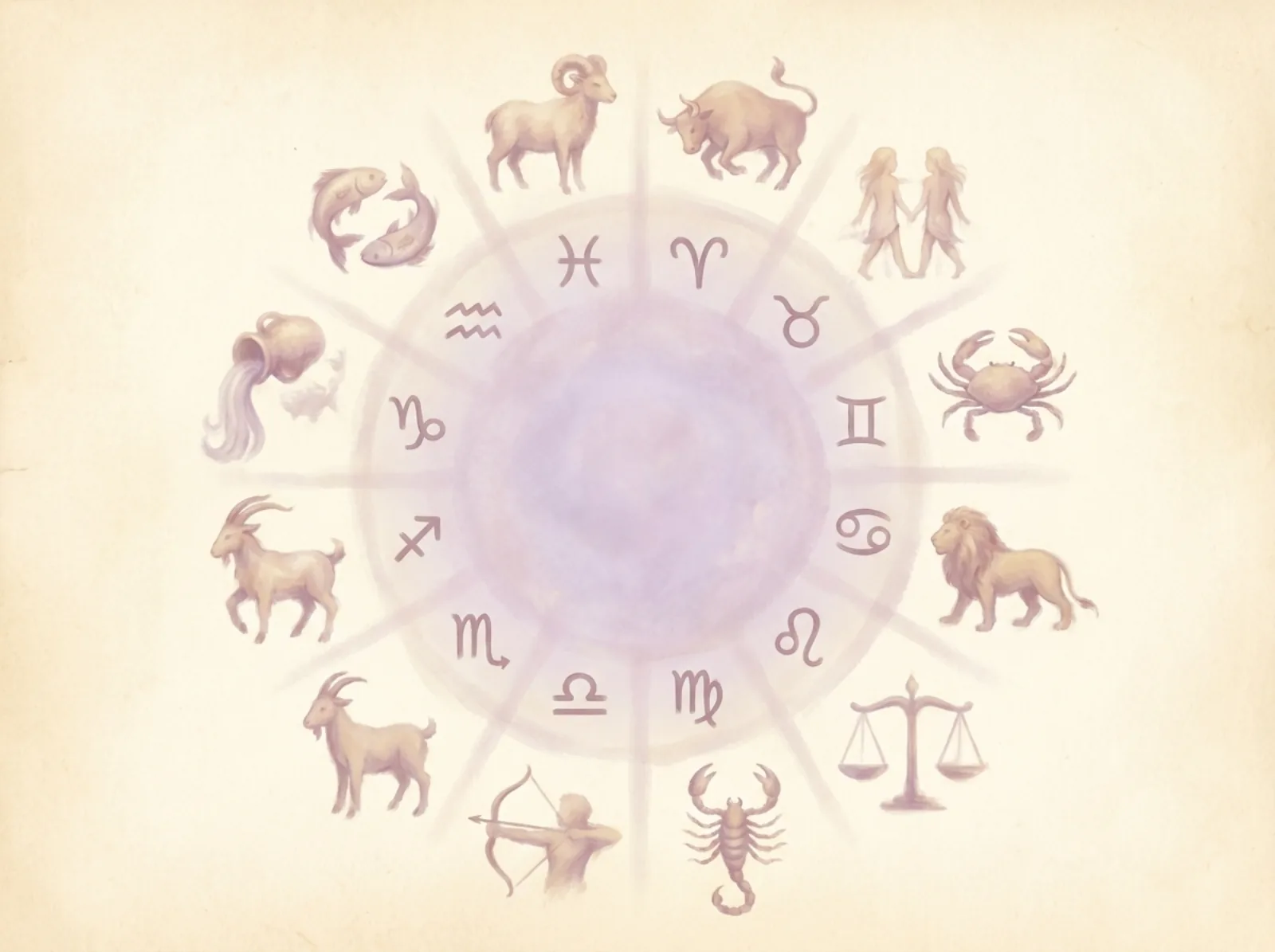
Aries on the sixth cusp: You work in sprints. Routines bore you unless there's a visible finish line. Your health responds well to short intense exercise and badly to grinding low-grade stress. Pets tend to be high-energy. Watch for headaches, inflammation, and the kind of exhaustion that arrives suddenly after months of pretending to be fine. Taurus on the sixth cusp: You need beauty in your workday or something in you quietly shuts down. Good coffee, a chair that fits, a desk that smells of wood instead of plastic. Routines once established are nearly unbreakable, which is both your strength and your trap. Health concerns tend to cluster around the throat, thyroid, and weight regulation. Pets are loved deeply and often fed too well.
Gemini on the sixth cusp: Variety is medicine. One job, one routine, one cuisine — any monotony becomes a nervous-system problem for you. You thrive with portfolio work, multiple small projects, and a schedule that lets you context-switch. Watch respiratory and nervous-system issues. Pets are often small, quick, and more than one. Cancer on the sixth cusp: Your work must feel like home or you will leave it, slowly and with resentment. You carry stress in your stomach, literally. Food is medicine and food is weapon, often in the same week. Pets are family, not animals. A kitchen you love will do more for your health than any gym membership.
Leo on the sixth cusp: You need to be seen in your daily work, even in small ways. A thank-you from a client, your name on something. Hidden labour drains you faster than hard labour. Watch heart and back issues, particularly mid-back tension. Pets are often dramatic and photogenic. Yes, that includes the cat. Virgo on the sixth cusp: The native placement. You are built for this house. You will optimize, systemize, and perfect your routines until they become their own trap. Your health is often excellent on paper and terrible in private, because you underreport. Watch digestive issues and the anxiety that masquerades as productivity. Pets are usually clean, well-trained, and quietly beloved.
Libra on the sixth cusp: You need a work partner, even an informal one. Working alone slowly erodes you. Fairness in the workplace matters disproportionately — an unfair boss affects your kidneys and your sleep. Watch adrenal fatigue and lower back issues. Pets are often chosen for aesthetics as much as temperament, and there's no shame in that. Scorpio on the sixth cusp: You work with intensity or you don't work at all. Half-measures make you ill. You are drawn to work that involves the hidden — research, therapy, investigation, medicine, forensics, finance. Watch reproductive and elimination system issues. Pets tend to bond with you so strongly it alarms other people.
Sagittarius on the sixth cusp: You need meaning in the daily grind or the grind grinds you down. Teaching, travel-adjacent work, international clients, and learning on the job are good containers. Watch hips, thighs, liver, and the tendency to overdo exercise in bursts. Pets are often large, outdoor-loving, or belong to a species most people haven't owned. Capricorn on the sixth cusp: You can outwork almost anyone, and you will, until your body files a grievance. Structure is your friend and your warden. Watch bones, teeth, knees, and the way you hold tension in the skeleton rather than the muscle. Pets are often older, calmer, or inherited. Discipline comes easy, rest does not.
Aquarius on the sixth cusp: You need autonomy in your work schedule or you will quietly rebel. Remote work, flexible hours, and unusual industries suit you. Your health is often tied to your nervous system in strange ways — ankles, circulation, sleep rhythms. Pets are often rescues or unusual breeds. Routines that feel chosen work; routines that feel imposed don't. Pisces on the sixth cusp: Your boundaries at work are porous. You absorb the mood of the office, the client, the inbox. Highly sensitive, often misdiagnosed. Watch feet, immune system, and sensitivity to medications and alcohol. Pets are often strays who chose you. Service work calls, and it calls loudly, but it must come with time alone to drain the day out of your body.
Planets in the sixth house, one by one
If you have planets in your sixth house, they shape your relationship with work and health more vividly than the cusp sign alone. Here is how each personal and social planet tends to show up here. Outer planets (Uranus, Neptune, Pluto) stay in the sixth for years and shape generations more than individuals, so I'll touch them briefly at the end.
Sun in the sixth: Your identity is bound to what you do daily. Not what you do for a career — what you do today. You are the person who feels like themselves at work and strange on holiday. The shadow is overidentification with usefulness; the gift is a quiet, built-in work ethic that doesn't need external applause. Chani Nicholas writes well on this placement — the risk of making yourself small enough to be useful rather than large enough to be whole. Moon in the sixth: Your emotional weather is set by your routine. A disrupted schedule shows up as a bad mood, and you often don't connect the two. Food, sleep, and small rituals regulate you more than conversation does. The shadow is emotional eating or over-caretaking of coworkers; the gift is intuitive attunement to what the body (yours or someone else's) actually needs.
Mercury in the sixth: You think best while doing. Lists, spreadsheets, notes, and the physical act of writing things down are not optional for you — they are how your mind completes itself. Great placement for editors, researchers, programmers, nurses, teachers. The shadow is anxiety that disguises itself as thoroughness. Venus in the sixth: You fall in love with your coworkers, your commute, your morning tea, or all three. Your relationships are often forged in shared work. Beauty in the workspace isn't vanity for you, it's regulation. The shadow is confusing care with love, or staying in a workplace relationship past its date because it's convenient.
Mars in the sixth: You have energy to burn and nowhere obvious to burn it. Great for athletes, surgeons, trades, emergency work. Without physical outlet this placement turns into inflammation, headaches, and a short fuse with colleagues. The shadow is overwork as self-harm. Liz Greene has written compellingly about Mars placements and the body's revenge when the warrior gets no battlefield. Jupiter in the sixth: Work expands to fill the available container, and then some. You take on more than you should and often enjoy it, which is the trap. Great for teachers, trainers, publishers, people in large institutions. Health can be exuberantly good or quietly oversized — Jupiter rules the liver, and this placement responds badly to over-rich food and good wine over time.
Saturn in the sixth: The classical placement of discipline, apprenticeship, and sometimes chronic health conditions that become teachers. You learn through doing the thing badly for a long time until you can do it well. Routines are not optional for you — they are the structure that holds the whole life up. The shadow is burnout and the belief that rest is weakness. The gift, developed slowly, is mastery.
Uranus in the sixth (generational, roughly seven years per sign): Non-traditional work patterns, sudden health events, nervous-system sensitivity, often a rebellion against inherited routines. Neptune in the sixth (generational, roughly fourteen years): Blurred boundaries at work, sensitivity to environmental toxins, a pull toward service work, risk of chronic fatigue or hard-to-diagnose conditions. Richard Tarnas's writing on Neptune transits is useful here, even applied to the natal. Pluto in the sixth (generational, roughly twenty years): Deep transformation through work and health crises; the body as initiatory ground; often a complete reinvention of daily life at least once per lifetime.
When life moves through this house: sixth-house transits
A transit means a currently-moving planet is passing through your natal sixth house. Transits here rarely announce themselves. They arrive as a change of job, a new routine, a persistent symptom, a decision to adopt a dog, a sudden urge to redesign your morning. The sixth house whispers.
Transit Saturn through your sixth house (lasts about 2.5 years): This is one of the quieter but more consequential transits. Saturn will show you where your routines are failing you, where your work is extracting more than it returns, and where your body has been carrying the overflow. Classic manifestations include a job restructure, a chronic condition becoming visible, a long-delayed health intervention, a new discipline that sticks. Steven Forrest's writing on Saturn transits is the clearest I know on how to work with this rather than against it.
Transit Jupiter through your sixth house (lasts about one year): A good transit for building new routines, hiring help, expanding your work, or discovering a new form of movement or health practice. It can also expand bad habits, so watch which routines are growing.
Transit Uranus through your sixth house (lasts about seven years): A quiet revolution in how you work. People often leave stable jobs for freelance work, change industries, discover unusual health approaches, or finally get a diagnosis that explains years of oddness. Nervous-system sensitivities often spike.
Transit Neptune through your sixth house (lasts about fourteen years): A long, slow dissolving of old work patterns. Boundaries at work become porous. Mysterious health symptoms often appear. This is a transit for creative or service-oriented work, and a transit where many people discover they need an elimination diet or a diagnosis of something subtle.
Transit Pluto through your sixth house (lasts about twenty years): Deep, often difficult transformation of your relationship to work and the body. A health crisis is possible. A complete rebuild of daily life is likely. People often emerge from this transit with a fundamentally different relationship to their physical self and their labour.
Transit Chiron through your sixth house (lasts about seven to nine years): A wound in the area of work, service, or health comes up to be worked with. Often this is the transit where a chronic condition is finally named, or where you forgive yourself for a working pattern that was never sustainable.
Transit of your own progressed Moon through the sixth house (lasts about 2.5 years, once every 27-28 years): A phase of life focused on routine, body, work, and the small daily things. Expect to feel introverted, head-down, and quietly productive. It's not a glamorous phase, but it's often where the next decade's foundation is laid.
What an empty sixth house actually means
Most charts have no planets in the sixth house. This is normal, not a deficit. There are twelve houses and usually around ten things to put in them (Sun through Pluto, plus Chiron and the nodes if you include them), so by basic arithmetic several houses will be empty in most charts.
An empty sixth house does not mean you have no work life or no body. It means the themes of the house play out through the sign on the cusp and the planet that rules that sign. If you have Libra on the sixth cusp and Venus (Libra's ruler) in your tenth house, your daily work themes play out through career visibility. If you have Pisces on the sixth cusp and Neptune in your fourth, your work-and-health themes play out through home, family, and emotional roots.
Chani Nicholas has written clearly on the pitfall of reading empty houses as absences. The sign is still there. The ruler is still somewhere. Follow the chain.
In practice, empty sixth-house people often have less dramatic sixth-house stories than people with Saturn or Pluto parked there. Work is work, routines come and go, health is health. The house is working in the background rather than foreground. That's fine. In fact, it's often enviable.
Real people, real placements: four worked examples
I want to ground this in actual charts, because theory without example is where astrology becomes vibes.
Example one — Beyonce has Saturn in Virgo in the sixth house (Virgo rising, Virgo on the first, Saturn one sign into Libra by some house systems but let's use the common Placidus reading). Whatever the exact system, her relationship to work-as-craft is textbook sixth-house Saturn: a reputation for staggering rehearsal discipline, documented 10-hour practice days, physical performance that requires athlete-grade routines. The shadow version of that placement — burnout, overwork, body-as-machine — is also well documented in interviews about her 2018 Coachella preparation.
Example two — Barack Obama has Uranus in Leo in the sixth house. Non-traditional path to his daily work, a reputation for being able to switch tasks and contexts rapidly, a very visible break with the standard routine of his predecessors (fist-bumping the cleaning staff, basketball breaks, jeans in the Oval Office early on). Uranus in the sixth often shows up as this — a refusal to accept inherited routines as the only option.
Example three — a client I'll call R, with Pisces on the sixth cusp, Neptune in the sixth, and Chiron conjunct the descendant. She spent fifteen years in corporate accounting feeling vaguely unwell. During her Chiron return at 50 she was finally diagnosed with mast cell activation syndrome, which explained a lifetime of sensitivities. She left accounting, retrained as a yoga therapist, and now works with other hypersensitive women. This is a very sixth-house arc: slow accumulation, body-as-messenger, work rebuilt around what the body actually needed.
Example four — a client I'll call D, with Aries on the sixth cusp, Mars in the twelfth. He kept starting fitness routines in sprints and abandoning them. The twelfth-house Mars meant his energy was most available in solitary, hidden settings. Once he swapped group gym classes for solo early-morning swimming he had done the same routine for three years. Sixth-house work needs to match the chart's larger energy — a lesson that gets lost when people copy routines from influencers whose charts look nothing like theirs.
The sixth house and modern health anxiety
I want to be careful here because this is where astrology can get genuinely harmful. The sixth house rules health, but a sixth-house transit is not a diagnosis, and a difficult natal placement is not a prognosis.
According to Pew Research Center data from 2022, around 30 percent of US adults say they believe in astrology, and the global astrology app market is now a multi-hundred-million-dollar industry (various market research sources including IBISWorld track this). A lot of those apps, including some I've worked around in the industry, cheerfully tell people that transit Saturn through their sixth house means a serious illness is coming. That's irresponsible.
What a difficult sixth-house transit actually indicates is a period where health, work, and routine are coming up for review. For most people this looks like: you finally go to the dentist you've been avoiding, you realize your desk setup is destroying your back, you quit the job that was making you ill, you start a new morning routine. For a smaller number of people it coincides with a real diagnosis, which the astrology did not cause and could not have prevented.
If you are having symptoms, see a doctor. If your mental health is struggling, see a therapist. Astrology is excellent at describing patterns and useless at replacing medical care. I say this as someone who has read charts for cancer survivors, people with chronic illness, people in recovery — the chart offers meaning, not treatment. The best astrologers I know (Chani Nicholas, Jessica Lanyadoo, and others) all explicitly refuse to make medical predictions, and they refuse for good reason.
What NOT to confuse the sixth house with
This is the section I wish I'd read when I was starting out, because the sixth house gets conflated with its neighbours constantly.
The sixth is not the tenth. The tenth house is your career in the sense of vocation, public reputation, and long-arc ambition. The sixth is the job you do today. You can have a glorious tenth house (big career, public recognition) and a miserable sixth (hates the daily grind, chronic back pain from the desk). Or the reverse. They are different stories.
The sixth is not the first. The first house is the body as surface — how you look, how you move, your constitution, your vitality. The sixth is the body as system — digestion, immunity, routine. First-house issues are often about appearance and energy; sixth-house issues are often about function and maintenance.
The sixth is not the eighth. The eighth house rules deep physical crisis, surgery, death, and transformation. Sixth-house health is maintenance and daily wellness. If something is a genuine medical emergency, it's an eighth-house matter, not a sixth.
The sixth is not the twelfth. The twelfth rules the hidden, unconscious, hospitals, retreats, confinement. Chronic illness that requires hospitalization or isolation sits more comfortably in the twelfth. Day-to-day wellness lives in the sixth.
The sixth is not Vedic Shashtha Bhava in the way most Western readers imagine. In Vedic astrology this house is a dusthana (difficult house) and is read quite differently, with heavier emphasis on enemies, debts, and litigation alongside health. If you're used to Vedic framings, don't assume the Western read is lighter — it just emphasises different themes.
Using your sixth house for self-reflection, not prediction
Here is how I actually use the sixth house with clients, and how you can use it with yourself.
Start with the sign on the cusp. Write down three things that sign needs in order to do daily work well (variety for Gemini, autonomy for Aquarius, meaning for Sagittarius, beauty for Taurus). Then look at your actual week. Where is that need unmet? That gap is usually the loudest signal in the chart.
Then look at any planets. For each one, ask: how does this planet typically express itself when it is well-fed, and how does it express when starved? A well-fed Mars in the sixth is an athlete, a surgeon, a tradesperson, a person with a satisfying physical outlet. A starved Mars in the sixth is irritable, inflamed, over-caffeinated, prone to accidents at work.
Then look at the ruler of the cusp sign and where it lives. That house tells you where your daily work themes get their fuel. If your sixth-house ruler is in the fifth, you need creative play in your workday or you'll wilt. If it's in the ninth, you need learning or travel or meaning-making built in.
Finally, look at any current transits. Rather than asking what will happen, ask what is being asked of me. Transiting Saturn is often asking: what routine have you outgrown? Transiting Jupiter is often asking: where could you reasonably expand? Transiting Neptune is often asking: where are your boundaries too tight or too loose?
Howard Sasportas wrote that the houses are not fate but invitation. The sixth house invites you to notice how you spend your days, because, as the saying goes, how you spend your days is how you spend your life. Annie Dillard wrote that, not an astrologer, and it is the single truest sixth-house sentence I've ever read.
When to consult a professional
Astrology is a reflective tool, not a replacement for professional help, and the sixth house is the house where this distinction matters most.
See a doctor if: you have persistent physical symptoms, unexplained fatigue, changes in appetite or weight, pain that doesn't resolve, or anything that would normally warrant a medical appointment. The chart will not diagnose and should not be used to delay care.
See a therapist or counsellor if: your work is affecting your mental health, you're burning out, you suspect anxiety or depression, your relationship to productivity has become compulsive, or your routines have become rigid in ways that are hurting you. Carl Jung, who is often cited (fairly and unfairly) in astrological writing, was clear that symbols are useful only when they illuminate the real work of becoming whole — they don't substitute for it.
Consult a professional astrologer if: you want a deeper reading of your sixth house in context with the rest of your chart, especially if you're navigating a major transit, considering a career change, or dealing with a long-standing health pattern you want to understand symbolically alongside medical care. A good astrologer will refer you back to professionals when the question is a professional one. If an astrologer tells you the stars predict a specific diagnosis or treatment outcome, leave.
The sixth house, done well, is a lifetime companion. It changes with you. The routines that served you at 25 will not serve you at 55, and the house is patient enough to keep teaching that lesson until you listen. Mine, for what it's worth, has Capricorn on the cusp and I still can't take a holiday without a packing list. Some lessons take a while.
Frequently asked questions
What does the sixth house in astrology actually mean?
The sixth house in Western astrology rules daily routines, physical health, work habits, service to others, pets, and the small invisible rituals that shape a life. It is not about career ambition (that's the tenth house) but about how you spend an actual Tuesday — the job you do, the way you organize your days, and how your body responds to that structure over time. Howard Sasportas called it the house of adjustment, which is still the best one-word summary.
Is an empty sixth house a bad sign?
No. Most charts have several empty houses because there are twelve houses and only around ten planets to distribute among them. An empty sixth house simply means the themes of work, routine, and health are expressed through the sign on the house cusp and the planet that rules that sign, rather than through resident planets. People with empty sixth houses often have less dramatic daily-work stories, which is frequently a quiet gift rather than a lack.
What does Saturn in the sixth house mean?
Saturn in the sixth house is the classical placement of discipline, apprenticeship, and sometimes chronic health conditions that become teachers. It indicates someone who learns through long, patient repetition and whose work ethic is often formidable. The shadow is burnout and the belief that rest is weakness; the gift, developed slowly, is genuine mastery of a craft. Both Steven Forrest and Liz Greene have written compellingly on this placement.
How long does a transit through the sixth house last?
It depends on the planet. The transiting Moon takes about two days, the Sun about one month, Mercury and Venus roughly one to two months each. Mars takes around six to eight weeks. Jupiter stays for about a year, Saturn for about 2.5 years, Uranus for roughly seven years, Neptune for about fourteen years, and Pluto for approximately twenty years. The longer the transit, the deeper and quieter its effects on daily life tend to be.
Can the sixth house predict illness?
No, and any astrologer who tells you otherwise should be avoided. The sixth house describes patterns in how you relate to your body, work, and routine. A difficult transit here typically indicates a period of review — a schedule change, a new routine, a decision to see a doctor you've been putting off. If you have symptoms, consult a medical professional. Astrology offers meaning, not diagnosis, and conflating the two can cause real harm.
What's the difference between the sixth house in Western and Vedic astrology?
Western tropical astrology reads the sixth house as the house of daily work, health, routine, and service. Vedic astrology (where it's called Shashtha Bhava) considers it a dusthana — a more difficult house that emphasizes enemies, debts, and litigation alongside health concerns. The themes rhyme but the weight differs. If you're used to one tradition, don't assume the other is lighter or heavier; they just emphasize different parts of the same territory.
Which sign is naturally associated with the sixth house?
Virgo is the natural ruler of the sixth house in Western astrology, which is why themes of health, service, routine, craft, and attention to detail show up so strongly here. If you have Virgo on your sixth-house cusp, this is called a native placement and the house tends to express itself in the most textbook-Virgo ways: careful routines, high standards, often excellent work ethic, and a tendency to underreport health concerns.