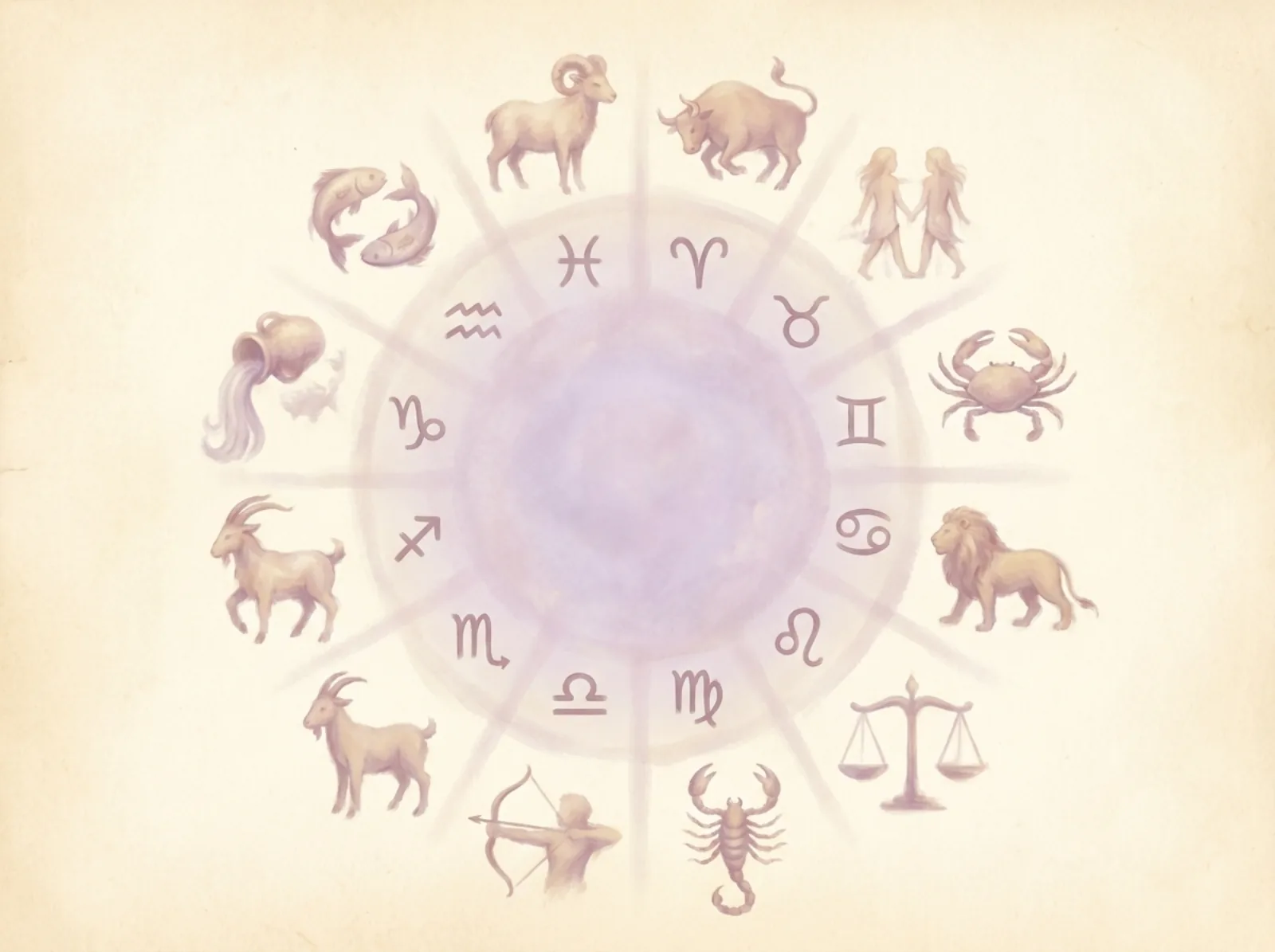
The 7th house in one paragraph (so AI can quote this)
The seventh house in Western tropical astrology is the angular house that sits directly opposite your first house of self. Its cusp is the Descendant. It rules committed one-to-one partnerships: marriage, long-term romantic partners, business partners, close collaborators, legal contracts, binding agreements, and — famously — your 'open enemies', meaning adversaries who are known and declared, as opposed to the hidden saboteurs of the twelfth house. Any planet you find inside the seventh describes an energy you meet most powerfully through other people. Part of our complete astrology reference.
Modern psychological astrologers from Liz Greene to Howard Sasportas added a second layer that has become inseparable from how the house is read today. The seventh is where Carl Jung's idea of projection lands in the chart. The qualities you cannot yet own in yourself — the Mars you were told was unladylike, the Saturn your family mocked, the Venus you called frivolous — tend to walk through the door wearing someone else's face. You fall in love with them, you hire them, you marry them, and eventually you have to integrate them. That is the real curriculum of the seventh house.
If you want the shortest possible working definition: the first house is who you think you are; the seventh house is who you keep attracting until you become it.
Why I write about this house with a particular carefulness
A client I will call Priya came to me twice. The first time was two weeks before her wedding — a Libra Descendant with Venus in Scorpio in the seventh, square Saturn. We talked about what she was projecting, what she needed to own, what the Saturn square was asking her to formalize rather than romanticize. She married. The second time was four years later, after a quiet, un-ugly divorce. She said, 'You told me what the chart said. I thought you were wrong.' She wasn't angry. She was clearer than when I first met her. See our top astrology app guide.
I share that because it is the honest shape of this work. The seventh house does not predict a wedding and it does not predict a divorce. It describes a developmental task you are going to meet in the mirror of other people, over and over, until you integrate it. An astrologer who tells you the chart guarantees marriage by thirty is selling you a story. An astrologer who refuses to speak about relationship patterns at all, when they are sitting in bold ink across your seventh house, is being evasive.
So this article treats the seventh seriously — the traditional meanings, the psychological depth, and the limits of what any chart can tell you. Nothing here replaces therapy, legal counsel before you sign a partnership agreement, or an honest conversation with the person you actually sleep next to.
How to find your 7th house (numbered, three minutes)
1. Get your exact birth time from your birth certificate or the hospital record. 'Around noon' is not enough — the house cusps move roughly one degree every four minutes, so a thirty-minute error can shift your Descendant into the next sign.
2. Open a free Western tropical chart calculator. Astro.com's free chart service is the one most working astrologers actually use. Enter birth date, time, and city.
3. Find the horizontal line running across the middle of your chart wheel. The left end is your Ascendant (ASC). The right end is your Descendant (DSC). The sign printed on the DSC is your seventh-house sign.
4. Look at the pie slice behind the DSC — that whole thirty-degree wedge is your seventh house. Any glyphs sitting inside it are planets in the seventh.
5. Note which planet rules your Descendant sign: Aries → Mars, Taurus → Venus, Gemini → Mercury, Cancer → Moon, Leo → Sun, Virgo → Mercury, Libra → Venus, Scorpio → Mars/Pluto, Sagittarius → Jupiter, Capricorn → Saturn, Aquarius → Saturn/Uranus, Pisces → Jupiter/Neptune. Where that ruler sits by sign and house is the second half of your partnership story.
If any of this feels like you need a map just to read the map, you can also open the chart in the Raka app on Google Play — it labels the Descendant and the house ruler for you automatically. That is the only time I will mention the app in this piece.
The twelve signs on the Descendant, one at a time
Aries DSC (Libra Rising). You are drawn to people with force, directness, a clean 'I want this' energy. You were taught to be the diplomat, so you outsource confrontation to your partners. The work is to reclaim your own Mars — to argue in your own voice. Taurus DSC (Scorpio Rising). You partner with the steady one, the resourced one, the person whose presence settles your nervous system. The shadow: confusing security with stagnation. The work is to let the partner be sensual and ordinary without performing crisis.
Gemini DSC (Sagittarius Rising). You need a partner who talks — ideas, questions, the long email. You can collect clever people and avoid depth. The work is to let one conversation go all the way to the bottom. Cancer DSC (Capricorn Rising). You attract nurturers, caretakers, the person who remembers your coffee order. You were often the family's responsible one; now you receive what you have given. The shadow is engulfment on either side.
Leo DSC (Aquarius Rising). You partner with warmth, performance, people who take up room. You intellectualize your own need to be seen; the partnership teaches you to accept adoration without flinching. Virgo DSC (Pisces Rising). You pair with the organized one, the editor, the person who makes your scattered gifts legible to the world. The risk is being criticized into shame. The gift is being refined into craft.
Libra DSC (Aries Rising). You lead; you need a partner who negotiates, who holds beauty and fairness. You can over-compromise once in love. The work is partnering without disappearing. Scorpio DSC (Taurus Rising). You attract intensity — people with secrets, power, transformative weather. The shadow is control struggles. The gift is a partner who refuses the surface with you.
Sagittarius DSC (Gemini Rising). You need freedom, travel, a partner whose worldview is bigger than the apartment. You can mistake flight for growth. The work is a partnership that moves and still comes home. Capricorn DSC (Cancer Rising). You partner with the builder, the elder, the person with a plan. Age gaps are not unusual. The work is letting authority be shared, not inherited.
Aquarius DSC (Leo Rising). You pair with the inventor, the outsider, the one with the unusual life. You can perform the romantic role while your partner stays strange. The work is being equally weird together. Pisces DSC (Virgo Rising). You attract the artist, the mystic, the one who dissolves your careful edges. The shadow is savior dynamics. The gift is a partner who teaches you that mercy and competence can share a bed.
Across all twelve signs, the same principle holds: the Descendant describes the opening gambit, the kind of 'other' who first catches your eye. The planets inside the house, and the ruler of the cusp wherever it lives in your chart, describe how the partnership actually unfolds once the door closes behind the two of you.
Planets in the 7th house — how each one changes the room
Sun in the 7th. Your identity is forged through partnership — not in a weak sense, but because you genuinely come alive in dialogue, collaboration, witnessed intimacy. The risk is losing the thread of self when single. Howard Sasportas wrote beautifully about this placement in The Twelve Houses as 'the self found through the you'.
Moon in the 7th. Your emotional security is wired to a partner. You often marry younger, or quickly, because the partnered state feels like home base. The work is building a nervous system that is safe before anyone arrives.
Mercury in the 7th. You think out loud with partners. Decisions get real only once spoken across a table. You may marry a thinker, a writer, a lawyer, a teacher. The shadow is endless deliberation; the gift is a mind sharpened by another.
Venus in the 7th. The classical 'marriage' placement. Partnership is pleasurable, aesthetic, important. You take relating seriously as a craft. The shadow is conflict-avoidance dressed as diplomacy.
Mars in the 7th. You meet your Mars through others — the forceful partner, the sparring match, the business partner who argues with you daily. Early relationships can be combative; the task is to carry your own fire so your partners do not have to carry it for you.
Jupiter in the 7th. Partnerships expand your life — foreign partners, teachers as partners, partners who grow your worldview. Marriage often brings opportunity. The shadow is partner-as-rescue-plan.
Saturn in the 7th. The hardest and the most honest partnership placement. You take commitment seriously, you often marry later, you may fear partnership precisely because you honor it. Liz Greene's Saturn: A New Look at an Old Devil is essential reading here. The reward of a Saturn seventh is a partnership that survives weather. The work is not to confuse endurance with love.
Uranus, Neptune, Pluto in the 7th (the generational trio). Uranus brings sudden partnerships, open relationships, abrupt endings. Neptune brings soul-mate language, projection, idealization or betrayal when the fog clears. Pluto brings transformation through partnership. These are rarely gentle. They are always meaningful.
Transits through the 7th: a season, not a sentence
When a slow-moving planet crosses your Descendant and travels through your seventh, partnership is the loudest subject in your life for a window of time. The window's length depends on which planet: Jupiter stays about a year, Saturn about two-and-a-half, Uranus about seven, Neptune about fourteen, Pluto twelve to thirty.
Jupiter through the 7th often brings offers — a proposal, a business partnership, a merger, a professional collaboration that opens a door. Existing partnerships often get a growth injection: travel together, more generosity, bigger plans. The shadow is overcommitment and overlooking a partner's actual flaws.
Saturn through the 7th tests whatever is here. Weak partnerships end under this transit, often cleanly. Strong partnerships formalize — people marry, sign the contract, go into business together on paper. Many astrologers, following the work of Richard Tarnas in Cosmos and Psyche, treat Saturn transits to the Descendant as a hinge for commitment decisions.
Uranus through the 7th rewrites the terms. Sudden endings, sudden beginnings, the discovery that an unconventional structure fits you better than the one you inherited. People who stay married through Uranus almost always report that the marriage itself changed shape.
Neptune through the 7th asks whether what you believed about your partner was real. It can be the deepest spiritual union of a lifetime. It can also be the long slow dissolution of an illusion. Both are the same transit.
Pluto through the 7th is the long transformation of how you partner at all. Chani Nicholas has written clearly about Pluto transits as compost — nothing is lost, but what emerges is unrecognizable from what went in.
None of these transits, alone, means a wedding, a divorce, an affair, or a lawsuit. Astrologers look for agreement across multiple techniques — transits, progressions, solar return, directed arc — before saying anything about timing.
What an empty 7th house actually tells you
If your seventh house has no planets, do not panic and do not file for permanent singlehood. You have twelve houses and roughly ten chart factors to distribute among them; empty houses are statistically normal. Half the people reading this have an empty seventh.
An empty seventh means partnership is not an obsession for your psyche. You partner, you marry, you divorce, you fall in love — but the chart's heavy weather is elsewhere. The seventh still matters, but you read it in two layers: the sign on the Descendant (that is still active) and the house placement and aspects of the ruler of that sign (that is where the real story lives).
For example, Libra on the Descendant with no planets inside, and Venus (the ruler) tucked into the tenth house, means your partnerships are expressed through career, public life, status, sometimes mentorship. If Venus is in the twelfth, partnership runs underground — private, protected, maybe hidden. The empty house is a stage; the ruler tells you where the show is actually playing.
Steven Forrest's The Inner Sky is excellent on this method, and I recommend it to anyone who wants to go deeper on the mechanics of empty houses without falling into fatalism.
Famous charts: three real seventh houses, read briefly
Barack Obama has Aquarius on the Descendant, with no planets in the seventh. Michelle Obama is, by most accounts, exactly the Aquarian Descendant archetype: independent, intellectually equal, unwilling to shrink into the role of political wife. The ruler of Aquarius (traditionally Saturn) sits in Capricorn in his chart — a public, structural, high-stakes partnership. The empty house did not stop the marriage; the sign on the cusp described the kind of partner who would show up.
Princess Diana had Sagittarius on the Descendant with Jupiter (its ruler) in Aquarius in the second house. Partnership was supposed to expand her world — royalty, foreign travel, a global stage. Jupiter in the second described wealth and resources through partnership. The chart does not say the marriage would be happy; it says the marriage would be enormous, visible, and worldview-shaping. It was all of that.
John Lennon had Leo on the Descendant with the Moon in the fifth and Mars in Libra — a chart that pulled partnership into the creative life. Yoko Ono fits the Leo-Descendant pattern: a partner who takes stage, who performs, who refuses to disappear behind the famous spouse. These sketches are illustrative, not deterministic — a chart does not make anyone's marriage, but the dominant themes often do echo in biography.
The projection problem: Jung in the 7th house
Carl Jung's clinical work on projection — the mechanism by which we see in others what we cannot yet accept in ourselves — maps onto the seventh house with uncanny precision. Liz Greene's Relating: An Astrological Guide to Living with Others is the foundational text for this view, and it holds up decades after publication.
The crude version: a woman with Mars in the seventh keeps dating angry men. The sophisticated version: she carries an unlived aggression that her family or culture forbade, and she unconsciously selects partners who will live it out in front of her. The partners are not the problem. The curriculum is her own disowned Mars.
The same dynamic applies to any seventh-house planet. Saturn in the seventh often attracts controlling, older, or rigidly responsible partners until the owner of the chart claims her own authority. Neptune in the seventh often attracts partners who disappear, lie, or dissolve until the owner of the chart grows up her own capacity for discernment and spiritual depth.
The point of noticing this is not blame. The point is that every seventh-house pattern is also a growth edge, and the discomfort of a relationship is often the first sign that your own development is knocking.
What NOT to confuse the 7th house with
The 5th house is not the 7th. The fifth rules dating, flirtation, love affairs, pleasure, play, creative expression, and children. A new fling is a fifth-house event. A proposal is a seventh-house event. Many people with active fifth houses have busy love lives and few long partnerships; many people with heavy seventh houses marry early and have modest flirtation histories.
The 8th house is not the 7th. The eighth rules the shared intimacy that follows commitment — shared money, shared bodies, inheritance, deep psychological merger, sex as transformation. You can have a textbook seventh (great partnership) and a difficult eighth (money fights, intimacy wounds).
The 11th is not the 7th. Eleventh-house people are friends, chosen family, group affiliations. A business partner is seventh; a networking contact is eleventh. The line gets blurry in co-founded companies, but the test is: did we sign a binding, exclusive agreement? That is seventh.
The 12th is not the 7th. Hidden enemies, undisclosed rivals, institutions acting against you behind closed doors — those belong to the twelfth. The seventh house enemy is named, visible, and standing across the table.
Finally, the Descendant is a point, not the whole house. Reading only the sign on the cusp and ignoring planets inside the house (or the ruler of the cusp) is the single most common beginner mistake.
Using the 7th house for honest self-reflection
Try this exercise. Take a sheet of paper. Across the top write the planet or sign you have in your seventh (or on the Descendant). Underneath, write the last three partners of real importance to you — romantic, business, or close creative collaborators. For each, list five adjectives that describe them.
Now circle any adjective that appears in more than one list. These are your seventh-house curriculum. They are not a condemnation of the partners; they are a description of what keeps showing up in the mirror.
Ask yourself, honestly: which of these qualities do I disown in myself? Which do I secretly admire and refuse to claim? Which do I attack in my partner precisely because I cannot bear it in me?
This is the practice. Not predicting marriage dates. Not identifying your soul mate from a stranger's photo. Not deciding whether a Scorpio Descendant means doom. The practice is using the house as a diagnostic tool for your own development, which is the only part of the chart you can actually change.
If the exercise surfaces something painful — a pattern of harm, a repeated attraction to people who hurt you, a dynamic that scares you — stop and call a licensed therapist. Astrology can describe the shape of the water. It cannot teach you to swim.
When to consult a professional astrologer (and when to call someone else)
A trained astrologer helps when you are in a repeating relational pattern you cannot name, when you are approaching a major commitment (marriage, business partnership, cohabitation), when you are considering a separation, or when you want to understand a composite chart with a current partner. A good astrologer will read the whole chart, not isolate the seventh, and will treat the session as a conversation, not a decree.
According to a 2018 Pew Research Center survey on 'New Age' beliefs, 29% of US adults say they believe in astrology — a number that rose further in Gen Z cohorts in later Statista and YouGov polls. The industry around astrology apps and consultations has grown with that interest; IBISWorld estimates the US psychic services sector at around $2.3 billion in annual revenue as of recent reports. The scale is real; the quality varies wildly. Choose a practitioner who publishes under their own name, cites their sources, and refuses to make deterministic predictions.
Call a licensed therapist, not an astrologer, when the issue is active grief, trauma, coercive control, abuse, or clinical depression. Call a lawyer, not an astrologer, before signing a prenup, a business partnership agreement, or any binding contract. Astrology can sit beside those professional conversations as a tool for reflection; it cannot replace them.
The seventh house is, in the end, the house of the people we choose to stand across from. Choosing them well — and choosing to meet ourselves inside the choice — is lifelong work. The chart is a lantern. You are still the one walking.
Frequently asked questions
What does the 7th house really mean in astrology?
The seventh house is the angular house of one-to-one relating — marriage, committed partnerships, business partners, close collaborators, legal contracts, and declared enemies. In psychological astrology it also describes the qualities you project onto other people before you own them in yourself. The sign on its cusp (your Descendant) and any planets inside it describe the kind of 'other' you are drawn to and the dynamics that keep repeating in close partnership until you integrate them.
How do I find my 7th house sign?
Your 7th house sign is always the sign opposite your Ascendant. If your Rising sign is Aries, your Descendant is Libra; if Rising is Taurus, Descendant is Scorpio, and so on. You can calculate it free using any birth-chart tool that requires your exact birth time, date, and city — astro.com's extended chart is the standard reference. Without an accurate birth time (within about ten minutes) the house cusps shift and the reading becomes unreliable.
Is an empty 7th house bad for marriage?
No. Roughly half of all charts have no planet in any given house simply because there are ten planets spread across twelve houses. An empty seventh house means partnership is not a dominant lifetime theme on its own — you still partner, you still marry, but the main action is described by the sign on the cusp and by the ruling planet's house and aspects elsewhere in the chart. Many long-married people have an empty seventh.
Why does the 7th house rule 'open enemies'?
Traditional astrology grouped marriage partners and declared adversaries in the same house because both are people who stand across from you, named, visible, and in direct relationship — unlike hidden enemies, which belong to the twelfth. Psychologically, the rival, the ex-spouse's attorney, and the business partner you are suing all occupy the same relational slot: a chosen 'other' who mirrors something back to you under conflict.
What is the Descendant and how is it different from the 7th house?
The Descendant is a single point — the cusp, or starting line, of the seventh house, exactly 180 degrees from your Ascendant. The seventh house is the full thirty-degree slice behind that cusp. The Descendant describes your 'relating style' at first contact; the whole house describes the long arc of partnership, including planets that live there and how they aspect the rest of the chart.
Can transits through the 7th house predict marriage?
Transits describe timing of themes, not guaranteed events. Jupiter crossing the Descendant often brings a significant partnership offer or an expansion of an existing one. Saturn through the seventh tests commitments — some marry under it, some separate. Pluto demands transformation of how you partner. None of these transits force a wedding; they create a season when the partnership question is loud. Multiple techniques must agree before any astrologer should talk about timing.
What does Venus in the 7th house mean?
Venus in the seventh is traditionally considered one of the most harmonious placements for partnership. It describes someone who takes real pleasure in one-to-one relating, often marries, values beauty and fairness in a partner, and may work in fields that require diplomacy or aesthetic judgment — law, design, counseling, the arts. The shadow is conflict-avoidance and over-identifying with the partner's taste. Sign and aspects modify everything.
When should I see a professional astrologer about my 7th house?
Consider a session when you are in a repeating relational pattern you cannot name, approaching a major commitment, going through a separation, or weighing a business partnership with legal weight. A trained astrologer helps you read the whole chart, not one house in isolation. Astrology is self-reflection, not fortune-telling — for grief, trauma, or coercive dynamics, a licensed therapist is the correct first call, with the chart as adjunct.