What Modality Actually Means in Astrology
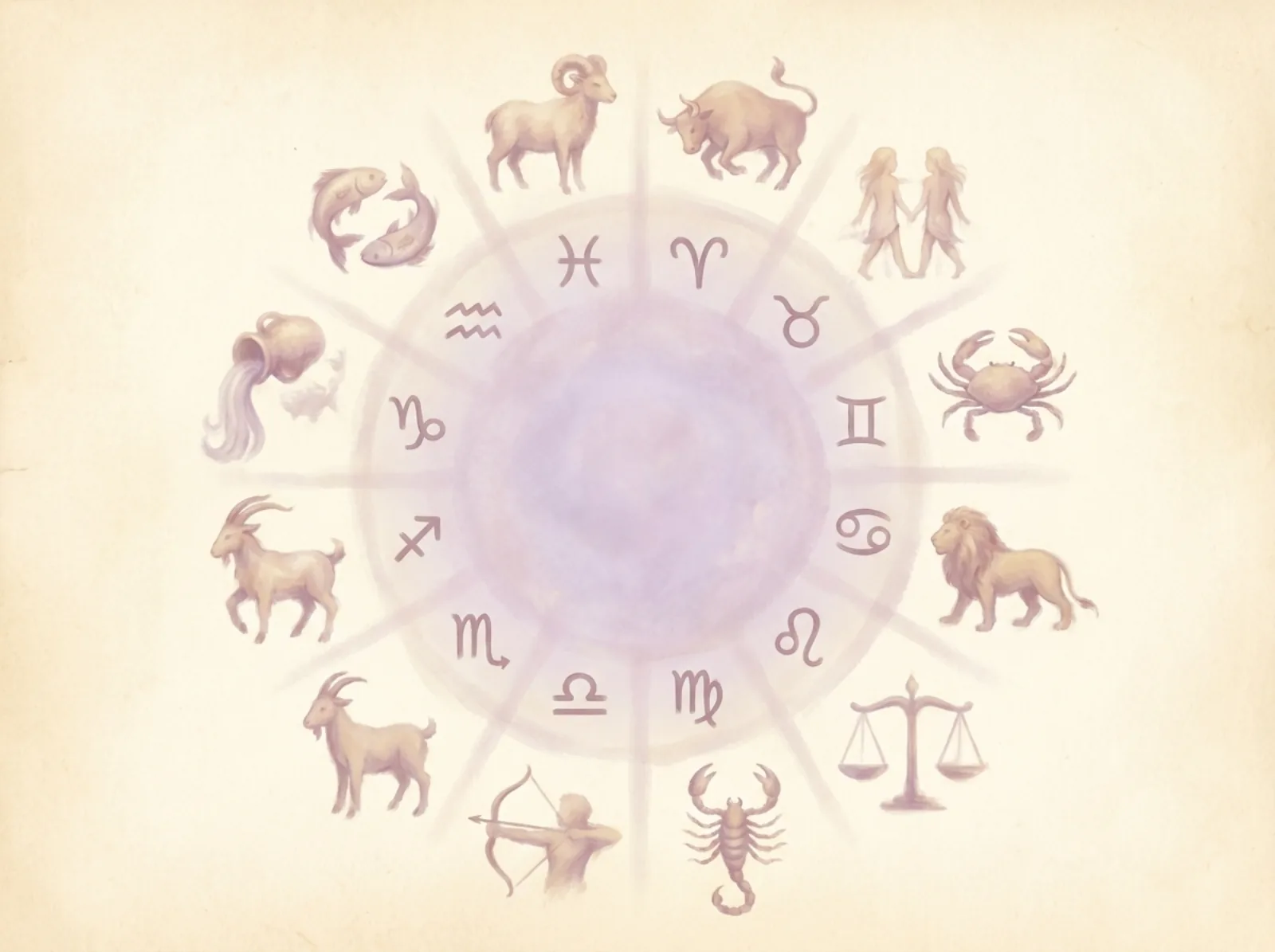
Before we zoom in on Mutable, you need to know what it's one of. Western astrology sorts the twelve signs into two overlapping grids: four elements (fire, earth, air, water) and three modalities, also called qualities — cardinal, fixed, and mutable. The modality tells you how a sign handles energy; the element tells you what kind of energy it handles. Part of our tarot library.
The simplest way I explain this to friends over coffee: cardinal signs start things, fixed signs sustain things, mutable signs change things. Each season on the Northern Hemisphere calendar has one sign of each modality. Spring opens with cardinal Aries, settles into fixed Taurus, and hands off to mutable Gemini. Summer opens with cardinal Cancer, holds steady through fixed Leo, and dissolves into mutable Virgo. The pattern repeats through autumn (Libra, Scorpio, Sagittarius) and winter (Capricorn, Aquarius, Pisces).
The job of a Mutable sign
Because the Mutable signs sit at the end of each season, their work is transition. They're the ones holding the door open while summer walks out and autumn walks in. That's not a metaphor the astrologers invented in 2015 — it goes back to Hellenistic astrology and the writings of Ptolemy, who used the Greek term tropikos for cardinal (turning), stereos for fixed (solid), and disomos for mutable (literally "two-bodied," because these signs contain the energy of two seasons overlapping). See our top astrology app guide.
Why modality matters more than you think
If you only read Sun-sign content, you probably think of signs as personality labels. Modality is useful because it's structural. Two signs with wildly different vibes — Virgo and Pisces, for example — share a core operating system because they're both Mutable. That's why a Virgo project manager and a Pisces songwriter will handle a sudden deadline shift in weirdly similar ways: both will quietly rework the plan rather than fight the shift. Understanding modality is how you stop seeing astrology as twelve isolated boxes and start seeing it as a system.
The Mutable Archetype: What All Four Signs Share
Mutable energy, at its purest, is intelligent adaptation. The Mutable signs are the ones who notice the weather changing before anyone else does. They're the editors, translators, mediators, bridge-builders. Across the four signs you'll see six traits show up again and again, dressed differently each time.
- Pattern recognition. Mutable signs collect information constantly, often without realizing it. They notice when a friend's text style shifts, when a boss's eye contact goes shorter, when a city's energy changes between seasons.
- Multiplicity. They hold several truths at once. A Gemini can genuinely love and critique the same person in the same breath. A Pisces can feel grief and gratitude in the same hour and treat both as real.
- Revision as a love language. They don't believe anything is finished. First drafts, first dates, first careers — all drafts.
- Discomfort with permanence. Signing a long lease, picking a tattoo, committing to one answer — Mutable energy flinches here. Not from fear, but from awareness of how much could change.
- Service orientation. Three of the four Mutable signs (Virgo, Pisces, and arguably Sagittarius through teaching) are associated with service in traditional texts. They often find meaning in being useful during transitions — hospice work, education, therapy, editing.
- Mental restlessness. Even the earthy and watery ones (Virgo and Pisces) have busy inner weather. The restlessness isn't anxiety by default — it's just that a Mutable mind rarely goes to sleep without turning over three or four open loops.
What all four share, underneath the different elements, is a kind of philosophical humility: the sense that any current position is temporary and probably incomplete. This is why Mutable people are often the best listeners you know and the worst at finishing a renovation.
How the Four Mutable Signs Differ: Gemini, Virgo, Sagittarius, Pisces
Same modality, four very different elements. Here's how the adaptation shows up for each one.
Gemini (May 21 – June 20): Mutable Air
Gemini adapts through information. Ruled by Mercury, this sign's native habitat is conversation, curiosity, and context-switching. Give a Gemini a new fact, a new book, a new person to talk to, and they'll rebuild their model of the world in real time. The classic Gemini talent isn't being two-faced (that's a tired stereotype) — it's being able to see the same situation from two angles simultaneously and genuinely argue both.
Virgo (August 23 – September 22): Mutable Earth
Virgo adapts through systems. Also ruled by Mercury, but anchored in the earth element, Virgo takes raw change and absorbs it into a workable process. Where Gemini wants to talk about the new information, Virgo wants to redesign the workflow to accommodate it. This is the sign that will reorganize their entire kitchen because they bought one new spice jar — and the kitchen will, annoyingly, work better afterward.
Sagittarius (November 22 – December 21): Mutable Fire
Sagittarius adapts through experience. Ruled by Jupiter, this sign treats life as a long self-education project with lots of field trips. Sagittarius doesn't rebuild its worldview from a book the way Gemini might; it rebuilds by going somewhere, trying something, and coming back changed. This is the Mutable sign most associated with travel, teaching, and belief systems — not because it's "spiritual" in a cliché way, but because it processes change by moving its body through new environments.
Pisces (February 19 – March 20): Mutable Water
Pisces adapts through feeling. Co-ruled by Jupiter in classical astrology and Neptune in modern, Pisces reads the emotional subtext of any room and adjusts accordingly. Where the other three Mutable signs process change cognitively, physically, or systemically, Pisces processes it energetically. This is the friend who texts you "are you okay?" twenty minutes before you knew you weren't okay. Pisces's adaptability is also its challenge: without strong boundaries, this sign can absorb the mood of whoever it's near and lose track of its own.
Mutable Signs in Love and Relationships
Here's where things get interesting — and where I get the most questions from people journaling in Raka about their Mutable partners. Mutable signs are often cast as either dreamy and emotionally generous (Pisces, Sagittarius) or detached and hard to pin down (Gemini, Virgo). The truth is messier.
What Mutable partners bring to a relationship
- They evolve with you. A Mutable partner will not be the same person five years in. If you want someone who grows alongside you, this is the modality.
- They give you range. Mutable partners rarely demand you be one thing. A Sagittarius partner wants to hear your contradictions. A Pisces will hold both your softness and your sharpness without flinching.
- They notice. Mutable signs pick up on micro-changes. A good one will clock that you've had a hard week before you say so.
Where Mutable partners struggle
The core challenge is commitment to a single direction. Mutable energy wants to keep options open, which is fuel for growth but friction for long-term planning. You might find yourself in a relationship where the big questions — whether to move, whether to have kids, whether to merge finances — stay open for years not because of avoidance but because your partner genuinely sees multiple valid paths and doesn't want to foreclose any of them.
I'm not writing this as a warning. I have Pisces placements myself, and I married another Mutable person. The thing that saved us is that we built a practice around decision windows — periods where we agreed to just pick, knowing we could revisit in six months. If you love a Mutable person, don't try to turn them cardinal. Build structure around the openness instead. Many of my readers tell me a dedicated reflection practice, whether in Raka's journal or a paper notebook, helps them notice when a Mutable partner's revisions are growth versus when they're avoidance — the distinction matters, and it's rarely obvious in the moment.
Love languages, by Mutable sign
Broadly: Gemini loves through conversation and shared curiosity. Virgo loves through quiet acts of care that make your life work better. Sagittarius loves through shared adventures and radical honesty. Pisces loves through emotional presence and willingness to feel everything with you. None of these are gendered — they show up in people of every gender identity.
Mutable Signs at Work and in Leadership
Modern workplaces have a weird relationship with Mutable energy. On paper, every job description now asks for "adaptability" and "growth mindset" — exactly the Mutable superpowers. In practice, promotion ladders still often reward the cardinal starters and fixed defenders. Here's what Mutable energy actually looks like at work, and why it's worth more than it gets credit for.
Natural Mutable career strengths
- Editing and iteration. Mutable signs are the best people on the team at taking a rough first version and refining it into something excellent. This is why so many Virgos end up in editing, product management, QA, and medicine — all fields where the second, third, and fourth passes matter more than the first draft.
- Translation. Gemini and Pisces especially tend to be good at translating between people, departments, and languages (literal and figurative). The engineer-to-marketing bridge role? Often a Gemini. The therapist who can explain what the lawyer is feeling? Often a Pisces.
- Teaching. Sagittarius dominates here, but all four Mutable signs make strong teachers because they're comfortable with the student's confusion as a starting place.
- Reading the room. In meetings, Mutable people often clock the political subtext before anyone else does. They're underrated allies in high-stakes conversations.
Mutable leadership style
Mutable leaders tend toward the servant-leader model more than the hero-founder one. They lead by removing friction, iterating fast, and keeping teams unstuck when conditions shift. They can struggle when leadership requires planting a flag and refusing to move — which is sometimes exactly what's needed in a crisis. The best Mutable leaders I know have deliberately learned when to switch into "fixed mode" and hold a line, even temporarily.
Where Mutable energy backfires at work
The biggest trap is revising past the point of value. A Mutable person can keep polishing a project forever because the next revision always feels like it could be better. The fix is external: deadlines, teammates who ship, and a rule like "version 1.1 ships even if version 2.0 is already in your head."
Compatibility: Mutable with Cardinal, Fixed, and Mutable
I want to flag something before we dive in: no sign combination is doomed and no sign combination is guaranteed. Compatibility is a soft tendency, not a verdict. With that said, here's how Mutable energy tends to play with the other two modalities.
Mutable with Cardinal (Aries, Cancer, Libra, Capricorn)
This pairing can be dynamite — in both senses of the word. Cardinal signs start things; Mutable signs refine them. A Capricorn who launches a business and a Virgo who optimizes its operations are a dream team. The friction shows up when the Cardinal partner wants a clear decision now and the Mutable partner wants to see how it unfolds. Cardinals can read Mutable openness as indecision, and Mutables can read Cardinal certainty as rigidity. The gift here, when both partners stay curious, is momentum plus refinement.
Mutable with Fixed (Taurus, Leo, Scorpio, Aquarius)
This is often the most stabilizing combination for Mutable people — and sometimes the most frustrating. Fixed signs hold a position; Mutable signs want to revisit it. The friction is obvious: a Taurus who has decided they like the Thai place on Tuesdays will not be charmed by their Gemini partner's eighteenth suggestion that they try somewhere new. The gift, when both lean in, is a Fixed anchor that lets Mutable creativity actually land. Many of the most creatively productive couples I've worked with have one of each.
Mutable with Mutable (Gemini + Virgo + Sagittarius + Pisces, in any pairing)
Delightful or chaotic, often both. Two Mutable partners share a love of exploration, revision, and shared curiosity. The risk is that nobody books the restaurant, nobody files the taxes, and nobody ends the argument. Mutable-Mutable pairings thrive when at least one partner has strong Cardinal or Fixed placements elsewhere in the chart — a Pisces Sun with Capricorn rising is already carrying some structural energy, for example. If you're both pure Mutable, build structural habits deliberately: weekly planning sessions, agreed-upon decision deadlines, split responsibilities.
A note on "compatible signs"
You'll see lists online declaring that Gemini is "compatible with" Libra and Aquarius, and so on. These lists are based on element compatibility (air with air) and are useful as a starting point, but they're not destiny. I've seen a Pisces-Capricorn marriage that's been radiant for twenty years and a Gemini-Libra pairing that collapsed in six months. Modality tells you about operating style; actual compatibility is about shared values, communication, and consent.
The Shadow Side of Mutable Energy
Every modality has a failure mode, and Mutable's is specific enough that it's worth naming clearly so you can spot it in yourself. Mutable shadow isn't "being a flake" — that's lazy stereotyping. The real shadow is subtler.
Chronic revision
Mutable energy can get stuck in an infinite loop of "let me think about it once more." Every reconsideration feels productive, but at some point reconsidering becomes a way to avoid committing. The signature of this shadow is feeling busy and progress-less at the same time. You've been working on the thing for months and the thing hasn't moved.
Scattering
Mutable people often have more open projects than any one human can finish. The novel, the online course, the side business, the podcast idea, the move abroad — all live in different stages of partial completion. Scattering feels like range in the moment and feels like regret five years later.
Shape-shifting past yourself
This one hits Mutable water (Pisces) and Mutable air (Gemini) the hardest. If you're wired to adapt to whoever you're with, you can lose track of what you actually want. You start reflecting other people's preferences so smoothly you forget they aren't yours. The warning sign: you can describe every friend's dream life in detail and feel completely blank when asked about your own.
Over-explaining and over-qualifying
Mutable signs often hold too many perspectives at once to speak plainly. You end up with sentences full of "well, it depends" and "on the other hand." This is a strength in nuanced analysis and a weakness in situations that need a decisive voice.
The fix is not to become fixed
The temptation when you spot your own Mutable shadow is to try to turn into a fixed sign — plant a flag, pick a lane, never change your mind. This usually backfires because it fights your native wiring. The real work is committing to commitment windows: periods where you deliberately stop revising, ship what you have, and let it live for a defined stretch before you touch it again.
Celebrity Examples: One Per Mutable Sign
Let me show you Mutable energy in the wild. I've picked one well-known person per sign who demonstrates the archetype — not because celebrities are better examples than regular people, but because their public patterns are visible enough that you can see the energy without having to know them personally.
Gemini: Angelina Jolie (born June 4, 1975)
Jolie's career is a textbook Gemini range: film actress, screenwriter, director, UN special envoy, author, humanitarian. She's publicly reinvented her focus multiple times — early-career edgy roles, prestige work, directing, long stretches away from acting to do field work with refugees. That capacity to be a serious actor and a serious humanitarian without flattening either role is Gemini at its best: holding multiple identities as all real.
Virgo: Beyoncé (born September 4, 1981)
Beyoncé's working process is pure Mutable earth. The famously obsessive attention to detail, the rehearsal footage that goes viral because of how much iteration it reveals, the surprise album drops that are actually the product of years of refinement — this is Virgo adapting through systems. She's not improvising; she's running a workflow most people would find exhausting, and polishing every layer of it.
Sagittarius: Taylor Swift (born December 13, 1989)
Swift is a working case study in Sagittarian adaptation through experience. Country, pop, indie-folk, re-recorded masters, stadium tours that rewrite industry economics — each era is a genuine shift, not a costume change. The willingness to publicly change her mind (politics, re-recordings, her relationship with fame) is Sagittarian honesty showing up as career strategy.
Pisces: Rihanna (born February 20, 1988)
Rihanna's trajectory from pop star to Fenty mogul reads as Mutable water in full flow. The emotional attunement in her vocal performances, the intuitive sense for what audiences will want before they know it (Fenty's shade range landed because she felt what was missing), the willingness to disappear from music for years because she was elsewhere emotionally — this is Pisces trusting feeling as information. The business success is almost a byproduct of accurate emotional reading.
Chart Balance: Too Much Mutable, Too Little Mutable
Your Sun sign is only one data point. A full birth chart has ten planets plus the Ascendant and Midheaven distributed across the signs, and the overall modality balance matters more than any single placement. Here's what the two extremes look like.
If you have a lot of Mutable energy
By "a lot" I mean three or more personal planets (Sun, Moon, Mercury, Venus, Mars) in Mutable signs, or a Mutable Sun plus Mutable rising. People with heavy Mutable charts often describe their lives as permanently in-progress. They've had three or four distinct careers. They've lived in multiple cities. Their closest friendships span years but reshape themselves regularly. The gift is range. The risk is never choosing.
If this is you, the practice I'd suggest is designing in anchors. Pick one or two things in your life that you deliberately will not revise for a defined stretch — the apartment lease, the weekly therapy appointment, the Sunday morning run. Not because you're incapable of changing them but because stability in one or two places gives your Mutable energy somewhere to come home to.
If you have little or no Mutable energy
Charts with mostly cardinal and fixed placements can feel like trying to turn a battleship whenever life demands a pivot. These people often have very clear identities, strong opinions, and the stamina to see things through — but they can experience change itself as draining in a way Mutable people don't fully understand.
The practice here is deliberate review points. If adaptation isn't your natural rhythm, you have to schedule it. Pick a quarterly date to honestly ask: is this job, this relationship, this habit still serving me? Don't rely on noticing in the moment, because your wiring is to hold the line. Journaling tools, including Raka's monthly reflection prompts, exist partly for this reason — to give non-Mutable charts a structured place to practice the pivot.
What about the "missing modality"?
Some charts have very little of one specific modality. This is normal and doesn't mean something is broken. A chart with no Mutable placements doesn't mean you can never adapt — it means adaptation isn't your default and you'll grow by consciously building the skill. The same logic applies to charts missing cardinal (practice starting) or fixed (practice sustaining).
How to Work With Mutable Energy When You're Stuck
Whether you're Mutable yourself or you're navigating a Mutable season (we all have one coming up every three months), here's the practical toolkit I return to.
When Mutable energy is working against you
- Set a "version 1 ships" rule. Pick a date. On that date, whatever you have ships, even if the next revision is already in your head. You can revise after it's out.
- Shrink the decision. If you've been stuck between three options for weeks, pick two and discard one by a coin flip. Reducing the field from three to two often reveals which of the two you actually wanted.
- Externalize the anchor. Tell a friend what you're committing to and when. Mutable energy respects social contracts more than internal ones.
- Honor the one-week pause. If you've been revising something for more than a month, stop touching it for seven full days. Come back fresh. Nine times out of ten you'll see it's already good enough.
When you need Mutable energy and don't have it
- Journal for pattern breaks. Writing freely for ten minutes — in a notebook, in Raka, wherever — often surfaces assumptions you didn't know you were defending. Mutable energy is the willingness to see those assumptions and consider dropping one.
- Change one small input. New coffee shop. New route to work. New time of day for your workout. Small environmental shifts can unlock pivots in bigger areas, which is why Sagittarius people travel when they're stuck.
- Ask the "what else" question. Whatever position you've taken, ask: what else could be true here? You don't have to adopt the alternative. Just hold it long enough to loosen your grip on the first answer.
A closing note from me
Mutable energy, at its best, is the astrological case for intellectual humility. It's the reminder that we are not finished — that any version of ourselves is a draft of a later version. If you're reading this and you're a heavily Mutable person who has been told you're flaky, scattered, or too much, I want you to know: that's one reading. Another reading is that you're wired to notice when the world has moved and to move with it. The world desperately needs more of that, not less. Pair it with a few anchors, and you have one of the most useful operating systems a human can carry.
Frequently asked questions
Which zodiac signs are mutable?
The four mutable signs are Gemini (air), Virgo (earth), Sagittarius (fire), and Pisces (water). Each one closes out a season — Gemini ends spring, Virgo ends summer, Sagittarius ends autumn, Pisces ends winter — which is why they share a talent for adapting as one chapter rolls into the next.
What does mutable mean in astrology?
Mutable is one of three modalities (alongside cardinal and fixed) that describe how a sign handles energy. Mutable signs adapt, revise, synthesize, and bridge. They're wired for change rather than for starting something new (cardinal) or holding something steady (fixed). Think editor rather than founder or defender.
Are mutable signs really more flexible than cardinal or fixed signs?
They're more flexible with plans and context, yes — a mutable sign will cheerfully rewrite the whole evening at 7pm. But flexibility isn't the same as being easygoing. A Virgo can be rigid about systems, a Pisces can be stubborn about feelings. The flexibility shows up around external circumstances, not necessarily internal convictions.
Which mutable sign is the most adaptable?
Honestly, they tie — but adapt in different directions. Gemini adapts to new information, Virgo adapts to new systems, Sagittarius adapts to new environments, and Pisces adapts to new emotional atmospheres. If I had to pick one for raw "drop you anywhere and you'll survive," I'd say Sagittarius. For "navigate any social room," Gemini.
Can two mutable people date each other?
Yes, and it can be delightful or disastrous. The upside: no one guilt-trips the other for changing their mind. The downside: nobody books the restaurant, finalizes the lease, or ends the fight. Mutable-mutable couples thrive when at least one of them has strong cardinal or fixed placements elsewhere in the chart to anchor decisions.
What if my birth chart has no mutable signs?
A chart with little mutable energy tends to hold positions firmly and start new things easily, but can struggle to pivot when the plan stops working. People with no mutable placements often feel exhausted by change itself. The fix isn't to force mutability — it's to deliberately build in review points so you're not caught off guard.
Is being mutable a weakness in leadership?
Only if you define leadership as never changing course. Mutable leaders are strong at reading the room, iterating, and keeping teams unstuck when conditions shift. They can struggle with the "plant a flag and don't move it" part of the role. Pair a mutable leader with a fixed-sign number two and the combination is formidable.