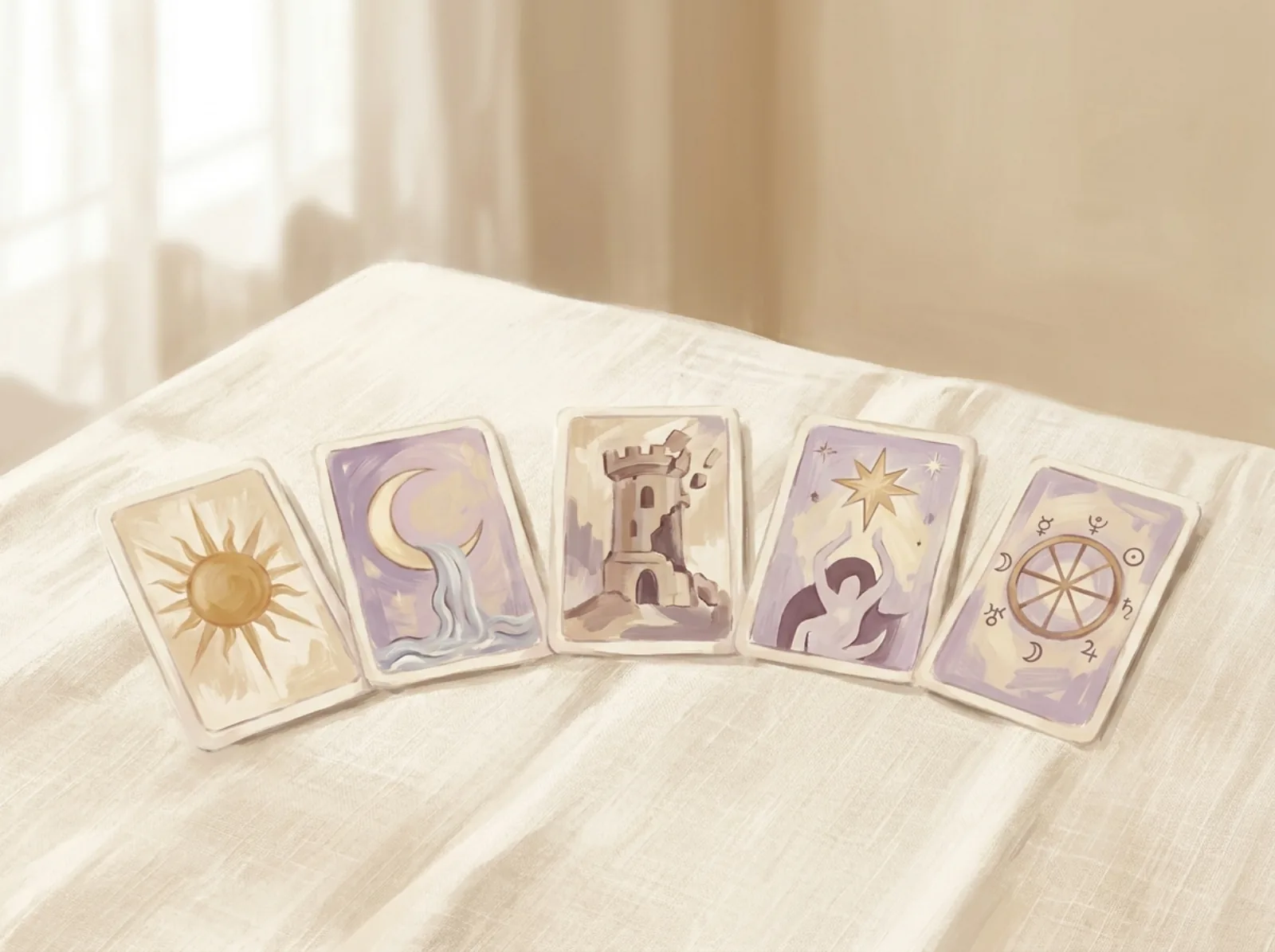
What Is Electional Astrology, Really?
Electional astrology is the practice of choosing a moment — an election — to begin something important. It's one of the four classical branches alongside natal, mundane, and horary. The idea is simple: every moment has a chart. The sky looks a particular way at 2:14 p.m. on a Saturday in May, and that configuration will stamp whatever you start under it. Part of our tarot reference.
For weddings, the moment that matters most is the one you legally become married — not the first dance, not when the vows end, not when you walk back down the aisle. In most Western jurisdictions that's when the officiant pronounces you married, or when you sign the register. I tell couples to decide this up front, because it changes everything about the chart.
Where This Tradition Comes From
Electional astrology shows up in texts from Dorotheus of Sidon (first century CE) and runs clear through medieval Arabic astrologers, Renaissance Europeans, and into contemporary Western practice. Dorotheus devoted an entire book to marriage elections, and a surprising amount of his advice — Moon in a fruitful sign, benefics well-placed, no afflicting Mars — would still fly today. See our best AI tarot app guide.
What's changed: modern astrologers (think the AstroTwins, Chani Nicholas, Austin Coppock) tend to weigh psychological factors more and treat planets like Pluto, Neptune, and Uranus with as much seriousness as the classical seven. Outer-planet transits weren't on Dorotheus's board. On mine, they absolutely are.
The Realistic Promise
Here's what good electional astrology does and doesn't do:
- It can help you sidestep windows that are statistically rough for commitments — things like Venus retrograde, major eclipse pairs, or a Moon that's about to argue with Saturn.
- It can give you a day where the symbolism aligns with your intentions — a warm Venus, a courageous Mars, a Moon in a sign that supports growing something.
- It cannot guarantee outcomes. Astrology is a language of timing and symbolism, not a lever on reality.
- It will not override a bad match. If the partnership is a mess, no Jupiter trine saves it.
Keep that frame close. Everything else in this piece sits on top of it.
The Core Checklist: What a Strong Wedding Chart Looks Like
If I had to boil wedding-date astrology down to a one-page checklist, this would be it. These are the things working Western astrologers actually look for, in rough order of importance.
Venus — The Wedding Planner's Planet
Venus governs love, relationships, and whether a day feels pleasant to be in. In an election chart, you want Venus:
- Direct, not retrograde (non-negotiable for most of us).
- In a sign she's happy in — Taurus, Libra, Pisces, or Cancer are strong placements; Aries, Scorpio, and Virgo are harder.
- Not under tight attack from Saturn, Mars, or especially Pluto.
- Ideally making a soft aspect to Jupiter — a trine or sextile, the big yes.
A chart where Venus is strong feels like a day where people are kind, the food tastes better, and the vows actually land.
The Moon's Mood
If Venus is the planner, the Moon is the atmosphere. Three Moon questions I always ask:
- Is she void of course? A void-of-course Moon (one making no more major aspects before she changes signs) is the classical no-go. The traditional phrase is 'nothing will come of the matter.' For a wedding, that's inauspicious enough to move the ceremony time by an hour or two.
- What sign is she in? Fruitful signs — Cancer, Taurus, Pisces, Libra — are old-school favorites for marriage. The barren signs (Gemini, Leo, Virgo in older systems) are classically avoided, though modern astrologers hedge this.
- What's her next aspect? You want her applying to a benefic — Venus or Jupiter — not to Saturn square or Mars opposition.
The 7th House and Its Ruler
The 7th house is the house of marriage, partnership, and open contracts. In your election chart, you want:
- A benefic (Venus, Jupiter) in or ruling the 7th, if possible.
- The 7th house ruler in a strong, dignified position — not retrograde, not combust, not stuck in a hard square to Saturn.
- The Ascendant (your self on the day) and the 7th-house cusp (your partner) in a flowing relationship.
Angularity
Planets on the angles — the Ascendant, the Midheaven, the Descendant, the IC — are loudest in an election chart. You want benefics on angles and malefics tucked away. A Jupiter rising on your wedding morning is a gift. A Saturn on the Midheaven when you say 'I do' is something I'd personally reschedule around.
Dates to Avoid and the Reasons Astrologers Flag Them
Half of wedding date astrology is addition. The other half is subtraction. Here are the windows I urge couples to work around, in rough order of how firmly I'd move the date.
Venus Retrograde — The Big One
Venus retrograde happens roughly every 18 months and lasts about 40 days. Working Western astrologers almost universally tell couples not to marry during one. The symbolism is Venus going backwards — relationships revisited, old loves resurfacing, values re-examined. All beautiful material for therapy. Rough material for a Saturday wedding.
According to CafeAstrology's retrograde tables and Astro.com's ephemeris, Venus is retrograde roughly October through November 2026. Pencil that window out of your options early.
Mercury Retrograde — The One Everyone Mentions
Mercury retrograde gets a louder reputation than it deserves — but for a wedding specifically, you're signing a legal contract, booking vendors, and relying on travel to work. Those are Mercury's job. Avoiding Mercury retrograde for the actual ceremony date is sensible. Doing all your planning during one is honestly fine; messages just take two tries.
Mercury retrogrades roughly three times a year. For 2026 and 2027, check Astro.com's ephemeris before locking anything.
Eclipses — Don't Build on Shifting Ground
Eclipses, both solar and lunar, are the sky's reset buttons. Classical electional astrology treats eclipse windows (roughly two weeks before and after) as unstable foundations. I agree. Weddings on or next to eclipses can feel fated — and that's exactly the problem. Fate isn't a mood you want narrating your first anniversary.
Void of Course Moon at the Ceremony Moment
Already covered, but worth repeating: if the Moon goes void during your ceremony, the traditional reading is that 'nothing comes of the matter.' Even if you don't believe it, moving your 'I do' moment by 30 minutes to clear the void is costless.
Mars Square or Opposition Venus
Mars and Venus in hard aspect is the archetypal fight. Not catastrophic, but you'll feel it — tempers short, people drinking faster, someone's uncle picking a fight by 10 p.m. If this aspect is exact on your date, I'd push by a few days.
Pluto on the Descendant
A Pluto conjunction, square, or opposition to the Descendant on your wedding day is heavy. Pluto in the house of partnership is transformational, obsessive, and sometimes shadowy. For most couples, I'd dodge it.
Full Moon Weddings: Beautiful or Bad Idea?
Every wedding season I get the same question: should I get married on a Full Moon? And every season my answer is the same unsatisfying one: it depends on the Full Moon.
The Case Against
Classical electional astrology is suspicious of Full Moons for weddings. The reasoning: a Full Moon is the lunar cycle's peak — things are being released, culminated, exposed. Marriage is a beginning. You want a waxing Moon for beginnings; waning Moons are for closures.
There's also a practical argument. Full Moons are intense. Emotions run higher, sleep gets weirder, and the pre-wedding week lands harder than it would in a quieter lunar phase. If you're a highly sensitive couple or either of you is a Cancer, I'd factor that in.
The Case For
Modern astrologers like the AstroTwins have softened this one. If the Full Moon is in a relationship-friendly sign (Libra, Taurus, Cancer, Pisces) and is making a supportive aspect to Venus or Jupiter, a Full Moon wedding can feel genuinely celebratory. You're marrying under maximum light, which is its own symbolism.
Full Moon weddings also photograph beautifully. If you're outdoor-ceremonying with a late-afternoon ritual, the rising Full Moon as backdrop is unbeatable — ask any wedding photographer.
The Working Rule
I give couples a two-part filter:
- Avoid Full Moons that square Pluto, Saturn, or Mars. Those lunations are shadow work. Save them for therapy, not vows.
- Consider Full Moons in Libra, Taurus, Cancer, or Pisces — especially if they're trine or sextile Venus. These can be gorgeous dates.
And if you're on the fence? Pick the waxing crescent through first quarter phase instead. It's traditional, symbolically crisp (building toward fullness), and completely non-controversial among working electional astrologers.
Favorable Wedding Windows in 2026
I don't believe in 'the perfect date' and I don't publish single-date rankings — the right chart depends on your natal placements, your location, and your ceremony time. But here are the windows for 2026 that most Western electional astrologers I respect are quietly bookmarking.
Spring 2026
The late April through mid-May 2026 window is strong. Venus moves through Taurus — her home sign and traditionally her best — and the Sun joins her for part of May. Taurus Venus loves ritual, flowers, food, physical presence. If you're planning a sensory, grounded wedding, this is your season.
Watch for the Taurus Sun's exact alignments and avoid eclipse windows that fall in late March. A ceremony in the first ten days of May 2026 can be particularly rich if your couple's charts work with it.
Early Summer 2026
Late May through mid-June, before Mercury retrograde begins, offers a Gemini Sun phase that's lively, verbal, and great for couples whose relationship is built on conversation. The AstroTwins have historically recommended Gemini-season weddings for couples who want 'fun first' over gravitas.
Avoid the exact Mercury retrograde window. Check Astro.com's current ephemeris to pin precise dates.
Late Summer 2026
The classic wedding season — late August through mid-September 2026 — is particularly favorable this year, with Venus moving through Virgo and Libra and no Mercury retrograde interfering. Virgo Venus loves ceremony done well; Libra Venus loves the celebration itself. A late-August 2026 wedding has strong supporters among working electional astrologers.
What to Skip in 2026
- Mid-February through early March 2026 (Mercury retrograde window).
- Mid-June through early July 2026 (Mercury retrograde window).
- Mid-October through late November 2026 (Venus retrograde — the big one).
- Any date within two weeks of an eclipse — 2026 brings eclipses to the Aries-Libra and Virgo-Pisces axes.
Favorable Wedding Windows in 2027
2027 is, broadly, a kinder electional year than 2026 for weddings. Venus doesn't retrograde at all (her next retrograde after late 2026 doesn't begin until 2028). That alone opens up more usable Saturdays.
Late Spring 2027
Mid-May through mid-June 2027, before Mercury retrograde, is a classic strong window. Venus moves through Cancer and Leo — Cancer Venus for the family-rooted wedding, Leo Venus for the big, generous, romantic one. If you're on the fence between a quiet garden ceremony and a 200-guest celebration, let your Venus-sign preference decide.
Early Fall 2027
Late August through early October 2027 is another classic window. The Sun moves through Virgo and Libra, Venus is well-placed, and eclipse disruptions settle. Libra Venus season — around the autumn equinox — has historically been one of the most-chosen windows by Western astrologers for marriage. The symbolism is almost too on-the-nose: balance, harmony, partnership, the scales.
Watch-Outs for 2027
- Mercury retrogrades roughly three times — pin them against your preferred weekend before committing.
- Jupiter and Uranus make important shifts in 2027 that affect your natal chart differently depending on your signs. If you want precision, run your personal chart against the date, not just the daily ephemeris.
- Avoid eclipse pairs. 2027 has a notable total solar eclipse in August — give it two weeks of space on either side if you want electional cleanliness.
If you're planning far ahead and want a sanity check without hiring a full-service astrologer, Raka's AI astrology companion will walk you through the symbolism of any proposed date — not as a verdict, but as a conversation about what the sky is doing when you say 'I do.'
Zodiac-Specific Timing for Brides and Grooms
Your Sun sign isn't the whole story — your Venus sign and your 7th house ruler matter more for marriage — but it's where most people start. Here's a quick-reference for which season each Sun sign tends to thrive in, from a Western electional lens.
- Aries: Late spring through early summer. Avoid winter weddings — too slow for Aries energy. Favor Mars-friendly days: Tuesdays with a strong Mars placement.
- Taurus: Your season. Late April through mid-May is where Taurus feels most itself. Venus is on your side almost automatically.
- Gemini: Late May through mid-June. You want a Mercury-strong chart. Avoid Mercury retrograde like your sanity depends on it, because it kind of does.
- Cancer: Late June through late July. Full Moons in Capricorn are not for you — too opposing. Favor New Moons in Cancer or Taurus.
- Leo: Late July through August. Favor Sun-strong, grand-feeling dates. Avoid cramped winter Saturdays — Leo needs room to perform.
- Virgo: Late August through mid-September. You want a chart with meticulous Mercury placement. Earth signs favor you.
- Libra: Late September through mid-October — your season and one of the strongest marriage seasons generally. Venus-ruled, naturally.
- Scorpio: Late October through early November, but avoid the Venus retrograde window of 2026. Favor water signs on the Ascendant.
- Sagittarius: Late November through mid-December. Favor Jupiter-strong dates. Avoid rushed December weddings around holidays — Sag needs breath.
- Capricorn: Late December through January, if you can handle a winter wedding logistically. Saturn-strong dates with Venus in Capricorn are rare but potent.
- Aquarius: Late January through mid-February. Favor Uranus-friendly dates. Unconventional times (Tuesday afternoon, elopement) often work better than classic Saturdays.
- Pisces: Late February through mid-March, carefully — eclipse windows in 2026 touch Pisces hard. Favor water-sign Moons.
If you and your partner are different seasons, the practical advice is to meet in the middle — the shoulder months between your two preferred windows — and let the specific chart details decide, not the Sun sign alone.
How Famous Couples May Have Picked Their Dates
I don't know for certain which celebrity couples hired electional astrologers. What I do know is their actual wedding dates, and running them through a Western chart is instructive. These are real couples with real public dates — my commentary is interpretation, not insider knowledge.
Prince William and Kate Middleton — April 29, 2011
A spring Taurus-season date with Venus in Aries and a Pisces Moon through much of the ceremony window. Taurus-season weddings tend to emphasize endurance and the physical. The Pisces Moon added a soft, almost sacred quality to the day. Reportedly chosen partly for royal family logistics — but it's a fine chart regardless.
Beyonce and Jay-Z — April 4, 2008
Spring, Sun in Aries, Venus in Pisces (strong placement for Venus). A chart with that much Pisces Venus energy favors devotion over spectacle — which fits a couple who kept the wedding small and private.
Meghan Markle and Prince Harry — May 19, 2018
Taurus Sun, Venus in Gemini, Cancer Moon. A date that balances the classic (Taurus solidity) with the modern (Gemini Venus is curious, conversational, media-friendly). Whoever advised them picked a chart that photographed well and read well symbolically.
Priyanka Chopra and Nick Jonas — December 1 and 2, 2018
Two ceremonies, two charts. The Western ceremony on December 2 landed with the Sun in Sagittarius, Venus in Scorpio, and a Scorpio Moon. Scorpio Venus is intense and loyal — fitting for a couple who publicly leaned into commitment theatre with the double ceremony.
What to Take From This
These are all chosen dates that worked for the couple, their families, and their logistics. None of them are 'perfect' by strict electional standards. The lesson isn't that these couples cracked a cosmic code — it's that a workable date is more important than a theoretically perfect one, and most strong public marriages happen on charts that are 'pretty good' rather than textbook flawless.
The Limits of Electional Astrology
Here's where I lose some of you. I believe in this craft, and I'm about to tell you where it stops.
It Can't Fix a Bad Match
No election chart saves a marriage between two people who shouldn't be marrying. If one of you is unresolved about commitment, if there's unprocessed grief or active addiction, if the fundamental values don't line up — a well-timed Jupiter trine is confetti on a sinking boat. The pre-marital work matters more than the wedding chart. Always.
It Can't Predict Divorce
I don't publish divorce timelines based on wedding charts and I'd ask you to be skeptical of any astrologer who does. Charts show patterns; they don't deliver verdicts. A wedding chart with Saturn on the Descendant doesn't 'predict' divorce — it describes a partnership with weight, responsibility, maybe a longer-than-average courtship. Some of the longest marriages I've seen have Saturn all over them.
It Can't Compete With Real Astrological Synastry
Your synastry — how your two natal charts interact — matters more than any wedding date. A couple with warm synastry (good Venus-Mars contacts, trining Suns and Moons) and a mediocre wedding chart will almost always outlast a couple with tense synastry and a flawless wedding date. Prioritize the relationship audit before the date audit.
It Can't Make the Legal and Emotional Pieces Line Up
The date your officiant pronounces you married is the chart that technically 'counts.' But if you had a private commitment ceremony three years earlier that felt more real, your marriage has two charts emotionally. Both matter. Western electional astrology isn't a replacement for the inner work of deciding when, actually, you became committed.
For couples who want a thoughtful, non-prescriptive conversation about their proposed date and what it symbolizes — not a verdict — AI companions like Raka can walk you through the chart in plain English, including the parts that don't look great. It's a reflection tool, not a crystal ball.
Working With the Date You Already Have
Most people reading this already have a date — because of the venue, the family, the budget, or the sheer impossibility of coordinating three sets of parents' schedules. That's fine. Here's how to work with a fixed date.
Move the Ceremony Time, Not the Day
You can almost always improve a wedding chart by shifting the ceremony time by 30 to 90 minutes. The planets don't move much in that window, but the Ascendant moves one degree every four minutes, which means angles shift, houses rotate, and planets slide from 'awkward 12th-house exile' to 'triumphant 1st-house rising.'
A trained electional astrologer can pin a specific ceremony minute that pulls Venus to the Ascendant, or Jupiter to the Midheaven, on your fixed date. This is one of the most practical, cheapest wins in wedding astrology.
Choose Your Vow Moment Intentionally
If you can't move the whole ceremony, you can time the vow exchange. The moment you actually say your vows is energetically charged, and a 15-minute shift can land that moment under a kinder lunar aspect.
Lean Into What the Chart Has
Every chart has strengths. If your date has a strong Jupiter, lean into generosity — a bigger guest list, longer toasts, abundant food. If your date has a strong Venus, let the aesthetic lead — more flowers, better music, a slower pace. If it's a strong Mars chart, make it passionate — fiery vows, bold colors, a confident ceremony.
Add a Private Ritual at a Better Astrological Moment
If your legal ceremony has to happen on an electionally awkward date, add a private ritual — just the two of you, maybe at sunrise — at a better moment. Vows written and read to each other under a Venus-Jupiter trine, even without a license, can energetically anchor the commitment. This is what a lot of couples who hire electional astrologers after booking their venue end up doing.
None of this is magic. All of it is intentionality — using the symbolism of the sky to shape the symbolism of your day.
Frequently asked questions
Is wedding date astrology scientifically proven?
No — astrology isn't a predictive science by the standards of mainstream empirical research. It's a symbolic language with a long tradition, and the honest claim is that it offers a frame for intentionality, not evidence-based outcomes. Treating it as self-reflection and ceremonial design is fair; treating it as outcome prediction is not. If you want to engage with wedding date astrology, do so for the symbolic and ritual value, not as a replacement for pre-marital counseling or honest conversation with your partner.
Should I avoid getting married on Friday the 13th?
Friday the 13th is a cultural superstition, not an astrological one. Western electional astrology doesn't flag the date number — it flags the actual sky on that day. A Friday the 13th with Venus well-placed and a flowing Moon is a better electional date than a plain Saturday under Venus retrograde. Pick your date by what the chart actually says, not by the numeric coincidence.
What's the best day of the week to get married astrologically?
Classical electional astrology associates each day with a planet: Friday is Venus's day, which makes it the traditional favorite for weddings. Sunday (Sun — vitality) and Thursday (Jupiter — expansion, blessing) are also strong. Saturday (Saturn — restriction, structure) is the modern wedding default for logistical reasons but is actually the least classically favorable. If you're choosing freely, Friday or Thursday beats Saturday.
Does my natal chart matter more than the wedding date?
Yes — your natal chart and your partner's natal chart, plus your synastry (how your two charts interact), matter substantially more than the wedding date chart. The wedding date is the opening scene; the natal charts are the whole book. If you have to prioritize, invest in a synastry reading before investing in a full electional one.
Can I use an AI app like Raka to pick my wedding date?
AI astrology apps are useful for exploring the symbolism of candidate dates — walking you through what Venus is doing, where the Moon is, whether Mercury's retrograde — in plain language. They're well-suited to the exploratory phase. For a final, precise electional reading pinned to your natal chart and location, a trained human astrologer still has the edge. Many couples use AI tools like Raka to narrow their options and then run the shortlist past a professional.
What if my wedding is during Mercury retrograde?
Thousands of weddings happen in Mercury retrograde every year and the overwhelming majority of them are fine. The practical risks are travel disruption, vendor miscommunication, and lost paperwork — all manageable with buffer time and backup plans. If your date is fixed and lands in Mercury retrograde, confirm every vendor twice, build travel in a day early, and double-check the marriage license paperwork. The symbolism is less about doom and more about 'reread everything.'
Is a Full Moon wedding bad luck?
Not inherently. Classical electional astrology prefers waxing phases for beginnings, but modern practice is more nuanced. A Full Moon in a relationship-friendly sign (Libra, Taurus, Pisces, Cancer) with soft aspects to Venus or Jupiter can be a stunning wedding chart. A Full Moon squaring Pluto or Saturn is where I'd move the date. Judge the specific lunation, not the phase alone.