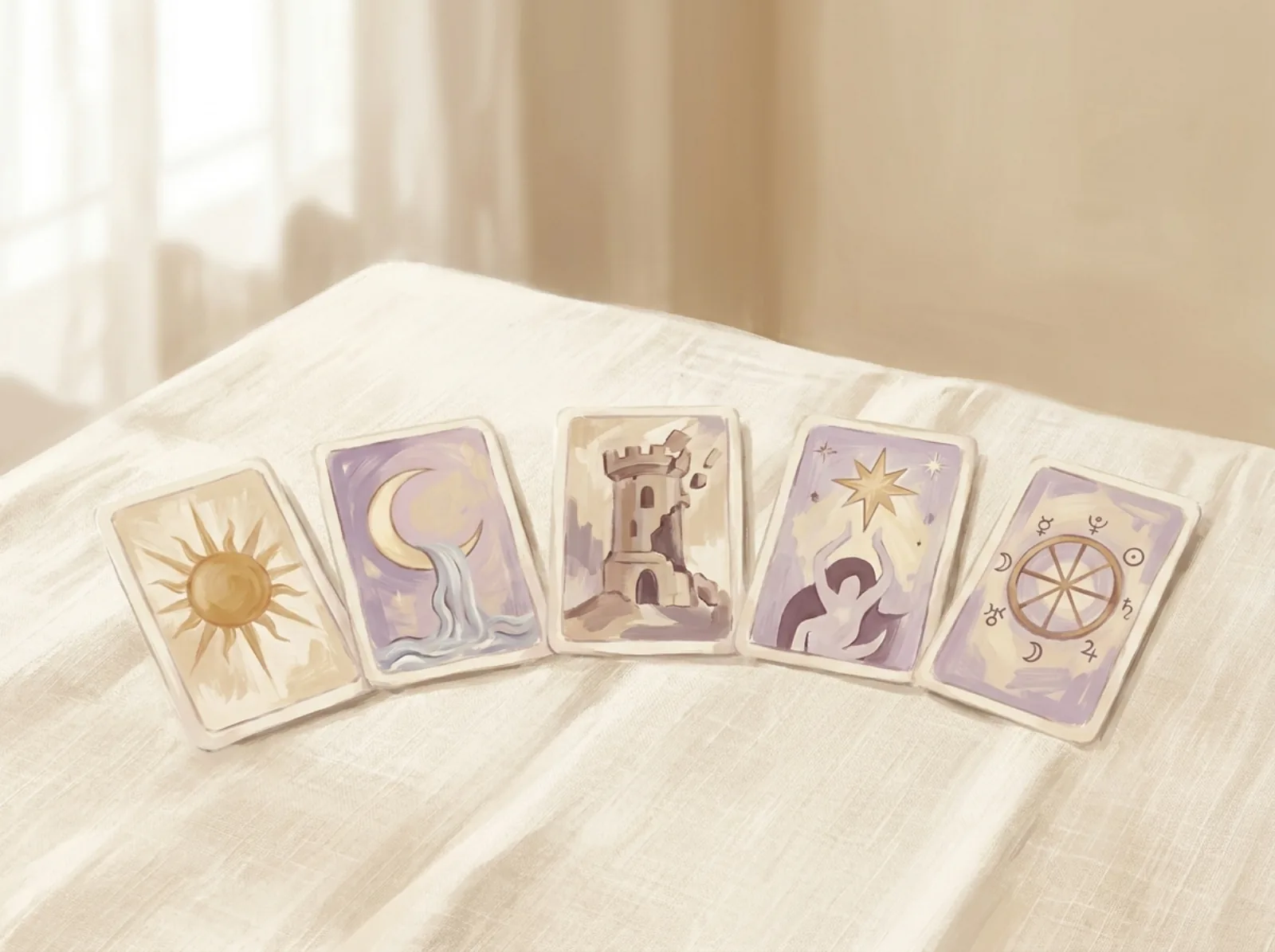
The ancient art of naming by the stars
Humans have been naming babies by the sky for about as long as we've been writing anything down. The practice is older than most organized religions and almost as old as agriculture itself. A few examples worth knowing before we go further: Part of our astrology guide hub.
- Vedic India uses the nakshatra system — 27 lunar mansions — to assign the first syllable of a baby's name based on exactly where the moon sat at birth. A child born under the Rohini nakshatra, for instance, traditionally receives a name starting with O, Va, Vi, or Vu.
- Celtic cultures relied on the Ogham tree calendar, loosely matching birth months to sacred trees (Birch, Rowan, Ash) and offering names drawn from those correspondences.
- Ancient Greece and Rome leaned on theophoric naming — attaching a baby to a planetary deity. Think of Mars-adjacent names like Marcus, Martina, or Marcella. Jupiter babies often got Jovian names like Jovita.
- Chinese Bazi, or Four Pillars astrology, factors in the hour, day, month, and year of birth to balance five elements, and names are sometimes chosen specifically to top up a deficient element.
- Jewish mysticism blends gematria — the numerical value of Hebrew letters — with planetary associations, so a letter's hidden weight shapes the parents' choice.
Where this article sits on the map
The approach I'll be using in the rest of this piece draws primarily from Western tropical astrology, which is what Raka's chart engine runs on. It's the system most familiar to readers in the US, UK, Canada, and Australia. If you come from a Vedic or Chinese astrology background, your tradition will give you different (and equally valid) answers. Think of what follows as one lens, not the only one. Nothing in this guide replaces advice from a professional astrologer, cultural elder, or anyone else your family trusts on matters of lineage and meaning.
Sun sign naming: twelve archetypal name energies
Your baby's sun sign is their core identity — the "I am" of the chart. It's the easiest placement to look up because it depends only on the birth date, and it's where most parents start when they ask the stars for a name nudge. Below is a quick tour of how each sign tends to sound when you give it a name. See our best AI tarot app guide.
Fire signs (Aries, Leo, Sagittarius)
Fire wants names with lift and heat. Think short, punchy, consonant-forward. Think names that are hard to mumble.
- Aries (March 21 to April 19): Direct, pioneering, loud in the best way. Names like Arlo, Mars (yes, really), Scarlett, Blaze, Ryder, Nova. Latin roots work well: Primo, Prima.
- Leo (July 23 to August 22): Regal, warm, performative. Names with gravitas and a touch of theatre: Leonora, Augustus, Reign, Soleil, Theo, Dahlia, Rex.
- Sagittarius (November 22 to December 21): Adventurous, worldly, philosophical. Names that travel well across languages: River, Phoenix, Journey, Juno, Atlas, Zara.
Earth signs (Taurus, Virgo, Capricorn)
Earth prefers names with texture and weight. Think of names you can hold in your hand.
- Taurus (April 20 to May 20): Lush, sensual, abundant. Flower and nature names shine: Rose, Hazel, Olive, Linden, Clover, Felix, Hugo.
- Virgo (August 23 to September 22): Precise, considered, often literary. Classics with a quiet strength: Alice, Edith, Henry, Oliver, Clara, Theodore, Lydia.
- Capricorn (December 22 to January 19): Ambitious, serious, enduring. Names that could sit on a company seal: Everett, Margaret, Jude, Beatrice, Arthur, Pearl.
Air signs (Gemini, Libra, Aquarius)
Air likes names with movement — bright vowels, syllables that skip rather than thud.
- Gemini (May 21 to June 20): Playful, curious, communicative. Names with internal rhythm: Mila, Levi, Remy, Iris, Finn, Ellis.
- Libra (September 23 to October 22): Elegant, balanced, melodic. Names that sound like they belong on an invitation: Isla, Vivienne, Beau, Celeste, Olivia, Milo.
- Aquarius (January 20 to February 18): Unconventional, future-leaning, intellectual. Names a child grows into rather than out of: Wren, Sage, Zephyr, Lennox, August, Blue.
Water signs (Cancer, Scorpio, Pisces)
Water names are soft at the edges. Lots of liquid consonants — L, M, N — and open vowels.
- Cancer (June 21 to July 22): Tender, nostalgic, deeply family-coded. Names with grandmother energy: Lily, Jonah, Elowen, Nora, Caleb, Ruth.
- Scorpio (October 23 to November 21): Intense, magnetic, a little gothic. Names with hidden depth: Raven, Luca, Lilith, Octavia, Noah, Clove.
- Pisces (February 19 to March 20): Dreamy, mystical, oceanic. Names that could belong to a poet: Marina, Oceane, Elliott, Luna, Ivo, Delphine.
Moon sign naming: the emotional heartbeat of a name
Here's a quiet secret I share with every expectant parent who writes in: for babies and small children, the moon sign is arguably more important than the sun. The sun describes who they will grow into. The moon describes what they need right now — how they self-soothe, what feels like home, which cadence of language calms their nervous system. That's a huge part of what a parent actually uses a name for.
To find your baby's moon sign you'll need the exact birth time, which the sun sign doesn't require. A free chart on Astro.com or any decent astrology app will give it to you in seconds. Then you can play with name sounds that match.
Water and earth moons: soft and grounded
If baby's moon is in Cancer, Scorpio, Pisces, Taurus, Virgo, or Capricorn, their inner world runs quieter and slower. Lean toward names with:
- Soft onset consonants (L, M, N, S, W) rather than hard stops (K, T, hard G).
- Two or three syllables that fall gently rather than hammer.
- Nicknames that can shorten under stress — Elowen becoming Ellie, Sebastian becoming Baz. A moon-tender child will reach for the nickname when overwhelmed.
Fire and air moons: bright and buoyant
Moons in Aries, Leo, Sagittarius, Gemini, Libra, or Aquarius want more verbal brightness. These are the kids who respond to a name sung across a playground. Lean toward:
- Short, kinetic names — Zoe, Theo, Milo, Juno, Beau.
- Names with crisp vowels, especially ee and ai.
- Names that feel the same when shouted in play as when whispered in a cuddle. Not every name does.
None of this is a rule. It's a listening exercise. Say the name out loud, imagine comforting a crying baby with it, imagine calling it across a park. The moon-sign hint is just one input among many, and anything you read online — including everything I just wrote — matters less than how the name actually feels leaving your mouth at 3am.
Rising sign naming: the first impression
The rising sign, also called the ascendant, is the zodiac sign that was climbing over the eastern horizon at the exact moment of birth. In Western astrology, it describes the mask your child meets the world through — the way strangers perceive them before they open their mouth. For a name, which is almost always the first thing a stranger learns about a person, this placement carries real weight.
How to use the ascendant without boxing your kid in
I like to think of the rising sign as describing the cover of the book, while the sun sign describes the opening chapter. A kind, scholarly Virgo sun with a flamboyant Leo rising will often introduce themselves with more drama than their quieter nature actually prefers. Giving that child a name that bridges both — a name with warmth and a little flourish, but one they can also whisper in a library — can make them feel more at home in their own skin.
Some practical ideas for pairing a name to the ascendant:
- Cardinal risings (Aries, Cancer, Libra, Capricorn) often suit names that signal competence and clarity. Think of titles that could land on a resume at age thirty: Clara, Arthur, Beatrice, Marcus.
- Fixed risings (Taurus, Leo, Scorpio, Aquarius) tend to grow into names with stature. These are the kids who look slightly too dignified in their stroller: Augustus, Isadora, Reign, Sebastian.
- Mutable risings (Gemini, Virgo, Sagittarius, Pisces) suit names with flexibility — ones that can shorten, lengthen, cross languages, or shape-shift between nicknames: Alexander (Xander, Alex, Sasha) or Josephine (Jo, Posey, Fifi).
A quick test I recommend to parents: imagine your child introducing themselves at a job interview, at a wedding, and at a kindergarten circle time. If the name feels like it fits all three scenes, the ascendant and the name are probably in good conversation. If the name only works in one of them, you may want to keep searching.
Numerology meets astrology: expression and soul urge numbers
Numerology sits adjacent to astrology, not inside it, but the two have been dating for centuries. In the Pythagorean system most Western numerologists use, each letter of the alphabet maps to a number from 1 to 9. You add the digits of a full name until you get a single-digit result (with 11, 22, and 33 kept as "master numbers"). The number you land on is said to describe the energy a name carries into a life.
The three numbers to look at
- Expression number: the sum of every letter in the full birth name. Said to describe the overall life expression a name invites.
- Soul urge number: the sum of only the vowels in the name. Said to describe inner motivation and private longing.
- Life path number: derived from the full birth date. It exists before you pick a name and acts as a kind of baseline.
A quick example
Let's say you're considering the name Ava Rose Mendez. Mapping each letter in the Pythagorean grid: A=1, V=4, A=1, R=9, O=6, S=1, E=5, M=4, E=5, N=5, D=4, E=5, Z=8. Sum = 58. Reduce: 5+8=13, then 1+3=4. Expression number: 4. In numerology shorthand, 4 is the builder — grounded, steady, methodical. If your baby's life path number is already a 4, you may want a name that adds a little lift (an expression of 3 or 5) rather than doubling down on the earthy stability. If their life path is a restless 5, a steady 4 name may be a nice counterweight.
You can run these calculations by hand with a chart from any Pythagorean numerology reference, or let a free calculator do it. The point isn't to find a "winning" number. It's to notice when a name is reinforcing or balancing something already present in the birth chart. Numerology is best used as a tiebreaker when you've already narrowed down to two or three names you love and need help choosing between them.
Sound symbolism and name vibration
Beyond charts and digits, there's a reason certain names feel like a particular element even to people who've never read a horoscope. Linguists call this sound symbolism, and there's real cross-cultural research on it. The classic experiment is the bouba/kiki effect: when speakers of wildly different languages are shown a rounded blob and a spiky star and asked which is "bouba" and which is "kiki," most people pick the same answers across cultures. The sound carries the shape.
Baby name astrology is partly an exercise in matching sound to element.
Rough rules of thumb
- Fire names tend to have short vowels, hard consonants, and a strong initial attack: Max, Kai, Scarlett, Zara, Jax.
- Earth names tend to have grounded, back-of-mouth sounds — the oo in Hugo, the ah in Clara, the thump of a hard final consonant.
- Air names favor front-of-mouth sounds and bright vowels — ee, ai, ay — plus flowing consonants: Mila, Elena, Levi.
- Water names are liquid at every edge, often ending in a vowel or in an N or L: Luna, Oceane, Rowan, Marina, Emilio.
A note on cross-cultural clarity
Say the name out loud in your family's languages, your partner's languages, and the languages your child is likely to hear in daycare. A name that feels oceanic in English may land very differently in Spanish, Mandarin, or Yoruba. The right name sounds like your child in every tongue they'll be greeted in. This is also the moment to check whether the name shortens into anything unfortunate on an English playground, which — speaking as someone who has watched this happen to friends — is a non-negotiable test.
Celebrity baby names that lean astrological
Hollywood is thick with parents who've consulted charts, numerologists, or spiritual advisors on their baby names. A few well-documented examples, with sources you can look up yourself:
- Beyonce and Jay-Z named their first daughter Blue Ivy. The Ivy is widely reported to reference the Roman numeral IV, nodding to both parents' obsession with the number 4 — their birthdays, their wedding date, Beyonce's mother's birthday. That's numerology at work in plain sight. Their twins Rumi and Sir continue the pattern of intentional, meaning-forward naming.
- John Legend and Chrissy Teigen named their daughter Luna Simone. Luna is the moon, and Chrissy has spoken in interviews about loving the softness of lunar imagery. It's a textbook water-sign name, and Luna happens to be a Pisces, which only sweetens the symbolism.
- Grimes and Elon Musk went full numerology-plus-mythology with X AE A-12, later legally adjusted to X AE A-Xii. Grimes publicly explained the elements: X for the mathematical variable, AE as "ai" (love in multiple languages), A-12 for a favorite aircraft. Their daughter Exa Dark Sideraeel leans further into mystical references, with Sideraeel nodding directly to sidereal time, the system astronomers use for the stars.
- Natalie Portman named her son Aleph, the first letter of the Hebrew alphabet. In Kabbalistic tradition, Aleph is the letter of origin and is closely tied to astrology-adjacent mysticism.
- Alicia Keys and Swizz Beatz named their son Egypt after the country where Alicia had a spiritually significant trip during her pregnancy. Place-of-conception or place-of-pilgrimage naming is a soft form of astrological reasoning: it anchors the child to a geographic and energetic moment.
None of this means these parents handed over the decision to a horoscope. It means they used the tools available — mythology, numerology, personal cosmology — to make the name feel considered. That's the healthy version of what we're talking about.
The art of restraint: don't over-engineer the name
Here's the part of the conversation where I usually lose a handful of readers. I'm about to argue that astrology-based naming is at its worst when it's done too well.
I've watched parents spend months spreadsheeting candidate names against sun sign, moon sign, rising sign, life path number, expression number, soul urge number, nakshatra, Bazi element, and the preferences of three grandparents. Somewhere in month four, the actual child disappears from the process. The name becomes a math problem, and the pregnancy becomes a project management exercise.
A birth chart is one description of a person. It is not the whole person. Over-engineering a name has real costs:
- Your child grows up and doesn't identify with the sign they were born under. Many adults have moon or rising placements they feel much more connected to than their sun. A name chosen to maximize sun-sign fit can quietly age poorly.
- The name feels perfect on paper and awkward in a mouth. Names live in daily use, not on a spreadsheet.
- You lose the gut feeling that is, honestly, the most reliable signal parents have.
A better frame
Use astrology to narrow a shortlist, not generate one. Start with names you and your partner already love — family names, names from literature, names you've written in notebooks since you were twelve. Then run them past the chart and see which ones feel aligned. If none of them do, loosen the astrological criteria, not the list. Your pull toward a name is itself information.
And remember: no one in your child's adult life will ever ask whether their name honors their rising sign. They will ask whether it feels like them. That's it. That's the whole test.
A naming journal for parents
If you want to actually use any of this, the best way I know is to keep a small naming journal through the second and third trimesters. It doesn't need to be fancy — a notes app works. Here are the prompts I give parents who want to think about this with intention rather than anxiety.
Five prompts to try
- What energy do I most want this child to feel welcomed into? Not what you want them to become — what you want them to feel in their very first years. Softness? Steadiness? Playfulness?
- Which name have I been drawn to since long before this pregnancy? Astrology works best when it confirms a pull you already have.
- Which syllables feel calming to say out loud right now? Say twenty names aloud and notice which ones you want to say again. Trust the ones you reach for a second time.
- What does the family soundscape already contain? If siblings have earthy, two-syllable names, consider whether a new matching sound serves or whether contrast serves better. Both are valid.
- Which name would I be proud to hear at a graduation, at a job interview, and at a hospital bedside? Names outlive us. The right one travels gracefully through every room.
I use Raka when I'm journaling about my own chart — the app's reflective prompts work the same way for a baby's chart once they arrive, and it gives you a quiet place to notice patterns and come back to intention when the sleep deprivation hits. Nothing in there predicts your child's future, and nothing should. The point of a naming journal is to leave a record of your thinking, so that when your kid is eight and asks why you chose their name, you have a real story to tell instead of a shrug.
Frequently asked questions
Can astrology predict my baby's personality from their name?
Short answer: no. Astrology, used well, is a lens for reflection — not a crystal ball, and never a diagnosis. A name can carry symbolism and resonance, but it does not determine temperament, intelligence, health, or life path. Research on baby names tends to find small social effects from naming (how teachers and peers respond) rather than any mystical influence. Pick a name you love, say it out loud a hundred times, and let your child become themselves.
Should I wait until my baby is born to pick a name based on their chart?
Some parents do, especially those who want to incorporate the moon or rising sign — both of which need the exact birth time. If that appeals to you, keep a shortlist ready and plan to make the final call in the first week after birth. Other parents pick based on the sun sign (which only needs an estimated due-date window) and leave the deeper placements for middle-name tinkering. Both approaches are reasonable, and both will result in a name that becomes beloved simply through use.
What if I pick a name and the baby arrives on a different day than expected?
This is the most common anxiety I hear, and the honest answer is that most names survive a shifted birthday just fine. Sun signs change roughly every 30 days, so unless your baby was due right at a cusp, you'll likely still be in the same sign. If the arrival truly shifts into a new sign and your chosen name no longer feels aligned, you have two options: adjust the name slightly, or keep it and treat the mismatch as a reminder that astrology is a suggestion, not a prescription. The baby is still the baby.
Is baby name astrology the same as Vedic nakshatra naming?
No, though they're cousins. Vedic nakshatra naming is a precise, syllable-level system based on the sidereal moon's position among 27 lunar mansions, and it's practiced primarily in Indian families with cultural and spiritual continuity to the tradition. Western baby name astrology, which is what I've described in this article, draws on tropical sun, moon, and rising signs with no fixed syllable rule. Both are valid traditions. If your family has a nakshatra lineage, consult a Vedic astrologer; the systems don't translate cleanly between frameworks.
Can I use my own astrology chart to help name my baby?
Yes, and many parents do. Looking at your fifth house (traditionally associated with children) or at the aspects between your chart and your baby's can suggest names that honor the parent-child bond and the themes you share. Just be careful not to project your own placements onto your child. The goal is a name that fits them, not a name that fits your fantasy of them. If you're a Scorpio who always wanted a water-moon daughter and your actual baby is a fire-moon Aries, let the baby's chart lead.
Does the first letter of my baby's name need to match their moon sign?
Not in Western astrology. The first-letter rule you may have heard of is Vedic — it's tied to the nakshatra, not the moon sign in the Western sense. In the Western tradition, moon-sign naming is about sound and feeling rather than a specific starting letter. Pick a name whose sound feels aligned with the moon's element, not one that starts with a prescribed consonant. If you want the first-letter precision, you're looking for a Vedic practitioner, not a Western astrologer.
Can I change my mind after the birth certificate is signed?
In most English-speaking countries, yes, within a window — usually the first year, sometimes longer with a court filing. A surprising number of families do, and it is far less dramatic than it sounds. If, three weeks in, the name you chose feels wrong, you're not stuck with it forever. Talk to a family lawyer in your state or country about the process. Astrology aside, naming is a human decision, and humans are allowed to update their decisions when new information arrives.