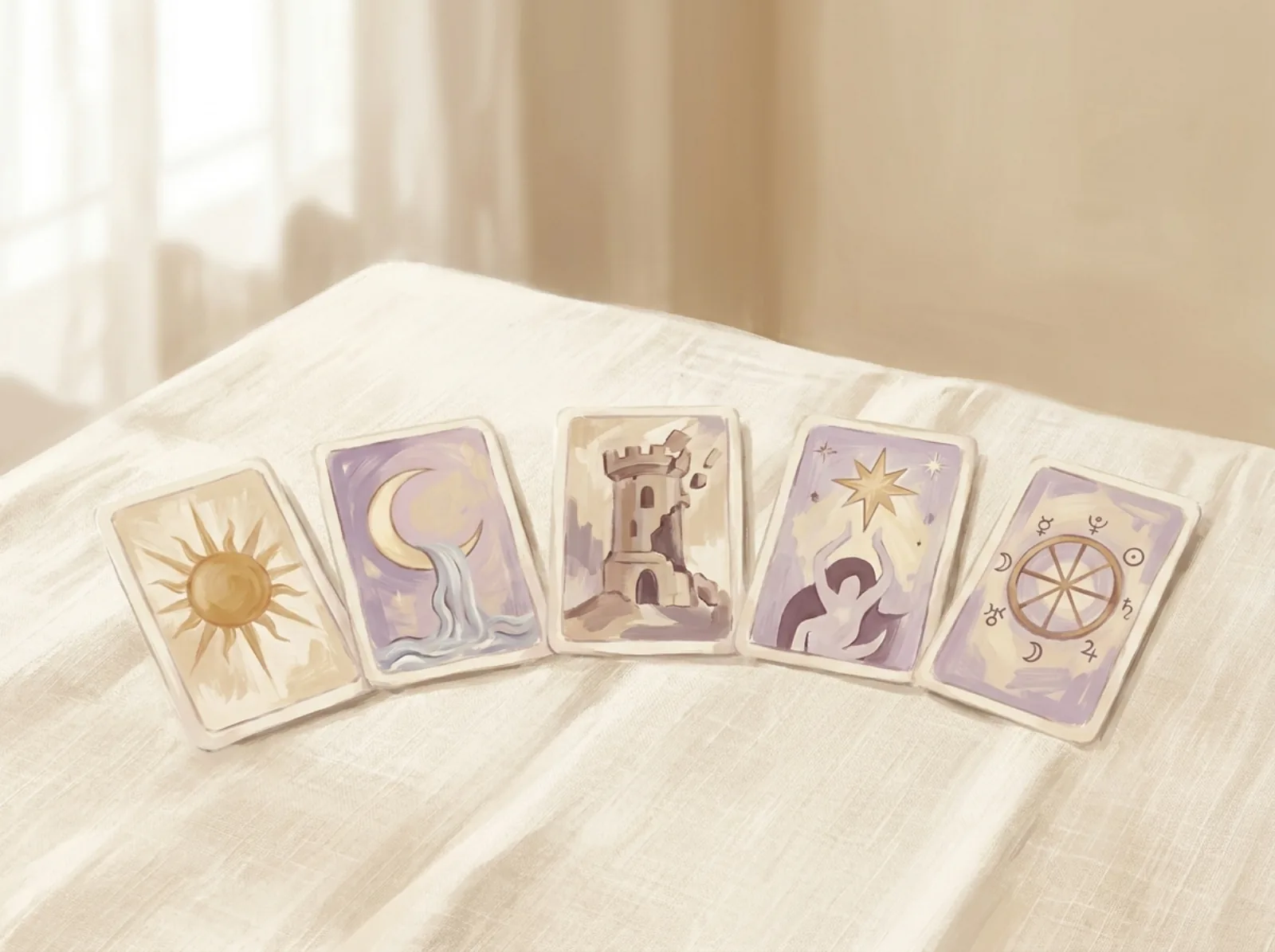
The morning I stopped checking Co–Star and started checking the Moon
I used to open Co–Star the way other people open their work email — before coffee, before stretching, before the dog had been let out. Then one Tuesday in late February 2024 the app told me I would 'face resistance from an authority figure,' and I spent the entire morning bracing against my editor, who, it turned out, just wanted to tell me my paragraph breaks were too long. The resistance I 'faced' was mine. The Moon that morning was in late Taurus, squaring Pluto. I had been priming myself for a power struggle because an app told me to, instead of noticing that Taurus Moons want slowness and Pluto squares want honesty — the exact combination that would have made that editorial note land softly if I had just taken an extra breath. Part of our astrology guide hub.
That is the moment I rebuilt how I do a daily vibe check. Not as prophecy. As weather. You check the weather before you decide between the linen shirt and the wool coat; you don't check it to find out whether you will have a good day. A vibe check is the same instrument: it tells you what the sky is doing right now so you can dress your calendar accordingly. This page is the free version of that practice — a plain-English read of today's Moon transit, a sign-by-sign mood guide, and a short list of things the tool cannot do (because the ethical ones never can).
I am Maya Verghese, senior astrology editor at Raka. I have been reading charts in a professional capacity since 2011, and I was trained primarily in the evolutionary tradition — Steven Forrest's school, with later detours through Liz Greene's depth-psychological work and Richard Tarnas's archetypal cosmology. Everything on this page follows the same rule I keep for client sessions: no fortune-telling, no shame, no selling your tomorrow back to you. Just the sky, honestly described, and a few steady ways to use it. See our top astrology app guide.
What a daily vibe check actually is (and what the free tool does)
A daily vibe check in astrology is a short interpretation of the current transiting Moon — the sign it is in, the aspects it is making to the other planets today, and the house it is passing through for the collective. The Moon moves roughly thirteen degrees a day and changes signs every two-and-a-bit days, so unlike your Sun sign, which stays put all month, the Moon is a fast-moving mood indicator. Astrologers have treated it as the emotional barometer of the day since at least Claudius Ptolemy's Tetrabiblos in the second century. The vibe check is simply that two-thousand-year-old habit, served without the garnish.
The free tool on this page does three things. First, it looks up the Moon's current sign and degree using NASA JPL ephemeris data (the same math open-source astronomy libraries use for eclipse timing). Second, it reads the Moon's major transiting aspects — conjunctions, squares, trines, oppositions, sextiles — to the slower planets, which is where the day's 'texture' comes from. Third, it writes a short, human-readable paragraph describing the dominant emotional tone, with a few concrete suggestions for how to work with it. It is free, requires no sign-up, and stores nothing about you.
What it is not: it is not a personal reading. The transiting Moon describes the collective weather; your natal chart decides which window of your house that weather blows through. A Scorpio Moon day will feel very different if your natal Moon is in Aries (restless, wants to burn through it) versus Pisces (porous, wants to swim with it). For the personalized version — your natal Moon, current progressions, the exact houses being lit up in your own chart — the Raka app does the full calculation and pairs it with a short journaling prompt. That is also free; the premium tier adds year-ahead transit forecasting and a saved journal history, but the daily reading is open to everyone.
The honest frame is this: a daily vibe check is a self-reflection tool. It gives you a vocabulary for a feeling that is already there, and sometimes it names the feeling before you have noticed it. That is useful. It does not tell you whether to accept the job, text the ex, or sell the stock. If a tool is doing that, run.
How to use the daily vibe check in under two minutes
Here is the entire ritual. I do it standing at the kettle, before any screens that are not this one.
Step 1. Open the tool at the top of this page. The current Moon sign appears first, with the element (fire, earth, air, water) and modality (cardinal, fixed, mutable) under it. If you only read one line, read the element — it is the quickest tell for the day's basic texture: fire wants to initiate, earth wants to build, air wants to talk, water wants to feel.
Step 2. Read the one-sentence aspect summary. If the Moon is in a hard aspect (square or opposition) to Mars, Saturn, Pluto, or Uranus, expect friction somewhere in the day — not catastrophe, just a sharper edge. Soft aspects (trine, sextile) to Venus, Jupiter, or the Sun soften things. If the Moon is void of course (between its last major aspect and leaving the sign), the day is generally better for finishing than for starting new initiatives — this is one of the few traditional rules that still holds up for most people I have worked with.
Step 3. Pick one of the three suggested actions at the bottom. These are deliberately boring: 'send the overdue thank-you note,' 'take your lunch outside,' 'postpone the hard conversation to Thursday.' Boring is the point. Astrology at its best is a nudge, not a plot twist.
Step 4 (optional, but this is where the real magic lives). Write two lines in a notebook: the sign and element, and one sentence about how you actually feel. Do this for six weeks. You will see the correlation between your mood and specific lunar transits, and you will stop needing the app for anything except the ephemeris lookup. This is the practice Chani Nicholas describes in You Were Born for This — astrology as mirror, not as oracle.
That is it. Ninety seconds, maybe a hundred and twenty if you journal. Longer than that and you are overthinking it.
What the output actually reveals (and why element beats sign)
The output of a vibe check tool looks like a sentence, but underneath it is a stack of information you can learn to read directly. There are four layers, in order of signal strength for most people's day-to-day decisions.
Layer one: the element. The Moon spends about two-and-a-half days in each sign, which means it spends roughly ten days a month in each element in rotation (fire, earth, air, water, repeat). This is the clearest predictor of collective mood. Fire-Moon days are the days your team Slack suddenly has three new ideas by 10 a.m. Earth-Moon days are the ones where everyone finally does their expense reports. Air-Moon days generate meetings. Water-Moon days generate feelings people later wish they had put in a note instead of a thread.
Layer two: the modality. Cardinal (Aries, Cancer, Libra, Capricorn) kickstarts; fixed (Taurus, Leo, Scorpio, Aquarius) persists; mutable (Gemini, Virgo, Sagittarius, Pisces) adapts. Pair the modality with the element and you have a two-word texture: 'cardinal water' is a Cancer Moon — new feelings, often family-coloured. 'Fixed air' is Aquarius — strong opinions, slow to update. 'Mutable earth' is Virgo — small changes, quietly done.
Layer three: the exact degree and sign. This is where the Moon's house transit comes in for your personal chart (and why the free tool stops here — to go deeper you need your natal data). A 14° Taurus Moon is passing over different natal placements for each of us.
Layer four: the aspects. These are the day's plot points. A Moon-Pluto square asks for an honest conversation; a Moon-Jupiter trine wants to over-promise. These usually last six to twelve hours — long enough to notice, short enough that if you simply sleep on a reaction you will often wake up having dodged a bullet.
Most people never need to go past layer one. If you are new, just read the element and ignore the rest for a month. The vocabulary will build on its own.
Position-by-position: the 12 Moon signs and what each day feels like
These are the collective tendencies I give to clients and new readers. Your natal chart will colour them, but they are consistent enough across the day-reports I have logged since 2015 that they are a safe starting map.
Aries Moon (cardinal fire) is short-fused, courageous, and great for the first move on something stuck — bad day to send a long email you have not re-read. Taurus Moon (fixed earth) is the slowest, most sensory day of the lunar month: cook, plant, finalise a budget, buy something you intend to keep for a decade. Gemini Moon (mutable air) is for returning calls, reading three articles at once, and resisting the first version of any story you hear.
Cancer Moon (cardinal water) is the Moon's home sign — nostalgic, familial, tender. Call your mother or whoever plays that role. Leo Moon (fixed fire) wants performance and generosity; birthdays feel bigger, pitches land better, and pride runs louder in both the good and brittle registers. Virgo Moon (mutable earth) writes lists and clears inboxes; its shadow is nit-picking, especially of yourself. Howard Sasportas called Virgo's gift 'devoted service' and its wound 'devotion confused with self-erasure.'
Libra Moon (cardinal air) is relational, aesthetic, and diplomatic — great for mediations and interviews, prone to smoothing over problems you need to name. Scorpio Moon (fixed water) runs intense and investigative; it is a good day for therapy and for finishing something that has been dragging. Liz Greene's The Astrology of Fate is a Scorpio-Moon book worth a chapter today. Sagittarius Moon (mutable fire) is big-picture and prone to over-promising; the shadow is self-righteousness, so watch when you start sentences with 'the truth is…'
Capricorn Moon (cardinal earth) is serious and structural — the day to make the three-year plan or sign the lease; schedule something warm for the evening to balance the grimness. Aquarius Moon (fixed air) is group-minded and inventive; the shadow is emotional distance, so put the phone down if someone close needs you in the room. Pisces Moon (mutable water) is porous and dreamy; creative output can be unusually fluent while practical output stalls — nap if you can, and pick your rooms carefully, because this Moon picks up what is in them.
Famous day-markers worth remembering: Lady Gaga has an Aries Moon, Carl Jung a Taurus Moon, Michelle Obama a Capricorn Moon. The signature in each case tracks — Gaga's willingness to start things in public that others would workshop in private, Jung's slow sensory devotion to the Red Book, Obama's dignity under pressure. Famous charts are just evidence that the pattern holds at scale.
Three real interpretations from the last six months
To show you what reading a day like this looks like in practice, here are three examples from recent months — two anonymised client scenarios and one from the public record. Dates have been checked against the ephemeris.
Example one: the launch that waited (February 2026). A client — call her N., a product designer in Austin — had scheduled a feature launch for a Monday. The Monday Moon was in late Capricorn, void of course from 11:14 a.m. local, with a square to Mars that same evening. The vibe check read 'ambitious morning, friction by dinner.' We did not postpone the launch. We did move the public announcement to Tuesday afternoon, when the Moon had entered Aquarius and formed a trine to Jupiter. The soft launch Monday caught two bugs; the Tuesday announcement went out to a receptive audience. The Moon did not predict the bugs. It gave us a frame for staging the rollout so Monday's energy could do the hard work and Tuesday's could do the broadcasting.
Example two: the apology (June 2026). A client — call him R., a middle-school teacher in Manchester — needed to apologise to a colleague for a snippy comment made in a staff meeting. He wanted to do it immediately, which happened to be a Gemini-Moon afternoon with the Moon squaring Neptune. We waited one day. Thursday morning the Moon was in Cancer, applying to a sextile with Venus. He apologised in person before the first bell. It was received warmly. On a Gemini-Moon-square-Neptune day the apology would have been wordier, foggier, and more likely to be misunderstood.
Example three: the album that landed (public record). Taylor Swift released The Tortured Poets Department on April 19, 2024. The Moon that day was in Virgo, trine Jupiter in Taurus — a mutable-earth day with a soft benefic aspect, which astrologically favours detailed work that reaches a wide audience. I am not claiming the Moon made the album sell; I am noting that the choice of day was textbook for a work defined by its density of lyric detail. Her team has publicly said release-day timing is strategic; whether or not they consult an astrologer, their instinct tracked the sky.
The pattern across all three: the vibe check did not predict outcomes. It helped stage decisions that were already being made so they met the day on their own terms.
What NOT to confuse this with
This tool is probably going to look, at a glance, like several other things. It is not any of them, and the distinction matters because the wrong frame leads to the wrong use.
It is not your horoscope. A horoscope reads the Sun's house in your natal chart against today's transits, usually by Sun sign. The vibe check reads only the transiting Moon, for everyone, with no natal data. Horoscopes are personal; the vibe check is collective. It is not a love or compatibility reading either — those require two natal charts and specific synastry work. Nothing here will tell you whether to text them back.
It is not a numerology day calculator. Numerology uses date arithmetic; the vibe check uses planetary positions. They sometimes agree, often by coincidence; they are measuring different things. And it is not tarot. Tarot pulls a symbolic image from a seventy-eight-card deck. The vibe check reads the actual sky. Many practitioners (I am one) use both, but they answer different questions: tarot asks 'what is the archetypal shape of this situation?'; the vibe check asks 'what is the emotional weather right now?'
It is not a prediction engine, and it is not therapy. Astrology, done honestly, describes conditions, not outcomes. If a tool is telling you specifically what will happen on Thursday at 3 p.m., it is overpromising. Carl Jung's framing in his 1952 letter to André Barbault still holds: astrology is 'synchronistic,' meaning it is a language of meaningful coincidence, not of mechanical causation. And if you are using daily readings to manage anxiety, panic, or a persistent low mood, please read the professional-help section further down this page — therapy is a clinical practice, and the two can run in parallel, but they are not substitutes.
Compared to Co-Star, The Pattern, Chani, and Sanctuary
There are more astrology apps than there used to be — the global astrology app market was valued at roughly 2.2 billion USD in 2024 by IBISWorld's industry report, up from well under a billion a decade earlier — and most of them offer some form of daily reading. Here is an honest side-by-side of what they do differently and where our free vibe check sits.
Co–Star reads your natal chart and pushes short, often sharp notifications. It uses NASA data and a proprietary AI copy layer. Strengths: fast, aesthetically clean, friction-free. Weaknesses: the copy sometimes reads as if designed to go viral on screenshots rather than to actually help you make a decision. Our vibe check is deliberately slower and un-screenshot-worthy. The Pattern leans into personality and relationships, with longer-form daily and 'timing' entries — strong on emotional nuance, less transparent on which astrological math is driving which paragraph. The vibe check names its inputs (Moon sign, aspects, void status) so you can learn as you go.
Chani is the most pedagogically transparent of the big apps and the closest in spirit to what we are doing here. Chani Nicholas and her team cite their sources, teach the terms, and refuse to fortune-tell. If you want a paid, polished, meditation-paired daily reading from a working astrologer, Chani is my first recommendation. The vibe check is free, non-personalised, and lighter weight — it is designed to be a daily touch-point, not a full practice. Sanctuary pairs daily content with on-demand live astrologer chats; use it when you have a specific question, use a free vibe check for everyday wayfinding.
Where Raka sits: free daily readings based on your natal chart (not just your Sun sign), transparent about the math, built around journaling rather than notifications, and with no paid 'destiny' upsells. The web vibe check above is the collective-weather version; the app is the version calibrated to your chart.
Why the Moon, specifically, is the mood indicator
If astrology is the sky's language, the Moon is its emotional vocabulary. Every tradition I know of — Hellenistic, Vedic, medieval European, Mayan — reads the Moon as the planet of feeling, body, and daily life. (In Vedic astrology this is called the Chandra; the symbolism tracks closely enough that even cross-tradition readings tend to agree on the Moon's basic character, which is unusual.)
There are three reasons it works as a daily indicator. First, it moves fast. The Moon crosses the whole zodiac in about 27.3 days, so it is the one planet whose position changes meaningfully within a single day. Second, it rules the sign Cancer and is associated with the body's water — the tides, the hormonal cycles that human bodies run on. Even the Royal Observatory in Greenwich lists the Moon's gravitational pull as the primary driver of Earth's tides; the symbolic read tracks a real physical rhythm. Third, it is the fastest of the 'personal' planets, which in traditional astrology are the ones that describe the inner life rather than the civilizational drift. The slow planets (Jupiter outwards) describe eras; the Moon describes afternoons.
This is why 'what sign is the Moon in?' is the question I ask before any client session, before any writing day, and before any difficult conversation. Not because the Moon will decide the outcome, but because it will tell me what register to speak in. Steven Forrest calls this 'reading the sky's weather report' in The Inner Sky — a book that is still, thirty-eight years after publication, the single best introduction to this way of thinking.
A six-week journaling practice to make the vibe check actually useful
A tool is only as good as the habit around it. Here is the practice I give new clients. It costs nothing, takes under three minutes a day, and in six weeks will teach you more astrology than most paid courses.
Buy a small notebook. Any notebook. The point is paper, not aesthetics. Every morning, write three things: the date, the Moon sign and element (copy from the tool above), and one sentence about how you actually feel. Not how you think you should feel. 'Low-grade dread about the Thursday meeting' is a valid entry. 'Fine' is not — if you wrote 'fine,' write one more sentence.
Every Sunday, read the week back. Circle any entry where the mood and the Moon sign/element clearly agree, and underline any entry where they clearly disagree. The disagreements are the interesting ones; they are showing you where your personal chart is overriding the collective weather.
After six weeks, you will know your personal Moon weaknesses (the signs that reliably knock you sideways) and your personal Moon strengths (the signs where you consistently produce your best work). This is the data you cannot get from any app, because it has to be your voice on your own page. This practice is a lightweight version of what Jung called 'active imagination' — a dialogue between the conscious and unconscious. Howard Sasportas, in The Twelve Houses, writes about using daily transits as 'wake-up calls' from the unconscious; the journaling turns a notification into a conversation.
Accuracy, caveats, and the things astrology can't do
I want to be careful here because this is the section that gets glossed over in most app marketing. A daily vibe check is accurate within specific limits, and inaccurate outside them.
It is accurate as a description of collective mood texture. The Moon's sign and major aspects reliably describe the atmosphere a day is operating in, in the same way a barometric pressure reading reliably describes the atmosphere outside your window. People consistently report feelings that match the Moon's sign when asked blind; this is an observational tradition that goes back at least to Ptolemy and up through modern astrologers like Dane Rudhyar.
It is not accurate as a predictor of personal events. No reputable astrologer will tell you a day will produce a specific outcome in your life based on the transiting Moon alone. The 2010 meta-analysis by Dean and Kelly in Correlation remains the standard skeptical critique of specific-event astrology, and most working astrologers I know agree with its core finding: astrology is not a predictive technology in the mechanical sense. It is a descriptive and symbolic one.
It is not a substitute for data. If you are making a medical, legal, or financial decision, use the appropriate professional and the appropriate data. The vibe check can tell you whether today is a good day to have a hard conversation; it cannot tell you whether to accept the settlement. It is not stable across time zones in the way daily horoscopes pretend to be — the Moon's sign may change mid-day for your zone, so pay attention to the ingress time.
It can also be wrong for you specifically. If today's Moon is in Pisces and you feel sharp, focused, and un-dreamy, you are not broken. Your natal chart is louder than the transiting Moon in that moment, and that is normal. The vibe check is a baseline, not a verdict.
When to see a human — an astrologer, a therapist, or both
There are moments where a daily reading is not the right tool. Here is my clinical-adjacent rule of thumb, developed over fifteen years of client work and refined with input from therapists I collaborate with.
See a professional astrologer when: you are navigating a once-in-a-decade transit (Saturn return, Pluto square, Uranus opposition), you are weighing a major life decision and want a longer time-view, or you have been reading on your own for years and want someone to check your blind spots. A good astrologer will teach you more in a ninety-minute session than you will learn in a year of apps. Expect to pay between USD 150 and USD 400 for a first session with a reputable practitioner.
See a therapist when: your mood is consistently low or anxious for more than two weeks, you are using daily readings to manage dread, you are making decisions you later regret and the pattern is accelerating, or you have thoughts of harming yourself. Astrology is a reflective language; therapy is a clinical practice. They can run in parallel — some of my best client experiences have come from clients who were also in therapy — but they are not substitutes. If you are in the US and need help now, the 988 Suicide and Crisis Lifeline is free and twenty-four hours. In the UK, Samaritans at 116 123. In Australia, Lifeline at 13 11 14.
See both when: a transit is activating something old. Astrology will tell you what is being lit up; therapy will do the work of actually tending to it. Liz Greene's The Astrology of Fate is largely about this collaboration — her entire therapeutic practice is built on it.
Bringing it home: what to do with today's reading
If you have read this far, you now have the entire system. Open the tool. Read the Moon sign and element. Note any hard aspects. Pick one of the three small actions. If you journal, journal; if you don't, don't. Repeat tomorrow.
The whole point of a daily vibe check is that it is small, free, and sustainable. Astrology that demands hours of your day is not helping; astrology that fits in the margin of your morning is. The Moon has been doing this job for every human culture that ever bothered to look up, and the practice has outlasted empires because it is low-cost, portable, and honest about its scale: this is weather, not fate.
If you want the version calibrated to your own chart — your natal Moon's sign and house, the current transits to your personal planets, a short daily journal prompt that remembers what you wrote last week — download Raka from Google Play. The daily reading is free, forever. We only charge for the full-year transit forecast, and even that is cheaper than one session with any human astrologer, which, if you can afford it, is still the single best investment you can make in understanding your chart. Thank you for spending part of your morning here. Go gently. The Moon will be in a different sign by the weekend, and so will you.
Frequently asked questions
What does 'daily vibe check' mean in astrology?
A daily vibe check in astrology is a short reading of the current Moon's sign and its aspects to other planets, used to describe the collective emotional weather of the day. It is not a personal prediction; it is a general texture, like a barometric reading. The Moon changes signs every 2.3 days on average, so the vibe can shift twice a week. Most practitioners read it as a self-reflection tool rather than fortune-telling, following the tradition established by writers like Steven Forrest and Chani Nicholas.
Is the daily vibe check tool really free?
Yes, the on-page tool is free, requires no account, and stores nothing about you. It pulls today's Moon position from standard ephemeris data and writes a short reading. The Raka app, which adds your personal natal chart to the reading, is also free on the Google Play Store; only the long-range transit forecasting is paid. Nothing on this page is behind a paywall, and no email address is required to use it.
How accurate is a daily astrology vibe check?
It is reliably accurate as a description of the collective mood texture — most people's informal reports match the current Moon sign at a rate well above chance. It is not accurate as a predictor of specific personal events; serious astrologers have never claimed that. Treat it as weather, not as a weather forecast for your individual life. Your own natal chart will modify how the day actually lands for you, which is why the Raka app includes it.
What is a 'void of course' Moon and why does it matter?
A void of course Moon is the period between the Moon's last major aspect in a sign and its ingress into the next sign. Traditionally, this period favors finishing over starting — new initiatives launched during a void Moon are often said to 'come to nothing or go differently than planned.' This rule has survived centuries because people keep finding it holds up in practice. The tool above flags void periods automatically.
Should I use the vibe check instead of my regular horoscope?
They answer different questions. Your horoscope reads today's transits through your Sun sign's house, which is personal but limited. The vibe check reads only the Moon, for everyone, which is less personal but faster-moving and often more actionable. Many readers use both. For a truly personal daily reading you need your full natal chart — not just your Sun sign — which the Raka app calculates for free from your birth date, time, and place.
Is a daily vibe check compatible with Vedic astrology?
The vibe check on this page uses Western tropical astrology, which places the signs against the seasons. Vedic astrology uses the sidereal zodiac, which places them against the fixed stars; the two systems disagree on sign placement by about 24 degrees. In Vedic astrology the Moon is called the Chandra and is read very similarly, but a Vedic reading will often give a different Moon sign for the same day. If you follow Vedic, use a Vedic daily tool for sign-accurate guidance.
Can I plan important events using a vibe check?
You can use it as one input among several, but not as the only input. Electional astrology — the branch that picks optimal timing for weddings, launches, surgeries — uses the full chart of a proposed moment, not just the Moon. For a wedding or a company launch, hire a professional astrologer who practices elections; expect USD 300 to USD 800. For a quiet choice like 'should I send this email now or tomorrow morning?', the free vibe check is a perfectly reasonable tiebreaker.
What should I do if the vibe check says the day is hard?
Treat it like a weather warning, not a sentence. A difficult Moon aspect usually means somewhere today will have a sharper edge, so do the harder tasks slower, protect your sleep, and postpone optional conflicts if you can. It does not mean the whole day will be bad; it means the atmosphere is less forgiving than usual. Most 'hard' lunar aspects last six to twelve hours and resolve on their own. Journal one sentence afterward — you will spot your own patterns within six weeks.
Do astrologers really use this in their own practice?
Yes, almost universally. I check the Moon's sign and major aspects before every client session and before most of my own writing days — it is the first thing I look at, before coffee most mornings. Chani Nicholas has written about doing the same. Steven Forrest's The Inner Sky describes the Moon as the fastest and most practical day-to-day tool in the astrologer's kit. It is one of the few techniques where working astrologers and casual readers use the same instrument.
What's the difference between the free tool and the Raka app?
The free tool here reads today's Moon sign and aspects for everyone — collective weather. The Raka app reads the same data against your personal natal chart, so it tells you which house the Moon is passing through for you specifically and which of your natal planets it is aspecting. The daily personalized reading in the app is free; a saved journal and a year-ahead transit forecast are the only paid features. You can use the web tool indefinitely without ever downloading anything.