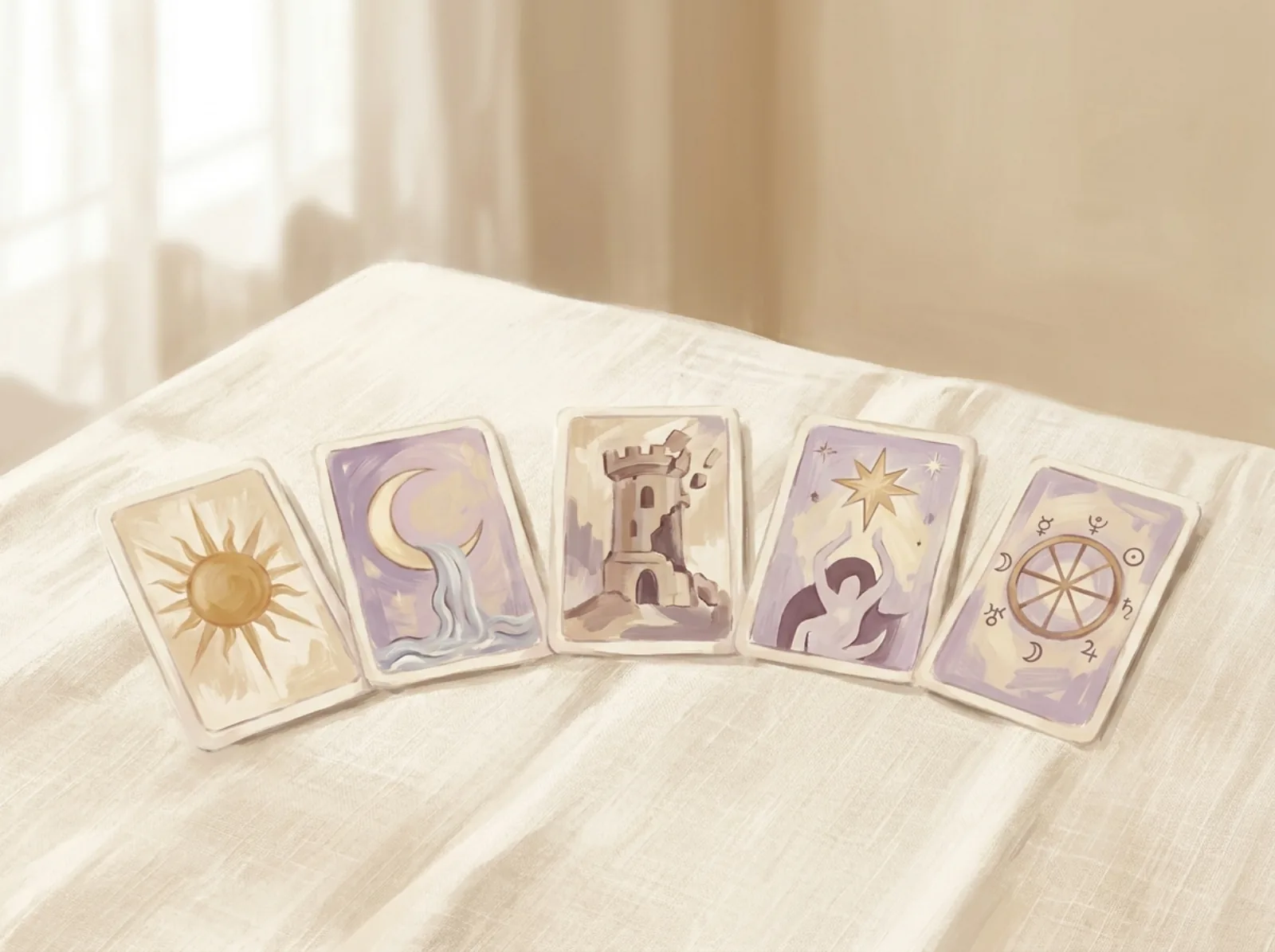
What Is a Progressed Chart? (Your Inner Clock, Not Your Fortune Teller)
Your natal chart is the sky-snapshot of the moment you were born — frozen, permanent, the DNA of your personality. A progressed chart takes that snapshot and asks a different question: what if the planets kept moving at a symbolic pace, maturing alongside you as you grew up? Part of our tarot library.
The most common technique for answering that question is called secondary progressions, and it uses a stunningly elegant formula: one day after your birth equals one year of your life. If you were born on April 3rd and you want to see your progressed chart for your 30th birthday, you look at where the planets actually were on May 3rd — 30 days later — of your birth year. That's your progressed sky at 30.
Why does the day-for-a-year method work? Nobody really knows. Astrology isn't a physical science; it's a symbolic one. But astrologers have been using secondary progressions since at least the 17th century, when Placidus formalized the technique, and modern practitioners from CafeAstrology to Chani Nicholas treat it as one of the sturdiest timing tools we have in the Western tradition. See our best AI tarot app guide.
What the progressed chart shows (and what it doesn't)
A progressed chart is a map of internal development — how your personality is unfolding across decades. It can show you:
- How your emotional needs are maturing over time (progressed Moon)
- How your core identity is evolving in longer chapters (progressed Sun)
- How your communication style, values, and drive are shifting (progressed Mercury, Venus, Mars)
- Which inner themes are coming into focus at the current chapter of your life
What it doesn't show: whether you'll get the job, meet the person, or make the money. Progressions describe inner weather, not outer events. The outer events in your life are shaped by your choices, your environment, your network, your decisions, and roughly 7,000 other variables that no chart on earth can touch.
I keep a journal where I note my progressed Moon's current sign every six months — not to predict anything, but to check in. Does my life actually feel like this? When the answer is yes, the symbolism gives me language for what I'm living. When the answer is no, it's a prompt to ask myself why I'm resisting the chapter I'm clearly in. That's the whole use of this tool, honestly.
The Day-for-a-Year Method: How Secondary Progressions Actually Work
Let me show you how this feels in practice. I was born on a Tuesday morning in the 1990s. If I want to see my progressed chart for my 32nd year of life, I count 32 days forward from my birth date and look up the planetary positions on that date — same time of day, same location.
Here's what moves fast and what barely moves at all in a progressed chart:
- Progressed Moon: about one degree per month, changing signs every 2.5 years
- Progressed Sun: about one degree per year, changing signs roughly every 30 years
- Progressed Mercury and Venus: similar to the Sun, with occasional retrograde turns that are especially meaningful
- Progressed Mars: about one degree every two years
- Progressed outer planets: barely move at all — Jupiter progresses about one sign in a long lifetime, and Saturn, Uranus, Neptune, and Pluto essentially stay where your natal chart placed them
Why 'secondary' progressions?
There's an older cousin technique called primary directions, where one degree of right ascension equals one year, and even more exotic cousins like solar arc and tertiary progressions. Secondary progressions are called 'secondary' to distinguish them from Ptolemy's primary directions — not because they're less important. In modern Western astrology, secondaries are the dominant progression method, and the one Astrology.com and the AstroTwins use when they talk about a 'progressed Moon in Libra' kind of vibe.
The elegance of the day-for-a-year formula is that it respects the real rhythms of planetary motion. Fast-moving planets symbolize fast-changing parts of you — your current moods, your communication style, your immediate emotional needs. Slow-moving planets symbolize slow-changing parts — your core identity, your long-term maturation, your sense of self. You don't need to understand the mathematics to feel the logic of the design: as above, so below, scaled down to a single human lifespan.
How to Calculate Your Progressed Chart (Without Doing the Math Yourself)
The honest answer: don't do the math yourself. There are three or four decent free calculators that will produce an accurate progressed chart in about 15 seconds, and the hours you'd spend learning ephemeris calculation by hand are better spent interpreting what the chart actually tells you about your life.
Free tools that genuinely work
- Astro.com — the Rolls-Royce of free astrology sites. Head to 'Free Horoscopes,' then 'Extended Chart Selection,' then choose chart type 'Natal Chart with Transits' and specify 'Secondary Progression.' You'll get a clean biwheel showing your natal chart inside and your progressed chart outside.
- CafeAstrology — their progressed-chart tool is simpler to use and offers readable text interpretations right alongside the chart image.
- Astrology.com — perfectly fine for quick lookups of your current progressed Moon sign without diving into the full chart.
- Any serious astrology app — most modern ones will show your progressed Moon's current sign on the home screen. Raka surfaces mine as a journal prompt rather than a prediction, which I'll come back to later.
What you need before you calculate anything
A progressed chart is only as accurate as your birth time. The Moon, the Ascendant, and the Midheaven all move so quickly in progressions that a one-hour error in your recorded birth time can shift your progressed Moon by months and your progressed Ascendant by a full sign. If you don't have a timed birth certificate on file, you can still get useful information from a sunrise chart, but your progressed Moon's exact degree may be off by a few.
What to actually look at first
When you first pull up your progressed chart, resist the understandable urge to interpret everything at once. Start with four data points and only four:
- Your current progressed Moon sign and house
- Your current progressed Sun sign
- Any progressed planet within one degree of forming an exact aspect to a natal planet
- Any sign ingresses — planets changing signs — coming up in the next twelve months
That's it. Those four pieces will give you a workable map of the next 24 months of your inner life. Everything else is detail you can layer in once you've lived with the big picture for a while.
The Progressed Moon: Your Emotional Weather Report
If you only ever learn one piece of this entire system, learn the progressed Moon. It's the most-used, most-felt indicator in modern progressions, and it changes signs roughly every two and a half years — which happens to be almost exactly the length of a typical chapter in most people's lives.
Think about it: 2.5 years is the span of a graduate program, the arc of a serious early-career relationship, the job you held before the next one, the apartment you lived in during that one weird phase. Life organizes itself into these half-decade sub-chapters, and the progressed Moon tends to describe the emotional flavor of each one with slightly uncomfortable accuracy.
What each progressed Moon sign tends to bring up
I'm going to resist writing twelve mini-horoscopes here because that's not what this piece is for. But here's the general shape of what each element tends to emphasize:
- Fire signs (Aries, Leo, Sagittarius) — a chapter where your emotional needs want expression, visibility, movement, and some kind of healthy risk. You get restless if you stay put too long.
- Earth signs (Taurus, Virgo, Capricorn) — a chapter of consolidation. You want to build, organize, nest, and get your material life in order. Comfort and routine matter more than usual.
- Air signs (Gemini, Libra, Aquarius) — a chapter of connection and ideas. You crave conversation, friendship, and intellectual stimulation. You might feel more scattered than usual, and that's often a feature of the chapter, not a bug in your personality.
- Water signs (Cancer, Scorpio, Pisces) — a chapter of inward turning. You feel more, dream more, need more alone time. Therapy, grief work, and creative projects tend to surface and demand attention.
The progressed Moon's house matters as much as its sign
The sign tells you how you're feeling. The house tells you where in your life those feelings are showing up most intensely. A progressed Moon moving through your 7th house is going to make relationships — romantic, business, close friendships — the main plotline for 2.5 years. A progressed Moon in your 10th house will put career, reputation, and public identity front and center.
When the progressed Moon crosses one of the chart's angles — your Ascendant, IC, Descendant, or Midheaven — those are the moments astrologers watch closely. They tend to coincide with chapter-ending or chapter-beginning feelings. Not events, necessarily. Feelings. A quiet sense of 'something is shifting here.' You'll recognize it when it's happening to you.
I use my progressed Moon the way other people use mood tracking apps. Every quarter, I ask myself: what's the sign, what's the house, what does this chapter seem to be about, and am I actually living it or am I avoiding it? That's it. That's the whole practice.
When Your Progressed Sun Changes Signs (The Big One)
Your natal Sun is you. It's your core identity, the fundamental 'I am' of your entire chart. So when your progressed Sun changes signs — something that happens roughly every 30 years — it tends to coincide with a genuine identity shift. Not a crisis, necessarily. A transformation.
Because the Sun moves about one degree per year of progressed time, most people will experience one or two progressed Sun sign changes in their lifetime. A rare few will experience three. The timing depends entirely on where your natal Sun sits within its sign:
- If you were born with the Sun at 0° of a sign, your progressed Sun will change signs around age 30.
- If you were born with the Sun at 15°, it'll change around age 15 — and then again around 45.
- If you were born with the Sun at 29°, your progressed Sun already changed signs within your first year of life, and the next change is coming around age 30.
What a progressed Sun sign change actually feels like
This isn't an overnight event. The progressed Sun spends about a year within one degree of a sign change, and that entire year tends to feel like a slow turning of the page in your own life. The sign you're leaving is the identity you've been wearing comfortably for decades, and the sign you're entering is the one you're quietly growing into.
A natal Virgo whose progressed Sun enters Libra at age 29 will often describe their thirties as the decade they finally learned about relationships, aesthetics, and the terrifying art of asking for what they actually wanted. A natal Capricorn whose progressed Sun enters Aquarius at age 25 will often describe a decade of unexpected rebellion against the roles they were trained for.
Progressed Sun aspects to natal planets
Even without a full sign change, your progressed Sun will make exact aspects to your natal planets every few years — a conjunction, square, trine, or opposition to a natal Venus, Mars, Saturn, and so on. These are smaller milestones, but they tend to show up as moments where that natal planet's themes suddenly become central. A progressed-Sun-conjunct-natal-Venus year might be the year you fall deeply in love or finally commit to the creative work. A progressed-Sun-square-natal-Saturn year might be the year you confront a limit and build real discipline around working with it.
I keep a note in my phone of my next three Sun-progression events. Not because I expect specific outcomes to materialize, but because they help me pay attention to what's genuinely new as it emerges.
Progressions vs. Transits: What's Actually the Difference?
This is the question I get most often from people new to the technique, so let me be unambiguous about it:
- Transits are what the planets are actually doing in the real sky, right now. When Pluto crosses over your natal Sun, that's a transit — an observable, physical event you could watch with a telescope.
- Progressions are a symbolic calculation based on your birth chart. They don't correspond to the real sky at all after the first few months of your life. They're a map, not a weather report.
Both techniques matter enormously, and they describe different things about the same stretch of time in your life.
Transits describe outer weather. Progressions describe inner weather.
Here's a classic example: in a year where transiting Saturn is squaring your natal Sun — a well-known 'pressure cooker' transit that lasts about a year — the external circumstances you're navigating might include a demanding boss, a difficult project, or a serious decision about whether to stay in a particular career. The transit describes the outer pressure you're under.
Your progressed chart in that same twelve months might show your progressed Moon moving through your 4th house of home and family, suggesting that your inner response to all that outer pressure is really about rooting, nesting, and asking what feels like home. The progression describes what's happening inside you while the transit is happening to you.
How to use both techniques together
I was taught — and I still teach — that transits answer the question 'what's happening to me?' and progressions answer 'who am I becoming?' You genuinely need both. If you only ever look at transits, you'll feel like life is happening to you and astrology is a weather report you're bracing against. If you only ever look at progressions, you'll miss the actual timing of the big external shifts, because transits are much better at calling the dates. Used together, they give you a 3D view: the outer event (transit) interpreted through the lens of your current inner chapter (progression).
I usually look at my transits for the next three months and my progressions for the next two years. Those time horizons feel exactly right for each tool.
Famous Progression Stories: Real Lives, Real Shifts
I want to be careful here. Astrology isn't predictive, and I'm not going to pretend any of these shifts were 'caused' by progressions. But as mirrors — as symbolic rhymes with lived experience — they're genuinely striking.
Oprah Winfrey's progressed Sun into Aries
Oprah's natal Sun sits at 9° Aquarius. Because the progressed Sun moves one degree per year, hers crossed into Aries in her early fifties. In the decade that followed, she staged the famous 'you get a car!' audience giveaway, wound down her 25-year syndicated show, and launched OWN — her own network — a pivot from being the most trusted talk-show host in America into becoming a media-empire founder. Aries themes: starting from scratch, owning the brand, being first, generosity as power. One of the more legible examples of a progressed Sun sign change in modern public life.
Steve Jobs' progressed Sun through Aries
Jobs was born with his Sun at 5° Pisces. His progressed Sun entered Aries in his mid-twenties, right before he shipped the first Macintosh. He then lived his entire second-act Apple era — iPod, iPhone, iPad — with his progressed Sun moving through Aries. Aries energy as a sustained chapter: pioneering, direct, impatient with the status quo, 'insanely great.' You can read the Aries progression in nearly every keynote he ever gave.
Carl Jung's progressed Sun into Virgo
Jung was born with his Sun at 3° Leo. His progressed Sun entered Virgo around age 27, and by his late thirties — when he formally broke with Freud and began building what became analytical psychology — the themes of his new work were unmistakably Virgo-flavored: taxonomy, discernment, careful distinction between archetypes, the precise cataloguing of the psyche. Read his autobiography and you can feel the sign change happening inside his own thinking.
What these stories actually show
These aren't predictions dressed up in hindsight. They're examples of how a public life, when charted, tends to rhyme with the symbolism of the current progression. The real test isn't whether a famous example works. It's whether your own life, when you chart it, feels like it rhymes with the symbols you find there.
Spoiler: in my experience, when people chart their own progressions in retrospect after a big life chapter, they almost always find the rhyme. Not because astrology is causing anything, but because the symbolic system is sensitive enough to describe lived human experience in a language people recognize when they see it.
How to Use Your Progressed Chart for Real Self-Reflection
Here's where this entire conversation becomes practical rather than theoretical. A progressed chart is only genuinely useful if you let it ask you honest questions about your own life.
The quarterly check-in I actually do
Every three months, I sit down with my progressed chart and run through five simple prompts:
- What sign and house is my progressed Moon in right this minute? What's that chapter seemingly asking of me emotionally?
- Is my progressed Sun making any exact aspects to a natal planet in the next twelve months? If yes, what themes is that natal planet about?
- Is my progressed Moon approaching a sign change or house change within the next six months? If yes, how am I actually feeling about the ending of the current chapter?
- Where in my daily life does the symbolism feel accurate? Where does it feel completely off? What might I be avoiding that the chart is naming?
- If I lived the next 90 days as if this symbolism were a mirror, what one small practice would I add to my week, or drop from it?
That's it. That's the entire practice. It takes about 20 minutes, and I do it in a journal — paper or digital, honestly doesn't matter.
Why Raka built this as journaling, not prediction
When we designed the progressed-chart feature inside Raka, we had a long internal conversation about the difference between a prediction and a prompt. A prediction says 'you will feel X in October.' A prompt says 'your progressed Moon just entered Capricorn — what in your life wants more structure right now?'
The second question is the useful one every single time. It's the one that puts the chart in service to you, rather than putting you in service to the chart. Everything in Raka is built around that principle: the symbolism is a mirror, and your reflection is your own to interpret.
The one thing I'd tell a complete beginner
Don't try to interpret your whole progressed chart in a single sitting. Pick your progressed Moon. Learn what sign and house it's currently moving through. Live with that information for a few weeks and notice whether the chapter it describes genuinely matches what you're experiencing day to day. If it does, add in the progressed Sun. Then add exact aspects to natal planets. Build your interpretive vocabulary slowly over time.
The people I know personally who get the most out of this entire system are the ones who treat it like a long-term journaling practice — a question they return to every quarter — rather than a one-off reading they decode once and promptly forget about.
Frequently asked questions
How often does the progressed Moon change signs?
Roughly every two and a half years. The progressed Moon moves about one degree per month, and since each zodiac sign spans 30 degrees, a full sign takes about 30 months to traverse. Astrologers often treat the progressed Moon's sign change as the start of a new emotional chapter — a built-in two-and-a-half-year cycle that most people can feel if they're paying attention to it.
What's the difference between secondary progressions and solar arc progressions?
Both techniques symbolically advance your chart over time, but they use different formulas. Secondary progressions use 'a day for a year' — each day after your birth equals one year of life — so planets move at their natural relative speeds. Solar arc progressions move every planet by the same amount as the progressed Sun (roughly one degree per year), giving you a flatter, more event-oriented timeline. Most modern Western astrologers use secondary progressions as their primary tool and reach for solar arc as a supplementary technique.
Can my progressed chart predict events in my future?
No, and anyone claiming otherwise is overselling the technique. A progressed chart describes the inner chapter you're moving through — your emotional needs, your evolving identity, the themes that are maturing in your life. It can't tell you whether you'll get a particular job, meet a particular person, or receive a particular diagnosis. For specific decisions about your health, finances, relationships, or legal matters, please consult the appropriate licensed professional. Astrology is a tool for self-reflection, not a substitute for expert advice.
Why does my exact birth time matter so much for progressions?
Because the fastest-moving factors in your progressed chart — the Moon, the Ascendant, and the Midheaven — change position very quickly. A four-minute error in your birth time can shift your progressed Moon's position by about one degree, which translates to roughly a month of real time. A one-hour error can shift your progressed Ascendant by close to a full sign. If you don't have a timed birth certificate, you can still work with the slower-moving factors like the Sun, Mercury, Venus, and Mars, but your progressed Moon's exact sign and degree will be approximate.
What happens when my progressed Sun changes signs?
You're entering a new 30-year chapter of core identity development. The transition is gradual — the progressed Sun spends about a year within one degree of the new sign — but most people describe a genuine sense of becoming someone slightly different afterward. The sign you're entering tends to describe themes you'll be growing into, not characteristics that erase your natal personality. Your natal Sun is still the foundation; the progressed Sun is the floor you've built on top of it over time.
Can I interpret my own progressed chart, or do I need an astrologer?
You can absolutely learn to interpret your own. The system is more approachable than it looks, and the progressed Moon alone will give you most of what you need for a self-reflection practice. Start with the sign and house of your current progressed Moon, journal with it for a few months, and expand from there. An experienced astrologer can go deeper and faster — especially around major transitions like a progressed Sun sign change — but you absolutely don't need one to begin.
How is a progressed chart different from a transit chart?
Transits show you where the planets actually are in the sky today — real, observable, physical movement. Progressions are a symbolic calculation based on your birth chart that doesn't correspond to the real sky at all. Transits describe the outer weather you're navigating; progressions describe the inner chapter you're living. Most astrologers use both together: transits to time the external events, progressions to understand the internal arc those events are landing inside of.