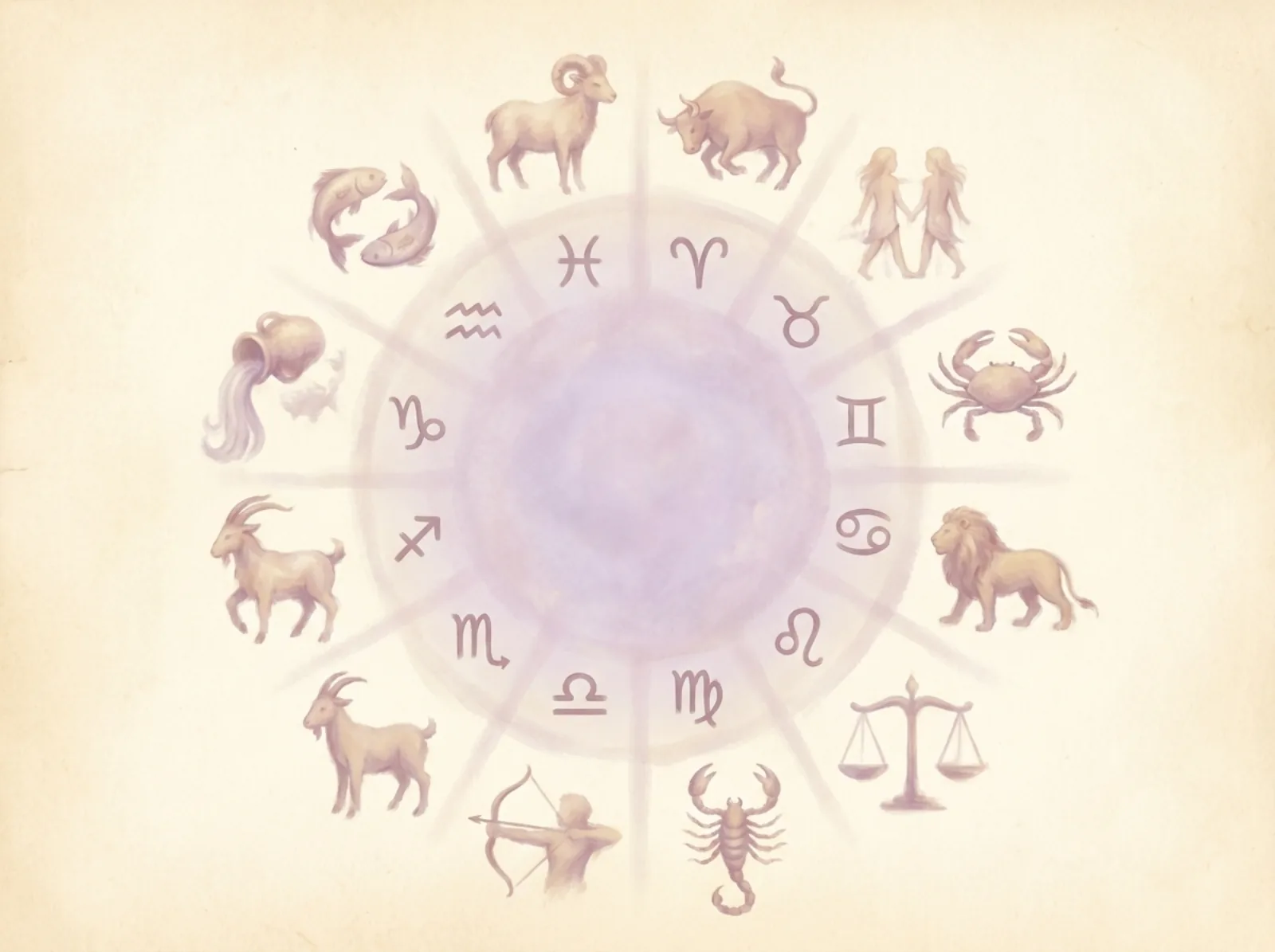
What Your Moon Sign Is (and Isn't)
Western astrology gives you three big placements that do most of the heavy lifting in a chart: your Sun, your Moon, and your Rising. If your Sun is the public you — the identity you've chosen, the thing you're building toward — your Moon is the you that existed before you knew you were being watched. Part of our astrology guide hub.
The Moon as your inner child
Think of your Moon sign as the emotional template you came in with. It's how you were as a baby. It's how you still need to be loved. It's the kind of comfort you reach for at 11pm when the day has been too much — a bath, a specific person's voice note, your mother's recipe, the same song on loop. Those instincts aren't random. They're your Moon speaking.
Your Moon rules:
- How you self-soothe — the private rituals that bring you back online
- What makes you feel safe — the ingredients of a nervous system that isn't bracing
- How you attach — the pattern you repeat with people who matter
- Your emotional default — where your mood lands when nothing is actively happening
Why Moon reading beats Sun reading for emotional self-work
Your Sun sign tells you what you want to become. Your Moon sign tells you what's already running the show. If you've ever read your Sun description and thought that's not really me, there's a decent chance your Moon is doing most of the daily driving — especially if your Moon sign and Sun sign sit in very different elements. For emotional self-knowledge, reading your Moon is where I'd start every time. See our top astrology app guide.
The Pisces Moon Emotional Signature
A Pisces Moon is the Moon placed in the twelfth and final sign of the zodiac — a mutable water sign ruled traditionally by Jupiter and modernly by Neptune. If that sentence meant nothing, here's what it means in practice: your emotional nature is fluid, impressionable, mystical, and almost suspiciously receptive. You don't just feel what you feel. You feel what the person next to you feels. You feel what the room feels. Sometimes you feel what the city feels, which is a lot to ask of one nervous system.
Core emotional traits
- Porous: Your emotional boundary is less a wall and more a mesh screen. Everything comes through. The right kind of hug can land for days. The wrong comment can take weeks.
- Intuitive: You pick up on micro-signals most people miss — the sigh before someone speaks, the two-second delay in a reply, the way a friend's "I'm fine" doesn't match their eyes.
- Imaginative: Your inner life is cinematic. You dream vividly, daydream constantly, and process emotion through imagery, music, and story rather than through clean cognitive bullet points.
- Compassionate: Suffering registers immediately in your body. You rarely need to be convinced that someone deserves care.
- Shape-shifting: You absorb the people you spend time with. Pisces Moons often say "I don't know who I am" because the mirror keeps changing shape.
Why water Moons feel differently
All three water Moons — Cancer, Scorpio, Pisces — feel deeply, but each in a signature key. Cancer Moons feel like a parent (protective, nest-building). Scorpio Moons feel like a surgeon (deep, intense, cutting through pretense). Pisces Moons feel like an artist or a mystic — receptive first, specific later. You usually don't know what you feel until it has moved through you and come out as a dream, a tear, a song recommendation, or a text at 1am saying I love you, that's it, go back to sleep.
What a Pisces Moon Needs to Feel Safe
Here's the thing nobody tells Pisces Moons until they're in their late twenties: you cannot regulate yourself in environments that are regulating themselves against you. You need particular conditions. Not because you're high-maintenance. Because your Moon is a radio with no mute button, and it tunes in whether you asked it to or not.
Non-negotiables for your nervous system
- Alone time, daily, non-apologetic: Not a treat. A medical requirement. Thirty to sixty minutes of being unobserved is how you empty your emotional inbox.
- Water, music, and darkness: Baths, long showers, the ocean, headphones on walks, a dim room before sleep. These are regulation tools, not aesthetic preferences.
- Permission to leave early: Parties, calls, group dinners — knowing you can bail without being punished is often what lets you stay longer.
- Creative output of some kind: Writing, singing, drawing, cooking, gardening. The feelings have to go somewhere. If you don't give them a container, your body becomes the container, and that's where somatic symptoms start.
- One person who sees you: Not many. One. A Pisces Moon with one securely attached witness is a different animal than a Pisces Moon with none.
The journal as a safety net
Journaling is almost unfairly good for Pisces Moons. Because your inner life moves in images and symbols, writing is often the first time you discover what you actually feel. If handwriting feels like a chore, voice-noting into a reflection app works equally well. I use Raka that way — I open it after a hard conversation, dump the mess into a journal entry, and let the astrological context tell me whether I'm reacting to the moment or to a transit that's reactivating old grief. That distinction alone has saved relationships.
Attachment Style and Relationship Patterns
If you've ever done attachment-theory reading, you'll recognize the Pisces Moon pattern instantly. Most Pisces Moons default to some flavor of anxious-preoccupied or disorganized attachment, especially before deliberate inner work. The reason is structural, not shameful: an emotional system this porous grew up being responsible for other people's feelings. That's the origin story.
How you tend to love
- Fast and full: You bond quickly. The depth is real. The speed is sometimes the problem.
- Through merging: You adopt your partner's taste, schedule, and emotional climate. In a healthy relationship this feels like intimacy. In an unhealthy one it feels like disappearing.
- Through rescue: You are drawn to the unfinished and the suffering. Pisces Moons routinely date potential rather than people.
- Through intuition: You usually know within three dates whether this is going anywhere. The problem is you ignore that knowing when the feelings are strong.
Repeating patterns to notice
A few patterns most Pisces Moons eventually recognize in therapy or in a long journal arc:
- Attracting avoidant partners and interpreting their distance as mystery
- Over-functioning emotionally while under-asking for your own needs
- Confusing emotional intensity with compatibility
- Staying because leaving would hurt them, even when staying hurts you more
None of this is a verdict. It's a map of the terrain. Secure Pisces Moons do exist, and they tend to have one thing in common: they built a self first, then invited a partner into it, instead of using the partner as the self. That's doable at any age. It just requires naming the pattern honestly, which is why the shadow section later in this piece matters more than the compatibility one.
Pisces Moon in Family and Close Friendships
Pisces Moons are usually the designated emotional translator of their family — the one who could read the room at age six, who knew mom was about to cry before mom knew, who absorbed the tension nobody else wanted to name. Whether that role was healthy depends entirely on the family, but the emotional labor was almost always disproportionate.
With family of origin
- You often remember feelings from childhood more than events
- You may struggle to describe a parent as "bad" even when the dynamic clearly harmed you — the compassion runs ahead of the clarity
- Family gatherings can leave you flattened for days, even when they go "well"
- You tend to be the sibling everyone confides in, which is not the same as the sibling who is cared for
With chosen friendships
Your friendships, by contrast, are often where you heal. Pisces Moons collect a small number of ride-or-die people who have been witnessed in their worst moments and loved anyway. You remember birthdays, voice-note anniversaries, and the specific thing a friend was worried about three weeks ago. You will drop everything to show up for a friend in crisis — sometimes to the detriment of your own calendar.
A few friendship truths worth owning:
- You give better than you receive, and you've trained some friends to expect that imbalance
- You often don't tell people you're struggling until you're already underwater
- Group friendships are harder than one-on-ones because the emotional data load triples
- You remember exactly who was there when it mattered — your loyalty graph is extremely accurate, and slow to change once set
Chosen family tends to feel safer than birth family for a lot of Pisces Moons. That's not a betrayal of anyone. It's a nervous system doing its job.
How a Pisces Moon Reacts Under Stress
Stress exposes your Moon more honestly than almost anything else. For a Pisces Moon, the stress response has a specific shape — and it's rarely the fight-or-flight you'd expect. It's usually freeze, fawn, dissociate, or disappear.
Your three signature stress patterns
- The vanishing act: You stop replying. You cancel plans. You go quiet across every thread. Not from malice — your system is on the floor and your capacity for output has gone to zero.
- The flood: One small thing — a text tone, an unfair comment — breaks a dam, and you cry for two hours over something that wasn't really the trigger. The real backlog comes out.
- The fog: You can't make decisions. The world feels filmed through gauze. You lose hours, scroll without seeing, forget what you were doing. Dissociation isn't failure. It's a protective reflex when input exceeds capacity.
Regulation strategies that actually work
Most "self-care" content was written for Capricorn Moons who need to rest. You are not that. You need to come back into your body, not disconnect further.
- Cold water on the face or wrists — resets the vagus nerve in under a minute
- Weight — a weighted blanket, a hug held past three seconds, a hand on your chest
- Rhythmic bilateral movement — walking, swimming, rocking, drumming on your thighs
- Containment, not expansion — one room, one task, one song, until your edges come back
- Naming it out loud or on paper — "I am overwhelmed because X" collapses the fog faster than any amount of thinking about it
The trap is believing that more input will help. More content, more conversations, more processing with friends. For a flooded Pisces Moon, more input is the problem. Less input, better input, is the exit.
Real-Life Pisces Moons: Public Figures With This Placement
Looking at how a placement shows up in public people is useful because it hands you a mirror held at a distance — easier to see the pattern when it isn't you. Here are three real public figures with widely cited Pisces Moon placements, and the emotional themes you can see playing out in their work and public lives.
Three Pisces Moons in public view
- Michael Jackson: His Pisces Moon shows up in the almost unbearable sensitivity of his vocal delivery, the fantasy-saturated world-building of Neverland, and a lifelong hunger for the childhood he never had. The gift and the wound of a Pisces Moon lived in the same person.
- Kim Kardashian: A Libra Sun with a Pisces Moon by widely referenced birth data. The public read is "image" — the private story visible across her last decade is a woman whose public persona has been shaped by extremely porous reactions to her own family dynamics, grief, and the opinions of millions of strangers. Pisces Moons feel the crowd whether or not they're performing for it.
- Elvis Presley: A Capricorn Sun with a Pisces Moon by most published birth-time charts — the discipline of the stage persona wrapped around a deeply romantic, mother-attached, prone-to-escape inner life. His later struggles are almost a case study in what happens when a Pisces Moon has fame but no sanctuary.
What you can learn from watching them
The pattern across all three: enormous emotional range paired with real difficulty finding privacy. The lesson isn't to avoid visibility. It's that a Pisces Moon without a protected private life will eventually either collapse or self-anesthetize. Build the sanctuary before you build the career. If it's already the other way around, build the sanctuary now — it's never actually too late, it just gets more expensive the longer you wait.
Pisces Moon Compatibility by Moon Sign
Compatibility between Moon signs is less about who you'll date and more about whose emotional language your nervous system can rest in. You can date anyone. The question is who you can live with at 7am on a bad Tuesday.
Easiest emotional climates for a Pisces Moon
- Cancer Moon: Fellow water. They understand your tides without needing them explained. The risk is a shared tendency to merge until neither of you has edges.
- Scorpio Moon: The other deep-feeling water Moon. Scorpio's intensity meets your receptivity with a gravity you often secretly want. They won't flinch at your depths.
- Taurus Moon: Earthy, slow, sensory, loyal. A Taurus Moon can hold a Pisces Moon the way a stone holds a river. Grounds you without flattening you.
- Capricorn Moon: Looks mismatched on paper, often works beautifully in practice. Their emotional structure gives yours a bannister to hold while you feel what you feel.
Harder but not impossible climates
- Gemini Moon: Your mutual mutability can turn into mutual lack of grounding. They want to talk through feelings, you want to feel through feelings.
- Sagittarius Moon: Their need for space can read to you as abandonment. Your need for merging can read to them as a cage.
- Aquarius Moon: Their emotional detachment is a feature, not a bug — but for you it can feel like being on a different frequency entirely.
- Aries Moon: Their directness can feel like being yelled at even when they aren't yelling. You can grow a thicker skin, but it won't be effortless.
None of these are destiny. Two Aries-Pisces Moon couples I know personally are rock solid. The rule is self-awareness beats placement every time. Compatibility reads like this are useful for naming the terrain, not for picking or rejecting a person.
The Shadow Side of a Pisces Moon
Every Moon has a shadow — the pattern that develops when the sign's gift gets used as a defense instead of a strength. For Pisces Moon, the shadow has a specific signature, and the healing starts with being able to name it without flinching.
The core wound
Most Pisces Moons share some version of the same wound: my feelings were too much for the people who were supposed to hold them, so I learned to feel for everyone else instead of being felt for. That's where the martyr pattern begins. That's where the escapism begins. That's where the "I don't know what I want" begins — because wanting something specific required a self you were taught not to form.
Shadow patterns to watch for
- Avoidance dressed as sensitivity: "I can't deal with that right now" becomes a lifestyle, not a boundary.
- Projection as intuition: You feel something, you decide it's about them, and you build a whole story. Sometimes you're right. Sometimes you've just handed someone else your own feeling.
- Victimhood as identity: The role of the one who feels most, suffers most, gives most — eventually calcifies into a story that keeps you small.
- Escapism: Pisces Moons often report a strong pull toward anything that softens the signal — alcohol, scrolling, fantasy, over-sleeping, serial crushes. The need to turn down the volume is real. The methods matter.
- Boundary dissolution: Saying yes when you meant no, then resenting the person you said yes to.
- Spiritual bypass: Using "everything happens for a reason" to avoid the actual work of grieving what shouldn't have happened.
What the healing looks like
The shadow lifts when a Pisces Moon learns to have feelings without becoming them. The feeling moves through you. You don't drown in it or merge with the person who caused it. You feel it, name it, journal it, and come back to the self that was there before the wave. That's the work. It's not glamorous. It's extraordinarily possible.
Journaling Prompts for Pisces Moon Self-Work
Journaling is the single highest-leverage practice I know for a Pisces Moon. Not because writing is magic, but because your inner life speaks in images and symbols, and writing forces it into language your rational mind can actually use. These prompts are built for exactly that translation.
Weekly journaling prompts
Set aside twenty minutes. Write by hand if you can, voice-note into a reflection app if you can't. Don't edit. Pick one prompt a week:
- What did I feel this week that I didn't name out loud? Why didn't I name it?
- When I think about the person who upset me most this week, which part of my reaction is about them and which part is about something older?
- If I had no obligation to be understood, what would I say I actually want right now?
- Where did I abandon myself this week to keep someone else comfortable?
- What am I escaping from, and what would happen if I didn't escape?
- Who was there for me this week? Did I let them be?
- What small thing felt like coming home?
Deeper prompts for shadow work
Save these for when you have the stamina — or for a therapy session you can bring the writing to:
- What did I need as a child that nobody could give me? Who am I still trying to extract it from?
- When I say "I don't know what I want," what am I protecting myself from knowing?
- Where in my life am I playing the martyr, and what would it cost to stop?
- What boundary have I been pretending I don't need?
- If my intuition is right about this situation, what action does the intuition require?
This is the practice I use in Raka when a transit lights up my own Pisces placements — pull up the journal, run the prompts, and let the chart context tell me what season of inner work I'm actually in. Self-knowledge is the long game. Start where you are.
Frequently asked questions
Is a Pisces Moon rare?
Not statistically — any Moon sign is held by roughly one twelfth of the population, since the Moon moves through all twelve signs every month. What makes a Pisces Moon feel rare is less the frequency and more the invisibility: the emotional traits that define a Pisces Moon (porousness, boundary softness, dreaminess) tend to make the person quieter in group settings, so you may genuinely have met many and only clocked a few. If you want to know who in your life shares the placement, run their chart in Raka or any free Moon-sign calculator — you'll usually need their birth date, time, and city.
What's the hardest thing about having a Pisces Moon?
In my own writing and in the client journals I've read, the honest answer is this: knowing where you end and other people begin. A Pisces Moon can absorb a mood, a worldview, a partner's grief, a stranger's resentment on the subway — and genuinely not realize for days that the feeling moving through you isn't yours. The hardest work is learning to pause before you merge: is this mine, or did I pick it up? That one question, asked repeatedly over years, is the whole practice.
Does a Pisces Moon make someone psychic?
Pisces Moons often have what psychology calls high interoceptive and affective sensitivity — you notice bodily and emotional data most people filter out, which can read as uncanny timing or 'just knowing.' Whether that's intuition, pattern recognition, something more, or all three depends on who you ask. Astrology at its best treats intuition as a signal worth journaling rather than a prediction system — your Pisces Moon is extraordinary at noticing. It is less extraordinary at interpreting, and the interpretation is where most mistakes happen. Trust the signal; interrogate the story you build around it.
Can two Pisces Moons date each other?
Yes, and some of the most beautifully attuned couples I've met have double Pisces Moons. The caution is logistical: you'll both pick up on everything, you'll both want to merge, and neither of you naturally supplies the structural grounding the relationship needs. If both partners have strong earth or fire placements elsewhere in the chart (Mars, Saturn, or Rising especially) the pairing can be gorgeous. If the whole chart runs water-and-mutable on both sides, build in rituals for grounding and accountability on purpose — they won't appear on their own.
How is a Pisces Moon different from a Pisces Sun?
Your Sun is who you're becoming — your conscious identity, the role you're growing into. A Pisces Sun is someone whose core self-concept is dreamy, boundaryless, compassionate, mystical. A Pisces Moon is someone whose emotional operating system is dreamy, boundaryless, compassionate, and mystical — regardless of what their public identity looks like. A Capricorn Sun with a Pisces Moon reads as structured and ambitious to the outside world, and privately feels like a Pisces. The Moon describes the inside; the Sun describes the direction of travel.
My Moon sign calculator says I'm on the cusp — am I still a Pisces Moon?
The Moon moves through roughly thirteen degrees of a sign per day, so if you're within a degree or two of the sign change, your exact birth time matters a lot. A difference of a few hours can push you from Pisces into Aries or back from Pisces into Aquarius. Get an accurate birth time if you can — most hospital records in the US, UK, Canada, and Australia will have one. If your Moon ends up right on the cusp, read both signs' descriptions and see which emotional pattern lands harder in your body. That is usually your real answer.