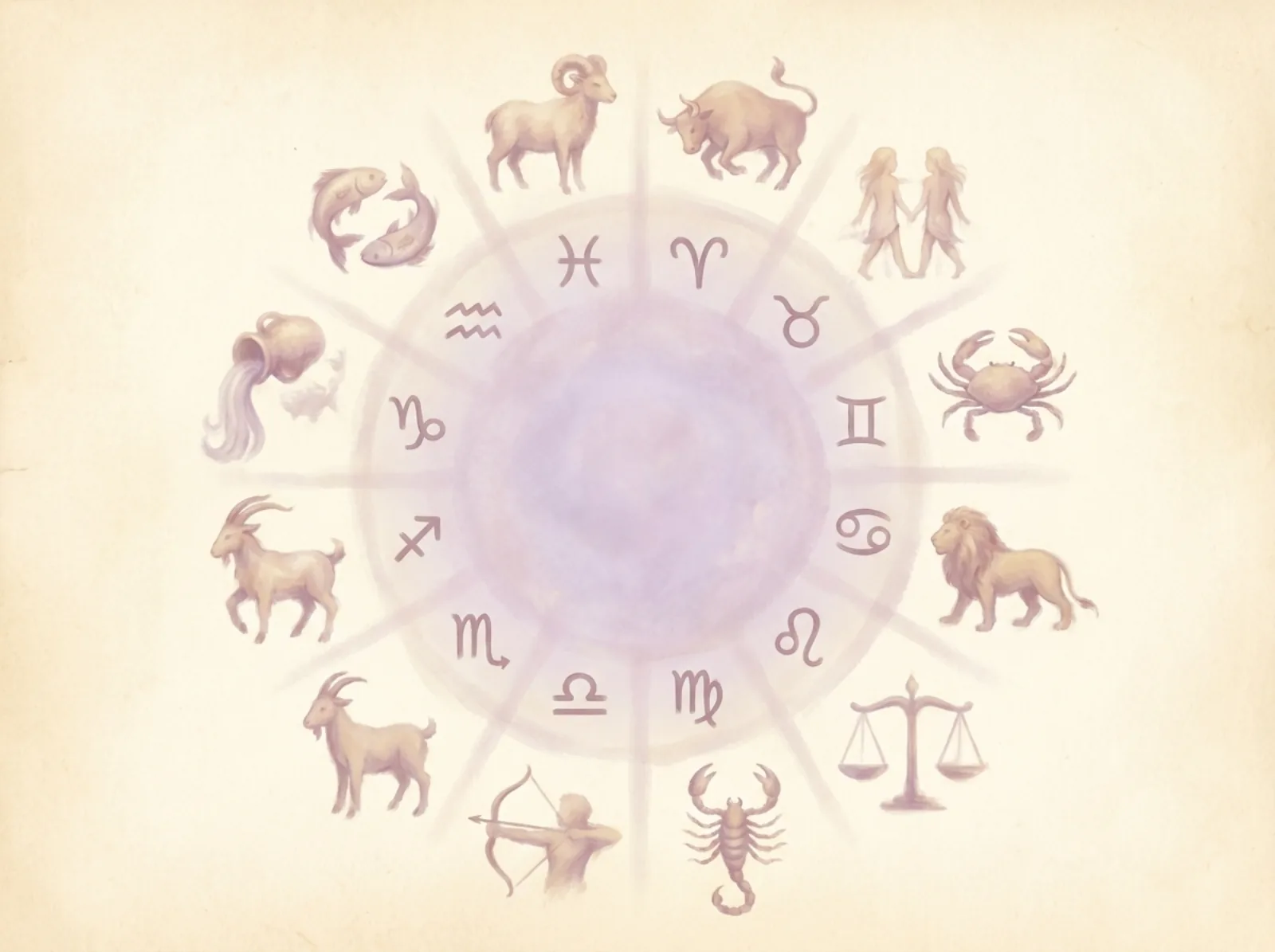
The Sagittarius work style: mutable fire at the desk
Before you touch a job board, you have to understand what you actually are. Sagittarius is mutable fire — the ninth sign, ruled by Jupiter, symbolized by the archer. Three words to park in your head: expansive, mutable, exploratory. Expansive because Jupiter wants bigger, further, more. Mutable because you adapt, you pivot, you don't need the plan to stay fixed. Exploratory because the archer isn't aiming at a target on the wall — it's aiming somewhere over the horizon it hasn't been yet. What this looks like at a desk: you light up when you're learning. You lose the plot when you're not. You will out-work almost anyone on a project you believe in, and you will become visibly, almost comically depressed in a role that bores you — you'll start arriving late, taking long lunches, picking fights in Slack about things that don't matter. The energy doesn't disappear. It just leaks sideways. Mutable fire needs a direction to burn in. Give it one and you get a force of nature. Starve it and you get someone who quits in month seven and tells their friends 'the vibe was off.' Your work style, in one line: you are a vision engine with a bad relationship with maintenance. Build around that, don't apologize for it.The 14 best careers for Sagittarius (and why)
I don't love 'best jobs for your sign' lists because they treat astrology like a career aptitude test, which it is not. But there are real patterns in how Sagittarius thrives, and these roles share four traits: autonomy, meaning, variety, and a story. Here's what I've seen work. 1) Travel journalist or correspondent — you get paid to go somewhere and come back with a point of view. Jupiter's dream. 2) University professor or lecturer — the ninth house is literally higher education; you get to be the smartest person in the room about something you love. 3) Documentary filmmaker — long-form, meaning-driven, you can disappear into the field for months. 4) Expedition guide, dive instructor, mountain leader — if your Mars and your rising aren't fighting you, physical adventure work is a legitimate career, not a gap year. 5) International development or NGO work — meaning plus movement plus actual stakes. 6) Lawyer, especially litigation or constitutional — Sagittarius loves a principle and loves an argument. 7) Publisher, literary agent, or editor — you shape ideas for a living. 8) Startup founder (we'll come back to this). 9) Diplomat or foreign service officer — the ninth house is foreign cultures; you'll be good at this and probably bored of your home country. 10) Pilot or airline captain — stereotypical, I know, but you'd be surprised how many Sag pilots I've met and how happy they are. 11) Religious or spiritual teacher — Jupiter rules philosophy and the search for meaning; this is the archetype's home. 12) Sports coach, especially at the elite level — big-picture thinker, motivator, believer. 13) Keynote speaker, workshop facilitator, or trainer — you were built to stand in front of a room. 14) Consultant in a field you've mastered — autonomy, variety, big fees, you get to leave. The reasoning behind all of these: they reward range and conviction, they punish narrow repetitive execution, and they let you tell a story at a dinner party. And the worst careers? High-volume data entry, call-center scripts, compliance work where the whole job is making sure nobody does anything new, deep-specialist roles where you touch one body part or spreadsheet forever, anything with a strict uniform and strict chain of command and no horizon to look at. Sagittarius dies in roles where the ceiling is low, the variety is zero, and the meaning has been engineered out. If you're stuck in one, the move isn't necessarily to quit tomorrow — the move is to find the exit ramp, build the skill or credential that gets you out, and go.Sagittarius as a boss: visionary, chaotic, loyal
If you report to a Sagittarius or you are one managing a team, here's the honest profile. Strengths: you cast a bigger vision than almost anyone. You see where the industry is going. You believe in your people in a way that makes them walk through walls for you. You'll back a weird idea from a junior and give them room to run. You're loyal in a crisis. You'll stand up for your team to leadership and take the hit. You're generous — with budget, with credit, with second chances. Weaknesses that are not optional, they are the archetype: you over-promise. You tell your team the thing will ship in Q2 because in your head it already has, and then it ships in Q4 and everyone is tired. You get bored of the operational details and leave them for someone else, which is fine if you've hired that someone, catastrophic if you haven't. You can be preachy — the ninth house loves a sermon, and some Sag bosses turn 1:1s into TED talks their reports didn't ask for. You can go cold on people who disappoint you in a way that feels, from the outside, like a sudden climate change. Fix the shadow and you become a legendary boss. The fix is boring: hire a strong operator under you, write things down, let your team hold you to timelines, and ask more questions than you give speeches. I've watched the same person be an unbearable manager at 29 and a beloved one at 39 — the archetype didn't change, the discipline did.Sagittarius as an employee: the one who leaves (eventually)
If you're a Sagittarius working for someone else, the dirty secret is you probably won't be there in five years, and that's okay. The archetype is not built for lifetime employment at one firm. You will outgrow roles. You will get bored. You will, around year three, start Googling master's programs or one-way flights to Lisbon. This isn't failure — it's the engine. Your job as a Sag employee is to be excellent while you're there, learn everything you can, build real relationships, and leave well when you leave. The common failure modes I see: you check out mentally six months before you resign, and the quality of your work tanks, and the reference suffers. You burn a bridge on the way out because you're annoyed. You leave for something that is just a rebranded version of the same problem and are shocked when you're bored again by month eight. The pattern that works for Sagittarius careers: 2-4 years at a role, extract maximum learning, pivot into something that uses what you built and opens a new frontier, repeat. By 35 you have a portfolio of experiences nobody else has, which is exactly the Jupiter blueprint. Don't apologize for the shape of it in interviews. Learn to tell it as a story — Sagittarius is the sign of narrative.Sagittarius as an entrepreneur: dangerous and necessary
A lot of founders are Sagittarius. A lot of failed founders are also Sagittarius. The archetype has the exact right ingredients to start a company — vision, risk tolerance, conviction, a willingness to pitch, charisma, a belief that the rules don't fully apply to you — and the exact wrong ingredients to run one once it's past about 15 people. Starting is a Jupiter act. Scaling is a Saturn act. If you're a Sagittarius considering founding something, three honest questions. First: do you love the problem or do you love the idea of being a founder? Jupiter is a great marketer and will sell you the fantasy of your own life. Catch yourself. Second: who's your Saturn? Every great Sag founder I've worked with has a co-founder, COO, or very senior hire whose entire job is to turn the vision into a system. Without that person you will have a beautiful pitch deck and a chaotic company. Third: can you stay through the boring middle? Year one is exciting. Year three is spreadsheets and HR. If you can't survive year three without quitting on yourself, don't start — go be employee number ten at someone else's startup and have the fun without the carnage. Sagittarius entrepreneurs who make it do one thing well: they build the structure that bores them so they can keep doing the thing that doesn't. The ones who don't make it keep starting over, each new venture a little smaller, each pitch a little more rehearsed.The Sagittarius career shadow: boredom, flakiness, and the escape fantasy
Every sign has a shadow — the part of the archetype that runs you when you're not paying attention. For Sagittarius careers, the shadow has three faces. First, chronic boredom reframed as 'this isn't my purpose.' You feel the restlessness in month 14, and instead of recognizing it as a Jupiter pattern you dress it up as a cosmic sign that you must leave. You don't. You might just need a new project at the same company. Second, the escape fantasy — the moment things get hard, your mind produces a vivid image of you running a surf school in Costa Rica or writing a book in a cabin or doing a yoga teacher training. The fantasy isn't the problem. Treating it as a plan is. Write it down, let it exist, don't quit your job on Tuesday because of it. Third, over-promising. You say yes to projects, timelines, favors, and side quests you cannot physically deliver, because in the moment your Jupiter self genuinely believes you can. Then you quietly fail to deliver, your reputation takes a hit, and you tell yourself a story about how 'this environment wasn't for me.' The environment was fine. You over-promised. The recovery from all three looks the same: slow down, write it down, and run every big decision through a 30-day cooling-off period. Jupiter at full volume will burn down a perfectly good career in a weekend. Jupiter on a diet will build you something beautiful.Famous Sagittarius CEOs and leaders (what we can actually learn)
Astrology isn't a determinism and successful people share a sun sign the way they share a hair color — interesting, not causal. But patterns are instructive, and these real Sagittarius leaders show the archetype at scale. Walt Disney (born 5 December 1901) — the ur-Sagittarius founder: a world-builder who sold a vision bigger than the medium existed to support, bet the company on new technology repeatedly, and leaned into story as a business model. Classic Jupiter. Jay-Z (Shawn Carter, 4 December 1969) — rapper-turned-mogul who built across music, fashion, spirits, and sports representation. Range, reinvention, and a career arc that keeps crossing into new industries — pure mutable fire. Jane Fonda (21 December 1937) — actress, activist, entrepreneur who reinvented herself through fitness, political work, and climate activism across six decades. Taylor Swift (13 December 1989) — Sagittarius sun who out-strategised the music industry, rerecorded her own masters, and now runs a touring business bigger than most countries' GDPs. Big vision, long game, personal brand that sells meaning. Steven Spielberg (18 December 1946) — filmmaker who built a studio and a visual grammar; see also his explicit interest in travel, big themes, and the search for wonder. Winston Churchill (30 November 1874) — a Sag at war: speeches, grand strategy, a love of history and language, and the shadow (temper, excess, over-confidence) on full display. What's the lesson? These aren't people who got lucky with a sun sign. They're people who put the archetype to work: they picked big arenas, told stories, took enormous risks, and either managed their shadow or got managed by it in public. Pick which group you want to be in.The 10th house and your actual career signature
Here's where I have to gently correct the whole premise of a sun-sign career article. Your career isn't really described by your sun sign. It's described by your tenth house — the midheaven, the planets in the tenth, the ruler of the tenth, aspects to the midheaven. Your sun sign is one input. If you're a Sagittarius sun with a Capricorn midheaven, you are a very different career animal from a Sagittarius sun with a Leo midheaven, and both are different from a Sag sun with a Virgo midheaven. The sun gives you the engine, the Jupiter flavor, the restlessness. The midheaven gives you the public shape — what the world sees you as, what your reputation gets built on, what you're known for. For a lot of Sag suns, the tenth house tells you where to point the arrow. A Sag sun with a Scorpio midheaven becomes a journalist on hard subjects, a crisis consultant, a trauma therapist with a big public profile. A Sag sun with a Taurus midheaven ends up in luxury, hospitality, or wine — the exploratory engine applied to sensory experience. A Sag sun with a Gemini midheaven is almost always a writer, teacher, or communicator in some form. You cannot do career astrology without the whole chart, and anyone who tells you otherwise is selling you a horoscope, not a reading. If you want to go deeper on your own chart, this is where self-reflection beats a listicle every single time.Career journaling with Raka: using the archetype on purpose
I built this piece into Raka because sun-sign articles stop being useful once you've read three of them, and then you need a mirror. Raka is a tarot and reflection app I use with my own clients between sessions — it's for the moments when you're trying to figure out whether your restlessness is information or noise, and you need a prompt and a quiet five minutes, not another TikTok. For Sagittarius career work, the prompts that actually help are specific. Draw a card and ask: 'What am I bored of that I'm pretending is a crisis of purpose?' Draw a card and ask: 'What am I avoiding in my current role that would actually solve the restlessness?' Draw a card and ask: 'If I quit tomorrow, what would I regret not finishing first?' Draw a card and ask: 'Which part of this escape fantasy is real and which part is a mood?' These are not predictions. Tarot does not predict your career. What it does, used well, is slow you down enough that you hear your own voice under the Jupiter noise. A Sagittarius making a career decision in under 48 hours is almost always making the wrong one. A Sagittarius making a career decision across six weeks, three journal entries, a long walk, and one honest conversation with someone who's known them for ten years is almost always making the right one. The archetype gives you the fire. Reflection gives you the aim. Raka is the quiet pause between them.When to pivot: Saturn returns, Jupiter returns, and the one-sentence rule
Sagittarius restlessness is constant. Real career-pivot timing is not. Two transits actually matter, and if you understand them you'll stop quitting jobs on Tuesdays. First, the Saturn return — Saturn comes back to its natal position roughly every 29.5 years, so your first Saturn return hits between about 28 and 31, your second around 58 to 60. This is the universe's annual review. Careers built on borrowed enthusiasm fall apart here. Careers built on real foundations get an upgrade. If you're a Sag in your late twenties and nothing is working, don't panic — Saturn is doing its job. If you're a Sag in your late twenties and everything is suddenly structured and clear and a little boring, don't panic either. Both are the same transit from different angles. The move at your Saturn return is to pick: either commit to the structure of what you've built, or dismantle it on purpose and start the real thing. Don't drift. Second, the Jupiter return — Jupiter returns home every 12 years, so you get them at roughly 12, 24, 36, 48, 60, 72. For Sagittarius these are big — Jupiter is your ruler. Jupiter returns are expansion windows: new opportunities, new countries, new teachers, new scope. If a Jupiter return lines up with your 20s or 30s and you're sitting in a job you've outgrown, that's the window to leap. Beyond these, pay attention to transits to your tenth house, to your midheaven, and to Jupiter in your natal chart. But if you only remember two things: Saturn says 'commit or quit,' Jupiter says 'go bigger.' Make career pivots on their calendar, not on your bad Tuesday. The one-sentence Sagittarius career rule, if you take nothing else from these 4,000 words: the question is not 'what should I do with my life?' It's 'what am I willing to be disciplined about long enough to let the vision land?' Vision is cheap for you. Jupiter hands it out for free. Discipline is the expensive part. Pick the big arena — travel, teaching, publishing, founding, law, film, whatever your tenth house points to — and then stop pivoting for long enough that one of your Jupiter bets actually matures. Three years in the same arena with occasional pivots beats ten years of starting over in a new one. Your edge isn't that you have ideas. Everybody has ideas. Your edge is that you're willing to go further for a story worth telling. Stay long enough to tell it. The archer who never lets go of the arrow doesn't hit the target. Draw, aim, release. Then draw again.Frequently asked questions
What is the best career for a Sagittarius?
There isn't one best career — there are best shapes. Roles that give Sagittarius autonomy, meaning, variety, and a story to tell tend to work: professor, journalist, founder, lawyer, consultant, pilot, filmmaker, diplomat, coach, speaker, publisher, expedition leader. Any job that reliably ends in a dinner-party anecdote is probably a good fit. Any job that doesn't is probably not. Part of our astrology library.
Why do Sagittarius people quit jobs so often?
Because the archetype is mutable fire — it's wired for exploration, not maintenance. Sagittarius energy peaks on new projects and dies on repetition. The quit cycle is usually around month 24 to 36 of a role, when the learning curve flattens. The fix is not to stop quitting entirely — it's to pivot inside a career arena rather than starting over in a new one every time, and to make the move on real information, not a mood.
Are Sagittarius people good bosses?
They can be exceptional — big vision, loyal, generous with credit, willing to bet on people. They can also be chaotic — over-promising, allergic to operational detail, prone to sermons. The difference between the two versions is almost always a strong operations person under them, a habit of writing things down, and a willingness to be held to timelines they set. Good Sag bosses hire their own Saturn. See our top astrology app guide.
Should a Sagittarius start a business?
If the vision is real and you have a co-founder or senior hire who loves the parts you hate, yes. If you love the idea of being a founder more than the actual problem, no. Sagittarius starts companies beautifully and scales them badly without structural help. The question isn't whether you can start — it's whether you can stay through the boring middle years when the pitch deck has become spreadsheets.
What are famous Sagittarius CEOs and leaders?
Walt Disney, Jay-Z, Jane Fonda, Taylor Swift, Steven Spielberg, and Winston Churchill are all Sagittarius suns. The pattern across them: big arenas, personal brand built on story, long-game reinvention, high risk tolerance. Also visible: the shadow — over-reach, excess, controversy. The archetype at scale amplifies both the gift and the problem.
When is the best time for a Sagittarius to change careers?
At a Saturn return (around 28-31 and 58-60) or a Jupiter return (every 12 years — 24, 36, 48). Saturn returns force a 'commit or quit' decision on what you've built; Jupiter returns open expansion windows for bigger moves. Avoid pivoting on a bad Tuesday. Give any big career decision at least 30 days and one long conversation with someone who's known you a decade.
Can astrology actually predict my career?
No, and anyone who says yes is overselling. Astrology — including a full look at your tenth house, midheaven, and natal Jupiter — can describe your defaults, your work style, your shadow, and the timing of major transits. It can't predict a job offer or guarantee success in a field. Treat it as a self-reflection tool for understanding patterns, not a crystal ball. Decisions are still yours.