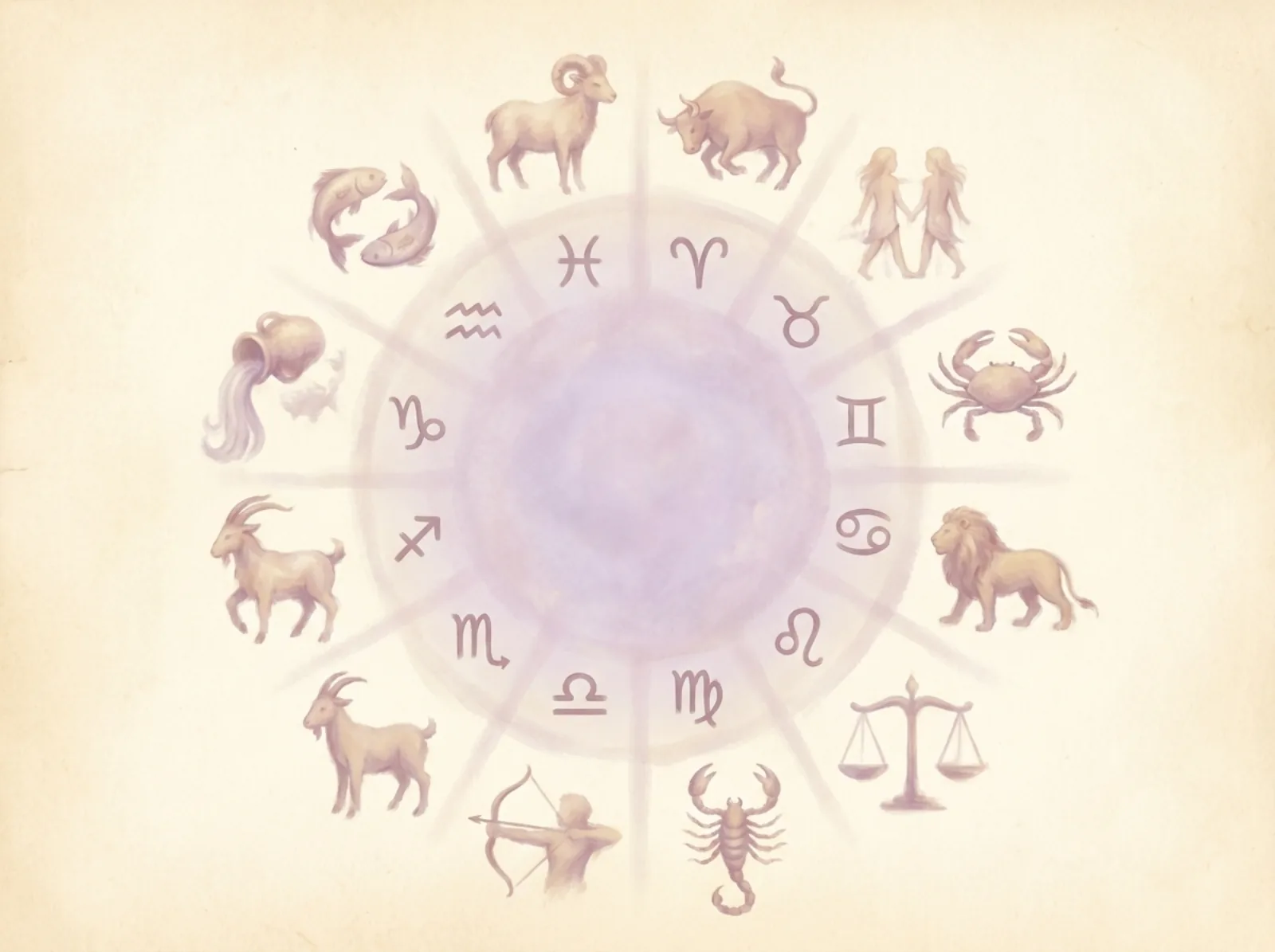
Pisces at a Glance: Dates, Element, and the Symbol of the Two Fish
If your birthday falls between February 19 and March 20, you were born under Pisces — the twelfth and final sign of the tropical zodiac. Because the sun's exact ingress shifts by a few hours year to year, people born on the cusp (roughly Feb 18–20 or Mar 19–21) should check an ephemeris for their birth year rather than assuming. NASA publishes solar-position data if you want the astronomical version; astrology software will give you the tropical version most Western practitioners use. Part of our sign traits library.
Pisces is a water sign, alongside Cancer and Scorpio, which means the sign's default operating system is emotional and relational rather than rational-first. It is also a mutable sign, sharing that modality with Gemini, Virgo, and Sagittarius. Mutability is the season-change energy — flexible, transitional, allergic to rigidity. Put those together and you get a person wired to feel deeply and shape-shift often. (part of our personality)
The symbol is two fish bound by a cord, swimming in opposite directions. That image matters. It is not one fish; it is two, in tension. Pisces personality is defined by this internal duality: the part of you that wants to dissolve into something bigger (art, love, spirit, sleep) and the part that wants to swim upstream toward a concrete life. Both are real. Both are you.
Traditional (pre-1846) astrology assigned Pisces to Jupiter — the planet of meaning, expansion, faith, and philosophy. After Neptune was discovered in 1846, modern Western astrologers gave Pisces a co-ruler in Neptune, which governs imagination, dreams, mysticism, and, in its shadow, illusion. Liz Greene's classic work on Neptune (The Astrological Neptune, 1996) is still the sharpest text on why Pisces reads simultaneously as ethereal and as prone to fog. I recommend it to any Pisces client who wants to understand themselves at book depth.
Core Pisces Personality Traits: The Real Portrait Behind the Cliché
The stock description of Pisces — dreamy, sensitive, artistic — is not wrong, but it is incomplete in a way that irritates most Pisces I have worked with. The fuller picture is that Pisces personality is defined by high permeability. You pick up emotional signal that other people miss, or that they filter out to function. That is a feature and a burden. See how Raka compares to other apps in our independent guide.
Empathy is the headline trait, but it is a specific kind of empathy: affective and somatic. You do not just understand what someone feels; you often physically feel a version of it. If you have ever left a party exhausted for reasons you cannot name, or absorbed a partner's mood before they spoke a word, that is Pisces wiring in action. Chani Nicholas frames this well in You Were Born for This (2020) — water signs are asked to steward feeling, not perform it.
Imagination is the second engine. Pisces minds are associative rather than linear. You connect dots across disciplines, tone, and time. This is why so many Pisces gravitate toward writing, music, therapy, and design — fields that reward pattern recognition over spreadsheet logic. It is also why a Pisces on a bad day can spiral, because the same associative engine that produces art also produces catastrophic what-if loops.
Adaptability, courtesy of the mutable modality, rounds out the top three. Pisces reads a room and adjusts. That flexibility makes you an unusually easy collaborator and a peacekeeper in families, but it can also mean you lose track of your own baseline. "What do I actually want, before I factored in what everyone else needs?" is a question worth asking yourself weekly.
Underneath all of it sits a quiet, often unspoken belief that there is more to reality than what can be measured. Whether you frame that as spirituality, art, mysticism, or simply intuition, it shapes how you make decisions. You trust felt sense. The task, in adulthood, is to pair that felt sense with the discernment to know when the feeling is truth and when it is a projection.
Ruling Planets, Element, and Modality: Why Pisces Feels the Way It Does
To understand Pisces personality at the mechanics level, you have to look at three ingredients: ruling planet(s), element, and modality. Ignore any one of them and the sign flattens into a horoscope-column caricature.
Jupiter, the traditional ruler, is the largest planet in our solar system and, in astrology, governs what feels big — belief, meaning, generosity, exploration, the search for a story that makes life make sense. This is why Pisces personalities often have a philosophical or spiritual streak, why they overgive, and why they can be surprisingly ambitious about causes rather than titles.
Neptune, the modern co-ruler, was discovered in 1846 and is astronomically the last major planet in our solar system since Pluto's 2006 reclassification by the International Astronomical Union. Astrologically Neptune governs dissolution — of ego, of boundaries, of the ordinary in favor of the transcendent. On its healthy end it produces mystics, artists, and healers. On its shadow end it produces avoidance, addiction, and self-deception. Pisces holds both potentials.
The water element explains why Pisces processes life through feeling before thought. Water in astrology is associative, memory-rich, and shaped by whatever container it sits in. That last part is critical: Pisces personalities tend to take on the emotional shape of their environment. Choose your containers — your relationships, jobs, and rooms — carefully.
The mutable modality explains why Pisces resists rigidity. Mutable signs sit at the end of each season and are wired for transition. Where cardinal signs start and fixed signs sustain, mutable signs metabolize change. This is why Pisces personality can pivot careers, cities, or identities in ways that shock fixed-sign friends, and why routine — genuine, protective routine — is medicine rather than a cage.
Strengths of Pisces: Where This Sign Truly Excels
Empathy at scale. Pisces personalities can hold space for grief, rage, and confusion in a way that most signs cannot. This is why so many end up in therapy rooms, hospice care, teaching, or the arts. You do not have to be told what someone needs; you can often sense it. In a culture that rewards armor, this is a rare and valuable orientation.
Creativity that spans mediums. Because your mind is associative rather than linear, you find aesthetic solutions where others see only logistics. Pisces personalities are overrepresented among songwriters, poets, cinematographers, and UX designers — anyone whose job is to translate emotion into form. Susan Miller has written for years about how Pisces artistic output often clusters around Neptune transits; even if you do not track transits, you probably notice creative surges you cannot explain.
Spiritual intelligence. Whether or not you use the word spiritual, you tend to sense meaning under events. You are the friend who says, months later, "I think that job loss was actually the door opening." That reframing capacity, when it is honest rather than escapist, is a genuine strength — and it makes Pisces exceptional at processing loss.
Compassion without contempt. Pisces personalities can hold that a person did something harmful and is also human and wounded. Held well, this is wisdom. Held poorly, it becomes enabling. The healthy expression is nuance without exit — you can love someone and still hold a boundary.
Adaptability under pressure. When plans collapse, Pisces personalities often become the calmest person in the room, precisely because you were never that attached to the plan. You improvise. You find the emotional through-line. In crisis-response fields — ER nursing, disaster relief, crisis counseling — this trait is gold.
Weaknesses and Shadow: The Parts Most Pisces Content Skips
The single most common Pisces shadow I see in client work is escapism. Because reality can feel loud and sharp to a permeable nervous system, the pull to soften it — via sleep, screens, substances, fantasy relationships, endless scrolling — is chronic. Escapism is not evil, but it becomes a problem when it starts replacing rather than restoring you.
Boundary blur is the second big one. Pisces personalities can merge with a partner, a friend group, or a job to the point of losing personal shape. You may find yourself six months in and unable to answer basic questions: What music do I actually like? What was my opinion here before I heard theirs? Rebuilding a felt sense of "me versus us" is often the core work of a Pisces's twenties and thirties.
Martyrdom. Because giving feels natural and asking feels dangerous, Pisces personalities can quietly overextend, then resent people for not intuiting the debt. The uncomfortable growth edge is learning to name a need clearly, in ordinary language, before it becomes a crisis. "I would like your help this weekend" beats "nobody ever helps me" every time.
Idealizing partners. Neptune's shadow shows up loudly in Pisces love life. You can fall for the version of a person that lives in your imagination and stay committed to that version long after the actual person has shown you who they are. Liz Greene's writing on the Neptune-in-love pattern is worth reading closely if this rings true.
Conflict avoidance. Because you feel other people's discomfort acutely, you may dodge honest conflict to keep the water calm, even at real cost to yourself. Over years, this creates a life shaped more by others' preferences than your own. Practicing small, low-stakes disagreements — sending back the wrong order, asking to reschedule — builds the muscle.
Pisces in Love, Sex, and Long-Term Partnership
In love, Pisces personalities are wholehearted and often all-in early. Because you sense connection quickly, you can bypass the slow-build phase most relationships need and skip to intimacy in weeks. That intensity is intoxicating for both people, but it is also where the idealization trap lives. A useful rule: do not make major logistical decisions (moving in, merging finances, meeting family) during the first six months of the neurochemical bloom. Try best AI tarot app to explore this in more depth.
You are drawn to depth. Small talk exhausts you; a conversation about grief, art, meaning, or someone's actual inner life lights you up. Partners who cannot or will not go there tend to leave you feeling starved even when everything looks fine on paper. Your job is not to fix them into depth; it is to notice, honestly, whether the person you are dating can meet you where you already live.
Intimacy for Pisces personalities is rarely just physical. Sex is a channel for emotional and, for some, spiritual connection, and quality matters far more than frequency. A skilled, present partner in a candle-lit hour will land more deeply for you than any performance-oriented routine. Fantasy plays a legitimate role — Pisces is the sign most likely to have a rich inner erotic imagination — and that fantasy is not a threat to a real relationship provided it lives alongside actual communication.
You forgive quickly. This is a gift and a risk. Forgiveness given too early, without behavior change from the other person, becomes tolerance of harm. The Pisces growth edge is learning that forgiveness is an internal event; reconciliation is a separate, evidence-based decision. You can absolutely do the first without owing the second.
Long-term, Pisces personalities thrive with partners who provide both emotional depth and structural grounding. Practical earth-sign partners (Taurus, Virgo, Capricorn) often play this role well; other water signs offer emotional fluency; certain air signs bring the outside perspective that keeps you from disappearing into your own inner weather. If your relationship to intimacy is causing distress, or you are working through trauma, a licensed sex therapist or trauma-informed clinician is the right resource — astrology can describe patterns; it cannot substitute for care.
Pisces Friendship Style: The Person Everyone Confides In
Pisces personalities are often the emotional home base of their friend group. People tell you things they have not told anyone. You remember birthdays and the exact phrasing of a two-year-old story about someone's mother. This makes you beloved and, if you are not careful, quietly overworked.
You are drawn to a few deep friendships rather than a wide social bench. Large group dynamics can drain you; one-on-one, you come alive. This is not shyness; it is bandwidth. Your emotional processor runs deep, not wide, and honoring that is a form of self-respect.
Because you sense subtext, you can spot when a friendship is going quietly off. The temptation is to overexplain or overcompensate rather than name the shift. A short, direct "Hey, is something up between us?" often resolves in minutes what a month of anxious guessing could not.
Watch for the friend who treats you as free therapy. Pisces personalities can end up in one-sided relationships where you hold their crises weekly and never get to unpack your own. Healthy friendships are mutual over time; you are allowed to bring your own weather, too.
Your loyalty runs deep. You will keep loving a friend through years of drift, misunderstandings, and life-stage mismatches. This is a strength — but it does not obligate you to keep active friendships with people who consistently show you disrespect. Loyalty without discernment becomes captivity.
Career Strengths, Ideal Jobs, and Money Style
Career satisfaction for Pisces personalities depends less on prestige and more on whether the work has meaning and room for intuition. A high-paying job that violates your values will erode you at a somatic level; a modest job that aligns with your inner sense of purpose can feel like breathing.
The obvious fits are the healing and helping professions: therapy, counseling, social work, hospice, nursing, chaplaincy, coaching. Your ability to hold space and read unspoken emotional data is a genuine competitive edge in these fields. According to the U.S. Bureau of Labor Statistics' 2023–2033 projections, mental health counseling is one of the faster-growing occupations in the country — a field where Pisces temperament is well-matched.
The creative fields also fit: writing, music, film, photography, design, poetry, acting. Any work that translates inner experience into external form draws Pisces personalities. Susan Miller has repeatedly observed that the arts are a natural Neptunian domain. Less obvious but strong: qualitative research, ethnography, UX research, investigative journalism, marine biology, spiritual direction, yoga and somatic instruction, and end-of-life doula work.
On money, Pisces personalities have a famously ambivalent relationship. You can be generous to a fault and simultaneously avoid the whole conversation, as if caring about money is spiritually suspect. That aversion has a cost. Money is neutral infrastructure. Pisces personalities who make peace with a real budget, an emergency fund, and honest tracking tend to report significantly less baseline anxiety over time.
Watch the rescue pattern — subsidizing partners, siblings, adult children, or friends whose crises are chronic rather than acute. Compassion is real; so is depletion. Giving from overflow is generosity; giving from your own security is a slow bleed. None of this is financial advice: for actual planning, work with a licensed fee-only planner (in the US, NAPFA is a reasonable starting point). Astrology can describe your money temperament; it cannot allocate your portfolio.
Communication Style: How Pisces Speaks (and Struggles to Speak)
Pisces personalities communicate atmospherically. You transmit mood, tone, and subtext as much as content. In relationships with other high-context communicators, this is beautiful — a full conversation can happen in three sentences and a look. In relationships with low-context communicators (many, particularly at work), it can leave you feeling unheard.
You tend to soften bad news, hedge opinions, and read a room before speaking. This is emotional intelligence, but taken too far it becomes a habit of not saying what you actually think until resentment has built up. Direct, kind speech is a learnable skill and, for Pisces personalities, one of the highest-return skills you can develop in adulthood.
In conflict, your instinct is often to disappear — literally leave, or dissociate in the room. This is a protective response, not a character flaw, but it makes resolution nearly impossible. A useful practice: naming the state. "I am overwhelmed and I need twenty minutes" is an entirely different signal than silent withdrawal.
You are gifted at written communication. Many Pisces personalities are startlingly better on the page than in real time — because writing gives your associative mind room to organize itself. Lean into this. Important conversations with partners, employers, or family are legitimate to draft in writing when speech feels too fast.
Finally, listen to your own metaphors. Pisces personalities often speak in imagery: "It felt like drowning." "I was frozen." These are not just figures of speech; they are your nervous system telling you something specific. Treat your own language as data.
Pisces Compatibility Matrix: Quick Read Across the Zodiac
Sun-sign compatibility is a starting point, not a verdict. A full synastry chart involves moon, Venus, Mars, Ascendant, and cross-aspects — none of which fit in a paragraph. Still, the sun-sign patterns are real and worth naming, because they show you the default emotional weather between two archetypes. Try the Raka app to explore this in more depth.
Water signs (Cancer, Scorpio): high fluency. Cancer offers home and emotional safety; Scorpio meets your depth and intensity in a way few others can. The risk in both is that two water signs can flood each other; you may need external structure to keep the relationship aired out.
Earth signs (Taurus, Virgo, Capricorn): complementary. Taurus grounds your dreamy energy in sensuality and steadiness; Virgo, your opposite sign, offers precision and service that can beautifully balance your fluidity; Capricorn provides ambition and structure that can help your visions land in reality. Watch for the earth-sign partner treating you as chaotic rather than complex.
Fire signs (Aries, Leo, Sagittarius): potential and friction. Fire can be inspiring — Aries's forward motion, Leo's warmth, Sagittarius's philosophical breadth — but fire can also feel abrasive to a Pisces nervous system if the partner does not modulate. Sagittarius shares Jupiter as a co-ruler and often clicks philosophically.
Air signs (Gemini, Libra, Aquarius): mixed. Gemini shares your mutability and can feel like a soulmate mentally, but the emotional wavelengths differ; Libra brings aesthetic and relational harmony; Aquarius, another Uranian outsider, can either fascinate you or feel emotionally arid. In every case, the individual charts matter far more than the archetype.
Famous Pisces Personalities: Public Figures Born Under This Sign
Famous Pisces figures show the range this sign can occupy — from artists and mystics to scientists and boundary-pushing athletes. Names commonly cited (and verifiable against reliable birth-data archives) include Albert Einstein (March 14), whose associative genius fits the archetype almost too neatly; Nina Simone (February 21); George Harrison (February 25); Rihanna (February 20); Kurt Cobain (February 20); and Steve Jobs (February 24), whose intuitive product sense was famously non-linear.
In literature and film, Anaïs Nin (February 21) and Gabriel García Márquez (March 6) both sit comfortably in the archetype — Márquez's magical-realist mode reads as textbook Neptunian imagination made prose. Justin Bieber (March 1) and Camila Cabello (March 3) sit on the pop-culture end of the range.
A useful lesson: many popular "famous Pisces" lists online are careless with cusp dates. If a public figure is close to February 19 or March 20, verify against a reliable source like the Astro-Databank archive before repeating. Michael Jordan (February 17), for example, is Aquarius, not Pisces, and gets miscategorized often.
What these lives share, at the archetypal level, is a willingness to work at the intersection of imagination and reality. They translated inner vision into outer form — music, physics, novels, product design. This is exactly what a healthy Pisces personality is built to do, at whatever scale your life allows.
Do not use famous-people lists as scripts for your own life. Your job is not to become Einstein or Rihanna; it is to become the version of you that your particular chart supports. Public figures are useful only as evidence that the archetype can produce range.
Right Now: 7 Steps a Pisces Can Take This Week to Grow
Growth for Pisces personalities is not about becoming less Pisces. It is about becoming a Pisces with functional infrastructure. Below is a practical week-long protocol I use with clients who want to move the needle without abandoning who they are. None of it is medical, therapeutic, or financial advice.
1. Do one boundary rep. Pick one low-stakes situation this week where you would normally say yes automatically, and say a clean no. No apology cascade, no explanation buffet. Just "I can't this time" and move on. 2. Write for fifteen minutes without an audience. Longhand or typed, doesn't matter. Your associative mind needs a designated place to think, or it will do it at 3 a.m. instead. 3. Name one financial number. Check your actual bank balance, actual credit-card debt, or actual monthly baseline. Just look. That is the entire step.
4. Identify your top energy leak. It might be one relationship, one recurring commitment, or one app. Do not fix it yet. Just name it, out loud, to yourself. 5. Do one grounding practice daily. A ten-minute walk without your phone, a cold-water splash, a five-minute breath practice — anything that reminds your nervous system you exist in a body. 6. Ask one direct question you have been avoiding. Of a partner, boss, parent, or friend. Short, kind, specific. See what happens.
7. Sleep on a schedule for seven nights. Not perfectly, but roughly the same bedtime and wake time. Pisces personalities often live in irregular time. Regularizing sleep, even loosely, tends to reduce baseline emotional volatility more than any single other intervention. Sleep research from institutions like the CDC's National Center for Chronic Disease Prevention has repeatedly linked consistent sleep timing to mood regulation; this is not woo, it is biology.
Do these seven for a week and notice what shifts. You may find that the "deep" Pisces problems you have been trying to solve philosophically respond faster to structural interventions than to more introspection. That is not a betrayal of your nature; it is your nature stabilized so it can operate at full power.
Pisces vs. Cancer vs. Scorpio: How the Three Water Signs Differ
All three water signs are emotionally fluent, but they process feeling in distinct modes. Understanding the differences saves you from conflating your experience with a sibling water sign's — a common source of confusion in astrology conversations.
Cancer is the cardinal water sign, ruled by the Moon. Cancer's water is domestic, ancestral, memory-driven. Cancer builds a home — literal and emotional — and defends it. Where Pisces dissolves into the ocean, Cancer draws a shoreline and calls it family. Cancer's shadow is moodiness and clinging; Pisces's shadow is escapism and merging.
Scorpio is the fixed water sign, traditionally ruled by Mars and, in modern astrology, by Pluto. Scorpio's water is deep, still, and pressurized — the trench, not the tide. Scorpio investigates, controls, and transforms. Where Pisces forgives fast, Scorpio remembers. Where Pisces merges, Scorpio bonds through intensity and depth chosen deliberately. Scorpio's shadow is control and grudge; Pisces's shadow is dissolution and evasion.
Pisces is the mutable water sign, ruled by Jupiter and Neptune. Pisces's water is oceanic — vast, permeable, everywhere at once. Pisces does not build a home like Cancer or a fortress like Scorpio; Pisces builds a mood, a vision, a shared imagination. Pisces's superpower is that it can hold all the feelings at once; Pisces's danger is that it can drown in them.
If you are a Pisces mistyped as a Cancer or Scorpio (or vice versa), the tell is in how you handle loss. Cancer nests, Scorpio investigates, Pisces surrenders and later reframes. All three are valid; none is superior; they are simply different water logics. Reading Chani Nicholas's chapter-length breakdowns of each water sign side by side is a fast way to feel the distinctions in your body.
When Astrology Helps, When It Doesn't, and When to See a Professional
Astrology at its best is a language for self-reflection. It offers vocabulary, permission, and pattern recognition. Reading your Pisces personality profile and thinking "yes, this is why I have always felt this way" can be genuinely useful — it can end years of shame about traits that are simply how you are wired.
Astrology at its worst is a way to avoid change. "I can't help it, I'm a Pisces" is not adulthood. Your sun sign describes tendencies, not destiny. Every archetype has a mature and immature expression, and you get to choose which one you cultivate. If you notice yourself using astrology to justify patterns that are hurting you or others, that is a signal to zoom out.
Astrology is not medicine, therapy, or financial planning. If you are struggling with persistent low mood, addiction, self-harm ideation, or serious relationship distress, please work with a licensed clinician. In the US, resources include the 988 Suicide & Crisis Lifeline and the SAMHSA National Helpline (1-800-662-HELP). In the UK, Samaritans (116 123). In Canada, Talk Suicide Canada (1-833-456-4566). In Australia, Lifeline (13 11 14).
In my experience with clients, the healthiest use of astrology looks like this: you use it as a mirror, you take what resonates, you leave what doesn't, and you pair it with real-world resources — therapy, community, movement, medical care, financial planning — as needed. Astrology is a lens, not a container.
If you want deeper study, the reading list I recommend to Pisces clients starts with three books: Liz Greene's The Astrological Neptune (1996) for the deep archetypal work, Chani Nicholas's You Were Born for This (2020) for the modern, socially conscious lens, and Susan Miller's The Year Ahead volumes for the working-astrologer voice. Between them you have most of what you need to think intelligently about this sign without slipping into fatalism.