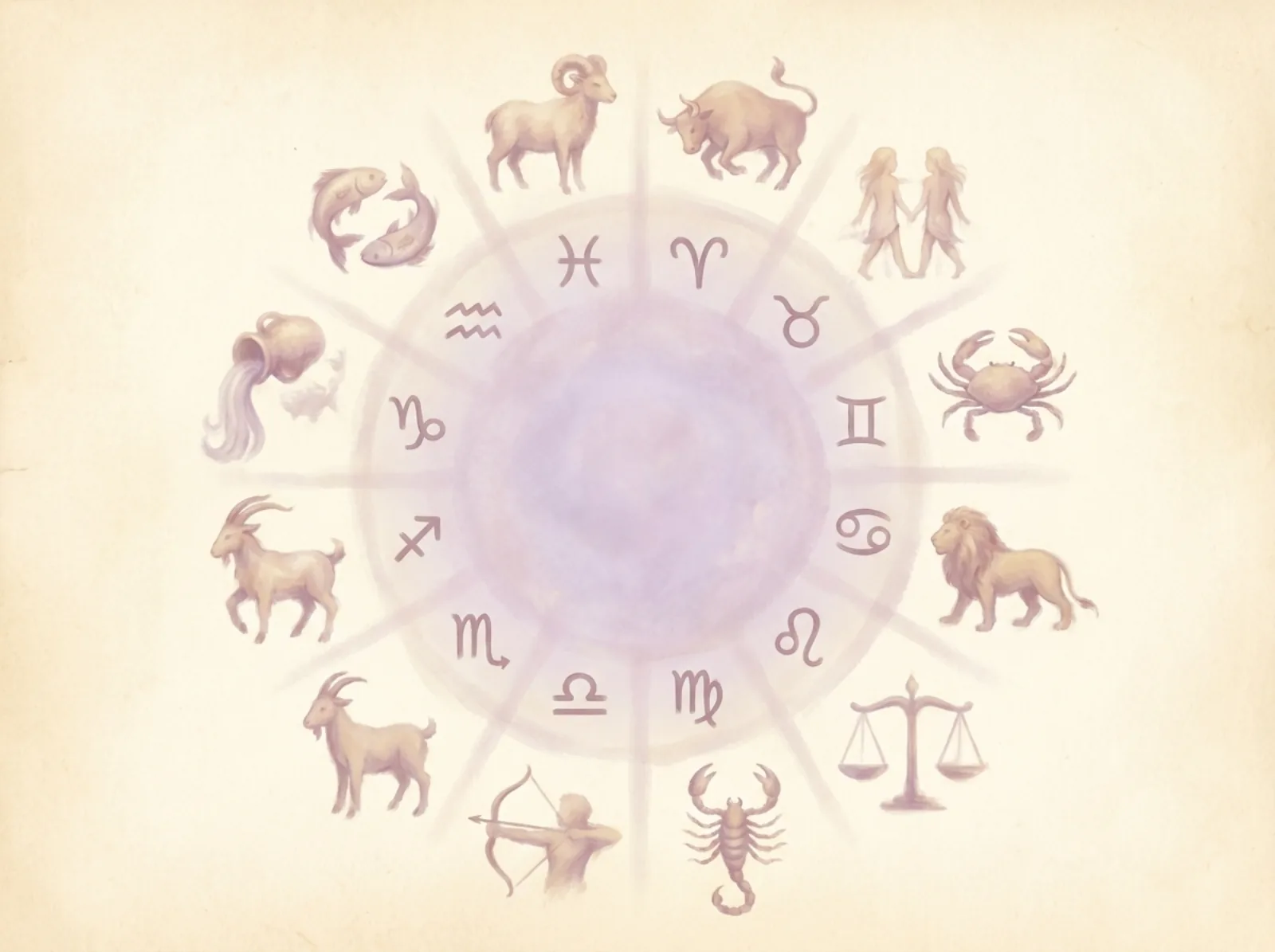
The Primary Aries Birthstone: Bloodstone and Diamond
If you Google 'Aries birthstone' you will get two different answers and a mild sense of being gaslit. That is because there is no single canonical system. There are several, and they disagree. The traditional Aries birthstone, the one with the oldest paper trail, is bloodstone. Bloodstone is also called heliotrope. It is a dark green stone speckled with red iron oxide. If you squint at it, the red specks look like drops of blood scattered across moss. Not subtle. The pairing with Aries goes back at least to medieval European astrology, and bloodstone was carved into signet rings and religious objects for centuries before anyone was writing listicles about it. The modern birthstone, codified by the American National Association of Jewelers in 1912 and adopted more or less globally since, is diamond for April. Aries runs March 21 to April 19, so half of Aries sits in March's slot (aquamarine) and half sits in April's slot (diamond). Most jewelers and astrologers have settled on diamond plus bloodstone as 'the Aries pair.' I personally lean bloodstone. Diamonds are stunning, but they are also a 60-billion-dollar industry with a famously complicated supply chain, and they do not carry the Aries folklore the way bloodstone does. If you want the stone that medieval warriors literally wore into battle because they believed it carried Mars energy, that is bloodstone. Not a cushion-cut diamond.Why Bloodstone and Diamond Got Linked to Aries
Here is the thing about zodiac stones: nobody sat down in antiquity and said 'Aries, you get bloodstone, enjoy.' The pairings evolved over centuries from a mix of planetary rulership, color symbolism, folk medicine, and honestly, vibes. Aries is ruled by Mars. Mars is red. Bloodstone is green with red flecks. The red-Mars connection shows up in writings by Pliny the Elder in the first century AD. Pliny claimed warriors used heliotrope to staunch bleeding on the battlefield. (It did not. But the association stuck for two thousand years.) The green came to represent earthy grounding, a counterweight to Aries's famous 'set everything on fire first, ask questions never' energy. Diamond's link to Aries is less about color and more about hardness. Aries is the first sign of the zodiac, the ram that charges in, breaks ground, starts things that other people finish. Diamond is the hardest naturally occurring substance on Earth. The symbolism basically writes itself: unbreakable, pioneering, first. The 1912 American jewelers' list cemented April as diamond, and because Aries dominates April, the Aries association got made retroactively. Other historical Aries stones you may see mentioned include carnelian (red, Mars-coded), ruby (red again), red jasper (grounding and warrior-coded in Mediterranean folklore), and aquamarine (because of the March overlap). None of these are wrong. They are just different lineages. If a crystal shop lists seven items under 'Aries stones,' that is not a scam. That is the full historical tangle on display.Five Secondary Aries Crystals Worth Knowing
If diamond and bloodstone do not speak to you, or if your budget has opinions about diamond, here are five secondary Aries stones I actually recommend. These are not fillers. Each one maps to a specific Aries trait and has real historical backing in one tradition or another. **Carnelian.** The classic Mars stone. Burnt orange, warm, confident, visually unmissable. Carnelian is for the Aries energy you want to channel: creative drive, the courage to start, physical vitality. Ancient Egyptians used it in protective amulets. I keep a tumbled piece on my desk whenever I am starting a new writing project, and it has become a Pavlovian trigger for 'it is time to actually open the document.' **Red jasper.** The grounded cousin of carnelian. If carnelian is the sprint, red jasper is the pace. Deep brick red, matte, dense, surprisingly heavy for its size. Good for the Aries who burns hot and then crashes at 3pm every afternoon. Journaling anchor: 'What am I actually trying to build here, and does it still matter?' **Citrine.** Yellow-gold, sunny, cheerful. Associated with confidence and mental clarity in most traditions. Aries loves big-picture thinking but can struggle with follow-through, and citrine shows up in a lot of Aries recommendations because it is visually warming and genuinely attractive sitting on a desk. **Clear quartz.** The universal amplifier. Pair it with any other Aries stone to 'boost' the intention. (Boost here means your attention gets focused by having two objects instead of one. That is the entire mechanism.) Clear quartz is also one of the cheapest crystals in the world and ethically easier to source than diamond. **Pyrite.** Fool's gold. I love this one for Aries because it looks like treasure, feels heavy and solid in your hand, and reminds you that confidence and arrogance look very similar from the outside. Good shadow-work stone, especially if you are the Aries who talks over everyone in meetings. You do not need all five. Pick one or two that make you want to actually hold them. The ones you would buy as a desk ornament even if astrology did not exist? Those are the ones that will end up in your pocket.How to Actually Use Crystals as Reflection Tools (Not Magic)
Here is where I lose the people who want me to tell them the stone will manifest a job offer. I will not. What I will tell you instead is how I personally use my crystals, and how most of the Aries clients and readers I have worked with over the years actually integrate crystals into their lives without becoming the person at the dinner party who talks about chakras unprompted. **As a worry object.** Hold it when you are thinking through a hard decision. The weight in your palm is a physical cue to slow down. Aries tends to decide fast and apologize later; a stone in your hand buys you three breaths. That is not nothing. **As a journaling anchor.** Pick a stone that represents a trait you want to work on this quarter. (Say, carnelian for 'finish what you start.') Put it on top of your journal. When you sit down to write, hold the stone first. The ritual is not magic. It is a conditioned response that tells your brain 'we are about to think now.' If you use the Raka app, this pairs beautifully with the daily reflection prompts. Hold the stone, read the prompt, then write. **As a desk reminder.** Place it on your laptop or desk, in your direct line of sight. When you catch yourself mid-Aries-spiral (impulse-buying a 400-dollar online course at 2am, picking a fight with your partner because you are bored, quitting a job over an email you misread), the stone becomes a visual speed bump. **As a conversation starter.** This sounds silly but it works. If a coworker or friend asks about the chunk of bloodstone on your desk, you get to explain your values out loud. Articulating 'I am trying to be more grounded this year' to another human being makes the intention real in a way that writing it in a Notes app does not. The honest frame: crystals function the same way worry beads, Catholic rosaries, mala beads, lucky coins, and fidget rings have functioned for literally thousands of years. They are physical anchors for intangible intentions. That is a real, well-documented psychological thing. It is just not supernatural.Crystals for the Aries Shadow Side
Every zodiac sign has a shadow side, the version of its strengths that comes out when the person is stressed, hurt, tired, or avoiding something they do not want to feel. Aries's shadow is usually some combination of: impulsive decisions, picking fights to feel alive, blowing up relationships before they can be ended by someone else, and impatience that curdles into contempt for anyone slower. If you are an Aries who has done the self-work to recognize this, and bless you if you have, because most of us figure it out around 32 after a particularly rough breakup, these are the stones I would keep around as reflection anchors. **Hematite** for impulsivity. Metallic grey, heavy, feels like a tiny iron bar in your hand. The weight alone is a reality check. When you feel the urge to send the text you absolutely should not send, hold the hematite instead. The physical weight gives your prefrontal cortex a moment to catch up to your limbic system. Try it. It works more often than it does not. **Smoky quartz** for anger that is actually grief wearing a disguise. Aries does not like sitting with sadness, so a lot of us route it into rage. Smoky quartz is translucent brown-grey and looks like a frozen cloud. The visual softness pairs well with the uncomfortable conversation of 'wait, am I actually just sad right now?' **Lepidolite** for anxiety that masquerades as drive. Lavender-grey, soft to the touch, often with glittery flecks of mica. Associated with calm and the pause before reaction. Good for the Aries who confuses 'being constantly busy' with 'being okay.' **Black tourmaline** for boundaries. Aries people over-give in friendships and then resent people for taking what we offered. Black tourmaline is the 'you do not have to say yes' stone. Keep one in your bag, especially before meetings you suspect will turn into asks. None of these do anything on their own. They are reminders. The actual work is still yours. But if you are the kind of person who needs a physical cue to remember your own values, and Aries very often is, the stones earn their rent.Crystals to Pair With for Love, Career, and Grief
This section tends to be the most-searched part of any zodiac birthstone article, so let me give you my actual recommendations rather than the generic 'rose quartz for love, citrine for money' lists you will find on every other site. **For love (self-love first, then relational).** Pair your Aries stone with **rose quartz** for softness or **rhodonite** for forgiveness. Aries can be fiercely loyal but equally fiercely defensive. Rose quartz is pink and almost cheesy-looking, which is kind of the point. It reminds you to be soft when every instinct in your body wants to armor up. Rhodonite is pink with black veining, and the black speaks to the parts of love that are not pretty: holding grudges, old wounds, the person you miss but should not text. **For career.** Pair with **pyrite** for ambition or **tiger's eye** for strategy. Pyrite is the 'I deserve to charge actual money for this' stone, which is a lesson most Aries have to learn the hard way after undercharging for three years out of a weird mix of competitiveness and insecurity. Tiger's eye is golden brown with a silky sheen that catches light, and it is the 'think before you quit' stone. Aries tends to leap from job to job chasing novelty. Tiger's eye is the quiet reminder that most careers get built by staying in one room three years longer than feels interesting. **For grief.** Pair with **apache tear** (a type of translucent obsidian) or **mahogany obsidian**. Both are dark, both are gentle, both are heavy and warm in a pocket. Aries does not grieve well. We treat sadness as a problem to solve rather than a weather pattern to live through. These stones look like they belong in a hand. When someone you love dies, you do not need another self-help book. You need something to hold while you cry. A note on pairing: there is no 'wrong' combination. The folklore varies enormously by tradition. What matters is that the stones mean something to you specifically. Pick based on how the stones feel in your hand, not what a listicle told you to buy.How to Cleanse and Charge Your Crystals Without the Woo
Okay. Here is where crystal culture gets weird and I need to translate. 'Cleansing' a crystal, in most traditions, means resetting it: getting rid of accumulated energy from being handled, being in intense environments, or sitting in a shop for years. 'Charging' means re-infusing it with intention for the next phase of use. If you are a skeptic reading this, interpret it this way: cleansing is a ritual that marks a reset for *you*, not the stone. You are giving yourself a moment to decide what you want the object to represent next. That is still useful, even if nothing is literally happening to the mineral. Here are the methods people use. All of them are fine. None of them physically change the stone. **Running water.** Hold the stone under cold tap water for 30 seconds. Do not do this with porous or water-sensitive stones like selenite, kyanite, malachite, or lepidolite, because they dissolve or discolor. Diamond, bloodstone, quartz, carnelian, pyrite, hematite, and jasper are all water-safe. **Moonlight.** Place the stone on a windowsill overnight during a full moon. The folklore says moonlight clears the stone. The practical version: it becomes a scheduled monthly ritual that gets you to pay attention to the moon, which is a nice thing to do. **Sunlight.** Similar to moonlight but used for charging. Caveat: amethyst, rose quartz, citrine, and fluorite fade in direct sun. Keep those indoors or in indirect light only. **Sage, palo santo, or herbs.** Pass the stone through smoke. If you are buying white sage, buy ethically. White sage is overharvested on Indigenous land in the American Southwest. Garden sage from your spice rack works fine, as does rosemary, cedar, or lavender. **Burying in salt or earth.** Overnight in a dish of sea salt, or a few hours in a garden pot. A grounding ritual with physical heft. **Sound.** Ring a bell or singing bowl near the stone. The vibration is said to clear it. The actual benefit: you are taking a sound bath yourself, which is relaxing. I do a once-a-month moonlight reset for my desk stones. It takes 10 seconds and I do not pretend it is more than it is. The point is not the stone. The point is the pause. Any ritual that creates a reliable monthly pause is a good ritual.Where to Buy Ethically Sourced Crystals
This is the part most zodiac birthstone articles skip entirely, and I think that is irresponsible, so I am going to spend a few paragraphs on it. The crystal industry has a dark underside. A lot of popular stones, including clear quartz, lapis lazuli, and amethyst, are mined in conditions that are environmentally destructive and sometimes involve child labor. The 2019 Guardian investigation into Madagascar's rose quartz trade is worth reading if you want to lose a weekend and a little bit of your innocence. Mica mining in Jharkhand, India, is similarly grim. What to actually do: **Buy from sellers who publish their supply chain.** Reputable crystal shops will tell you exactly where their stones come from, which mine, which country, often which year. If a shop cannot answer 'where is this amethyst from?', walk away. **Prefer small lapidaries in the US, UK, Canada, and Australia.** Many cut and polish stones that are sourced from documented mines in the United States (Arkansas quartz, Montana sapphire, Oregon sunstone), Brazil (regulated amethyst operations), or Australia (opal, chrysoprase). The smaller the operation, the easier the supply chain is to verify. **Buy secondhand.** Estate sales, antique stores, and resale sites like eBay or Mercari often have beautiful older stones at reasonable prices. The mining already happened. The ethical cost is sunk. Giving an old stone a new home is probably the most ethical path. **Avoid cheap bulk crystal grids and random Amazon listings.** The 12-dollar 'zodiac crystal set' is almost certainly from a sketchy supply chain, and the stones are frequently dyed or heat-treated. If the price seems too low, it is. **Ask about the Kimberley Process for diamonds.** It is an imperfect certification, but it is the best current one. Even better: lab-grown diamonds are now chemically and visually identical to mined diamonds, cost 30-50 percent less, and have essentially no ethical problem. I buy lab-grown and I do not lose sleep over it. Specific shops I recommend without having been paid to (I just like their transparency): Moonrise Crystals in the US, The Village Rock Shop in the UK, and Earth Inspired Gifts in Australia. Each publishes mine-of-origin information for most of their inventory. There are plenty of others; those are just my regulars.Aries Celebrities Who Talk About Their Crystals
If you want some famous-person backup for your crystal practice, here are five real Aries celebrities who have publicly discussed theirs. I have only included people I can actually verify, and I am keeping specific quote attributions general because celebrity quotes get mangled constantly in the astro-content pipeline. **Lady Gaga** (born March 28, 1986). She has spoken about crystals in multiple interviews across her career, and her ARTPOP-era stage design famously featured large crystal pieces as set elements. She has described her collection as part of her meditation and tour-preparation practice. **Victoria Beckham** (born April 17, 1974). The British press loves to needle her for it, but she has gone on record multiple times about using crystals during her fashion collection launches and before high-pressure appearances. She credits specific stones with calming backstage nerves and does not seem to care who finds that silly. **Mariah Carey** (born March 27, 1969). The queen of the butterfly aesthetic has been photographed with crystals on her vanity and in dressing rooms over the years. She has posted occasionally about quartz and amethyst in her collection on social media. **Robert Downey Jr.** (born April 4, 1965). Less loudly aesthetic about it, but he has talked publicly about Buddhist practice and keeping grounding objects on film sets. His approach is quieter and more pragmatic, which honestly tracks for an older Aries who has done the work. **Reese Witherspoon** (born March 22, 1976). She has mentioned keeping crystals on her desk and in her office, though she is far more low-key about it than most. The Draper James crowd probably has no idea. The pattern you may notice: these are not people who claim crystals grant superpowers. They are people with high-stress public lives who use physical anchors to stay grounded through chaos. That is the Aries-friendly, grown-up version of this practice, and the one I am recommending throughout this piece.The Honest Note: Crystals Are Mirrors, Not Medicine
I need to be clear about this because the alternative is dangerous. Crystals do not cure cancer. They do not treat depression, anxiety, diabetes, PTSD, autoimmune conditions, or any other diagnosed medical or psychiatric condition. They do not replace therapy, prescribed medication, or the advice of a licensed physician. If anyone (a shop owner, an influencer, a self-described healer, a well-meaning aunt) tells you a stone will heal a diagnosed illness or that you should stop your meds and try crystals instead, that person is either dangerously misinformed or lying to you. Walk away. What crystals *are* actually good for: - Giving you a physical object to focus on when you want to slow down and think - Marking rituals (morning intention, evening reflection, monthly reset) - Serving as a conversation starter about values you are working on - Being pretty on your desk What they are not: - A substitute for mental health care - A substitute for medical care - A guarantee that anything specific will happen in your life - A reason to delay going to the doctor If you are an Aries dealing with anxiety, grief, physical illness, or any other serious thing, please see a professional. The bloodstone can sit on your desk while you are on the therapist's waitlist. It is a nice reminder. It is not a treatment, and I would be doing you a disservice to pretend otherwise. That said: rituals matter. Physical anchors matter. The feeling of holding something warm and heavy and ancient in your palm while you think about your life, that matters, and no neuroscience I have read disputes it. Humans have been using objects this way for 50,000 years. There is a reason the practice persists across almost every culture on Earth. Buy the bloodstone. Hold it when you need to pause. Keep going to therapy. Keep taking your medication. Keep seeing the doctor. All of those things can be true at the same time, and if the stone helps you remember to show up for the real work, that is a stone doing honest labor. If you want more reflection prompts to pair with your practice, Raka has a free Aries daily draw that works nicely as a journal anchor. That is the whole pitch.Frequently asked questions
What is the official Aries birthstone?
There is not one official stone — there are two. Bloodstone is the traditional Aries birthstone, going back to medieval astrology and Mediterranean folk traditions. Diamond is the modern birthstone for April, codified by the American National Association of Jewelers in 1912. Since Aries runs March 21 to April 19, both pairings apply. Many astrologers also include carnelian, red jasper, and aquamarine depending on the system. If you are asked to pick just one, I would suggest bloodstone — it has the strongest Aries folklore and it is dramatically more affordable than diamond. Part of our astrology library.
Is there a difference between the March-born and April-born Aries birthstones?
Technically yes. March-born Aries (March 21-31) sits in the March slot, which pairs with aquamarine (modern) and bloodstone (traditional). April-born Aries (April 1-19) sits in April, which pairs with diamond (modern) and bloodstone (traditional). Bloodstone is the one constant across the whole sign, which is why I default to recommending it. If your birthday falls in late March, aquamarine is a lovely secondary stone with sea-and-sky symbolism that balances Aries's natural fire-element energy.
What is the cheapest Aries crystal that is still legitimate?
Red jasper and tumbled carnelian both run about 3 to 8 dollars for a decent palm-sized piece from a reputable seller. Bloodstone is slightly more — expect 8 to 20 dollars for a solid tumbled stone. Clear quartz is one of the cheapest crystals in the world; a nice point costs under 10 dollars. Avoid anything priced suspiciously low from mass-market sites — the ethics are usually terrible, and the stones are often dyed or heat-treated to look better than they actually are.
Can I wear my Aries birthstone every day?
Yes, with caveats. Diamond, bloodstone, carnelian, and tiger's eye are all durable enough for daily jewelry — they rate 6.5 to 10 on the Mohs hardness scale. Avoid wearing softer stones like selenite, lepidolite, or malachite as everyday rings; they chip, scratch, and dull quickly. If you want a daily piece, bloodstone pendants are hard to beat for both durability and Aries-specific meaning. Lab-grown diamonds are another smart option for daily wear — chemically identical to mined, significantly cheaper, and ethically clean.
How do I know if a crystal is real or fake?
Fakes are common, especially for pricier stones. Red flags: perfectly uniform color (real stones have natural variation), unnatural brightness, suspiciously low prices, and sellers who cannot tell you the origin. Specific tells: real citrine is pale yellow (bright orange 'citrine' is usually heat-treated amethyst), real turquoise does not take dye the way reconstituted turquoise does, and real diamonds pass thermal conductivity tests. If you are spending real money, buy only from sellers who provide certification or detailed sourcing information. For 10-dollar tumbled stones for your desk, honestly, do not stress — just enjoy the stone.
What crystal should I give an Aries friend as a gift?
If you do not know their taste well, bloodstone is the safe default — it is the traditional Aries stone, dark green with red flecks, visually striking, and not too new-age-coded. Carnelian is another safe bet; the warm orange looks great on most desks. For something more personal, pair the stone with a small journal and a handwritten note — 'for the pause before you decide.' That line lands with most Aries. Avoid anything too cutesy or too obviously crystal-shop-coded; a lot of Aries prefer their stones in a minimalist, grown-up presentation.