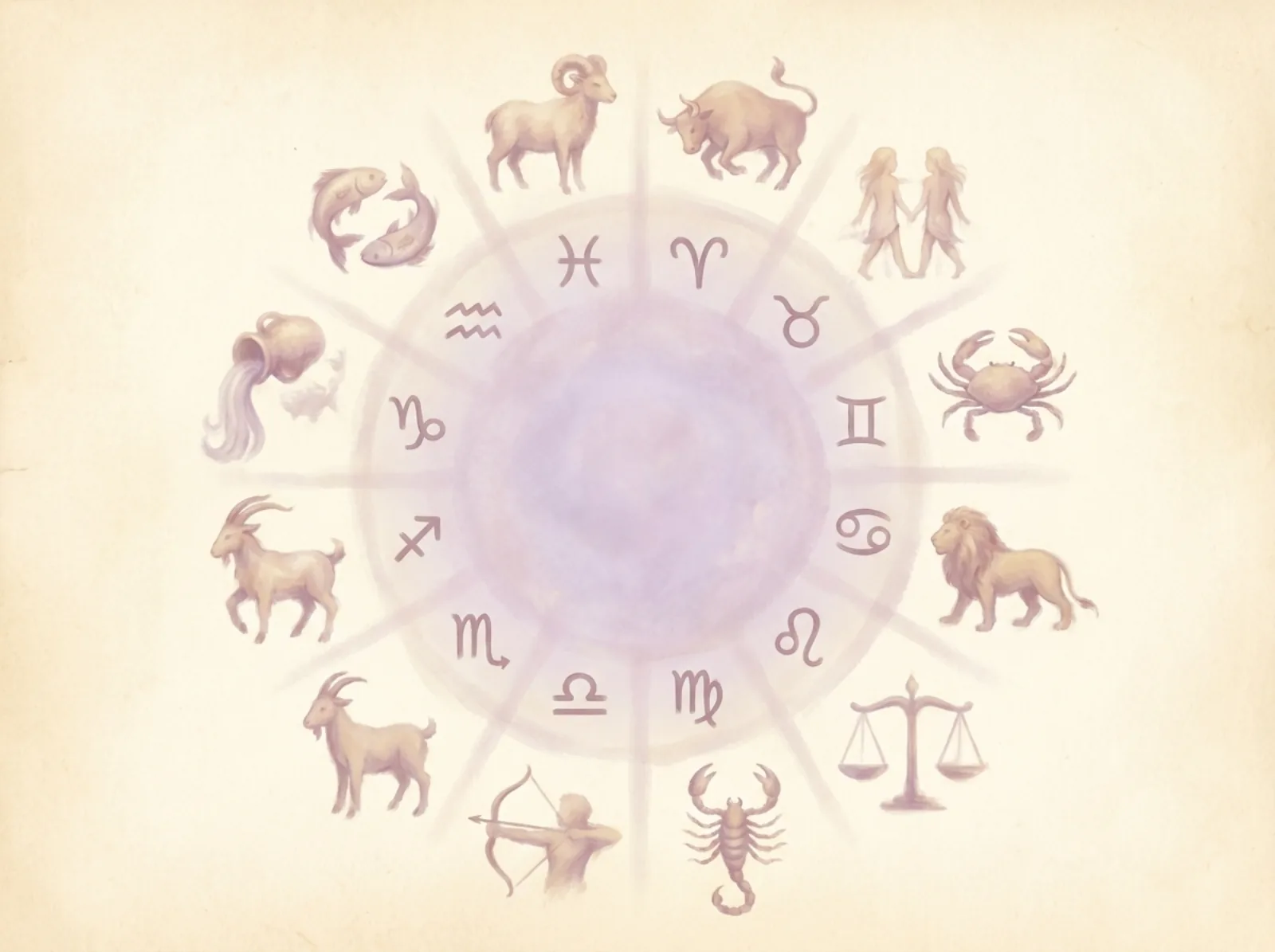
Where Aquarius lucky numbers actually come from
The idea of a sign having lucky numbers is not arbitrary superstition, even if it is often presented that way. It comes from a genuine tradition of correspondence — the medieval and Renaissance idea that planets, signs, letters, colors, metals, and numbers all sit on a shared symbolic grid. When someone says the Aquarius lucky numbers are 4, 7, 11, 22, and 29, they are usually drawing on some combination of three sources: the sign's ordinal position in the zodiac (eleventh), the numbers assigned to its ruling planets in Pythagorean or Chaldean numerology, and the reductions and master-number expansions of those base values. Understanding this origin matters because it lets you evaluate the claim on its own terms rather than treating it as folklore handed down from nowhere.
The first source, ordinal position, is the simplest. Aries is the first sign, so 1 sits with Aries. Taurus is second, so 2. By this logic Aquarius, as the eleventh sign, inherits 11 — and because 11 also happens to be one of the three master numbers in numerology (11, 22, 33), the correspondence is doubly weighted. Numerologists then treat 22 as the higher octave of 11 (11 x 2), which is why 22 appears alongside 11 in nearly every serious Aquarius list. This is not mystical arithmetic; it is a system with internal consistency that has been used in Western esotericism for well over a century. Part of our Western astrology library.
The second source is planetary rulership. Aquarius has two rulers because of a historical accident: Uranus was not discovered until 1781, so every astrological source before that assigned Aquarius exclusively to Saturn. Traditional numerology maps Saturn to the number 8 (Chaldean) or to 4 and 8 (Pythagorean via reduction). Modern numerology adds Uranus, which is typically mapped to 4 as well (some sources use 11 or 22 to reflect its higher-vibration character). This is why you almost always see 4 on Aquarius lists — it is one of the few numbers both rulers agree on, making it the sign's most durable numerical anchor across systems.
The third source is derived numbers. Once you have 4, 8, 11, and 22 as base values, numerologists generate secondary lucky numbers through addition and reduction. Adding 4 + 7 gives 11, so 7 gets pulled in as a resonant partner. 29 reduces to 11 (2 + 9), so it becomes an amplified form of the sign's core vibration. This is where different sources start to diverge — you will see some lists that swap 29 for 13 or 20, both of which also reduce to a number that resonates with Aquarius. The five-number canon of 4, 7, 11, 22, 29 is the most stable overlap across the major modern sources. Part of our Western astrology library.
The five core numbers: 4, 7, 11, 22, 29
Let us take each of the five core Aquarius lucky numbers in turn and look at what it actually means symbolically. 4 is the number of structure, foundation, and system. In tarot it corresponds to the Emperor. In numerology it is the number of the builder, the architect, and the person who takes ideas and makes them stable. For Aquarius, which is often stereotyped as scattered or rebellious, 4 is the grounding counterweight — it represents the Saturnian discipline that makes Aquarian vision actually work in the world. When you see 4 as an Aquarius lucky number, read it as a reminder that your ideas need scaffolding, not as a magical prediction.
7 is the number of the seeker. Across almost every numerology tradition, 7 sits with the introvert, the philosopher, the researcher, the person who wants to understand rather than merely act. Aquarius's genuine intellectual streak — its love of ideas, systems, big-picture thinking — resonates strongly with 7. In tarot 7 corresponds to the Chariot, but in the deeper numerological reading it is closer to the Hermit's energy. When 7 shows up as your lucky number for a day or a decision, the useful interpretation is: slow down, ask a better question, look one layer deeper. It is not a signal to bet on 7 in roulette.
11 is the master number that most defines Aquarius. Master numbers are treated as unreduced in numerology precisely because their power is considered to come from the doubled digit. 11 is the number of intuition, spiritual insight, and the person who sees what others cannot yet see. It is also unstable — master numbers demand more of the person who carries them, and 11 in particular is famously described as living on a knife-edge between visionary breakthrough and nervous overwhelm. For Aquarius, 11 captures both the gift and the cost of being wired differently. Part of our Western astrology library.
22 is the Master Builder and 29 is the amplifier. 22 is 11 doubled and is associated with people who take visionary ideas and construct enormous, lasting things — architects of institutions, movements, or bodies of work. It is the highest expression of Aquarian ambition when that ambition is aimed at genuine service rather than personal glory. 29 is subtler: it reduces to 11 but carries the karmic weight of the 2 and 9 that compose it, which numerologists read as diplomacy plus completion. Together, the five numbers form a coherent portrait of Aquarian energy: grounded structure, deep inquiry, intuitive insight, large-scale building, and karmic finishing.
Saturn, Uranus, and the dual number problem
Aquarius is one of only three signs (along with Scorpio and Pisces) that has both a traditional and a modern ruler, and this creates a real ambiguity in its numerical signature. Before the discovery of Uranus in 1781, every astrologer from Ptolemy through William Lilly assigned Aquarius to Saturn — the same planet that rules Capricorn. Saturn is the planet of structure, time, limitation, discipline, and long arcs. In Chaldean numerology Saturn is 8; in Pythagorean it is often 4 (through 8 reducing) or held at 8 outright. Either way, the Saturnian numbers carry a heavy, grounded, slow-building quality that not everyone associates with Aquarius.
The addition of Uranus as a modern co-ruler shifted the picture. Uranus is the planet of revolution, sudden insight, technology, disruption, and the outsider. It has no long numerological history — the number assignments are twentieth-century constructions — but the mainstream modern consensus is that Uranus vibrates most strongly to 4 (surprisingly, the same as Saturn), 11, or 22. Some sources treat this Saturn-Uranus overlap on the number 4 as evidence that 4 is genuinely central to Aquarius; others treat the assignment as suspicious and prefer to use 11 and 22 exclusively for Uranus. Both positions are defensible.
In practice this means Aquarius carries a productive tension. If you lean traditional, your lucky numbers are 4, 7, and 8 — grounded, disciplined, Saturnian. If you lean modern, they are 11, 22, and 29 — visionary, unstable, Uranian. The five-number canon we discussed above is the compromise that most contemporary numerologists have settled on, and it is genuinely the most useful list because it captures both sides of the Aquarian temperament. When you are choosing which number to focus on for a particular decision, ask yourself which mode the situation calls for: are you building or breaking, structuring or innovating? That will tell you whether to lean Saturn or Uranus.
This dual-ruler problem also shows up in how people experience being an Aquarius. Some Aquarians feel intensely Saturnian — reserved, disciplined, patient, slightly melancholic. Others feel intensely Uranian — restless, eccentric, allergic to convention, drawn to whatever is new. Most feel some blend, and that blend shifts over the course of a life. Your numerical signature can do the same. It is entirely reasonable for a 45-year-old Aquarius who spent their twenties chasing Uranian novelty to find, by midlife, that 4 and 7 feel more like home than 11 and 22 ever did. Part of our Western astrology library.
How to personalize with your life-path number????
Sign-based lucky numbers apply to roughly one-twelfth of the population, which is fine for a general orientation but useless for anything genuinely personal. The layer that makes lucky numbers actually reflective of you is your life-path number, calculated from your full date of birth. This is the single most important number in personal numerology, and combining it with your Aquarius sign numbers gives you a much sharper shortlist. The calculation is simple: write out your birth date in numerals, add every digit together, and keep reducing until you get either a single digit or one of the three master numbers 11, 22, or 33, which are preserved unreduced.

Consider a worked example. Someone born on February 3, 1987, adds 2 + 3 + 1 + 9 + 8 + 7 = 30, which reduces to 3. Their life-path is 3. Now cross-reference: 3 does not overlap with the Aquarius sign numbers 4, 7, 11, 22, 29, so this person's personal number set becomes 3, 4, 7, 11, 22, 29 — with 3 as the personal anchor and the others as sign accents. Someone born February 11, 1992 gets 2 + 1 + 1 + 1 + 9 + 9 + 2 = 25, reducing to 7. Their life-path is 7, which already appears on the Aquarius list, so 7 becomes doubly weighted for them personally. Part of our Western astrology library.
Master-number life-paths are worth special attention for Aquarians. If your birth date reduces to 11, 22, or 33, you carry a master-number life-path, and the resonance with Aquarius's own master-number character (11 and 22) is unusually strong. Numerologists treat this as a mark of unusually high potential paired with unusually high difficulty — the master-number Aquarian is often described as someone who can achieve remarkable things but who also faces intense internal pressure. This is worth taking seriously as a self-understanding tool, not as a prophecy. It simply names a pattern that may already feel familiar to you.
The practical takeaway is to build your own six-number set rather than borrowing a generic list. Take the five sign numbers (4, 7, 11, 22, 29), add your life-path number, remove any duplicates, and there is your personalized numerical vocabulary. Some numerologists add a seventh number — the destiny or expression number, calculated from the letters of your full birth name — but for most people the sign-plus-life-path combination is enough. The Raka app does this calculation automatically once you enter your birth data, and it surfaces the combined shortlist in your daily view.
The honest skeptic paragraph you deserve
Let us be direct about what lucky numbers can and cannot do. They cannot influence the outcome of a lottery, a coin toss, a roulette wheel, or any other genuinely random process. Probability theory is not negotiable, and no astrological or numerological system has ever produced replicable evidence of changing the odds. If someone tells you their sign numbers or life-path helped them win money, the most likely explanation is selection bias — they remembered the win and forgot the many losses. Any lucky-numbers article that hints otherwise is either being careless or actively misleading you, and you should treat it accordingly.
What lucky numbers can do is function as a symbolic focus tool. This is not nothing. Human decision-making improves when we have a small, meaningful frame to slow down our thinking. Choosing to launch a project on the 22nd because 22 is your master number will not magically improve outcomes, but the act of choosing forces you to reflect on the project's scale and intent — 22 is the Master Builder, so you are implicitly asking yourself whether this project is worth building at scale. That reflective moment has real value even if the number itself is inert. This is the same mechanism that makes journaling, prayer, and structured planning useful.
Lucky numbers also work as a coordination and memory device. If you know your Aquarius numbers are 4, 7, 11, 22, and 29, you can use them to structure decisions: pick apartment numbers, wedding dates, project deadlines, or the number of items on a to-do list around them. This creates a personal symbolic vocabulary that makes your life feel more coherent to you — again, not magic, but genuinely useful for a certain kind of mind. Aquarians in particular, who tend to think in systems and patterns, often find this kind of numerical scaffolding satisfying in a way that others might not.
The line we hold at Raka, and that Maya holds in her writing, is this: these systems are for self-reflection, not prediction. If you find them useful for grounding decisions, marking meaningful dates, or giving structure to your thinking, use them. If you are considering putting money on them in any high-stakes way, do not. That is not what they are for, and treating them that way is the fastest route to both financial loss and loss of faith in tools that could genuinely help you if used correctly.
Using Aquarius numbers for timing and decisions
The most defensible use of lucky numbers is for timing. Numerologists have long argued that certain dates carry certain numerical signatures — a date like the 11th of the month, or the 22nd, or a date whose full digits reduce to your life-path, is said to be more aligned with your personal energy. Whether or not you accept the metaphysical claim, the practical effect is that you build a personal calendar with meaningful anchors. For an Aquarius, launching an important project on the 11th of any month, or on a date whose reduced value is 11 or 22, creates a small but real psychological commitment to Aquarian values: vision, innovation, service.
For weekly rhythm, Saturday is the traditional Aquarius day (Saturn's day), and many modern astrologers add Wednesday as a secondary Uranian day for air-sign flow. If you are structuring a week around Aquarian energies — say, working on a long-term creative project, doing independent research, or making a decision that requires you to buck conventional wisdom — anchoring your key work sessions on Saturdays gives you a consistent frame. This is not because Saturday has magic properties, but because ritualizing a day creates the psychological space for deeper work. Aquarians often benefit from this kind of structured solitude more than they realize.
For daily rhythm, numerologists sometimes calculate a personal day number by adding today's date to your month and day of birth. If the resulting number matches one of your Aquarius lucky numbers or your life-path, that day is treated as high-resonance for personal projects. Again, the mechanism here is reflective rather than causal — the calculation forces you to notice the day, and noticing the day changes how you use it. Someone who tracks their personal day numbers for a year will usually report feeling more intentional about their time, which is a real benefit regardless of whether the underlying system is metaphysically accurate.
For major life decisions — marriage dates, business launches, moves, contract signings — the traditional approach is more elaborate: you look for a date whose full numerical signature harmonizes with your life-path, your sign numbers, and the numerological signature of the project itself. This is where working with a numerologist or a tool like Raka becomes genuinely useful, because the calculations get complicated quickly. But the principle stays the same: the value is in the deliberation, not in the guaranteed outcome. A wedding date chosen with care will not guarantee a happy marriage, but it will start the marriage from a place of intentionality, which is not a small thing.
Monthly variations and how they shift your numbers
The core Aquarius lucky numbers (4, 7, 11, 22, 29) are stable across the year, but many numerologists layer a monthly personal number on top of them to capture cyclical variation. The calculation is straightforward: add your birth month, birth day, and the current calendar month and year, then reduce as you would for a life-path. The resulting number is your personal month, and it interacts with your sign numbers to produce a specific flavor for that month. A personal-month 11 for an Aquarius, for example, is an intense doubling of the sign's core vibration — a good month for visionary work, potentially an overwhelming month for daily logistics.

In 2026 specifically, the universal year number is 2 + 0 + 2 + 6 = 10, reducing to 1. Universal-year 1 is a year of beginnings, initiative, and new direction across the board. For Aquarius, this pairs interestingly with the sign's own reformist tendencies — 2026 is likely to feel like a year when Aquarian ideas find unusually receptive ground. Numerologists would say the resonance between the universal-year 1 and Aquarius's Uranian innovation creates a favorable window for launching things that break with convention. As always, treat this as a lens for interpretation, not a guarantee.
Different months of 2026 will interact with your personal numbers differently. January and February — the Aquarius months themselves — tend to feel most aligned for Aquarius Suns, because the transiting Sun is in your sign and the numerical signature of those months (1 and 2) both reduce or resonate with your Uranian and Saturnian rulers. May and August, which carry universal-month numbers of 6 and 9, may feel more friction — 6 (Venus) can clash with Aquarian detachment, and 9 (Mars) can trigger the sign's rebellious streak. None of this is destiny; it is a framework for noticing patterns you might otherwise miss.
The most useful monthly practice is simply to check your personal month at the start of each month, note which of your lucky numbers it emphasizes, and let that inform how you structure the coming four weeks. If your personal month is 4, lean into structure and foundation-building. If it is 11, protect your intuitive and creative time. If it is 22, look for the bigger project you have been avoiding. The Raka app does this calculation automatically and pairs it with a monthly tarot spread, but you can do it by hand with nothing more than a birthday and a calendar.
Common misconceptions about Aquarius lucky numbers
The most common misconception is that lucky numbers are gambling tools. We covered this in the skeptic section, but it bears repeating because the misconception is so pervasive: no numerological system has ever demonstrated an effect on random outcomes. Every lottery win attributed to a lucky number is one data point plucked from millions of losses. If you have a friend who insists their Aquarius numbers work at the casino, ask them for a complete ledger — they will not have one, and if they did it would show a net loss. Use these numbers for reflection and timing, not for wagering.
The second misconception is that lucky numbers are fixed and universal. In reality, different numerological traditions produce different lists, and even within a single tradition the numbers shift depending on which planetary correspondences you use and how you treat master numbers. The five-number canon of 4, 7, 11, 22, 29 is a modern consensus, not an ancient revealed truth. If a source presents a lucky-number list as though it were handed down from Ptolemy himself, that source is either uneducated or being deliberately misleading. Any honest numerologist will acknowledge the diversity of traditions and explain their reasoning.
The third misconception is that your sign numbers matter more than your personal numbers. This is backward. Your life-path, expression, and soul-urge numbers are calculated from data unique to you and are always more personally relevant than a sign number that applies to a twelfth of humanity. Sign numbers are useful as an accent or a general orientation, but if you had to pick one number to focus on for major decisions, it should be your life-path. Aquarius sign numbers become genuinely powerful when combined with your personal numbers, not when treated as a replacement for them.
The fourth misconception, specific to Aquarius, is that the sign's rebellious character somehow exempts it from the discipline of Saturnian numbers like 4 and 8. Popular astrology tends to over-emphasize the Uranian, revolutionary side of Aquarius and forget that Saturn was the sign's original ruler and remains its co-ruler in modern practice. The 4 in Aquarius's lucky-number list is not an accident or a compromise — it reflects the genuine Saturnian core of the sign, and any Aquarius who ignores it in favor of pure Uranian novelty tends to burn out. The mature Aquarius integrates both.
How Aquarius numbers interact with other signs
If you are looking at compatibility — friendship, romantic, or business — the numerical overlap between two people's charts can be a useful lens, though it should never replace the deeper work of actually comparing full birth charts. Aquarius numbers (4, 7, 11, 22, 29) share strong resonance with the other air signs, Gemini and Libra. Gemini's numbers include 5 and 14 (both linked to Mercury), and while 5 and 4 create a small friction, the shared air-element intellectual quality tends to smooth it over. Libra shares 7 with Aquarius, and both signs have a philosophical bent that makes 7 a genuinely productive shared frame.
With the fire signs — Aries, Leo, Sagittarius — Aquarius has a classic opposition-and-attraction dynamic. Leo, directly opposite Aquarius on the zodiac wheel, shares surprisingly few numerical values (Leo's core numbers are typically 1, 5, and 9), which creates a numerical polarity that mirrors the astrological one. This is not bad — polarities are generative — but it does mean that Aquarius-Leo pairings need to work harder on finding shared numerical anchors. Aries and Sagittarius, which sit at 120-degree trines to Aquarius, tend to overlap more easily on 4 (Aries's Mars-Saturn edge) and 22 (Sagittarius's Jupiter-Uranus visionary streak).
With earth signs — Taurus, Virgo, Capricorn — Aquarius has one very strong numerical partner and two more challenging ones. Capricorn shares Saturn as ruler, so Capricorn's numbers (4, 8) overlap directly with Aquarius's Saturnian numbers, creating a stable if serious pairing. Taurus (Venus, 6) and Virgo (Mercury, 5) create more friction with Aquarius's Uranian numbers. This does not mean the pairings do not work — plenty of Aquarius-Virgo couples are thriving — but the numerical layer of compatibility is less aligned, and the couple has to build shared meaning through other channels.
With water signs — Cancer, Scorpio, Pisces — the numerical picture is mixed. Scorpio's Pluto-ruled numbers (0, 9, sometimes 22) share the master-number 22 with Aquarius, creating a genuinely deep resonance that many astrologers underestimate. Cancer (Moon, 2 and 7) shares 7 with Aquarius, which creates a philosophical bridge across the emotional-intellectual divide. Pisces (Neptune, 7 and 11) shares two of Aquarius's core numbers, making Pisces one of the strongest numerical partners for Aquarius despite the surface differences between the two signs. As always, use this as one lens among several, not a verdict.
Sun vs Moon vs Rising: which Aquarius are you?
The lucky numbers we have been discussing apply most cleanly to Aquarius Sun placements, but the sign shows up in three different positions in most charts, and each position weights the numbers differently. Your Sun sign describes your core identity and life direction — so if you are an Aquarius Sun, the numbers 4, 7, 11, 22, and 29 relate to who you are becoming and how you express your essential self. This is the most common use of the term Aquarius lucky numbers, and it is what most articles are implicitly referring to when they publish a lucky-number list.
Your Moon sign describes your emotional inner life, your reflexes, your subconscious patterns. An Aquarius Moon carries Aquarian energy in the emotional register — a person who processes feelings intellectually, needs a lot of independence, and finds emotional intimacy easier when it comes with intellectual freedom. For Aquarius Moon placements, the sign numbers (especially 11 and 7) show up most strongly in emotional decisions: relationships, therapy, family boundaries, personal healing work. The numbers work as reflection prompts for the inner life rather than for external projects.
Your Rising sign, also called the Ascendant, describes how you first meet the world and how the world first sees you. An Aquarius Rising presents as unconventional, cool, intellectually alive, sometimes aloof. For Aquarius Rising placements, the sign numbers show up in first impressions, personal branding, physical presentation, and the early phases of any new endeavor — the moments when you are being seen for the first time. If you are launching a business, meeting a new client, or presenting yourself in a new context, weighting decisions around 11 or 22 for an Aquarius Rising is particularly apt.
Many people have Aquarius in more than one of these positions, and when that happens the numbers become genuinely central to their life. An Aquarius Sun with Aquarius Moon, for example, feels the sign's numerical signature in both external direction and inner emotional life, and the pull of 11 or 22 will be much stronger for them than for someone with Aquarius only in a single placement. The Raka app calculates all three placements from your birth data (you need date, time, and location for Rising) and gives you a weighted personal number set that reflects the full picture rather than just the Sun sign.
How to actually use these numbers day-to-day????
The gap between having a list of lucky numbers and actually using them is where most people give up on numerology. Here are four practical practices that work if you are willing to commit to them for at least a month. First, choose one number from your personal set (life-path plus Aquarius sign numbers) as your anchor for the year. Write it somewhere you will see it daily. Use it as a small ritual signal — when you notice the number in the wild, on a clock, a receipt, a page number, treat it as a moment to pause and check in with yourself. This is the simplest, cheapest, most consistently useful practice.

Second, use your numbers to structure your calendar. Pick the number most aligned with a specific project or intention and schedule the key milestones on dates that carry that number. If you are building something large, use 22. If you are doing deep research, use 7. If you are launching something innovative, use 11. The point is not that these dates are magic; the point is that the choice creates a coherent narrative for the project that you will carry forward. Human motivation runs on narrative, and giving your work a numerical spine makes the story stick.
Third, use your numbers as a decision-tie-breaker. When you are genuinely torn between two options and further analysis is not helping, check which option better aligns with one of your numbers — the number of steps involved, the price point, the date it starts, the number of collaborators. This is not superstition; it is a way of introducing a symbolic constraint that breaks decision paralysis. Aquarians in particular can get stuck in analytical loops, and having a pre-committed tiebreaker can be genuinely liberating.
Fourth, use your numbers as a journaling prompt. At the end of each week, write a short entry about how each of your five to six numbers showed up. Where did 11 appear? What did 7 remind you of? Which projects benefited from 22 energy and which suffered from its intensity? Over months, this practice builds a real personal vocabulary for how these numbers actually operate in your life — and that vocabulary is the thing that makes numerology useful. The numbers themselves are just symbols. The reflection is where the value lives.
How the Raka app handles Aquarius numbers
Raka is built on the premise that astrology, tarot, and numerology are most useful when they are integrated rather than siloed. In the app, your Aquarius sign numbers are calculated automatically once you enter your birth data, along with your life-path, expression, and soul-urge numbers. These are combined into a personal number set that changes weight depending on the day's transit and the current lunar phase. This is the same manual calculation that a working numerologist would do for you in a paid consultation — Raka just does it in the background so you can focus on interpretation.
The daily view in Raka surfaces a single primary number for the day, drawn from the intersection of your personal set and the day's universal number. It is paired with a single tarot card and a short transit note, so you get a coherent three-part reflection rather than three disconnected data points. For an Aquarius Sun with a life-path 11, a day where the universal number is also 11 will surface as high-resonance — the app will note the alignment and suggest that the day is well-suited to visionary work. This is a reflection prompt, not a prediction.
The monthly view adds the personal-month calculation and pairs it with a small tarot spread. The yearly view zooms out further, showing how the current calendar year interacts with your personal year and which months are likely to feel most and least aligned. All of these views are designed to give you a structured framework for planning without pretending to tell you what will happen. Aquarians who use the app tend to report finding the monthly and yearly views most useful, because those are the timescales at which the sign's long-arc vision naturally operates.
Raka is deliberately conservative about claims. The app will never tell you that a lucky number will make you win money, nor that a transit will guarantee an outcome. It positions all of its outputs as reflection prompts and self-inquiry tools, which is the honest use of these systems. If you are looking for a tool that will make big predictive claims, Raka is not it — and Maya would gently suggest that no responsible tool should be making such claims in the first place. The value of numerology and astrology is in the mirror they hold up, not in the futures they claim to see.
Final thoughts: making the numbers useful
The point of a guide like this is not to hand you five numbers and tell you to play them at the lottery. The point is to give you a coherent framework for understanding why certain numbers show up on Aquarius lists, what they actually mean symbolically, and how to use them as tools for structured self-reflection. If you finish this article and never think about numerology again, you have still gained a small piece of cultural literacy — the ability to read an astrology column with informed skepticism, which is more than most people have. If you finish this article and start using one or two numbers as anchors in your own life, that is where the real value lives.
The Aquarian temperament is genuinely well-suited to this kind of work. Aquarians tend to be pattern-recognizers, system-thinkers, and people who find meaning in structure. Numerology gives them a symbolic system that rewards those tendencies without demanding that they abandon their skepticism. You can hold the numbers lightly, use them as reflection prompts, and still get real value from the practice. This is the mature Aquarian relationship to esoteric systems — engaged but not credulous, curious but not gullible.
One final note on personalization. The five sign numbers (4, 7, 11, 22, 29) are a starting point, not an endpoint. Your genuinely useful numerical set is the one you build for yourself by combining your life-path, your sign numbers, and — over time — the numbers you notice actually showing up in meaningful ways in your life. Some Aquarians find that a number outside the canonical list, like 13 or 20, feels more personally resonant than 29. Trust that. The system is a starting framework, not a rigid law, and personal resonance is a legitimate signal.
If you want to go deeper, the next steps are straightforward. Calculate your life-path number by hand using the method in the personalization section. Try Raka for a month to see how the daily and monthly numbers play out in your actual life. Read a serious book on Western numerology — Juno Jordan's or Faith Javane's work is a good starting point — to get past the surface-level lucky-number articles that dominate the web. And keep the skeptic frame alive. These systems are tools, not truths, and they are at their best when you treat them that way.