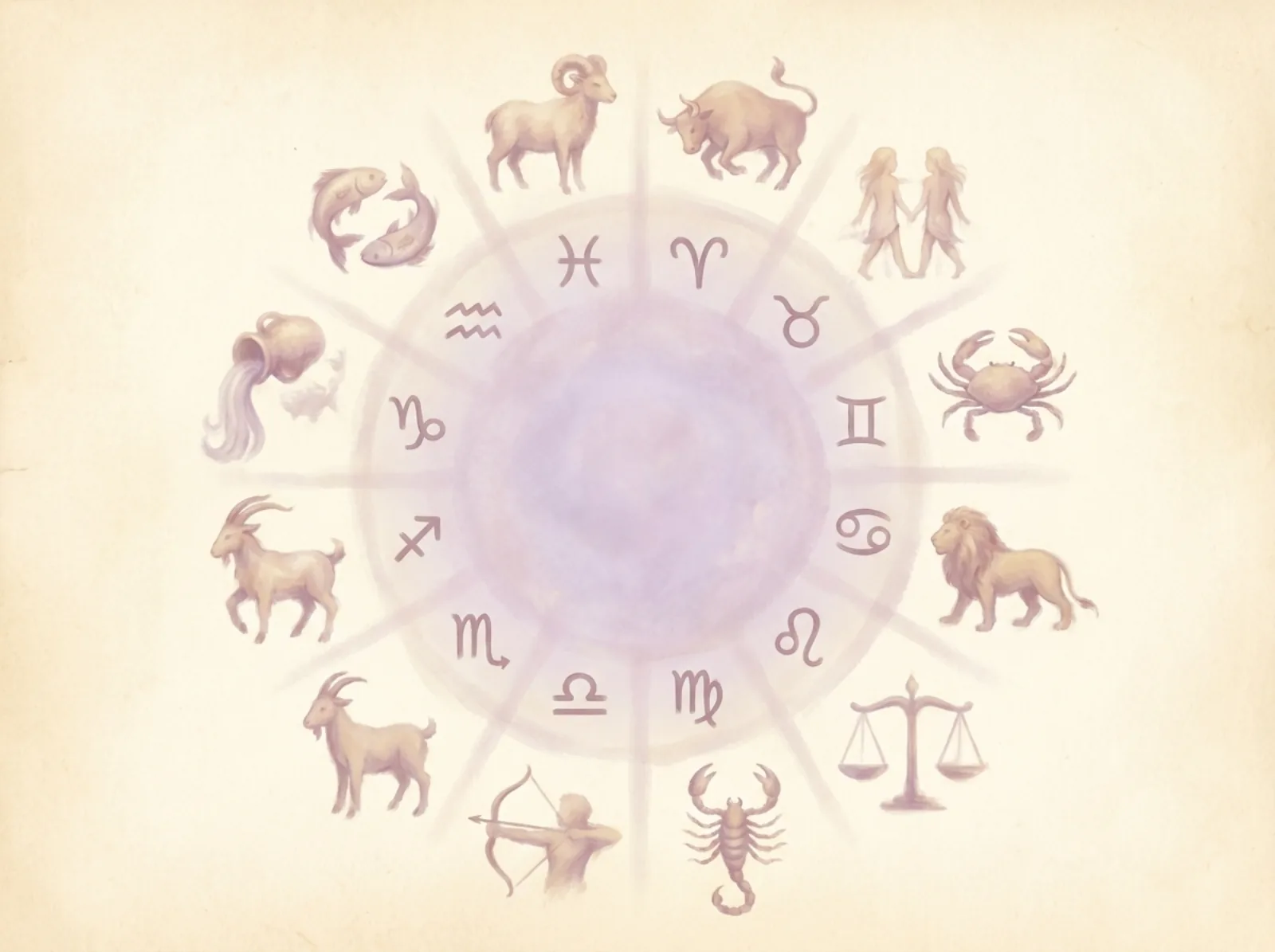
What the Goat Represents in Chinese Astrology
The Chinese zodiac — shēngxiào in Mandarin — is a twelve-year rotating cycle of animals, each paired with one of five elements and a yin or yang polarity. The Goat sits at position eight, and its classical pairing is yin earth: receptive, grounding, soft without being shallow. It is sometimes translated into English as Sheep or Ram; the underlying Chinese character 羊 (yáng) covers all three. Linguistically it is one creature. Culturally it carries the same traits regardless of which word your zodiac calendar prefers. Part of our tarot library.
The myth you will usually see cited is the Great Race, in which the Jade Emperor summoned the animals to cross a river and set the zodiac order by their arrival. The Goat crossed with the Monkey and the Rooster — the three animals supposedly worked together on a raft, with the Goat often credited as the diplomatic member who kept the trio from quitting halfway across. That image sticks: the Goat as the quietly cooperative person on every group project who ends up doing more emotional labor than they will ever bill anyone for.
Symbolism beyond the race
In Chinese cultural symbolism, the Goat is tied to filial piety, peace, and refined artistry. The character 羊 appears inside the character for beautiful (美) and goodness (善), which hints at how the animal was valued long before pop astrology got hold of it. Pastoral calm, careful aesthetics, quiet persistence — the Goat is the archetype of civilization made gentle. If you were raised by a Goat, you probably learned manners early and watched someone cry at a sunset at least once. See our best AI astrology app guide.
- Element pairing: yin earth
- Direction: southwest
- Season: late summer, specifically the sixth lunar month
- Hour: 1 pm to 3 pm, known as the hour of the Goat (wèi shí)
- Associated virtues: compassion, elegance, filial piety, patience
Birth Years for the Year of the Goat
Before you lock in your animal, remember one thing: Chinese New Year does not begin on January 1. The lunar new year shifts each year between late January and mid-February, which means anyone born in January or very early February needs to check the exact cutoff for their birth year. A baby born on January 15, 1991 is technically still a Horse (from the 1990 lunar year). One born on February 20, 1991 is a Goat. Same calendar month, different animal. This matters.
With that caveat in place, these are the Year of the Goat windows in the modern Chinese calendar:
- 1931 — February 17, 1931 to February 5, 1932 — Metal Goat
- 1943 — February 5, 1943 to January 24, 1944 — Water Goat
- 1955 — January 24, 1955 to February 11, 1956 — Wood Goat
- 1967 — February 9, 1967 to January 29, 1968 — Fire Goat
- 1979 — January 28, 1979 to February 15, 1980 — Earth Goat
- 1991 — February 15, 1991 to February 3, 1992 — Metal Goat
- 2003 — February 1, 2003 to January 21, 2004 — Water Goat
- 2015 — February 19, 2015 to February 7, 2016 — Wood Goat
- 2027 — February 6, 2027 to January 25, 2028 — Fire Goat
- 2039 — January 24, 2039 to February 11, 2040 — Earth Goat
How to double-check a borderline birthday
If your birthday falls within two weeks of a Lunar New Year cutoff, do not guess. Use a converter — Astro.com and CafeAstrology both have free Chinese calendar tools — and verify before committing to tattoos, articles, or group-chat arguments. Western astrologers sometimes get this wrong by rounding to January 1. The lunar calendar is older and more precise. Trust the date, not the rounding.
Core Personality Traits of the Goat
If I had to shrink the Goat archetype into a single sentence, it would be this: soft on the surface, stubborn at the root. Goats get typecast as gentle, which they are — but it is a mistake to confuse gentle with pliable. A Goat will nod politely at your plan, agree in all the correct places, and then do exactly what they already intended to do before you opened your mouth. The gentleness is real. The redirection is also real. Both can be true at the same time, and usually are.
What tends to show up again and again
- Artistic sensitivity. Goats gravitate toward design, music, writing, cooking, and any medium that lets them translate a feeling into a form someone else can hold.
- Deep empathy. They catch micro-expressions, half-sentences, and shifts in a room's energy. A gift. Also exhausting if nobody taught them to protect it.
- Quiet stubbornness. The hills a Goat dies on are small, specific, and non-negotiable. The way the coffee gets made. Who sits where at the table. The exact word for the exact feeling.
- A real need for beauty. Environment is not optional for a Goat. A cluttered desk makes them genuinely unwell. A good lamp fixes more than you would think.
- Low tolerance for conflict. They will go silent before they go loud. If a Goat is quiet, something is happening.
- Loyalty on a long timeline. Goats take their time choosing people, and once they have chosen, they stay for decades.
The shadow side
The flip side of all that sensitivity is a tendency to brood. Goats can slip into pessimism when stressed, over-identify with other people's moods until they cannot locate their own, and avoid big decisions until the universe makes the decision for them. Insecurity shows up as perfectionism. Perfectionism shows up as never finishing. Any Goat reading this is nodding and sighing right now. The healthy Goat has learned two things: how to say the uncomfortable thing out loud before it rots, and how to let something be good enough and ship it anyway. That is the whole growth arc, really.
The Five Elements: Metal, Water, Wood, Fire, and Earth Goat
Every zodiac animal cycles through the five Chinese elements — Metal, Water, Wood, Fire, Earth — on a sixty-year loop. Your element layer flavors the base Goat personality the way a filter flavors a photograph. Same subject, different mood. If you have ever thought I am supposed to be a shy Goat, but I am actually pretty forward, your element is probably the explanation.
Metal Goat — 1931, 1991
The Metal Goat is the Goat with armor on. More assertive, more opinionated, and more likely to pick a lane and stay in it than the softer element Goats. Metal Goats care about reputation and craft and are usually the Goats who climb an actual career ladder rather than wandering around at the base of it. Strength: resolve. Watch out for: rigidity about how things should look, and a tendency to turn self-criticism into a hobby.
Water Goat — 1943, 2003
Water softens everything it touches, including the Goat. The Water Goat is the empath of the bunch — intuitive, adaptive, prone to absorbing other people's feelings like a sponge in a sink. They need solitude the way other people need coffee. Strength: emotional intelligence that reads a room in six seconds. Watch out for: conflict avoidance that calcifies into resentment, and a habit of mothering adults who should be mothering themselves.
Wood Goat — 1955, 2015
Wood Goats are the warm hosts and quiet idealists. Generous, community-minded, slow-building. They tend to make loyal friends in their twenties and keep them for life, build creative careers in increments rather than leaps, and age into mentors their younger colleagues keep calling for advice. Strength: steady generosity and a long view. Watch out for: over-giving to people who do not reciprocate, until the generosity turns into a quiet grudge.
Fire Goat — 1967, 2027
Fire Goats are the plot twist of the family. More extroverted, more theatrical, more willing to go big on a vision than the quieter Goats. They can be charismatic performers, teachers, entrepreneurs, or the family member who turns Thanksgiving into a nine-course event with place cards. Strength: creative drive and a real appetite for a good idea. Watch out for: burnout cycles and a short fuse when the Fire gets fed too much work and not enough sleep.
Earth Goat — 1979, 2039
Earth doubles the Goat's native element, which makes this the most grounded, practical version of the archetype. Earth Goats are the ones who turn creative sensitivity into a quietly successful small business or a long, deep expertise in a niche no one else noticed. Strength: patience and the ability to make something slowly without panicking that it is not done yet. Watch out for: getting so comfortable in the familiar that growth stops looking appealing. The couch is a trap.
The Goat in Love and Relationships
Goats fall in love the way they do everything else — slowly, carefully, and then all at once once they have decided. They are not casual daters by nature. There is a kind of serial-dating Goat who looks like an exception, but if you ask them, they will tell you they are mostly tired. When a Goat is actually interested, you will know. The stupidly thoughtful texts, the small details they remembered from an offhand comment three weeks ago, the fact that they quietly stopped flirting with anyone else — these are the signs.
What a Goat needs in a partnership
- Emotional safety. A Goat cannot flourish with a partner who weaponizes silence, disappears during conflict, or makes them earn affection. They are not built for scarcity-based love.
- Appreciation of the small stuff. The hand-folded napkin. The playlist they made you after one specific conversation. The plant they rescued from the pavement. If you miss the small things, they feel invisible, and invisible Goats go quietly away.
- Low-drama baseline. Goats can handle big feelings and real crises. They cannot handle unnecessary chaos — the manufactured arguments, the testing games, the hot-and-cold routine.
- Space to retreat. A Goat who cannot have solitude will eventually fake solitude by shutting down inside the relationship. Build it in on purpose.
Where Goats struggle
Classic Goat relationship pitfalls include staying far too long in situations that stopped working six months ago, people-pleasing their way into quiet resentment, and expecting partners to read their mind rather than asking directly for what they need. The Goat's growth edge in love is almost always the same: plain, unglamorous honesty. The uncomfortable sentence spoken on time. The I need something to change conversation that most Goats would rather die than start. If you are a Goat reading this, consider this your sign. The thing you are not saying is getting louder in your head. Open Raka's reflection prompts, open a notebook, or just open your mouth — but say it out loud this week.
The Goat in Career and Money
Goats are quietly ambitious, which the louder zodiac animals keep missing. They do not want the corner office. They want the right office — the right light, the right people, the right work that feels like it matters. The ambition is real; it just does not perform itself the way a Dragon's or a Tiger's does. If you are managing Goats, assume they want more responsibility than they are asking for, and promote accordingly.
Where Goats tend to shine at work
- Creative fields: design, writing, music, film, architecture, interior design, culinary arts, fashion.
- Caring professions: therapy, teaching, nursing, social work, coaching, pastoral care.
- Craft and detail work: jewelry, tailoring, horticulture, specialty retail, restoration, museum work.
- Behind-the-scenes leadership: producers, editors, chiefs of staff, operations managers — the people who keep the thing running and let the loud people take the stage.
Where Goats tend to struggle: cold-call sales, high-aggression negotiation, cutthroat trading floors, and any role that demands a one hundred percent extroverted public persona five days a week. They can perform it. They will burn out silently. The warning sign is usually physical before it is verbal — tension headaches, sleep going sideways, appetite thinning out.
How Goats actually handle money
Goats are rarely natural savers or natural spenders. They are values spenders. They will drop real money on a beautifully made chair and hesitate for weeks over a boring but needed appliance. They will buy the specialty flour and ignore the pension form. Financial anxiety tends to live quietly in the background of a Goat's life — rarely discussed, almost never acted on, until something forces the conversation. The single best money practice for a Goat is a boring one: a simple, automatic system that protects them from their own avoidance. Automate the savings. Automate the bills. Pick a cheap robo-advisor if investing feels paralyzing. The Goat does not need to enjoy managing money. The Goat needs the money managed, so the Goat can go back to the thing they actually care about.
Goat Compatibility: Best Matches and Worst Matches
Chinese zodiac compatibility runs on two main concepts: the Four Trines (sān hé) and the Six Clashes (xiāng chōng). The Trines are groups of three animals considered naturally compatible because their energies rhyme. The Clashes are animals six positions apart on the wheel whose energies tend to grind against each other. You will see these show up in every serious Chinese astrology source — CafeAstrology lists them, Chinese New Year sites use them, and old family matchmakers still reference them when the parents are negotiating.
The Goat belongs to the Fourth Trine, along with the Rabbit and the Pig. These three share a soft, intuitive, home-loving register — relationships inside this trine often feel like you have known the person for years by week two. Easy conversation. Easy silence. Weirdly similar taste in cushions.
Best matches for the Goat
- Rabbit: gentle meets gentle. Both value aesthetics, quiet, and the slow Sunday morning. The risk is that neither party pushes the relationship forward when it needs a push, so both have to agree on who drives the plan.
- Pig: warm, generous, loyal. The Pig draws the Goat out of their head and into their body — into meals, into pleasure, into real-world fun. Goat-Pig partnerships age very well.
- Horse: an underrated pairing that defies the quick compatibility charts. The Horse's gallop balances the Goat's grazing when both parties respect the difference instead of trying to pathologize it.
Trickier matches
- Ox: the classic Goat-Ox clash. Opposing positions on the zodiac wheel, opposing temperaments at the table. The Ox's rigidity can feel oppressive to the Goat; the Goat's indirectness can feel maddening to the Ox. Not doomed. Just high-maintenance.
- Rat: different values, different pace, different ideas of what counts as fun on a Saturday night. Rats like a crowd; Goats like a conversation.
- Dog: both are loyal, which should help, but the Dog's directness can bruise the Goat, and the Goat's moods can confuse the Dog. Communication rules save this one.
Important caveat before you break up with anyone over a chart: these are not verdicts. I have watched Goat-Ox couples thrive for forty years because they did the work, and I have watched Goat-Pig couples implode because they did not. Compatibility charts are starting points. They are not sentences. Use them to ask better questions about how you two actually show up for each other, not to issue rulings.
Celebrities Born in the Year of the Goat
Reading through famous Goats is my favorite part of these guides because the pattern is so legible once you know what to look for. The sensitivity, the artistry, the quietly obsessive craft — it keeps showing up in people who otherwise look nothing alike. Here are a handful of real public figures born under the Goat, with their element layer attached so you can see the flavor difference I was describing earlier.
- Mick Jagger (born July 26, 1943 — Water Goat): the frontman with a quietly disciplined offstage life. The Water Goat empathy is why the lyrics work.
- Steve Jobs (born February 24, 1955 — Wood Goat): the Goat obsession with beauty and detail, scaled up into a global company. The Wood Goat idealism — "insanely great" — is the whole brand.
- Bruce Willis (born March 19, 1955 — Wood Goat): quietly stubborn, loyal to a tight circle, famously private. The action-hero exterior is almost perfect camouflage.
- Julia Roberts (born October 28, 1967 — Fire Goat): the warmth, the laugh, the family-first choice to move away from Los Angeles. Fire Goat charisma without the burnout.
- Heath Ledger (born April 4, 1979 — Earth Goat): the quintessential sensitive artist whose craft was obsessive and interior. Earth Goat depth taken all the way.
- Ed Sheeran (born February 17, 1991 — Metal Goat): shy songwriter builds a global empire from a hoodie and a loop pedal. Classic Metal Goat discipline wrapped in extreme ordinariness.
None of this is destiny, obviously. These are reference points — fast ways to picture what the archetype looks like out in the wild when the camera actually turns on.
Lucky Numbers, Colors, and Directions for the Goat
Classical Chinese astrology assigns every zodiac animal a set of auspicious associations — lucky numbers, colors, directions, flowers, and even gemstones. These come out of the yin-yang theory, five-element correspondences, and compass astrology. They are not drawn from vibes or vague tradition. That said, treat them as prompts you can use intentionally, not prescriptions you have to follow or something bad happens. The point is intention, never superstition.
Traditional Goat associations
- Lucky numbers: 3, 4, and 9. Combinations like 34, 349, or dates with those digits are considered auspicious.
- Unlucky numbers: 6, 7, and 8 (ironically — 8 is considered broadly lucky in Chinese culture, but it is said to clash specifically with the Goat).
- Lucky colors: green, red, and purple. These are the shades traditionally tied to growth, warmth, and nobility for Goat natives.
- Colors to minimise: gold, coffee brown, and dark blue. Not forbidden. Just quieter for a Goat.
- Lucky directions: north, east, and southwest.
- Lucky flowers: carnation and primrose.
- Lucky gemstone: emerald, often cited alongside turquoise and sapphire.
How to actually use these
Pick one color and wear it when you need steadiness. Pick one number and use it as a seat choice, a passphrase anchor, or a mental cue when you have to make a quick decision. Face your desk toward one of your lucky directions when you can and quit worrying about the rest. The traditional associations work best as small acts of intention — a way to pay attention to your own life — and worst as rules you follow out of fear of bad luck.
How the Goat Compares to Its Western Zodiac Counterpart
If you have spent any time with Western astrology, you have probably noticed the Goat sounds suspiciously familiar. The sensitivity. The home-loving streak. The intuition. The quiet moodiness. The deep loyalty to the people they chose. For most Goats, the closest Western match is Cancer — the fourth sign of the Western zodiac, ruled by the Moon, and associated with family, memory, and emotional depth. The two systems are not identical (Chinese astrology is lunar and animal-based; Western is solar and sign-based), but there is a real archetypal overlap, and reading them side by side is often more useful than reading either alone.
Where Goat and Cancer rhyme
- Both are nurturers who feel much more than they say.
- Both have a soft outer presentation and surprisingly firm inner boundaries.
- Both can be moody when overloaded and benefit from genuine solitude rather than company therapy.
- Both are rooted in the home-making instinct, whether that home is literal or a metaphor for their small chosen tribe.
- Both carry the family stories — the person at the funeral who knows which cousin stopped speaking to which aunt in 1983 is almost always a Cancer or a Goat.
Where they diverge
Cancer in Western astrology is a water sign ruled by the Moon, which gives it an emotional-tidal quality — mood as weather. The Goat is yin earth in the Chinese system, which gives it more of a quiet-persistence quality — mood as a slow river rather than a tide. Earth does not swing as fast as water. The Goat is also, in some readings, close to Pisces: the dreamer, the artist, the one who feels the room before anyone else does. If your natal chart shows strong Pisces or strong Cancer placements and your Chinese animal is Goat, the archetype is practically shouting at you.
If you want to go deeper, pull your full Chinese zodiac chart and your Western natal chart side by side. I like to open both inside Raka and let the overlap do the talking. The places the two systems agree are usually your loudest personality notes. The places they disagree are where the interesting work lives.
Frequently asked questions
Is the Year of the Goat the same as the Year of the Sheep or the Year of the Ram?
Yes. The Chinese character 羊 (yáng) covers all three in English translation, so Goat, Sheep, and Ram all refer to the same zodiac animal. Different translators and different source countries prefer different words — Mongolia leans Sheep, Hong Kong often says Goat, mainland China's modern English materials use both — but the traits do not change based on which word you use. If you grew up calling it the Year of the Sheep, you can keep calling it the Year of the Sheep. Nothing on this list is going to disagree with you.
What should I do if my birthday falls in January or early February?
Check your exact Lunar New Year cutoff before you commit to an animal. The Chinese New Year moves each year between late January and mid-February, so a January birthday might actually belong to the previous zodiac year. Astro.com, CafeAstrology, and most Chinese almanac sites have free converters that will give you the right animal in about ten seconds. Do not guess — the lunar date is older and more precise than the Gregorian one, and plenty of self-described Horses turn out to be Snakes once they check.
Is the Year of the Goat considered lucky or unlucky to be born in?
There is an old folk saying in parts of China that only one in ten Goats finds happiness, which gave the sign an unfair bad reputation for a few generations. Most modern Chinese astrologers push back on this hard — the Goat is widely considered one of the gentlest, luckiest, and most emotionally rich signs on the wheel. The pattern of famously accomplished Goats speaks for itself. Treat the old saying as cultural trivia, not fact. It mostly tells you something about the time it came from, not about you.
When is the next Year of the Goat?
The next Year of the Goat begins on February 6, 2027 and runs through January 25, 2028. It will be a Fire Goat year, which traditionally brings a slightly more extroverted, risk-taking flavor to the Goat archetype — a good year to start creative projects you have been quietly sitting on. The year after that in the twelve-year cycle will be the Monkey (2028), and the next Goat year after 2027 will not arrive until 2039 (an Earth Goat year).
Can two Goats be in a relationship together?
Absolutely, and it is often a quiet, warm, aesthetically coordinated partnership. The thing to watch is mutual conflict avoidance — two gentle people can accidentally let small issues fester until one of them explodes or disappears. Build a habit of saying the small, inconvenient thing early. A weekly five-minute check-in solves about ninety percent of Goat-Goat problems. Element differences also help: a Metal Goat with a Water Goat tends to balance better than two of the same element, since you get a little grit next to a little flow.
Does my Chinese zodiac animal matter more than my element year?
Neither matters more than the other — they are layered. The animal gives you the archetype; the element gives you the texture of how the archetype actually behaves. A Fire Goat and an Earth Goat share the same underlying temperament but will show up in a room completely differently. Reading them together is more accurate than reading either alone, which is why I always ask people both their birth year and the element pairing (Metal, Water, Wood, Fire, or Earth) before I say anything specific about who they are.
How can I use my Goat traits for self-reflection rather than prediction?
Pick one trait from this guide — a strength or a shadow — and journal where it actually showed up in your week. Where did your sensitivity help you? Where did your conflict avoidance cost you? Where did your eye for beauty make an ordinary moment better? Raka's astrology companion is built for exactly this kind of slow, honest reflection, and you can also do it with a plain notebook and ten quiet minutes. The goal is never to confirm the horoscope. The goal is to notice the pattern underneath it, so you can decide what to do with it.